Bring the whole tithe into the storehouse, that there may be food in my house. Test me in this,” says the LORD Almighty, “and see if I will not throw open the floodgates of heaven and pour out so much blessing that you will not have room enough for it.Malachi 3:10
I’ve heard and read this verse a ton of times. And the phrase that has always popped out to me is– “test me in this.” It’s one of those passages of the Bible that you read and think that it can’t literally be true.
If I trust God with my money will he really pour out so much blessing that I won’t know what to do?
Sounds like a load of bull spoken by a TV preacher trying to build his version of Disneyland, right?
As I’m learning– maybe not.
I don’t often write about things that are happening RIGHT NOW in my life. As much of myself as I share, I tend to let things percolate a little bit and mellow into principle before I try to capture my thoughts in words.
But the last few days I’ve just come home and looked at Kristen and said– “My life is crazy right now. I can’t hardly explain it. All awesome stuff.”
Two photos really capture visually what I’m having a hard time processing into words.
1. The juggler.
Photo by Andy_Tyler via Flickr (Creative Commons)
My work life is a constant juggling act. Big projects, little projects, add leadership over one area and support over another. Go on the road to do one thing while keeping everything in order on something else. It’s a good kind of juggling. As my co-workers know, I wouldn’t have it any other way. Even when I come home I’m still juggling all sorts of personal and McLane Creative projects. From a thriving garden to the latest social media campaign– I’ve just got a lot of balls in the air.
Juggling requires constant attention. And when people see a juggler they like to ask you one important question… can you juggle one more ball? Sometimes I shrug my shoulders yes and sometimes I shrug my shoulders no.
2. The overflowing cup
Photo by shioshvili via Flickr (Creative Commons)
Is Malachi 3:10 really literally true? It sure seems that way right now. The last month was filled with unexpected showers of awesome. Several people and organizations are asking for quotes for new web designs. Several outlets are looking for me to write for them. Our community group is doing some cool things. In a few weeks Lisa is coming here for the summer. In June, Kristen and I have planned an amazing local vacation capped off by a fun celebration. My second trip to Haiti is coming together and basically full. And in the last 2-3 days a whole new shower of unexpected blessings has come my way– earth shakingly awesome stuff, too!
If you bump into me these days I’ve kind of got this crazed mad Scientist look going. Buggy wide eyes, haven’t slept, and a scary perma grin.
Breathing out the stress of my day, while breathing in the view in El Cajon
Last year Kristen and I made a long-term family decision about having two cars.
We don’t need one. And when we do we will just rent one.
Since last Spring I’ve taken the trolley to work as opposed to a crazy driving ritual. We live 1.2 miles from the trolley stop at San Diego State University. And the YS office is 1.6 miles from a trolley stop in El Cajon. So, to keep my commute quick I ride my bike, take it on the trolley, and then ride my bike to work and reverse that on the way home.
Here’s the crazy thing. When we shared one car it felt like we needed two cars. But now that we have one car and I ride my bike or take the trolley everywhere… it kind of feels like maybe we could live without a car!
Granted, we live in a major metropolitan area that has a decent public transit system. While it’s not “easy for me,” it is something I chose to make work in my life because of the benefits.
Here are five of those benefits.
We don’t have the expense and stress of a second car. No repairs. No insurance. No regular maintenance. No license fees. No gas. I pay about $50 per month to ride the trolley 3-4 days per week. (I’m not religious about taking the trolley. If I don’t want to, I don’t!)
I have about 1:20 per day to myself. When I leave the house at 8:00 AM and get on my bike I pop my headphones in and just relax. Once you nail a routine, the bike ride and time on the trolley is amazing. I listen to music or podcasts, I read the newspapers on my iPhone, stuff like that.
I get to see, hear, talk to, and interact with strangers every day. If you think about your average day… chances are you don’t interact with a lot of the general public. And you definitely don’t interact with the general public if you drive and go to an office! It brings me great joy to interact with “real people” every day.
I make Kristen’s life simpler. This might be the one place in our relationship this is true. When we shared our car daily we had to go through this routine where we arranged for who was going where, when. Now, Kristen just does her thing and I do mine. If I need a car during my work day I can just take our work truck. If I need to do something outside of that– we rent a car. Seriously, the guys at Enterprise in our neighborhood know me by name!
I have a concrete get to work and leave work time. I’m a total work-junkie. But knowing I need to leave the house at 8 and leave the office at 5 to catch my trolley– that’s awesome.
Of course there are other benefits. Taking public transportation is also green as I’m using very little natural resources to get to and from work. And 5 miles of bike riding per day has health benefits. But, in my mind, those are by-products of these main benefits.
What about you? How can you ditch the solo-car routine and find some added benefits?
In part four of this series, I’ll offer some conclusions and solutions for reversing the trend of deifying our children. To catch up on the series, check out part one, two, and three.
Where do we go from here?
This is the important question. Hopefully you’ve read through this series and reflected on the situation, the parents you know, or even your own habits as a parents and thought, “There must be another option.” When baby Rex pops out of his mom’s womb he doesn’t deserve to be worshipped. He’s a child. To deify him really messes him up. And making baby Rex the center of your life really messes parents up, too.
It wasn’t always this way. It’s not meant to be this way. And our society just can’t move forward with it being this way.
Reflect on the goal of parenting
I actually think most parents never stopped to think about the goal of their parenting. Just like an engaged couple only thinks about the wedding day (and night) and not the marriage, that same couple thinks about becoming parents but not the goal of raising a child. Then the kid comes and their life gets upside down in a pile of photos and dirty diapers. The default goal becomes the American dream. They never stop to think that maybe pursuing the American dream will be a nightmare.
For me the goal is simple: I’d like my kids to become healthy, happy, and independent adults.
Certainly, I’d love to see Megan or Paul grow up to be more successful than me. I’d love it if they chose a career path that I can brag about to my friends. But as think about that last statement… “that I can brag about to my friends” I guess I really mean that I want to brag about how satisfied my kids are. Are they pursuing their dreams the way I did? Have they found a spouse they adore? Is their work fun and fulfilling?
Wow! That changes everything, doesn’t it? If my goal for raising my kids is that they are healthy, happy, and independent… I really can work backwards from that.
That affords me a working backwards action plan that is reasonable and in line with what I know of God’s plan.
God first, adults second, kids third
You don’t have to be a psychologist to know this is true:
Healthy kids come from a healthy home.
Happy kids come from a happy home.
Independent kids come from parents who allow them to take care of themselves.
Rather than try to offer advice for raising a healthy, happy, and independent child– I’ll just off the questions that we wrestle through. We don’t have it all figured out. But we have determined that we will not have a baby Rex. Our relationship with God is primary in our marriage. Our marriage flows from our relationship with God. And we believe (hope, pray, beg!) that if we get that right, there’s a pretty good chance that our kids will become healthy, happy independent adults.
Healthy homes
What does a healthy home look like? What role does church play? What are the rules? Are they comfortable and safe in their role as a child? What are the boundaries? What are the rewards? How does a healthy home talk to one another? How does a healthy home motivate children? What type of schedule does a healthy home maintain? How many nights of activities does a healthy home have?
Happy kids
What is the profile of a happy kid? Do they have chores? How are they treated? Are they given autonomy? Do they have friends? Are their lives scheduled? How is success measured? Are they a project to be managed? Are they trusted? How do they acquire stuff? What role does church play in a happy kids life? What role does discipline play?
Independent kids
Can they make choices for themselves? Can they care for themselves? Do they know how to clean? Do they know how to earn money? Save money? Budget money? Do they know what to look for in a friend? Can they handle social dynamics? Do they bear the weight of the consequences for their choices? Can they have conversations with adults?
I love documentaries. I think it’s the non-fiction narrative that gets me. But given the choice between a feature film and a documentary, I’ll take a documentary every time.
Now that we have NetFlix streaming through our Wii, (and Hulu has lots of great ones completely for free) I’m getting the opportunity to catch-up on some great documentaries I’ve wanted to see but missed.
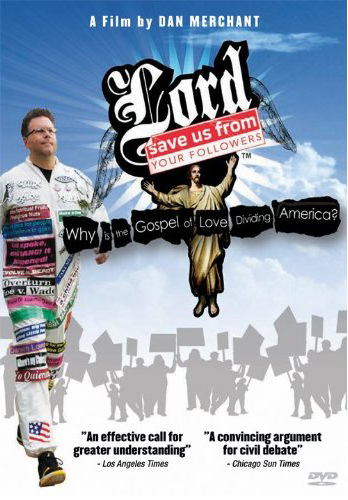
Lord, Save us From Your FollowersI don’t know who Dan Merchant is, but I really appreciate his outlook on the church. The film is dripping with the “inside the Nashville Christian scene” smell… But if you can look past that and the Michael Moore copying, the message of the movie is really interesting.
Essentially, Merchant points out that over the last few years Christians have made themselves outcasts in the greater society. Merchant points out some areas where we look especially nutty and reminds us, “Um, this isn’t the Christianity of the Bible. Where’s the love?” I was especially touched by the scene where Dan sets up a confessional at Gay Pride weekend in Portland. How’s that for cultural engagement?
If you can get past the cheese and the stupid outfit he wore the whole time– its a decent film. I’m looking for more from Merchant and assuming that future films will be better. I’d suggest dropping the book deals as it just makes the film seem like a commercial for the book.
Man on WireI wasn’t alive when this event actually happened, but I was completely captivated by the documentary about the stunt. On August 7th, 1974, Philippe Petit spent 45 minutes dazzling onlookers below as he walked a 3/4″ wire he had rigged between the north & south towers of the World Trade Center. Later, when questioned about the stunt by the media he told them, “When I see three oranges, I juggle; when I see two towers, I walk.”
Besides winning the 2008 Academy Award for Best Documentary there were a few things I appreciated about the film. First, while the centerpiece of the movie was the Twin Towers there was never a mention of the September 11th attack which brought them down. Second, the movie was beautiful. The filmmaker uses light and darkness in a way that makes the entire movie enchanting. Third, this movie is about chasing ones dreams– even if they are absolutely insane and may get you killed. Fourth, the film shows the power of artistically and magically breaking cultural mores. The delight on the arresting officers face tells the whole story.
Jesus Camp This movie has been out since 2007, so plenty of people have seen it. As I was watching it, I fell for the sucker pins. The producers of the film wanted to show how crazy Evangelicals can be and how churches are manipulating children to be political activists for the religious right. I was appalled and a bit angry that any parent would allow Becky Fischer to talk to their children like that. (And the one kid with the mullet, man he rocked that mullet HARD!)
Of course, the movie went to find extremes. It labeled the main characters as Evangelicals– yet they were far from middle-of-the-road evangelicals. These are our Evangelical cousins who are just a little bit short of handling snakes. Where homeschooling is normative and cultural engagement is seen as grabbing the devil by the tail.
Stepping back, I think the film has a lot to teach those of us who work with children and teenagers in the church. Anyone who teaches teens knows that it is really easy to manipulate a response and what we saw was some pretty nasty manipulation. (I mean, really? Talking to 9 year olds about abortion and giving them tiny fetus’ to hold onto. Really?)
Anyone who teaches knows that we can scare kids to get them to do whatever we want. But if we want to change a students life we know that they have to encourage them to make rational decisions which they can own for themselves. We know that when we allow students to encounter truth, giving them space to think about it, and respecting their personhood– they will make lifelong decisions. The film reminded me of the phrase, “Fear is a short term motivator.”
All three are great documentaries for creating discussion. They’d be really cool to watch with your leadership team or adult small group.
In a city of 3 million people roughly half are still homeless four months after the earthquake.
Why is a country, once rich in natural resources, a nation whose slave population rose up and defeated Napoleon’s army for independence, and given aid for generations by rich nations like the United States and France, still steeped in such poverty?
The answer is simple: Corruption.
There is corruption at every level of government. There are oppressors and the oppressed. And the people with social status to do something about it? Their idealism is often overcome by greed.
Even the relief aid workers who have gone— too many have succumbed to temptations. Too much talk, too much skimming, and not enough work getting done.
According to this New York Times editorial, only 7500 of the 1.5 million left homeless have been moved to a resettlement site. Not even a permanent home.
The cameras are gone. The news attention is now fixated somewhere else. (On the gulf oil spill.) The American publics attention, like that of a mosquito, is looking for the next story that bleeds.
$1.5 billion in aid was given. About $1000 per person displaced. [In a nation where the average family makes under $200 annually] And yet no one has a new place to live. Tents? Yes. Homes? No.
7500 people resettled. 1,492,500 still sleep on the ground tonight. Mothers will lay down their babies on dirt, under a tarp with your countries name on it in tent cities that would make your knees buckle when you see them.
I’ve heard snarky Americans say, “Why is Haiti our problem?” Or “Won’t our help just further the problem?”
Haiti is our problem. We have funded the corruption. We have turned our attention away from the corruption there… we’d prefer to not think about it. We have stood by and gotten rich off of their natural resources. We have gleefully paid unfair wages to their workers for generations so that we can buy socks at $2.99 for six pairs.
And while we wear their socks their children sleep on a piece of cardboard under a tarp tent with “USAid” flapping 12 inches above their face.
Shame on us.
Why can’t Haiti fix its own problems? Why can’t people just move? Why can’t they just go get jobs? Why can’t they rebuild their own homes?
My reply to that is plain: Why don’t you go to Haiti and discover the answers to those questions for yourself. If the problem is so simple– why not go and fix it?
This much I know. This I can assure you. One day a poet will rise up from the squaller of a tent city and cry out:
How long, how long must we sing this song?
One day the shame of our inaction will get to us. We will pay $100 to watch this poet pronounce shame and guilt on us for our inaction to a stadium of people who nod their heads in agreement.
While your children sleep safely in their beds tonight I want you to think of this song…
I’m always amazed how little leading most leaders actually do.
If a leader takes someone where they would otherwise not go on their own— the fact is that most people we label as leaders are just people who talk about leading. On a good day they are administrators. On an average day, they are do-nothings with leadership titles. On a bad day, they are busy saying they are leading while they aren’t actually leading.
Nobody cares how you intend to lead.
When you are a leader you are measured by your results, not your intentions.
Go through your own list of your favorite leaders. They all have great actions tied to their words we quote.
Leaders have a responsibility to lead. They need to say the words that move people. They need to prepare people to go somewhere or do something they are afraid of.
Then they need to take their people there.
Call yourself a leader?
No more excuses. No more coulda done this. Or second-guessing woulda done that. We’ve all failed, but dwelling on the shoulda just makes you sound like a loser.
Hey mom & dad. I don't want to be a god. I want you to be in charge.
Children were not always worshipped as the gods of the American family.
In part three of this series, lets examine the effects of the Baby-god myth on parents and teenagers. You can catch-up by reading part one & two.
School vs. Work
In fact, for most of our nations history we didn’t keep track of children very much. We didn’t have things like compulsory public education in every state, or child protection agencies, or children’s hospitals, child psychologists, or even pediatricians.
It wasn’t until the mid-20th century that school became mandatory. And it wasn’t until the unions forced child labor laws through that high school became part of compulsory eduction. Unlike the European system of mandatory compulsory education, our public education system is built on the belief that:
Children under 18, ideally, shouldn’t work at all.
Everyone should go to college.
Everyone, given the proper education, would want to go to college.
Not going to college is somehow a failure of the American dream.
The American dream can only be achieved through education.
The “all kids are meant for college” lie is very popular among educators. (Duh, maybe they have a vested interest?) Whereas, in Europe, students are given the choice to go on a college-prep course of study or a trades-oriented track, in the United States we don’t have such a system. While it exists, de facto, in almost every high school– it’s hardly celebrated.
If children have become our gods, achievement is our offering.
Labor laws amplified youth culture
The Great Depression gave the labor unions the ammunition they needed to finally get child labor laws passed in America. Believe it or not, not everyone was in favor of removing children from the workforce. With kids out of the workforce adolescent culture, as we know it today, took root. When children of the Great Depression and post-World War II baby boom hit their teen years and didn’t head off to work they began to hang out together and a sub-culture exploded.
The need for a college educated workforce
If you think about jobs in America over the past century you can see why culture has dictated the “all kids must go to college” mantra. Technology created the office job. A move from an industrial/agricultural economy to an economy based on white collar jobs (administration) required workers who were more polished and more highly educated. (Of course, many now see this as a trap. The debt required to enter the workforce puts you, fiscally speaking, decades behind a peer who goes into the trades.)
So society created the need for a college-bound student while those same students weren’t allowed to do much in their high school years. (Traditionally, people 14-18 worked!) Those post-puberty & pre-workforce years have really become a holding pattern. Too young to work but too old to be children. These kids, with all sorts of time on their hands, got creative with all that time. (Remember sex, drugs, and rock-n-roll) There wasn’t a massive youth culture prior to this because this age group was traditionally occupied with more adult endeavors. More on that for a different day.
What does this have to do with deifying children?
By the 1980s parents had come through youth culture and were appropriately afraid of it for their own children. In their boredom they smoked enough pot and had enough sex to realize that they probably didn’t benefit themselves in the long run. And with the college-lie now in full effect, and the further lie that if you went to the “right school” you could get ahead in life, parents just started to work backwards. It was a logical pendulum swing to protect kids from the damaging effects of youth culture by sheltering them and keeping them busy.
For Rex to go to the right college, Rex had to do well on the SATs.
For Rex to do well on the SATs, Rex had to go to the right school.
For Rex to fit in at the right school, Rex had to act, dress, and do activities with the right kids.
For Rex to fit in with the right kids, Rex’s parents both have to work, plus figure out how to get him to the right activities.
For Rex to do this, mom and dad were going to have to give every waking minute thinking about Rex and his future. (Or earning the money to afford his future)
Through the 1980s this myth developed, it metastasized in the 1990s, and became parental law in the 2000s.
All kids are not meant for college
I know this is educational heresy but we all know it. Walk on any high school campus and you will see the vast majority of kids who are done with education and are stuck in a holding cell called high school. The college-prep kids segment themselves out while the vast majority ghost walk through the process and are culturally forced to head off to another holding cell– community college or state university.
Those who are going to excel, do. Just as they always have. (Just like those who invented standardized tests intended to identify those kids, not as a tool for choosing the minimum, but to find those who could do the maximum) Those who aren’t going to excel, aren’t. But now that high school graduation is a basic requirement that we all must legally achieve– college has become the new high school. And grad school has become the new undergrad.
Effects on the American family
Deifying Rex has come at a high cost of the American family. With more than 40% of children in America now born to single mothers, single parents are under incredible pressure. Even in more traditional homes, the need to put Rex on a college-bound path leads to all sorts of sacrifices.
If Rex is going to go to Yale, he needs to be in the right pre-school. (Um, really?)
If Rex is going to go to Michigan, he needs to be in football by age four. (Um, really?)
If Rex is going to go to Penn State, we need to live in the right neighborhood because they have good schools. (Um, really?)
Part of Rex getting into Berkeley is being well-rounded, so Rex needs to go to music camp. (Um, really?)
On and on. We never stop preparing our kids for something we don’t know if our kids will even want.
Even crazier, parents have convinced themselves that this is 100% their responsibility. Particularly in Christian circles– parents don’t even trust their own parents to invest in the lives of Rex. Parents are so insanely crazed by worshipping Rex that parents won’t hire a babysitter, won’t go on vacation, and won’t allow their child to socialize or do ANYTHING that won’t further a perceived resume.
In my opinion, today’s parenting norms would be considered a psychosis just a generation ago. Parents are addicted to parenting.
Pressure
Parents feel this pressure. There are men and women in my life who don’t want to get married or have children because they feel the pressure. Just the thought of a marriage which has to perform to this level is not worth it– or at the very least, hard to imagine. Marriages crumble by the thousand under the pressure. Marriages struggle through unnecessary debt under the pressure to provide the “right kind” of lifestyle for their children. Parents, raised in a feminist society that tells them they are equals with men, are now making themselves subservient to their children. These “mommy-managers” are now an entire sub-culture to themselves!
Kids feel this pressure, too.
Have you been to a six-year-olds soccer game? The pressure is ridiculous. Parents don’t want the kids to have fun. They want them to learn skills and score goals. Why? So that they can get good and make it on the travel squad. Then what? Well, if they are good on the travel squad, they will play high school soccer. Then what? If they score a lot of goals in high school, maybe they will earn an athletic scholarship. Then what?
This is the pressure/expectations you hear on the sidelines of six-year old kids soccer games.
Have you ever been in a high school cafeteria? The pressure there is ridiculous. Besides all of the social pressure. Besides the horrible food offerings. There are kids studying. There are kids cramming. And then there are the little Rex’s who have given up. OK, that’s the majority of the kids.
With all the pressure to achieve (coupled by all the freedoms we’ve removed from teenagers over the last 40 years) there is little wonder you see so much deviant behavior. And depression. And drug abuse. And self-injury. And risky sexual behavior.
Teenagers disrespect adult authority, largely, because adults disrespect teenagers right to autonomy. And something within us says that when an adult is disrespected by someone we need to clamp down even tighter– having higher expectations and putting them higher on a pedestal they don’t want to be on.
By deifying our children we have put them on an pedestal they cannot stay on. No one can. We expect too much and we don’t give them enough space to grow.
Little Rex, worshipped since conception, will not become a god because he is not God.
Deifying Rex has trapped him. He is miserable. He is fighting for independence. While he is worshipped and deified he has no power.
We have the whole thing backwards.
Postscript: This New York Times article appeared after I published this piece, but does a good job explaining the ramifications of the myth that you have to go to the right school to get ahead in life. Another Debt Crisis is Brewing, This One in Student Loans
Today Megan, my oldest child, turns nine. To celebrate I thought it would be appropriate to share nine things that are awesome about Megan.
She is beautiful but not in a girly, make-up, gotta have the best of everything kind of way.
She has a crazy fun friendship with her cat, Lovely Gorgeous. She is the only one in the family who can run and grab Lovely at any time. For some reason the cat will even hold still as Megan tries to teach her tricks.
Imagination flows out of every pour of her body. Megan creates elaborate story lines and transforms her bedroom into all sorts of things. Right now her bedroom is a magic wand shop. Complete with homemade wands for $.05, used wands for $.02, and wand repairs for $.01.
Speaking of money, she is crazy entrepreneurial. She is constantly creating ways to create businesses.
She loves origami. Her ability to make the most complex things with paper astounds me.
Like her mom, she is a reader. We have every gadget a kid could want– and yet a trip to the library is the best adventure we can offer.
She is brave. Megan might not be the most outgoing kid on the block, but she is eager to try hard things and to explore. Living near the ocean has really brought this out.
She is nice to her little brother. I don’t know how she does it as Paul does his best to bug her. She will be the first to volunteer for time away from him, but she has found a way to love and include him that I adore.
Her face is hilariously expressive. Her mom is the queen of dirty looks. I am pretty good at making funny faces. But Megan is insanely good at making all sorts of faces and expressions.