Category: Church Leadership

  • Easter Strategery

    peeps

    If church is all about reaching numbers than this is Super Bowl Week for church.

    If you work in a church, holy week is kind of hell week. Church staff can’t wait for Monday. (Speaking as a former church staffer!) Weeks of planning and putting together a marketing plan, an event plan, a parking plan, and a planning session to make sure all of the plans are lined up.

    Here’s the dirty secret: Easter strategery doesn’t lead to long term benefits to 99% of churches.

    – While attendance is high on Easter morning, engagement is at an all-time low.

    – While production is high on Easter morning, these are largely the same people who saw the Easter show last year and weren’t effectively changed.

    – While tensions are high on Easter morning, people who are coming aren’t coming to find a church… they are there to celebrate the Resurrection of Jesus.

    I’m not sure how Easter became the Christian Super Bowl, but I do know a better plan.

    – Make the Easter service and the events leading up to it about Jesus.

    – Instead of the whole thing leading up to a Gospel presentation (Built on the false assumption that visitors aren’t believers in the resurrection… I mean, why would they be there?) why not make the service a kick-off in how you can get involved in living out the message of Jesus in your community? (Romeo nailed this last year IMO) I’m not saying we should share the Gospel, but I’m thinking we should all remember that the Gospel is all these Christmas and Easter folks hear at church. Maybe that’s why they think your church is irrelevant?

    – Instead of hosting an experience people won’t see for the next 12 months, why not invest that energy in meeting the practical needs of the people who come? A gift card for groceries says “I love you” way more than hiring a band.A warm handshake and an open heart is way more valuable then an Easter play.

    – Instead of marketing hype, why not invest in relationship hype?

    – Instead of stressing out the staff, why not send a message to the community that the church is healthy by “forcing” the staff to work less and experience Holy Week?

    – Perhaps it is time most churches took an old school approach to Easter morning, let the visitors come. Invite them back. But don’t bend over backwards for people who are only committed to coming Easter and Christmas. While it is an “opportunity” I think it’s more a distraction from the people who really want to grow in Jesus than an opportunity to reach those who have already decided to be nominal.

    Side note to those who don’t get what I’m talking about: Imagine the pageantry that you’ll experience at your church this weekend. Now, multiply that by every church and your community. Then envision that across the country… what you’ll see is an “Easter industry” that is as weird as the the Easter aisle at Target. It just doesn’t fit, but we accept it!

  • Mark Riddle Interview

    I’ve had fun finally getting to know Mark Riddle. He and I have interacted on forums and blogs for several years, but we only met face to face for the first time back in February. He has a new book out which is near and dear to my heart… Inside the Mind of Youth Pastors. It’s a fun little staffing book that is designed to help church leaders understand what makes youth pastors tick.

    Anyway, here’s an interview I did with Mark about the book for the YS Blog. I apologize for the poor audio. There are times you can hear the birds in my backyard better than Mark. But if you can get past that I think it’s a pretty solid interview.

  • Changing the metaphor for small church

    farmer

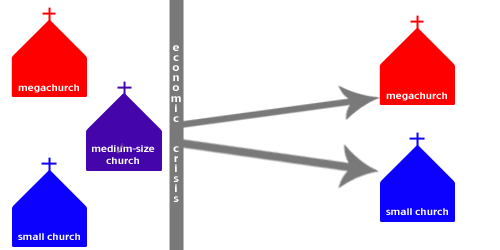
    A couple months back I raised some eyebrows by saying that medium-sized churches were in crisis. Since that post I’ve had dozens more conversations which confirm that it isn’t just me seeing this, it really is happening. Church leaders all nod their head when they read Seth Godin,Big is the new small. But you’ll always have big.” In the business world, Wal*Mart is still getting bigger while medium-sized outlets struggle to exist. But the real growth in retail happens in the mom-and-pop shop online. The same is coming true in chuch-world.

    In churches, the big will keep getting bigger. Just like people are driven to the big box retailers, people are continuing to be drawn the big box churches. I say… let them have their big buildings, ginormous programs, and endless pursuit of perfection. While it doesn’t appeal to everyone… certainly, that appeals to masses and its obvious that those megachurches will/should continue to get mega-er.

    For them, the business model really is the best model for church. 10% effort and 90% profit.

    But for small churches, the best model is a farm. 90% effort and 10% profit.

    Both are noble. Both are valuable. But both operate in strikingly different manners.

    I see that we are at the forefront of seeing an explosion of small, niche based small churches. Just like it’s easy to dream of an online shop selling homemade Mario Brothers crafts and finding an audience on Etsy.com, it’s getting increasingly easy to build a church around a niche. People are more-than-happy to drive 50 miles to worship with people in their tribes who share their passions. That’s why we’re seeing a major wave of church planters who successfully grow from 1 to 200 and then plateau… happily. They are churches full of artists or surfers or engineers or soccer players.

    Differences between business models and farming models of church leadership.

    At the core it’s this: Business models are driven by growth. Farming models are driven by sustainability.

    home-depot1. Success is different. In business models growth is expected every year. You are expected to have a larger audience in 2010, 2011, 2012 or you’ve failed. When you reach saturation you have to franchise by planting a new megachurch or going to satellite services somehow. Plateau is the enemy, growth is measurable. In a farming model, growth is important but sustainability is more important. A farming-based model recognizes that you’ll have bumper crop seasons where there will be temptation to grow the farm… but you don’t, intentionally, because you know there will be tough times when a bigger farm would lead to failure. Successful farmers expect good years and bad years.

    2. Discipleship is different. Examine any discipleship method in the business model of church and it all goes back to the Sonlife model taught in youth ministry of the 80s. Win-Build-Equip-Multiply. Navigators, Sonlife, Willow Creek, Saddleback, North Point… all of those models are designed to grow a church through multiplication. In a farming model, it’s all about yield per person. How can I maximize growth with the people that I have? How can the people within my congregation grow the most? How can I love them more? Since farming is about sustainability and not multiplication discipleship is always about maintaining a healthy ecclesia. One isn’t better or more biblical than the other… they are just different methods. (Of course, proponents of each think their model is superior!)

    3. Leadership is different. A large church pastor is driven [and held accountable] by growth. There are many good ramifications of this. Tens of thousands of people are introduced to the Gospel… please don’t misread that I’m saying big churches are bad. But a nasty byproduct of that drive for growth is that the successful church in this model really becomes about the pastor. New Spring is Perry Noble’s church. Lifechurch.tv is Craig Groeschell’s church. Willow Creek is Bill Hybels church. North Point is Andy Stanley’s church. Mars Hills is Mark Driscoll’s church (Or Rob Bell’s church, depending which coast you live in.) On and on. While those leaders never desire to create a cult of personality… the leadership-style that creates that movement of God draws that type of person in the same way Ebay is Meg Whitman’s company, Microsoft is Bill Gates company, and Apple is Steve Jobs company. Contrary to what you might think… I don’t think the drive to grow a large church is evil. It’s perfectly fine and healthy to live within that paradigm. My fear with those churches is that there simple isn’t a succession plan if/when that leader steps away! Look back to last generations megachurches and you see the problem and how it plays out.

    soy-fieldA small church pastor is driven by sustainability. It always has to be about the people, the families, and the community. Since everyone will actually know everyone in a small, niche-based church can’t afford a cult of personality. In a small church the people are always aware that the pastor won’t be there forever… and so they hold the pastor accountable by making him make sustainable decisions. The small church pastor is motivated by “the farm” and he isn’t frustrated when there are bad times… it’s just part of what he does. He fertilizes and tills the ground, he maximizes the yield, and he understands that good and bad times are part of the ebb and flow of small church ministry.

    4. Expectations are different. Values in a large church are that things will be professional, smooth, highly organized, and striving for perfection. In a small, farm-modeled church, excellence is nice when you have an excellent person… but the expectation is “the best we can do.” That’s why there was so much pride in Mainstreet when I was in Romeo. It was the best thing we could do and we were proud of it. Sure, it wasn’t Broadway quality. Reggie Joiner wasn’t going to come to Romeo and write a book about how we adopted his model with cardboard and a fat youth pastor dressed like a cow. But no one in Romeo really expected it to be and we set it up in a way that could sustain. That’s why Mainstreet is still happening even after I moved away. In a small, niche/affinity based church, perfection isn’t the goal… the niche is the goal. Quaint is good! Rock that quirky church, baby! Mrs. Nelson’s son playing on the piano poorly is just fine. A kids program lead by an ex-stripper now Christian grandma is a blessing. Ministries lead by teenagers is about sustainability of the niche-based church… not about having the best leaders teaching.

    What do you think? Do you think it’s time to introduce a model for small church ministry that is based on sustainability? Do you agree with this premise… or am I way off?


  • How do we get to Youth Ministry 3.0?

    t_9780310668664I’ve been wrestling with the concepts of Marko’s book, Youth Ministry 3.0 for a long time. Actually, before I worked a YS I had been going through a prolonged set of discussions at Romeo saying in a thousand different ways… What I’m doing isn’t working anymore.

    The problem was simple. I was trained and experienced at how to do youth ministry a certain way. The entire ministry was built around a youth group night of games, worship, small groups, and a talk. I had seen it work and do incredible things! Even in Romeo we had seen this ministry model draw 40+ students to a church of 120. Lives were changed, kids were discipled, volunteers loved it, on and on. We ran that thing and worked that model like a well-oiled machine. I was well-versed in all the terminology of all the other well-oiled youth ministry systems and had written tons comparing and contrasting the strength of one model over the other. But in the last few years the model tanked. Kids stopped coming. The whole thing became kind of toxic. Instead of re-arranging their schedule to make in on Wednesday night all of a sudden kids were trying to find things to do on  Wednesday night so they could politely bow out. Frustration mounted and I kept saying, “What I’m doing isn’t working anymore.

    The crazy thing was my reaction to a YM 2.0 model. My response was always, even to the last day, “I know this works, something is just missing, that’s all.” I would tweak things here, re-emphasize this or that. It was never that the concept was broken. The problem was always either the kids not getting the vision of the model or my model not having the funding/support it needed to succeed. It never really dawned on me that my solution to fixing things was to kill the model and search for a better way to minister to students. My reaction was always to just work harder and to keep trying.

    Pray more, blame the parents. Pray more, blame the money. Pray more, blame myself. Pray more, blame the kids busyness. In the end I was royally frustrated and a little angry at God that He had me in a place where I couldn’t fix things.

    But as Marko’s book shows, there is a massive shift from what he calls “Youth Ministry 2.0” built around programs and models, towards “Youth Ministry 3.0” where the programmatic approach is, probably though not necessarily, foregone for a draw towards ministries built around affinity. (A super over-simplified analysis, right there!)

    My wrestling point right now is pretty simple… how do I help ministries kill what has worked for a generation and open their eyes to a way to reach this generation. My experience in YM 2.0 environments is that they’d be happy running an un-attended YM 2.0 model if that means they don’t have to change things. Youth workers may not like the sacred cows of big church but they have certainly built some sacred cows themselves. (Remember the fury over my articles, “I Kissed Retreats Goodbye?“)

    From a national perspective I’m seeing one trend that is scaring me and I don’t want it to be the solution: Killing youth ministry budgets, staffs, and programs. Please tell me that we’re not going to throw the baby out with the bath water? Simply because a model isn’t working doesn’t mean that we shouldn’t minister to adolescents!

    What is a more productive outcome than that?

  • A Dare for Pastors

    lunch

    I am daring you and your staff to take this challenge. I promise you it isn’t as dangerous as it sounds. In fact, I think it may just fundamentally change the way you interact with the people in your ministry.

    Here’s the dare.

    Lock every staff person out of your church building for a work week. From the senior pastor to the part time guy to the janitor. Instead of going to the office and doing your normal thing for 7 work days I am daring you to put all that “work” aside for a work week and a couple of days to spend that time getting to know 10 people who go to your church in their native environment.

    Here’s how it works.

    1. Instead of getting up and going to the office, split your day in half. In the morning you’ll spend a half-day with a first shift office worker and in either the afternoon or evening you’ll pull a half shift with a blue collar worker. Trust me, you’ll find a bunch of volunteers. It’ll be fun for everyone. Repeat this for 5 days so each staff member gets to see 10 of your church attendees in their work environment for half a day.

    2. Run your ministries that week in the most stripped down way possible. Just wing it for a week… you’re professionals, you know you can wing a week. Tell the pastor to talk about his week or something. The preacher absolutely doesn’t get special treatment in this. Heck, download a free sermon from open.lifechurch.tv and tell the band to play last weeks songs on Sunday. This dare will make your ministry better, I promise.

    3. When that week is over schedule an off-site meeting with your entire church staff for Monday and Tuesday. It’ll take 2 days to debrief this.

    3a. Spend the entire first day (with a lunch paid for by the boss) sharing your experiences. What did you do? What was unexpected? What went crazy? Who works their butt off? Who has the easy job? Why do people do what they do? Who is the most servant hearted? You get the idea.

    3b. Spend the entire second day (bring a bag lunch) determining how getting to know people in their native environments changes how you minister to people, families, children, and students.

    4. Send thank you notes to every single person you visited. Let them know how much you appreciated the time with them, how much you learned, etc.

    Money back guarantee! Since this project isn’t costing you anything I promise to refund you fully if you take this dare and learn absolutely nothing.

    Go ahead, spend time with your people at work. I double dog dare you!

    For those taking the dare. Let me know if your staff is doing it. I’d love to pray for you all. Also, let me know how it went. Leave a comment here or drop me an email, mclanea@gmail.com.

  • Andrew Marin goes to Washington

    I probably seem like a total fanboy for Andrew Marin. Thing is, I think he’s one of those few prophetic voices within Evangelicalism. Here’s a message he presented as part of the Inauguration Weekend in Washington, DC.

    I’m really digging his book, Love is an Orientation. It comes out soon, you can get yours today at Amazon.

  • Rock that Quirky Church

    dsc_0211I think some of my harsh criticisms of the evangelical church come from a love of our church. The mission of Harbor Mid-City is one that is quirky by design.

    We have a hyper-qualified staff brought together despite significant theological difference who lean into that tension for the sake of the Gospel in the neighborhood. For my theologically savvy readers (aka Kristen) we have staff people from PCA, Salvation Army, Baptist, pentecostal, emergent-types, traditional evangelical and hard core liturgical backgrounds. In most communities these folks wouldn’t even get together to pray for one another… much less chose to work at the same church!

    Toss on top of that theological stuff the language issues we experierience every week and you will start to see the quirks pop out. We offer the same service in both English and Spanish, meaning there are painfully long times of translation. But this is San Diego and people are used to hearing both languages on the radio and TV… so that’s no big deal. We also have a population of people who speak Korean, Vietnamese, and Swahili. Sometimes our worship music is in those languages. In fact, there tend to be as many non-English songs as English ones.

    Ready for this? It gets more quirky as the design of the church allows minority cultures to have equal voice in our services. What that means is that we’re more worried about celebrating our worship service in a way that lifts up Latin American, Mexican, African American, Southeast Asian, and African cultures above the dominant white evangelical culture.

    OK, one more quirk. There is a huge hodgepodge of socio-economic situations in our church as well. You have working class poor next to college kids from San Diego State. And you have immigrants next to upper-middle class folks who live just north of the church.

    Is it perfect? No. Do I agree with every last bit of the theology? Absolutely not! Are there things about the church I really dislike? Yes! Am I comfortable in the service? Rarely. Are the messages challenging and encouraging to where I am at in my walk with Jesus? Not often. Do they offer all of the things I need for my family? No, children’s ministry is just getting organized. Youth ministry is in a pre-formational stage.

    So why do we go? We go because we believe at the core of our being that there is tremendous strength in that diversity. I am not arrogant enough to believe that my evangelical expression of theology and worship is superior. I love to worship in a place that agrees on the essentials while allows gray areas to be interpreted through the lens of culture.

    Don’t get me wrong. This place is solid theologically. In fact, I’m convinced that Harbor expresses in their worship many best practices of things believed across Christianity. This hodgepodge isn’t just the brain child of idealists. It is the brainchild of idealists who are stupid enough to think that it will work, have the training and experience to make it happen, and have a core of people at the church who are dreaming the same dream.

    In these quirks I see tremendous hope for the Gospel across our country. Lives are changed as they are surrendered to Jesus. And as I think about it, much of what I rebel against here on the blog about evangelicalism is because I see Harbor doing something right while most of evangelicalism is doing it wrong.

  • YS Podcast

    Hard to believe that this is the 28th episode of the re-launched YS Podcast. I like that we’ve kept it simple, short, and all about youth ministry.

    I’ve talked to Sean a bunch of times about this piece. His ministry helps youth groups around the country buy airtime on local radio. Not event spots… but real ministry time. A very cool concept and surprisingly cheap. The second segment is from Tic… obviously! I love what he says about Lent and taking care of yourself. I know I need to hear this type of thing and I’ve already watched it a couple of times.

    The most consistent feedback I get from the show is from the closing. It always amazes me, but at least once a week I’ll get a voice mail, email, or Facebook message says… “I needed to hear that my ministry matters this week.All that to say, if you know a youth ministry volunteer or paid staff member take a couple of minutes this week to express to them how they are making a difference in your church and community. Don’t assume they feel appreciated.

  • Fast Tuesday, Temptation

    fast_tuesdayA full week into Lent, today marks my first Fast Tuesday. Not sure if “pumped” is the right word to use for entering a period of fasting, but I am prepared to enter this season of preparation.
    I woke up thinking about this passage:

    Jesus, full of the Holy Spirit, returned from the Jordan and was led by the Spirit in the desert, where for forty days he was tempted by the devil. He ate nothing during those days, and at the end of them he was hungry.

    The devil said to him, “If you are the Son of God, tell this stone to become bread.”

    Jesus answered, “It is written: ‘Man does not live on bread alone.”

    The devil led him up to a high place and showed him in an instant all the kingdoms of the world. And he said to him, “I will give you all their authority and splendor, for it has been given to me, and I can give it to anyone I want to. So if you worship me, it will all be yours.”

    Jesus answered, “It is written: ‘Worship the Lord your God and serve him only.”

    The devil led him to Jerusalem and had him stand on the highest point of the temple. “If you are the Son of God,” he said, “throw yourself down from here. For it is written:
    ” ‘He will command his angels concerning you
    to guard you carefully;
    they will lift you up in their hands,
    so that you will not strike your foot against a stone.”

    Jesus answered, “It says: ‘Do not put the Lord your God to the test.”

    When the devil had finished all this tempting, he left him until an opportune time. Luke 4

    Lent is deeply rooted in the 40 days fast Jesus observed in the desert as he prepared for his earthly ministry. I think it’s amazing how many times I’ve come into Lent and missed the meta-narrative of what Lent was preparing me for. Lent is a 40 day fast of preparation of the observance of Easter… duh, right? Wrong! There was a two-fold point to Jesus’ 40 days of preparation, wasn’t there?

    Point one: Pay the penalty of sin with death, making a way for man-kind to have a relationship with God. (Bringing the Gospel message to us individually)

    Point two: Open the door for all believers to act as agents of God’s mercy, regardless of earthly decension. Previously, this belonged only to the tribe of Aaron. (Bringing the Gospel message to the whole earth.)

    Lent isn’t meant to just prepare me for Easter. It’s also to remind me to continually prepare for my lifelong ministry as a believer. Conversely, my role as someone called to “professional ministry” is to not only call people to the cross, but to prepare and encourage God’s people to act as agents of the Cross wherever they go.

    So Jesus went to the desert to fast and prepare for his ministry. And while fasting the devil tempted him along three lines a Messiah would be tempted. I’m a pretty self-reflective guy… and I don’t think the temptations I face are anything like those. But let me share some of the tempatations I wrestle with as a ministry leader.

    The temptation to attack. Part of that giftedness is a strong sense of what ought to happen in just about any organization I’m exposed to. (Schools, libraries, sports teams, churches, work, families, game shows, and even organizations I’m not tied to, just curious about.) The temptation is stop trying to gently reform and just nail 95 Theses to the wall and walk away. There is a big difference between pushing something to get better and being rude. And while being a jerk is often times more effective at fixing things it hardly reflects a Gospel-driven approach. So I feel constantly tempted to say things in ways that aren’t helpful, blog about things in an attacking manner, etc.

    The temptation to invest in the wrong things. Anyone who knows me knows that I struggle deeply with balance. I tend to fall in love with something to the point where things get out-of-whack… thus messing up the thing because of a lack of balance. For example. There were about 2 years in Romeo where things were very balanced. Home life was great, work life was great, and working with the golf team helped me keep both in check while somehow making both better at the same time. Then, I allowed a pressure from work to push me out of helping with the golf team. That was my centering activity and from that point on life spun further and further out of control. Had I just stood up to that pressure and resisted the temptation to allow myself out of balance, who knows what would have happened? I need to resist that temptation continually as it comes.

    The temptation to lead instead of serve. I don’t know if I’m the only one who notices this, but a lot of church leaders have a jacked up view of leadership. They lead with ego, talent, and brute force. Unfortunately for them, Jesus called us to lead by serving others. (see John 13) I have to admit, it’s a huge temptation to try to lead things in the way I see church leaders being successful! I want to ram-rod my will on others all the time. But as we see in the Gospels and the early church in Acts… Jesus’ ministry came to conquer the hearts of mankind. You can’t conquer a persons heart by force… in case you didn’t know, that doesn’t work.

  • Medium-sized Church Crisis… Let’s Talk Money

    medium-sized-church-crisis

    The first time I talked about this topic, the assumption in comments was that the reason the medium-sized church is struggling is because of money. In my last post on the topic I explored the core problem… that there are no “medium-sized church people” in America. There are big church people and small church people. So… here were: Money problems are the effect and culture is the cause.

    3 Financial Reasons the Medium-sized Church Struggles

    1. People give to vision, not to guilt. What this means for medium-sized churches is that people simply aren’t going to give to a vision they don’t believe in. So if you talk about growth, the small church folk won’t give and visa versa. See number 3 for what I think the solution is.

    2. Video killed the adequate preacher. A former student of mine summed this up well in describing the church she currently attends. “What I like about the worship leader is that he’s not trying to be Crowder or Tomlin.” In a society where everything seems fake, authenticity goes miles.

    3. Big buildings are a waste of money. If you’re a megachurch you can spread that cost of a big building around. And massive buildings and huge programs are affordable for megachurches. Otherwise, I think most churches would be wise to shed their buildings and complext programs. This really squeeezes medium-sized churches. That’s why I think most medium-sized churches will go multi-site, video-site, house church, etc. See, I’m not predicting the death of a medium-sized church. I’m predicting that this size church will get creative in order to sharpen their mission.

    Again, I’m not claiming to be an expert here. I’m just kind of putting into words a bunch of conversations I’ve had over the past few months. Share your thoughts!