If you are interested in helping fund the school in Wilnard’s church or perhaps your church (Or a group of Christian educators, or any combination) is interested in adopting this school to help pay the teachers, provide uniforms and shoes, or even feed the students, please let me know.
If you’d like, we can plan a trip together and I can introduce you to Pastor Wilnord myself.
The needs in Haiti are still real. The opportunity is still huge. Please don’t forget.
Jeffrey and Joel were visiting with the people of a tent city in the town of Carrefour, Haiti when they heard periodic banging. Used to the sound of big diesel engines and definitely used to the sound of kids laughing and playing games, metal on metal banging was distinctive pang and piqued their curiosity.
Under a tree, away from the main tent area, they met Daniel. Daniel is a mason by trade. But right now there are way more masons than opportunities to do masonry so he began to improvise. With all of the aid flowing into the tent camp there was plenty of garbage generated. One thing that seemed like it was useful for something was all of the one gallon aluminum cans which brought foods like beans.
After some messing around and possibly scouting out what was selling in the city, Daniel started cutting open the cans and making flat sheets of aluminum. Then, using only a large square chunk of steel and a smaller, shorter chunk of steel, he began shaping the aluminum into little boxes and punching a hole in them.
Bam. Instant piggy bank made from recycled cans.
Next, he began selling them to street vendors to sell up the hill in Carrefour. He sold them at 3 for 25 gouds. (3 for about 75 cents in US dollars) Each one took him about 2 minutes to make. So, in theory, Daniel could earn about 75 cents per hour. Remember, the average Haitian family earns less than $1 per day.
Jeffrey and Daniel bought about 6 piggy banks. (They paid him a little more than he was asking.)
Later that night as our team debriefed the day Joel brought up this story. And as the conversation morphed our team decided that we wanted to buy as many piggy banks as Daniel could make. Maybe, if we could get enough, we could use them to raise money for something like the Sons of God Orphanage?
The next day we went back to the tent city and found Daniel under his tree, banging away. We told him our plan and he liked it.
We will buy as many banks as you can make by noon tomorrow.
He thought he could make about 50. We said, no matter how many he makes… we’ll buy them all.
The next day, we were all a little apprehensive and hopeful. We had a feeling he’d have the 50 piggy banks. But we joked that we’d also walk into the camp and see tons of little kids with band-aids on their fingers from making these things all night long!
Daniel looked like a smart businessman. Maybe he’d hired the whole neighborhood to turn garbage into cash? Wouldn’t that be hilarious? I’d hoped we had enough money.
When we found Daniel under his tree it was clear that he was exhausted. He hadn’t slept. The interpreter tried to nice it up by saying that he thought Daniel had a fever. But it was OK, he had worked all night and we had come to buy what he had. His hard work was a good sign that he cared for his family.
He had 44 piggy banks. We counted them. We examined them. We made a big deal over how cool they were and well they were constructed. And then we talked about price.
You could tell he was nervous about that part. I don’t speak Creole but I could read his body language. Were the Americans going to try to offer him a bad price? And what would he do if we did?
The same price came up… 3 for 25 gouds. We told him no. We told him that he had worked all night and that we had rushed him. We told him that we didn’t feel right about paying him so little. We asked him if he thought it was fair if we paid him 25 gouds each. (It took a couple rounds of interpreting to get what we were saying.) He looked kind of confused by our proposition. I doubt anyone had ever told him they should pay him MORE because he had worked hard.
So, we counted them up and paid him just over 1000 gouds. (About $25 US) We shook hands, gave him the money, and walked away.
I don’t know what justice looks like. I can define justice. I can talk about it. But I don’t have a clue what it actually looks like.
I honestly don’t know if that was justice in action or just some silly Americans buying souvenirs thing. I just don’t know because I live in a world where basic justices are a given. But I do know business. I know that on that day, under that tree, that act of business felt like an act of justice.
I pray that more Daniel’s find more ways to recycle things. Turning garbage into money is good in any longitude or latitude.
The hope for Haiti’s future lies in the churches ability to recognize and empower leaders as they emerge.
On my first trip to Haiti I got to see this first hand. As we built relationships with key church leaders we began to gain access to some of their best and brightest leaders.
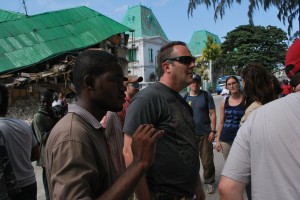
I met John on my first day in Port-au-Prince. When we divided into teams to go to a massive public worship service, Lars and I were assigned to John. [Pictured right]
John was working as a translator since the earthquake destroyed and indefinitely closed his seminary. He had translated for another ministry in his early 20s, but since there weren’t many other options for him to work– it was logical to go back to it for him until his seminary opened.
For the next 3 days John and I were constant companions. Each time we went out to do ministry it just became a given that he and I would work together. What I like about him is his easy-going attitude and heart for ministry. He took his job very seriously. It wasn’t just work, it was ministry for him.
One day, as we were walking from one tent city to another, I asked John about his life as a seminar student. “What is your greatest difficulty?” He kind of looked at me and thought about it. Finally he said, “Doing my homework in an internet cafe is very hard. I find it hard to concentrate on my Greek or a passage with so much else going on.” He wasn’t asking for me to help him buy a computer, but it was clear that a computer would make all the difference in his studies.
I left Haiti and committed to praying for John’s ministry. And in the months to come John emerged as one of the key translators and connecting points for AIM.
Flash forward to May. Mark Oestreicher and some other church leaders headed back to Haiti to launch the Church to Church program. During the trip, Marko had the opportunity to get to know John as well. And as we exchanged texts one morning I asked Marko if John had anything I could bring him when I came in July. His request? A laptop.
Good. Because that is what I had in mind as well.
But the truth was… I didn’t really have an extra $400 I could spend to buy it. Kristen and I put out so much cash for our trip already, it just wasn’t responsible.
So I put out this Twitter request:
To my surprise and astonishment… yes, people did want to help! Within a few days I had raised the $400 needed to buy a very nice netbook for John. On top of that coolness, when I went to Best Buy to pick it up, I explained what I was doing to the associate who helped me… and he kicked in a protective sleeve as his contribution.
In the grand scheme of our trip to Haiti I had hoped to see John again and give him this gift. It wasn’t to be. The ministry site I was at was nearly 40 minutes from the place he was at. And without a car it just wasn’t possible to make that moment happen. I was, however, able to give it to his boss who could give it to him. Not quite as “fun” for me… but the gift will have the same effect anyway.
It might not seem like a big deal. One computer for one leader. But, to me, it is a big deal. An emerging church leader should have the equipment he needs. And the thought of studying for a Greek exam in a crowded and hot internet cafe, or writing a message, or just trying to do some research… it was an inequity I wanted to do something about!
Some big thanks! Several people donated money to help equip John’s ministry. In fact, donations covered this 100%! I owe a massive thanks to Todd Tolson, who rallied his friends from Journey church and his business, Wired Community. I put out the call and within hours they had met 75% of what I needed to raise. I was shocked!
Thanks again to Katie from Adventures in Missions for making the time to produce this video. Why am I passionate about connecting North American churches to ministry opportunities in Haiti? Well, you’ll see it goes both ways. You give a lot and get a lot. In the long term, I long to see more of this culture bridging work transform our church culture. With this new global society… I want to get beyond a traditional view of missions and see more bridging ministries spring up.
Thinking about taking a group to Haiti? I don’t work for AIM, but I am happy to share a third-person perspective on what they are doing. Leave me a comment or use my contact form to send me your information, let’s chat.
24 hours into my second trip to Haiti and I started crafting this phrase:
Theology and culture always co-mingle. You just hope that theology and culture never conspire against the goals of the church.
In America: Theology and culture conspire to destroy the church through our belief in the American Dream and pursuit of happiness.
In Haiti: Theology and culture conspire to over-spiritualize everything.
At least that’s my opinion after my second visit. The first go-round, I was doing my best to look past all of that so I could focus on evaluating the needs of the people. But this time, it became clear to me that the desire to blame everything on the spiritual world was seriously hampering rebuilding.
God may have been in the earthquake. But there were certainly human factors at play as well.
Walking around Carrefour, the epicenter of the January 12th quake, is like a scene out of a movie. Not the beginning and fun parts. And not even after the credits roll. It’s like that sense of curiosity you have when you watch a movie like I Am Legend. What would happen if people re-inhabited the set? That’s the feeling you get walking around the effected areas. You are on the set of a movie about the end of the world.
“The world has ended.” These are the words of some church leaders. Most Christians in Haiti seem to believe that January 12th was the beginning of the tribulation. And who can blame them? On a single day half the cities people became homeless. Almost 10% of the cities population was killed. Countless homes, business, churches, and government buildings either collapsed or were severely damaged. If this isn’t tribulation than the real tribulation is truly something unimagineable.
Last week I documented some signs of hope in Haiti. This time I wanted to be fair and share some signs of despair. (And evidence that you need to be involved!)
Some rebuilding has begun. But with no building codes, horrible materials, and skilled labor lacking… people are just making the same mistakes that lead to so many deaths. It’s easy to blame God, but one major contributor was faulty construction practices.
Billions of dollars in foreign aid will be distributed mostly to wealthy oppressors. Joel spoke with a Spaniard on his way out of Haiti. He had been in the country for 3 years and is leaving because he can’t handle the corruption anymore. “Want to know where all the aid is going? The Haitians the NGOs are hiring are selling it out of the back door.” Enough money has been given to Haiti to completely level and rebuild Port-au-Prince. Unless people intervene all of that money will be squandered away bit by bit. Sorry if that’s shocking to you.
While there are thousands of NGOs on the ground, very few have camp managers like Sean Penn. Like it or lump it, each camp needs a foreigner who will go to the various NGOs and leverage social currency selflessly on behalf of people. Spiritual needs are great to meet. But there are still plenty of physical needs unmet too. A camp manager who checks in 1-2 times per week isn’t going to cut it. It takes people who make running the camp their life mission to make things happen.
The earthquake shook the people, but a culture of dependency is hard to loosen. Americans have a “fix-it” mentality. It’s in our cultural DNA and we exhibit it everywhere we go in the world. As the recipient of generations of this, Haiti (and other places in the world like Haiti) have a “foreigners fix-it” mentality. Our cab driver in Ft. Lauderdale was the perfect example. His wife is a doctor in Haiti and he sends home money to support her. When I asked him when he would move back to his country he told me, “I will move back when I find a white man willing to partner with me on my water and ice business.” When I told him that, in my opinion, the only hope from Haiti was if the Haitian people lead themselves and stopped depending on outsiders… he just laughed. “I wish that same thing, but the Haitian people just like to buy and be given things by white people. It means it is a better gift or business than a Haitian can create.”
The government of Haiti is dragging its feet. A major problem facing rebuilding efforts are the myriad of 18th century property laws that govern ownership. You need a permit to remove rubble. And if you are renting you need to get the owners permission. The owner might live in another country, and he may only have a share of the ownership with dozens of cousins. And, of course, to prove you own the land you need to go to a government building which collapsed. Round and round you go. Months go by and nothing gets done. Unless you pay a bribe, that is.
Is there hope for Haiti? Obviously. I believe to the core of my being that Jesus brings renewal of the soul and the land. While this is an incredible time of spiritual revival in Haiti it is also the greatest opportunity in our lifetime for Christians to get involved at the grassroots levels and help root out corruption and see the best interests of the people served.
If not you than who? Want to change the world? Think you are crazy enough?
I think a lot of people question our involvement in Haiti. I’ve heard it over and over again, “We have so many problems here in our country. Let’s take care of our problems first.”
Yada. Yada. Yada. We can’t turn a blind eye to the world because our backyard isn’t perfect.
That rant aside. Stories like this are excellent reminders that outsiders come into Haiti with a different set of lenses. They see the forgotten and help call the church to act. Now if only outsiders would come to our churches from places like Haiti to point out the big planks in our eyes… that’d be something.
Activity: We walked everywhere. I was constantly playing soccer with the kids. Even though we all took a siesta from 12:30-2:30 every day to avoid the heat… we were all exhausted at the end of each day. Just imagine how much I would have lost if we’d done a construction project?
Heat: There was no escaping the heat in Haiti. Air conditioning is not a luxury many Haitians enjoy and our team was no exception. Each day was 100+ F and the humidity hovered between 80%-99%. I lived on water and Gatorade. (Drank on average 320 oz. of liquid per day, went pee about one time per day…. you just sweat that fast.) When we did visitation or even just walked around the neighborhood, my clothing would be soaked to the core within minutes. Thank goodness for shirts that wick away the moisture. Those with cotton t-shirts looked miserable.
Food: We didn’t starve. In fact, I think we ate very good. Mornings we had oatmeal. (Not what you want to eat when its so hot, but it was all about calorie loading.) Lunch was PB&J and Pringles. And dinner was provided by a Haitian cook. That always had a rice element, a non-lettuce salad element, and either chicken or goat. In fact, the food was delicious.
Wrestle with this
Kristen and I both felt physically great during our time in Haiti. We were tired by the end of the day and we were constantly thinking about hydration. But overall, we were 100% fine. No gastro distress. No travelers stomach. No cramps. No upturned noses at disgusting food.
But since we’ve been home. Neither of us have felt good.
The reality is that we ate better quality food in Haiti than we buy from stores and restaurants here. I’m thankful we are in the middle of our harvest season so that we can feed our family fresh, organically grown foods. (90% of our produce is now from organic sources like our CSA and our own garden) If anything, this last trip has proven to me that the GMO grains and sugars that have taken over the American food supply are making us all, collectively, sick.
Two points of thought:
I don’t think I’m done leading trips to Haiti. While the work is shifting from relief to rebuilding, its a slow culture and re-culturing the nation will take time and outside encouragement. The reality is that I feel strangely awake and alive there– it’s beyond explanation.
I am once again re-examining how/what my family eats. I think it may be time to try a food experiment. It might be time to eliminate high fructose corn syrup, GMO grains, and non-organic trickle down products like dairy.
We were very encouraged to find a decent soccer field and some team practicing. We came back the next day and played a U18 group. It was fun to play… while we had some valiant plays we eventually got creamed. I will let you know that both Joel and I scored goals though. His was legitimate and mine was a fluke. (You don’t score many goals off a goal kick. But I did!)
This was one of the many signs of health we saw at this tent city. Plenty of commerce. Lots of organization. Clean water, showers, and toilets. And organized sports for various ages.
Sidenote: The guys were lobbing passes across the field while we were filming thing. You’ll notice that about a minute into the video there’s a little disturbance. I guess one of the Haitian guys thought it’d be funny to try to snipe me while I was filming. I never saw the ball coming at my head from about 40 yards. Thankfully, Josh stuck out his arm and blocked it. Otherwise… this would have been my ticket to $10,000 on Americas Funniest Home Videos. Er, maybe that’d be the Haitian version?
OK, so in order to really appreciate this video you need to know that Kristen has no moves whatsoever. She loves music. She actually likes to dance and clap to music. But the poor woman… well, she has no beat. And this has long held her back from sharing her dance-worthy moments with the general public.
But put her in an orphanage full of children filled with joy– no problem!
Saturday afternoon most of the team pealed off to go to do VBS and I just felt like I needed to make one more little trip to the Sons of God orphanage. I wasn’t sure why. It was just in me and I needed to do it.
So I did.
As we made our way through the series of dirt streets from Pastor David’s house to the orphanage I was just asking God… please, show me your forgotten child. I was praying for just a moment of connection with a child to let him know that Jesus is there for him. I didn’t have a clue how it’d work. But that was my prayer.
We opened the green heavy steel gate and wound our way through the Pastors house to the little courtyard the children hang out in. Of course, 3-4 visitors from America drop in and every kid just comes to hang out.
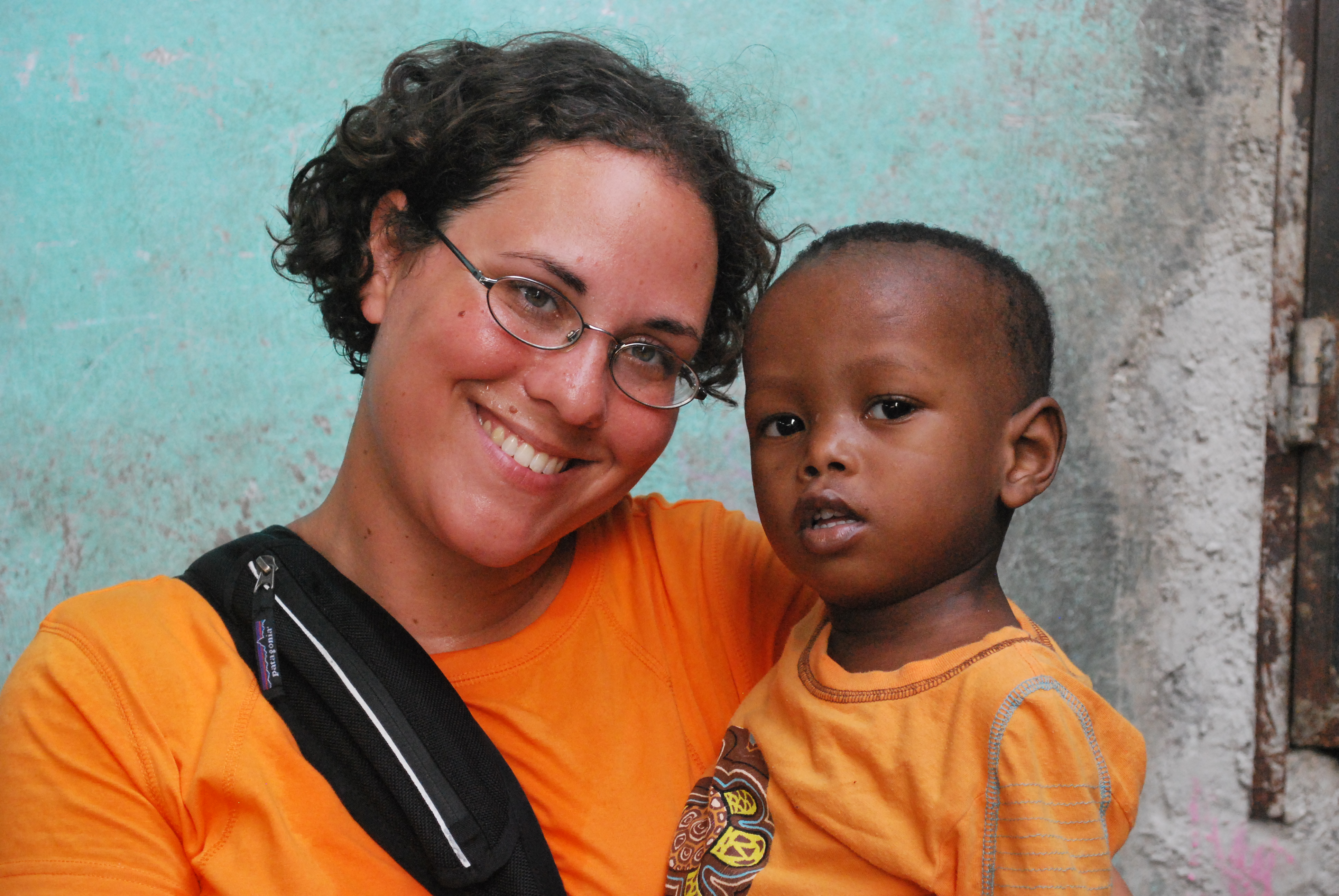
Within a few minutes I was carrying around a little two year old boy… the same one who attached himself to Kristen on her visits there. My heart melted as the warmth of our bodies created a silent bond of sweat. (Older kids, about 6 years old, put the younger ones on their shoulders to bring the babies to you to hold. It’s sweet and scary at the same time!)
As I held one boy, another would poke me in the back of the leg and go hide. He and I would lock eyes and he would run off to another place. And so, in this tiny little courtyard filled with children and carrying a two year old, I began to play a game of poke/chase with this older boy. (About five years old) It was cute to see his smile and the joy he got from being chased by a fat white man.
About 15 minutes of this go by. I’m laughing, he is laughing, the baby boy is laughing as I bounce him around, and my back is aching. Eventually I decide I can’t bear the pain of it any longer and sit on the steps leading into the main house.
The little boy who had alluded me while playing chase just sat down next to me and leaned against by big sweating body. He touched my head, bald and sweaty. He felt the hair on my arms. He kept leaning against me. It was a sweet moment. Then he took his t-shirt, filled with holes, and gently squeegeed off the sweat from my arms. It was tender and loving and I hoped a ball of sweat would land in my eye so I could release the tear building up.
As I rested and played with the antsy baby he and I just shared a moment where we were in one another’s presence. No words were shared… we just were together and silent among the swarm of activity.
Suddenly, he got up and went inside. We were sharing such a moment that I didn’t even think it was odd that he got up. He just got up. About a minute later he came back out of the house and sat right next to me… just like we were before. Except he had a picture.
When I saw the picture I lost it. Sure, I didn’t weep outwardly. But I wept inwardly and only allowed that one Cherokee tear to trickle out. I held those tears in for me. But maybe I also just held it together for him?
He reached out his arms and showed me a picture of his parents. It was worn and torn. It was faded. And whoever took the snapshot had somehow clipped off the top of his fathers face.
The photo was of his parents wedding day. The bride beaming, the husband standing proudly next to her, and the table before them filled with foods and a 3 tier wedding cake.
The boy made eye contact with me. Then pointed to his mom. Then made eye contact with me again. Then pointed to his dad. Then made eye contact with me again to make sure I was looking at his prized possession.
I understood. He understood. These were his parents. He was orphaned. His heart longed for a day when one of them would walk through the doors of the orphanage and take him home. And that day may never come.
And so, he and I sat, staring at the picture.
God answered my prayer in that moment. I don’t know why I felt like I needed to go to the orphanage that afternoon. But I did and this was why. As the little boy and I shared our presence he was able to know that he was not forgotten. Perhaps his parents had abandoned him or perhaps they had died… but he held onto hope.
The truth is that the orphanage scared me to my core. I never had it perfect as a kid but I always had a loving home to sleep in. My parents loved my brother and I. We never doubted it. And we both knew they would never abandon us. Through the toughest of times they took care of us before they took care of themselves. I never felt the way this boy felt. My empathetic pains were merely hypothetical. I couldn’t fathom his pain. But I could rest in the presence of sharing that moment with him.
One of the most biting things ever said about me was a pastor, early in my church experience, who said from the pulpit one morning, pointing right at me and asking me to stand up so he could use me as an illustration of his point, that he and the elders had labeled me a “spiritual orphan” in the church.
Those words punched me in the chest and I don’t know if I have ever recovered from that pain. I felt like I was part of that church community and they merely looked at me as an orphan. I knew those words didn’t reflect the words of Jesus… and yet I knew that I would never quite fit in again in that kind of church.
Perhaps, at the very core, that is the thing deep inside me that looks at the evangelical church and says… somewhere, deep at the core of who we are as a church… we need to reform?
You see, we are all spiritual orphans. We are all adopted by Christ.
Without the love of Jesus, we are all like that boy in the orphanage. We all are looking for a moment of presence. We are all holding on to an image of what a reconciled life will look like.