• Tech Tuesday Question – Social media, perceived anonymity, and future employment

    Tech Tuesday Question – Social media, perceived anonymity, and future employment

    GREAT content on social media and the issue of whether or not anonymous apps really are anonymous! I am giving a presentation to 1,000 college students with an emphasis on what future employers will look for when looking at social media posts. I’m also looking for info on how to prove to them that what they believe they’re posting as anonymous really isn’t.

    I found one of your posts to be especially helpful (Is that message private?)

    If you have other posts or sites that would be helpful about this, I would love to see them. Thanks again, Adam. Great content!

    — Kristin

    This is one of those pressing questions, right? Adults feel the need to provide some fair warning that college life is not real life and what’s cool in college might actually be detrimental to the reason they are at college. Meanwhile, college students stare blankly at an adult who they think speaks another language about their social life. I really think this is more about extended adolescence than specifically social media, but I digress. 

    With the popularity of so-called “anonymous” or “ephemeral” apps, it’s good to remind everyone from time to time that the only one who thinks these apps are private or anonymous are the users themselves. Snapchat isn’t anonymous. Nor is YikYak or Tinder or whatever.

    A few ways they are not anonymous:

    1. Your account is linked to your device ID, your phone number, your email address, or something that you use to sign-on. That points back to you.
    2. The app recognizes your device beyond your username and login info, often times recognizing unique identifiers.
    3. Most apps use geolocation, logging your general location based on your ISP info OR using the GPS function in your phone to pinpoint your exact location every time you access the app.
    4. Your phones carrier is logging your usage. (Text, data, messaging, voice calls, etc.)
    5. You can mask your identity but your language is a unique identifier. The things you talk about, how you talk about them, your phraseology, the way you spell/misspell words, etc. All of these things point directly back to you.
    6. Images you share often have metadata in them that point directly back to your device, geolocation, etc. Save an image to your computer, open in  basic image viewing software, and voila.
    7. As soon as you take a photo/video with your phone, you’ve already lost control of that file. Many phones backup your images directly to the cloud automatically. Even if that’s later deleted, it’s more likely just not shown to you but still in your account for a period of time in case you want to “un-delete it.
    8. As soon as you send an image/message/video to another person, you’ve completely lost control of what happens to it. They can do whatever they want with it, their device may or may not store it automatically, on and on.

    What does this have to do with employment?

    This is a complicated question because every employer and every hiring process is somewhat different. Likewise, boundaries between what’s acceptable, what’s normal business practice, and what’s legal in the hiring process are somewhat blurred lines.

    A couple of articles on the topic:

    Common sense tells you that there’s a difference between what companies are allowed to do in screening candidates for a position and what they actually do. Someone hiring a person is putting their own reputation and their future with the company on the line, so they are wise to do whatever they can to make sure their candidates are right for the company.

    A few things that an employer might want to know that aren’t on the resume:

    • Character qualities
    • Approximate age
    • Relationship status
    • Background
    • Hobbies, passions, attitude, and stuff like that

    Different employers are going to use different techniques to figure that stuff out. Some will figure that out in an interview or pre-screening phone call. But it’s easy enough to look at public profiles of a candidate on social media.

    Are most employers going to do a full-on investigation that might include seeing if they can find out what you did for Spring Break 2013? Probably not. But don’t be surprised that employers sniff around on your various profiles to see what kind of person you are.

    Expect it. 

    If you don’t have anything to hide than none of this matters.

    But this might mean you have some cleaning up to do, as well.


    Have a Tech Tuesday question for Adam? Submit your question on the sidebar of his blog.

     

  • My Favorite High School Graduation Speeches

    My Favorite High School Graduation Speeches

    Enjoy these five minutes of nerd fame. 

    Those five minutes when the smartest kid in the school demands to be listened to.

    Let’s start off with the basics…

    Let’s take it to the next level though, OK?

    This kid has a future… in stand up. 

    If in doubt appeal to what’s hot!

    Gotta toss in the selfie, right? (4:25)

    Good speech, she rushed it though.

    Slow it down next time homegirl.

    Ready for some nerd-introspection?

    Something tells me this isn’t the last time he used this object lesson. Something tells me the dude with the guitar gets more dates than the valedictorian.

    Blame Canada

    And just in case you thought only Americans gave funny graduation speeches, here’s Canada. Homeboy puts on a clinic. He solidly roast of every teacher in Prince Edward County, then does shout outs to every graduate, and even a nice little thought at the end. Something for the grandmas in the house.

    Taking it to the next level

    Future youth pastor???

    What’ve better than the very solid photobomb by the state of California? The finish. Strong! 

    Mic Drop – Whole ‘Notha Level

    Another future youth pastor… Pastor Mo’Dollas

    Pretty sure the first half of her speech was approved. Second half, freestyle. And clearly the camera operator been drinking.

    Is that dancing at a Christian high school? I’m not sure if the administration is just that cool or if they had no idea it was going to go like that. Either way, props to them.

    I suspect I’ll see Mo’Dollas performing at a student evangelism conference soon.


    9781942145097cover-squareShameless Plug Time

    Looking for a graduation gift for the teenager in your life? Check out The Amazing Next by Brock Morgan over at our store or Amazon. (Bulk orders at our store are great… order like 8 of them and we toss in free shipping.)


  • Youth Group isn’t THE Answer

    Youth Group isn’t THE Answer

    By now, everyone has heard about the latest Pew Research.

    Last Fall, I stood up at The Summit and presented complimentary data.

    “Youth Group” Reaches Few

    Programmatic “youth group” reaches 5%-10% of any given student population.

    But, in many churches, youth group is accepted as 100% of what the church formally does to reach teenagers.Anything else that happens is ancillary, at best, sometimes viewed as competing with the “real” youth ministry at the church.

    40+ Years of Data on Youth Group Returns

    While the youth ministry tribe generally refuses to do so, you can look at 40+ years of youth group data and come to an educated conclusion– youth group, in it’s current iteration, will continue reaching fewer and fewer teenagers.

    After generations of investment… investment largely backed by good will and not data… most reasonable people have come to accept that youth group, as we know it today, isn’t going to reach a theologically appropriate number of middle and high schoolers going forward.

    The answer to reaching more teenagers can’t be “Just keep going, go harder, be faithful and this strategy will work eventually.

    Less Money, Not More

    I feel like the town crier on this. I guarantee you that thousands of people will look at new data from Pew and try to use the data as a justification that their youth group needs more investment. We need better facilities, we need another staff member, we need a new stage or a band or lights or whatever.

    Hogwash. 

    Since the 1980’s the church in America has invested billions and billions of (tax free) dollars to rapidly expand facilities and staff at local churches.

    And what’s the result? We’re reaching fewer than ever. Why? That’s for smarter people to debate, I’m sure there are lots f reasons, the video above outlines a couple of things I think.

    S2P4 Adam McLane.007

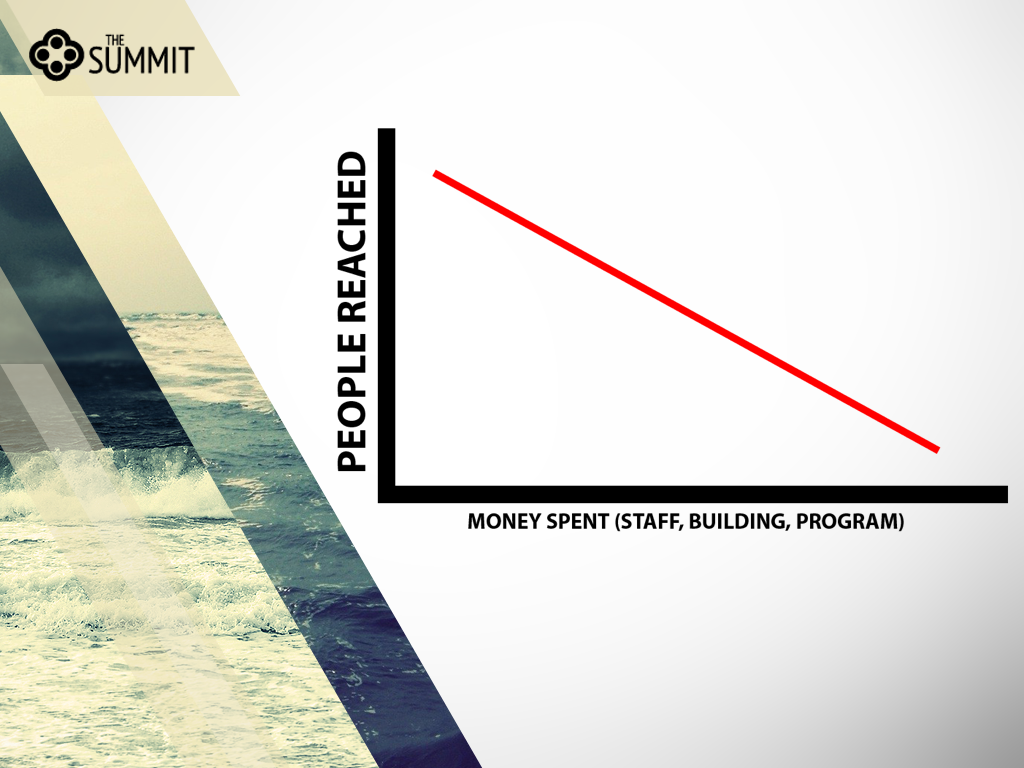
    But I do know that when the U.S. church is compared to places in the developing world where the church is growing that there’s an inverse relationship between the amount of money spent and the number of people reached: The more money you spend on buildings and staff, the less people you reach.

    To Americans this seems counter-intuitive, but this is the trend nonetheless. 

    U.S. churches have near limitless resources and reach fewer and fewer people.

    Many places around the world have no or almost no financial resources and reach more people.

    That’s not an indictment on the people doing the ministry. That’s not an indictment on the effort. But it is an indictment on the one-size-fits-all approach.

    It. doesn’t. work.

    It. never. worked.

    Stop. the. insanity.

    Where Do We Go From Here?

    Don’t mis-read this. I am saying that we need to give up on youth group as the solution to ministering to teenagers at your church.

    Absolutely. We need to deal with the fact that youth group is A solution. It’s not THE solution.

    Youth group pretty effectively reaches 5%-10% of the communities teenagers. Let’s keep doing it, let’s keep making it better. (Obviously, so much of what I do on a day-to-day basis resources youth group’s around the country.)

    I am not saying get rid of youth group or youth ministry is dying or whatever.

    But we need to shift our priorities. 

    Schedule a meeting today and start thinking about how you can activate the adults in your church who already have a natural connection to teenagers outside of youth group to minister to teenagers. Create something that isn’t an invitation to come to a room, sing some songs, listen to a talk, etc. 90% to 95% of teenagers in your community have heard about it and rejected it.

    Create something that doesn’t require a staff or a facility.

    Create something that any adult can do to minister to a single teenager on their block.

    Unleash 100 ideas.

    Try something different.

    Experiment.

    Track your data.

    Make decision based on data, not emotions.

    Pretty please with sugar on top.

    I double dog dare you.

    I’m begging you.

    Try something else.

    You aren’t the problem, you’re the solution.

    Allow it. Encourage it. Champion it. Celebrate it.

    And then come tell us about it. 

  • Transitions

    Transitions

    I know what you’re thinking. You saw the title “Transitions” and you instantly thought… “Holy crap, Adam is transitioning?

    Nope. And I didn’t buy those transitions lenses for my glasses that adjust to the sunlight either.

    In the past year or so I’ve really started to think of the youth ministry tribe as a people of transition who minister to people in transition.

    Why? Because at least once per week I hear from someone who is changing jobs for a wide variety of reasons. And unlike a lot of other tribes… when you change jobs in youth ministry that almost always means a change in everything… where you live, what your role is, sometimes what denomination you’re affiliated with, where your kids go to school, on and on. Transitions are big and dramatic in youth ministry.

    But they aren’t really talked about much outside of the people actually transitioning.

    When Transition Comes About

    10-15 years ago you heard about train wrecks of ministry transitions. We’ve all heard horror stories:

    • 10 years of ministry at a church and you get a letter on your desk from the board… not even a face-to-face conversation.
    • Churches who fire people quickly, not allowing for closure.
    • People asked to sign contracts for final paychecks… being “forced to resign.”

    Each person in youth ministry could share a stories of people they know that stuff like this has happened to.

    I share that not to expose anything but to point out that it seems that there are fewer of these horror stories happening, at least in the circles I run in. Instead, I’m seeing the same amount of transition as before… just less hostile.

    Sure, when people get fired they are always surprised by it. They are always (initially) convinced they’ve been wronged. And they very rarely have the ability to see what contributed to it. They just know they have a massive problem (they need a job) and they feel a sense of relief. (A sign they knew deep down it wasn’t  going well.)

    Here’s a few categories of transition that I see most often:

    Transitions for Fit

    Perhaps the most healthy transition I hear about is simply fit. Sometimes an organization intentionally hires a square peg for a round hole. But, as a professional square peg, being that odd-man-out wears on you. It might be appreciated in a high-level kind of way. The kind of way that will push an organization to think differently or see things they don’t want to see. But these are rarely long-term… it’s just exhausting for everyone. (Presbyterians hiring Southern Baptists or bringing in a relational youth worker at a highly programmatic church.)

    I think it takes a certain level of maturity in the individual to recognize that their ministry isn’t a good fit for their giftedness, theology, etc. It’s brave to step away for this reason if that’s the real reason. (“Fit” has also become a blanket term, right?)

    Transitions for Stage of Life / Stage of Family Life

    It’s really hard to stay in a ministry through various stages of life. A lot of people start off in youth ministry as a single young adult. But it gets harder as you move into different stages of life. You get married and you don’t want to spend 24/7 focusing on your job. You have a kid and you realize that your ministry isn’t just your job. Your kids get a little older and you start think… “Do I want to raise PKs?” Then you think, “Do I want to have my kids in my youth group?” Then you think “How the heck am I going to pay for college on this salary?” Then you think “My kids are starting families… can I still do this?

    At each of these waypoints and a lot more should be a true reality check for you. The simple fact is that there are very, very few ministry positions that’ll work out for all stages of your career. That doesn’t mean those are bad places to work, it just means that there’s no shame in looking at how you’ve changed or how your circumstances have changed and embracing the reality that sometimes you transition because of a stage of life.

    Transitions to Deal with Failure or Conflict

    Failure and conflict are two of the biggies in why people transition. There’s an unfortunate irony that the hardest jobs in ministry usually go to the least experienced and least trained. Church plants, walking into small and older congregations, etc. But the simple reality is that both failure and conflict (usually inter-related) happen at every type of ministry.

    A lot of transitions happen because you didn’t deal with failure or failed so badly that they had little choice.  (Could be a moral thing, but could also just be a failure to execute your job.)

    It takes some time and maturity to admit when you did a bad job. Just remember that failing at a job doesn’t make you a failure. Failing to learn from failure and repeating it over and over again? That’s what failure looks like.

    The other side of this is transition because of conflict. Mismatched expectations or personality conflicts or any number of other factors can produce conflict that you can’t manage to resolve. And so the sad reality is that people who preach reconciliation cannot reconcile and someone has to go. (You!)

    Patience

    I like hearing people use the phrase “transition” to describe job change because the word itself is about patience and implies a certain level of discernment.

    If I were to offer advice to people considering a transition… or maybe a transition has been considered for you… it’s this:

    • Be as patient about it as you need to make a decision.
    • When you decide, act swiftly. It’s not good for anyone to drag things out.
    • Make space for healing. Even the most healthy job changes require a period of healing. Leaving a job one week and starting the next in a few days isn’t doing anyone a favor.
    • Leave well. Even when you get hurt, leave well. Take the high road, be the bigger person, be professional… whatever phrase you need to latch onto, do it.
    • Involve outsiders. Sometimes you’re too close to the situation to be able to see clearly. I’ve seen people leave great jobs that are perfect fits for them because they just hit a hard period and gave up. You’ve got to see the big picture sometimes and you can’t do that alone.
    • Laugh a lot. It’s just a job.
  • Throwback Thursday – 2007

    Throwback Thursday – 2007

    This is a doozy of a Photoshop job, circa 2007.

    Lesson: Affiliations matter. 

    When YMX joined Gospelcom in 2007 it was a little deal that was kind of significant. The truth is that joining a small affiliation of Christian websites meant very little to us as a company. But the impact of an affiliation with a more recognizable, trusted brand, communicated something bigger to the Christian community.

  • The Value of Attention

    The Value of Attention

    If you want to know what’s important to a person…

    1990s answer — Look in their checkbook…

    checkbook register

    and follow the money. Where a person spends money shows what they really value.

    2000s answer — Look at their calendar…

    Google Calendar

    and see where they spend their time. Where a person spends their time shows what they really value.

    2015 answer — Look at what they pay attention to…

    obamas-on-phone

    and you’ll see what they value. Where a person’s attention is at is what they care the most about, regardless of place or time.

    The Power Shift

    Those old adages are no longer true, particularly when it comes to younger people. (Teenagers and young adults.)

    They have little control of where they spend their money. We no longer live in a country where most teenagers and young adults have jobs. What disposable money they have is more likely to come from their parents or debt than from money they’ve earned. Largely, what money they have is already spoken for. Consequently, what they spend their money on has less and less value.

    They have little control of their schedule. Schools, sports, after school activities, social responsibilities, church & service expectations, and an incredible amount of newfound travel accessibility means that people’s bodies are busier than ever… But going places and doing things just doesn’t have the same value that it once did. Going on a big trip, going off to college, or even going out to dinner with your family– all are less of a big deal than ever.

    Today’s teenagers and young adults have almost no control or choice over their schedule… and consequently, it’s value to them means less.

    So what’s the most valuable thing today? 

    Attention. 

    Here’s the thought process– you’re likely doing it and haven’t even thought about it…

    I will go somewhere I’m forced to go, say to school or watching a movie on the couch with my parents Friday night– but being there doesn’t ascribe value to that activity because you you can’t make me pay attention. Being there and paying attention are two different things. One I have choice over and the other I don’t.

    Attention is my choice.

    Where I go is irrelevant.

    Doesn’t really matter if I have money.

    I will pay attention to what I want to pay attention. That’s my choice.

    Welcome to the Attention Economy

    Consequently, things that get our attention have the most value in our society.

    • Why is Snapchat valued at $10 billion without a real revenue stream to back it up? Attention.
    • Why are presidential candidates jockeying for the perfect announcement? Attention.
    • Why does ISIL have power? Attention.
    • Why do people look at their phones in the middle of the sermon? Attention.
    • Why do brands do outlandish things like give away their product on a specific day? Attention.
    • Why do app developers build in like buttons, push notifications, and other tricks to trigger your brain to release dopamine? Attention.
    • Why are you reading this right now instead of working? Attention.

    In 2015, if you want to make money. If you want to impact change. If you want to gain power.

    You have to get people to give you their attention.

    Take my money.

    Take my freedom of movement.

    But only I will know if I give you my attention.

    Unlike money, unlike place, unlike time… my attention is finite. It’s limited and what I pay attention to is is my choice and shows what I value.

    Ruh Roh, Shaggy

    83206ae67da70662c246b9cca0b92d2da77cae199a14e8d23e102739d5192b2e

    Buy you know what? The flip side is also true.

    I might be physically present. I might give you money. But that doesn’t necessarily mean anything.

    You’ll know I value something by what I pay attention to.

    Thought Questions

    1. In what ways is this true or false in your line of work?
    2. Do you agree that money and time have less value?
    3. If this is true, what needs to change for your organization to accomplish it’s goals?
    Photo credit: See it in my eyes by Adriana Cecchi via Flickr (Creative Commons)
  • Cool Church

    Cool Church

    “You can’t make yourself cool. You can’t buy cool. You’re either cool or you aren’t. The harder you try to be cool, the more you look like a dork.”

    I don’t know if someone told me that in 9th grade or if it’s from an episode of Saved by the Bell or maybe it was from Family Ties?

    Either way, it’s a good starting point for my point: Please stop trying to make church cool.

    I know how it gets started…  you go somewhere… say an amusement park or concert or conference or even watch a TV show… and something cool happens. In the moment you are overcome by the cool factor and you make a mental note.

    Then, let’s say in a planning meeting or a staff meeting, an idea pops in your head… “Hey, that cool thing happened on stage, our church has a stage, we could do that cool thing in church!

    When you do that you break Rule #1 of Being Cool: The harder you try to look cool, the more you look like a dork.

    I’m not saying it’s impossible to do something cool in your role at church. But I am saying that it’s pretty tough when you start from a place of copying something cool.

    Rob Bell? Dang, in his prime that was one cool cat. He was doing things in a pulpit no one had seen before. He was a Charles Finney level game changer. He was cool.

    But the next hundred people who wanted to try to be like Rob Bell? Not cool.

    You go to a conference and see $100,000 in lighting effects and think, that’s cool. So you go home and try to do the same effect with $500 in lights. Not cool.

    You go on a date with your spouse to see see a comic. This professional comedian tells a bunch of jokes and takes the audience somewhere to talk about something really deep and you think, that’s cool. You go home and add jokes into your next message– you get 3 jokes in and you realize– not cool.

    You Are Not an Entertainer

    At the core of this [somewhat natural] desire to be cool is a misunderstanding of the role of a minister in the life of the individual and congregation.

    Whether you are a youth pastor, senior pastor, worship pastor, kids pastor, executive pastor, small groups pastor, church planter, missionary, whatever: You are a minister of the Gospel and not an entertainer. 

    Comparing your work to that of an entertainer is not going to lead you to a healthy place. Instead, it’ll lead you to confusion, and frustration. You didn’t go into ministry to be an entertainer, did you?

    The word “pastor” relates to a rather humble and straight-forward role of a shepherd. Like with sheep or goats– more cowboy than anything. Even in an age where everything is back-to-the-farm, most real-life shepherds aren’t cool.

    I’ve never seen a title: “The Most Entertaining Shepherd in the World.

    That’s why it’s so weird to see pastors trying to be entertainers. It’s a misunderstanding of your role in a person’s life.

    People come to your church looking for (and needing) a shepherd.

    See, my family has enough entertainment. What we don’t have enough of is shepherds. We don’t go to church for a laugh or have our face melted off by a band. We go to church to worship in community, to gather together with fellow believers.

    We need ministers to minister to us.

    Really, the last thing we need is more entertainment.

    Your Message is Important

    Scariest of all? With the American churches desperation to be seen as cool we’ve become infatuated with what’s hot instead of what’s important.

    I think that many churches, particularly non-denominational evangelical congregations, have gotten unmoored from millennia old traditions and are just floating out there in a sea of felt need.

    Instead of being informed by a liturgical calendar they are informed around their needs and what they perceive to be the needs of people in the congregation or community. I don’t think there’s any ill-will or intention to do anything other than serve the community. But I do think that felt needs get old.

    The course is actually easy to correct. Just stop trying to be cool and be a regular, old-fashioned, weird church.

    And, what’s hilarious in all of this? The more we give up trying to be cool and go back to the “old, uncool way” the cooler we’ll likely become.

    Because just like the end of every after school special taught us: The coolest person you can be is your real, authentic self.

  • Parenting in an Online World

    Parenting in an Online World

    A couple weeks ago I had the opportunity to record a podcast with Rhett Smith, a friend, Texas therapist, long-time youth worker. His book, The Anxious Christian, has been extremely helpful in our home, helping us understand the role anxiety plays within ourselves and our kids.

    In this extended interview Rhett brought out many good points and nuances. If you’re trying to figure out how to integrate your families digital life into your home, I think you’ll find this show helpful.

    Show Description

    I first got to connect with Adam McLane when we were driving through the Dominican Republic, and across the border into Haiti. It was only about a month after the devastating earthquake that hit Haiti, and we were part of a youth ministry team that went down there (though as Adam points out, it was more like a bunch of youth pastors and me — a therapist). Over the course of those last five years I have had the opportunity to really connect and get to know Adam better, as well as speaking at his initial Summit in 2012, on the topic of, The Anxiety of Teenagers.

    But in the last 5 years Adam has become one of the leading experts on youth and technology. In August of 2013, Adam’s expertise really gained attention when his blog post, “Why You Should Delete SnapChat” went viral. But don’t mistake Adam for some kind of anti-tech Luddite, rather he is a very thoughtful, thinker on technology and how it shapes our lives. And one of the things I really like about Adam when talking to him about technology, is that he’s not one to just lay down rules and put tech tools into action, rather he really encourages the consumer of tech to think about how they use their technology, and how they can create “sacred spaces” and practice sabbaths in their lives.

    In this episode Adam and I dive deep into the work of Danah Boyd, and more specifically her latest book, It’s Complicated: The Social Lives of Networked Teens. It’s a great book, and Adam recommends that all parents buy the book, if only to read the first chapter. We also explore bullying and cyberbullying and how what takes place online is most often modeled offline.

    We also explore the issue of trust between parents and kids, and talk about why Adam doesn’t recommend filtering or monitoring devices on computers. One of Adam’s concerns that he addresses is that too often parent’s turn over their parenting responsibilities to devices, rather than to help their kids think critically about how they engage technology. This was a fun conversation, and ultimately, I think both Adam and I mourned a little bit the loss of a lot of the freedoms that we had as kids (taking off on our bikes and being gone all day; cruising; loitering, etc.), but that kids today don’t/can’t experience (Danah Boyd’s work explores this cultural shift). This episode is for any of you who use technology (which is you if you are reading this). So whether you are a parent, or not, I highly recommend listening and discovering how you can more thoughtfully consume technology in your own life.

    Show links

    Rhett Smith

    Podcast episode on iTunes

  • What Haiti Taught Me About Nepal

    What Haiti Taught Me About Nepal

    Tony Jones wrote this:

    A standard issue in theodicy has been an attempt to protect the sovereignty of God. Consider that theological shorthand for the omni’s: omnipotence, omniscence, and omnipresence. Combine that with God’s benevolence and immutability, and you’ve got a divine being who’s a lot closer to Plato’s Nous than to Moses’ Yahweh.

    What if, instead, God is traveling through time with us?

    What if God abdicated all the sovereignty so as to give creation room to flourish?

    What if God is in a dynamic love-relationship with us, and both we and God are being changed as a result?

    If this is the case — and there’s ample biblical evidence that it is — then the earthquake in Nepal caught God by surprise. God is neither planning earthquakes nor sitting back and allowing them to happen. God is a victim of the earthquake because thousands of God’s beloved children perished.

    – Source

    For some folks, Tony is a troublemaker, some would even say he’s dangerous.

    But I think that’s because they don’t know him. I don’t claim to be close to Tony, but we’re acquaintances enough where I frame Tony more as an instigator than a troublemaker. (If you’ve met him you know he isn’t dangerous. Professorial? Yes. Dangerous? Nah.)

    He asks and says things that need to be said in a way that demands to be heard. He forces folks to think about what they’ve been taught and challenge assumptions, and in an age where everyone is circling the wagons around what they believe that’s a very good thing.

    I like the way Tony thinks and stirs me even if I don’t always agree. (Let me be blunt: I don’t want to be friends with only people I agree with. That’d be boring.)

    So, given what I know about Tony, his work, and even his most recent book– his post today didn’t take me by surprise.

    But I disagreed with him to the point where my Facebook comment stretched into 600 words… which is more of a blog post than a Facebook comment.

    Here’s my response for Tony, one that I don’t think he’ll be uncomfortable with and am positive he’ll dismiss as just a typical evangelical’s response: I think God’s ways are bigger than our ways. He acts at a level our processors can’t handle… And yes, He can even author an earthquake for His glory because He’s all those omni’s without the constraints of our philosophical limitations.

    He’s big enough for us to describe His actions as evil.

    And He’s “omni-enough” to be patient for us to get it.

    God is no more afraid of being blamed for what we perceive as evil than He’s excited about being constrained to the rigors of 20th century systematic theology’s attempt to define Him.

    My respectful disagreement isn’t born merely in my far-less-educated study of every theological vantage point.

    It’s informed by having walked down the same path already and allowing my experience to correct my incorrect thinking. (Something I believe would be good for Tony, as well.)

    The Surprise of Haiti

    I must confess that I wrestled with Tony’s concept in the aftermath of what happened in Port-au-Prince in 2010. Hearing about what happened and the wall-to-wall post-Earthquake television coverage shook my walk with God more than I was willing to admit in the moment. As news continued to roll in that the death count was thousands, then tens of thousands, then hundreds of thousands I started to doubt that God was truly good. In the aftermath I was left with big, gaping holes in a matter-of-fact, indoctrinated evangelical theology, kind of way.

    For lack of a better term– God disappointed me with what happened in Haiti.

    I was left blaming God because that’s where my theology lead me– then I quickly forced myself to walk back because I know God is ultimately good and benevolent and cannot, by His very nature, also be the author of something so tragic as mass loss of life. It was all so senseless.

    So I get what Tony is writing about. I really do… I don’t want to “blame God” for an earthquake because it just feels so un-God-like of Him. Morally speaking, blaming God for a natural disaster just feels wrong.

    But that changed when I went to Haiti.

    Walking among the rubble, seeing destruction no TV camera could convey, smelling the death still hanging in the air, I remember looking out the window of our beat-up white minivan and wondering to myself… “No… really… How could a loving God allow this to happen?” and even bigger “Where was God in that moment? Because He surely wasn’t here.

    As a witness I was left wondering if God was even there. But when we got out of the van and started talking to people, I realized that my judgement was grounded in assumptions about what was going on, not what was going on when you really talked to people and listened.

    The answers to those minivan questions took my breath away. Over and over again as we heard stories… our minds were blown to learn that He was right there with people, some of whom were believers but most of whom were not.

    God wasn’t surprised by the Haitian earthquake in 2010. Yes, many died. But even more were saved. Over and over again we heard people’s testimony that in the moment… literally with everything falling around them… they heard the voice of God. We heard testimony from people who can’t explain how they escaped, that they were picked up and carried out of a collapsing building.

    We met common people who had uncommon encounters with God that day. God wasn’t surprised. God wasn’t absent. He was fully present because that’s is, by His definition, who He is.

    More than five years after the earthquake in Haiti– the rubble is long gone. But what has endured is the revival that was sparked by the earthquake. To outside eyes it looked like an unloving God was responsible for the senseless loss of more than 200,000 people. But to people on the ground? I’ve heard five year’s of testimonies from people in Haiti that the earthquake was the closing of one chapter of a nations relationship with God and the beginning of a new one.

    As hard as it is to understand with humanity– usually the death of one thing leads to the birth of something new– new life was born out of death in 2010. We see it all the time in life’s great hardships. (Loss of a child, loss of a relationship, loss of a loved one, loss of an identity, on and on.) Death brings forth new life. It’s this universal expression of the Gospel which points us to an ultimately loving, knowing God who operates in dimensions we simply can’t comprehend.

    In Haiti… this is what you’ll hear from Christians and non-Christians alike:

    Where did people run to and find food and shelter in 2010? The church.

    Who was there to help? Christians.

    In the aftermath, who came down to help after the NGOs left? North American Christians.

    Who has continued to help re-build and now plant new churches? North American and Haitian Christians.

    Who is now sending missionaries to remote areas of their own country, neighboring islands, and even the United States? Haitian Christians.

    To quote a friend of mine, Sister Mona at Good Shepherd Orphanage in Carrefour, “The earthquake was a wake up call.

    In the aftermath of Haiti no one would have blamed Haitians for seeing only darkness and despair. But what actually emerged? Hope and new life.

    In closing, I don’t claim to know what’s going on in Nepal. But my experience in Haiti over the past five years has confirmed for me, beyond my own comfort level, that God was not surprised by the earthquake in Nepal.

    He was right there, loving His children like He always does.

    My hope and prayer for Nepal is the same today as my hope and prayer was for Haiti in 2010: That the Author and Finisher of all things, life itself, is revealed through the earthquake and it’s aftermath.


    Get Involved

    Tony ended his post by linking to some resources to get involved with Nepalese relief efforts. Here’s the link.

    If you want to get your church or youth group involved in World Vision’s relief efforts, here’s the link.

    And if you would like to learn more about taking a team to Haiti, to be a part of the work I described in this post, fill out the form below.

    [gravityform id=”10″ title=”false” description=”false” ajax=”true”]


  • An Ecosystem for Success

    An Ecosystem for Success

    Why are some organizations so successful while others try really hard but never seem to get there?

    Or, when something successful does come along, why doesn’t it last?

    Why do successful people leave?

    These are big, important conversations for every organization. Every organization.

    Your local bank, taco shop, church, school, and even– maybe oddly– sole proprietorships. (Yes, you can quit working for yourself!)

    Success Versus Long-term Success

    Long-term success is rarely an accident. I find it’s more frequently the byproduct of an ecosystem. Happy, highly motivated, and well-rewarded people are just doing what they are doing… working hard and living life… and success just kind of happens.

    I can’t tell you how many times I’ve been in a successful organization and asked “Why is this success happening?” and no one can tell me why it’s happening. It just is. That’s because the success they are part of is an entire ecosystem where success on a product/program/people isn’t the aim, it’s the byproduct.

    The flip side is that when you see an aberration, success happening in an otherwise not-very-succesful environment, and you ask the same question people often point to something identifiable. (A person, a program, or even an outside force such as a population they are serving.) That’s because this type of success isn’t a byproduct of a healthy ecosystem, it’s the product of the moment.

    Control and Power

    Last week, I shared a video of a presentation I made at The Summit last Fall. I’ve given versions of that talk over and over again. What’s interesting to me is that when I deliver that talk I’ll hear “Amen” and lots of people will nod their head that what I’m saying is absolutely true.

    So why don’t things change? Why is youth ministry nearly wholly focused on reaching 5% of the population of teenagers?

    I don’t know the answer to that question. I wish I did.

    But I know it has something to do with power— youth workers often don’t feel empowered to do what is necessary to reach and/or exceed the expectations put on them.

    And I know it has something to do with control— youth workers often times aren’t equipped to create their own ecosystem, so most of what happens within their area is out of their control.

    Questions

    • What are examples of healthy ecosystems that you’re aware of where success is the byproduct?
    • What’s the ecosystem like where you work?
    Photo credit: Micro Ecosystem by Pierre Pocs Photography via Flickr (Creative Commons)