Search results for: “good news”

  • 5 Ways to Build Intrinsic Motivation in Students

    Fear is a short-term motivator
    Photo by marysia via Flickr (Creative Commons)

    Fear is a short term motivator.” That was the first lesson in my first class on managing people. As a 21 year old manager of a staff at a health insurance company in Chicago, this was a valuable lesson for me. Most of my subordinates had either been with the company 25+ years or were right off the street, having never held a job more significant than McDonald’s or making license plates in the state pen.

    That lesson stuck with me as I entered into vocational youth ministry. One youth ministry professor drilled into me that big things happen in students lives when we shift the focus from extrinsic motivation to intrinsic motivation. In other words, as faith develops from a childhood faith where rewards motivate students to learn and begin to grow into an adult-like faith, we need to shift motivational strategies so that they will continue to grow because of something inside of them spurring them to learn and grow.

    Question: If fear doesn’t work long-term and external rewards (pizza parties, badges, trips) are decreasingly effective as adolescence progresses, what are intrinsic motivators that work with students in youth group?

    Here’s 5.

    1. Ambition – Remember this Super Bowl commercial from Monster.com? Every student is full of ambition. One way to motivate students is to tie their personal ambitions, self-talk & delusions of grandeur, into Gospel-oriented purposes. When you connect the dots that a life with Jesus could be a fast-track to what they dream of doing with their life, that creates fusion.
    2. Disdain for past failures, family patterns – Disdain is different from fear in that disdain towards your current condition has a repelling reaction. I’ll never forget when I figured out that living a life focused on my relationship with Jesus would help me navigate away from the shame of my personal failures and the gravity family failure. Deep inside I knew I didn’t want that to happen to me. Together that made living as a sacrifice to God more attractive. No sacrifice was too great if it meant I could avoid repeating the things I was most ashamed of and potentially have a more steady family in the future.
    3. Self-improvement – This is similar to ambition but even more internal. I’ve had many students over the years who have a strong, innate desire, to better themselves. They want to learn. And they want to maximize their impact on others. Tapping into that desire to self-improve by laying out how x will make them better at y has acted as an easy way to motivate students. They already want to grow! You are just giving them an avenue for growth to occur.
    4. Serving the greater good of society – So this isn’t exclusively a Christian motivational technique. Yet clearly, there is something in adolescent culture today that seeks to live out lives of justice, mercy, and compassion. In recent years I’ve learned that service projects are easier for students to invite their friends to than fun outings. Why? Because for lots of people public service has been ingrained in them as valuable and they like how serving makes them feel. It becomes your job, as their leader, to clearly make the tie between acts of service and the Gospel being good news to the less fortunate among us.
    5. Joy of doing what is right – We are all born with a conscience. It is shaped by culture with an innate desire to do what is right and avoid what is wrong. Helping students navigate those waters, in a practical and guilt-free way, is a powerful motivation for sticking around. Just like our conscience happens on the sub-conscious level… when you can connect the dots between the right they desire to do and Biblical truth for why they should do that, mountains move in students lives.

    What are intrinsic motivators you are finding work with your students?

  • You aren’t going to change

    On Evolution, Biology Teachers Stray From Lesson Plan

    Researchers found that only 28 percent of biology teachers consistently follow the recommendations of the National Research Council to describe straightforwardly the evidence for evolution and explain the ways in which it is a unifying theme in all of biology. At the other extreme, 13 percent explicitly advocate creationism, and spend at least an hour of class time presenting it in a positive light.

    That leaves what the authors call “the cautious 60 percent,” who avoid controversy by endorsing neither evolution nor its unscientific alternatives. In various ways, they compromise.

    Read the rest

    Here’s the kicker to the article: (read carefully)

    But Dr. Moore is doubtful that more education is the answer. “These courses aren’t reaching the creationists,” he said. “They already know what evolution is. They were biology majors, or former biology students. They just reject what we told them.

    No doubt this article will make a lot of Christians chuckle. As a whole we aren’t big fans of evolution, nor are we fans of the compulsory indoctrination of children to the theory.

    In truth– we should cringe at what this reveals about our condition in youth ministry. We do the same thing.

    Just like schools can’t get biology teachers to teach evolution the way the government requires, we often refuse to change the ways we minister to students. Just like America’s biology teachers, we can read study after study or attend seminar after seminar… but we are ultimately going to teach the way we want to teach using methods we want to use. To quote the article, “They just reject what we told them.

    If it was good enough to reach us, it must be good enough to reach today’s teenagers. Right? Wrong.

    Truth + human behavior = no change

    • I could overwhelm you with evidence that your communication methods are ineffective. And you wouldn’t change.
    • I could show you longitudinal research proving that your programs don’t deepen a students walk with Jesus. And you wouldn’t change.
    • I could prove, from your own experience, that other methods of teaching Biblical truth could deeply impact your students. And you would not change.
    • I could show you study after study that shows that the way you do youth ministry reaches a decreasing percentage of students in your population. And you wouldn’t change.
    • I could point you to studies which show how certain types of strategies affect long-term change while others seem like they affect long-term change but ultimately don’t. And you wouldn’t change.

    That’s not how change works. You and I don’t change for rational reasons. We say we do. But we don’t.

    You can’t expect change from people who won’t acknowledge their failure.

    Some of you will read that list above and say… “But if you showed me that evidence, I’d change.” No– you probably wouldn’t. You might say you will. But if I come back to you in six months you’d fill my time with excuses.

    • This is a big organization, it takes time to turn the Titanic. (True, but it sank in just a few hours.)
    • I couldn’t convince leadership to make any of those changes. (Um, and they call you a leader?)
    • We already had a plan when we learned those things, but we are planning on implementing them this summer. (Really? I bet if the internet broke in your building you’d get it fixed today.)
    • I want to do things differently but we run this ministry as a team. (Consensus is the way to go. Just ask the federal government how that’s working for them.)

    Change is intrinsic. That’s why extrinsic evidence is often a waste of brain cells.

    You won’t change who you minister to until something changes in your heart. You won’t change how your programs work until something changes inside of you. Your behavior won’t change until you take the time to internalize who you are, what you believe, why you do this, and count the cost of change.

    Take a moment to read this from Alcoholics Anonymous. They deal with the same problem every day. Change starts inside of you!

    Each of us in youth ministry is faced with the same challenge. We are called by God to help adults form meaningful connections with adolescents. And we are called to go and reach students with the Good News of Jesus Christ.

    Will we continue to do things the way we have always done them and watch the church reach 8% of the population. 7%, 5%, 2%… 1%. Or will we snap out of our trance, look in the mirror, and make the changes in ourselves needed to reverse that trend?

    “Wake up, sleeper,
    rise from the dead,
    and Christ will shine on you.”

    Ephesians 5:14

  • A faith that costs you nothing is worthless

    When Jesus had called the Twelve together, he gave them power and authority to drive out all demons and to cure diseases, and he sent them out to proclaim the kingdom of God and to heal the sick. He told them: “Take nothing for the journey—no staff, no bag, no bread, no money, no extra shirt. Whatever house you enter, stay there until you leave that town. If people do not welcome you, leave their town and shake the dust off your feet as a testimony against them.” So they set out and went from village to village, proclaiming the good news and healing people everywhere. Luke 9:1-6

    You will be hated by everyone because of me, but the one who stands firm to the end will be saved. When you are persecuted in one place, flee to another. Truly I tell you, you will not finish going through the towns of Israel before the Son of Man comes. Matthew 10:22-23

    On hearing it, many of his disciples said, “This is a hard teaching. Who can accept it?” Aware that his disciples were grumbling about this, Jesus said to them, “Does this offend you? Then what if you see the Son of Man ascend to where he was before! The Spirit gives life; the flesh counts for nothing. The words I have spoken to you—they are full of the Spirit and life. Yet there are some of you who do not believe.” For Jesus had known from the beginning which of them did not believe and who would betray him. He went on to say, “This is why I told you that no one can come to me unless the Father has enabled them.” From this time many of his disciples turned back and no longer followed him. John 6:60-66

    When Jesus heard this, he said to him, “You still lack one thing. Sell everything you have and give to the poor, and you will have treasure in heaven. Then come, follow me.” When he heard this, he became very sad, because he was very wealthy. Jesus looked at him and said, “How hard it is for the rich to enter the kingdom of God! Indeed, it is easier for a camel to go through the eye of a needle than for someone who is rich to enter the kingdom of God.Luke 18:22-25

    When the members of the Sanhedrin heard this, they were furious and gnashed their teeth at him. But Stephen, full of the Holy Spirit, looked up to heaven and saw the glory of God, and Jesus standing at the right hand of God. “Look,” he said, “I see heaven open and the Son of Man standing at the right hand of God.” At this they covered their ears and, yelling at the top of their voices, they all rushed at him, dragged him out of the city and began to stone him. Meanwhile, the witnesses laid their coats at the feet of a young man named Saul. While they were stoning him, Stephen prayed, “Lord Jesus, receive my spirit.” Then he fell on his knees and cried out, “Lord, do not hold this sin against them.” When he had said this, he fell asleep. Acts 7:54-60

    If I am laying my life on an altar… what is the sacrifice? What is the cost? What are people testifying about my life? Am I doing things worthy of a stoning?

    Or am I just standing around, being religious, holding the jackets while my friends stone someone?

  • Moving towards the polite middle

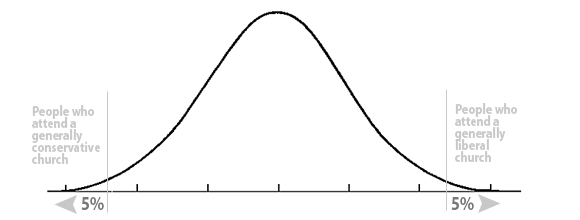
    As I think about the church and the 5%-10% of people we reach in the community I wonder where we fall on the bell curve.

    Something tells me that it looks a little like this.

    I wonder if the positions we take attracts, appeals to, and connects a certain type of people? And I wonder if church leaders are going for the sucker pin of thinking of going more conservative (politically/socially/by American cultural definitions) or more liberal is going to lead to growth in their congregation? However, this is counter to what we know about behavior from the bell curve. This just means that to attract more people “like us” we need to have a wider reach and draw people from a larger and larger geographic area.

    Sidebar: Now, immediately I have some people who will read this upset because they don’t really like my labels. And they especially don’t like that I’ve lumped nearly all churches into two categories. And some are going to be quick to point out ways that their church is neither liberal nor conservative. That’s OK. This is just some generalization and hyperbole to make a point.

    Here’s my neighborhood on the bell curve. Again, full of hyperbole and generality.

    Our neighborhood is not unlike any other urban or suburban neighborhood I’ve lived in. We have our cooky people on the fringes, we have our people who are just a little bit political, but who will quickly drop it for the sake of community… and we have the vast majority of people who probably have some personal opinions but just want the neighborhood to be a nice place to live, are willing to politely disagree on some stuff, and otherwise would rather be defined by their neighborliness than their political leanings.

    Think strategically church leader!

    Instead of trying to out-conservative or out-liberal ourselves, where we will find decreasing populations and have to incur the expense of widening our reach, the reality is that reaching the majority of the population will come as we lay aside our ideals and move towards the middle.

    As Stephen Phelan, my pastor, put it yesterday– The two extremes will come together when we focus on a common mission. For instance, if we focus on feeding and housing the poor, both extremes agree that we should do it for their own ideologies, and people in the middle are just happy to participate in something cool. The happy middle will agree to be a part of it because everyone knows it’s good to take care of the poor in your community.

    For example. I’m an egalitarian. I would love to see more women in the pulpit. And I’ve turned down positions on boards that were all male with the exception that I’d join the board if they moved towards 50% board membership by females. But I go, love, and support a church in my neighborhood that is PCA. (Which doesn’t allow women to preach or hold pastoral roles.) How do I deal with that contradiction between what I believe the Bible teaches about women and the church I attend? It’s easy… I’m in love with the mission of our church! Just like we overlook the flaws of our spouse because of our love, so I overlook this disagreement because of my love for the church. While I disagree with that one position, I am in full agreement with their strategy to reach our community and I love the staff as brothers and sisters in Christ. That over-powers my personal preferences.

    How to reach more people

    If you want to grow, from a population standpoint, you need to better represent your zip code and move to the middle. To do  this, you’ll need to take a sober judgement of your congregation. Walk around the place with centrist eyes. Ask yourself, “What is in this building that could be offensive to the general population? What would make people feel uncomfortable? What would make them feel like they didn’t fit in?

    Over the past few months people have approached me and said that I present both radical and simple ideas… that their church would never go for. The reality is this: Move to the middle to find growth and those naysayer voices will be overcome by the reality of your strategy. Focus on what we all know to be true… Jesus called the church to be good news to the neighborhood. It’s a centrist position that only feels extreme to people on the extremes scared to be pulled towards the middle!

    To move towards the middle you may need to realize that your leadership might just be on the leading edge one way or the other. That doesn’t mean that they can’t hold those positions. But it might mean that they can’t represent those personal convictions on behalf of the church.

  • Retreating

    A couple weeks back I wrote about our free retreat. I just got back. It was a quick, but profitable time.

    I’m more convinced than ever that when you are good news first, not only will the Good News be received, but the news of Good News will spread like wild fire as a result.

    Last night the whole group shared some intimate details of our story. At the core we found a deep need for our Heavenly Father to step in and our desperate need for our community to become our family.

    There is great hope, there. To have a heavenly Father that literally can’t betray you, leave you, and is bound to never forsake you is a promise too important to miss.

    Half of my brain is thinking, “Wow, we’ve stumbled on a great way to minister to hurting teenagers.” But the other half of me is thinking, “Wow, we’ve stumbled on an amazing way to minister to every teenager.

    Our culture is wounded and destructive. But praise be to God that these wounded students cry out to God from Genesis 50:20, “You intended to harm me, but God intended it for good to accomplish what is now being done, the saving of many lives.

    I’ll unpack that more another day.

  • Nativity, Defined

    Photo by Grand Canyon NPS via Flickr (Creative Commons)

    Nativitythe process whereby someone becomes a native.

    Christmas is one of the most confusing holiday’s on the planet. It’s half religious and half a celebration of solstice. The secular vs. religious scales have tipped back and forth over millennia.

    That’s a historically accurate tension.

    If you are feeling it this year. Welcome. You are in good company. Grab a glass of eggnog.

    Some people think that Christmas is a religious holiday that’s been ruined by secularization. In fact, it’s a secular holiday that’s religious people have tried to hijack since the 3rd century when Rome turned to Jesus.

    Sometimes Christmas is about revelry. And sometimes it’s about Jesus. Right now it’s a little bit of both, isn’t it?

    Centuries ago, Christians strategically capitalized on a holiday which felt like it had something to do with the incarnation of Jesus. Every pagan group in Europe had celebrated some variety of a multi-day winter solstice festival, some marked by the giving of gifts, and as Christianity became the dominant religion in the area we just tried to rebrand it as being all about Jesus.

    Every element of our modern Christmas celebration is irreligious and about revelry. The tree, the carols, Santa Claus, the yule log, the Christmas parties, the gifts, the traditional foods, family togetherness. These are all pagan festivities we’ve adopted into a pseudo-Christian hybrid holiday we call Christmas.

    The tension you feel is because tension is the intention of the season.

    Imagine how it must have felt as Jesus stepped out of heaven and into the arms of a teenage mother? Uninvited game changer. He ruined the reputation of a young woman. He entered the world as a family disgrace. And the political powers didn’t like who people said he was to become so they had every boy his age killed. Like it or not… Jesus’ arrival changed everything. His process of coming here was just as messy as the messiness you feel at a family Christmas celebration this December.

    That is nativity at it’s core. The process of becoming a native. Uncomfortable. Foreign. Out of place. Contradiction. Frustration.

    And just like Jesus dealt with the tension and contradiction of becoming a native, he asks us to do the same by doing things which seem counter-intuitive. Instead of Good News being about us, Jesus asks us to be Good News to our neighbors. Instead of Good News something we privately keep to ourselves, Jesus asks us to live a life worthy of sharing. Instead of living a life about our family, Jesus invites us into a community of new family.

    There’s a lot of tension in this season we call Christmas. It is by design. The tension you are feeling is the tension of bringing Good News into a broken world.

    Ask yourself today, “How am I being Good News today to my neighbors? What can I do to be Good News to the family next door?

  • Choosing a new identity for youth ministry

    Choosing a new identity for youth ministry

    Disorganized. Uncommitted. Unreliable. Unprepared. Unprofessional. Immature. Hot-headed. Last in, first out. One-dimensional. Sloppy.

    Youth pastors are disposable.

    These are the words used to describe our profession by outsiders.

    Youth ministry needs a makeover. While that makeover may need to include some changes in strategy this is really a makeover of something far more important than how we look.

    If this were a marketing issue some would argue that we need to think about re-branding our profession. (Kind of like airline stewardesses became flight attendants.) You are already seeing some people try to shift their verbiage to say, “I’m a student pastor.” But that’s not the kind of makeover I’m suggesting.

    I don’t think we need to change the name of our profession as it serves us well. Ultimately, this isn’t a marketing problem.

    We need a new identity.

    See, the list of things I posted above aren’t really true for most youth workers I’ve met. And while you could throw up your hands and claim that a small number of people are giving us a bad name I don’t think that this is the problem, either.

    But let’s be honest for a minute. There really is a little bit of truth in all of us within those descriptions. Just like there is probably the same amount of truth in that with each person on the planet.

    What I mean by “we need a new identity” is that we need to think of ourselves differently.

    As I engage with oodles of youth workers each year I’m a little bit disappointed how the things above are actually how many in youth ministry think of themselves and are even proud of it. There’s a certain arrogance in saying things like, “Yeah, I don’t dress like a normal 29 year old.” Or “Of course I was late, I’m the youth pastor.

    The stereotype we have created for ourselves, created our persona around, and even forms the identity of our community doesn’t accurately reflect the work that we do or the work professional youth workers do.

    We’ve type casted ourselves and it is killing us from the inside out.

    This is a thinking issue more than it is a reality issue. We in youth ministry need to start thinking of ourselves differently. We need to apply some sober judgement of ourselves and think about ourselves and our ministry in more positive ways.

    Most youth workers are hard working, loyal, loving, thoughtful, amazing people. In fact, most of the people I know who work at churches and parachurches are actually inspiring to be around.

    There is a difference between not taking yourself too seriously and not being taken seriously. There’s an important distinction between having a fun-loving attitude and loving to be made fun of. And there’s a big difference between being uncomfortable with the respect people naturally give pastors and feeling comfortable with a certain amount of disrespect.

    It’s my prayer that those who call youth ministry a profession would aspire to a new level of sophistication. I hope that we shed our whiney exterior and instead identify ourselves as faithful, creative, passionate servants willing to do whatever it takes to reach this generation with the Good News of Jesus Christ.

    Join me.

  • Why did Jesus come here?

    It’s a perfectly logical question for this time of year.

    The incarnation of Jesus: God becoming flesh in the form of a baby. St. John covers this pretty good in chapter 1 of his gospel account.

    Here’s a hint: It didn’t have anything to do with Christmas. How do I know that? When Jesus was born they didn’t celebrate birthdays. His parents didn’t even use the Roman calendar we use to declare his birthday as December 25th. Maybe somewhere someone wrote down the day Jesus was born. Heck, we’ve got a 1 in 365 day chance that he was born on that day. But considering they used a 360 day calendar it’s safe to say that Christmas isn’t really about Jesus’s birth.

    So let’s instead focus on the incarnation of Jesus the Christ. All of that birthday stuff is just a distraction from the really good stuff.

    Christmas, from a religious holiday perspective, is about Jesus bringing the Good News to earth.

    I’m pretty sure the incarnation of Jesus has nothing to do with having his birth celebrated by giving one another gifts financed by debt. Oops. Sorry, too personal?

    And I surely know it had nothing to do with putting a ton of your churches resources into putting up decorations and hosting a pageant. God didn’t take on flesh as an outreach event. Yeah, I’m looking at you.

    The incarnation, a quick review

    1. John 1:12 – “Yet to all who did receive him, to those who believed in his name, he gave the right to become children of God.” [Let’s be honest, we like this statement best because it has to do with us. It’s OK, it’s good news to us. It’s awesome news to become a child of God!]
    2. John 1:9 – “The true light that gives light to everyone was coming into the world.

    The Good News of Jesus is personal. I’m an evangelical and boy do I like that! It’s all about me, baby!

    Or is it?

    John 1:9 is oddly inclusive. It implies that it’s not just about me. And it’s not just about bringing people to church so that they can be exposed to the message of Jesus.

    The incarnation of Christ includes bringing a more general Good News to the earth. To everyone. And for those of us (myself included) who see the incarnation through an evangelical lens… this idea messes with our theology a little. We talk a ton about personal salvation and accepting Jesus into our heart. But John makes it clear that there is some general good news brought to the whole world through Jesus’ light.

    Think about the physics of bringing light into a dark room for a second. Let’s say you are in a dark movie theater. It’s full of people… a thousand of them. And suddenly the screen goes pure white.

    Who does that white light effect? Just the people who chose to be effected by the light? Of course not! Everyone who was in darkness is effected by the light. Personal choice has nothing to do with it. Everyone in the room was in darkness and is now experiencing some sort of the benefits of the light shining.

    So, as we think about the incarnation of Christ we must think about “What does it mean that Jesus brought light to the whole world, practically?

    It’s a lot to chew on. And I’ll step away, asking you to reflect on these two passages which I think move believers towards the reality that Jesus is asking us to bring Good News to our neighborhood more than he is asking us to grow our church. (Specifically, he is expecting Good News to flow to your neighborhood through you.)

    Mark 12:28-31 – “One of the teachers of the law came and heard them debating. Noticing that Jesus had given them a good answer, he asked him, “Of all the commandments, which is the most important?”

    “The most important one,” answered Jesus, “is this: ‘Hear, O Israel: The Lord our God, the Lord is one. Love the Lord your God with all your heart and with all your soul and with all your mind and with all your strength.’ The second is this: ‘Love your neighbor as yourself.’ There is no commandment greater than these.”

    I love how the teachers of the law ask him a singular questions in Mark 12 and he gives them two answers. Take that!

    Ephesians 5:8-12 – For you were once darkness, but now you are light in the Lord. Live as children of light (for the fruit of the light consists in all goodness, righteousness and truth) and find out what pleases the Lord. Have nothing to do with the fruitless deeds of darkness, but rather expose them. It is shameful even to mention what the disobedient do in secret. But everything exposed by the light becomes visible—and everything that is illuminated becomes a light. This is why it is said:

    “Wake up, sleeper,
    rise from the dead,
    and Christ will shine on you.”

    I love how Paul says, “You were once darkness.” Not, “You were once in darkness.” No, things were dark because of you. We’re all in the same boat there.

  • DREAM Act & Youth Ministry

    Everywhere I’ve done youth ministry I’ve met undocumented students. (Chicago, Northern California, Suburban Detroit, and here in City Heights)

    But it wasn’t until I started doing youth ministry here in City Heights that I truly started to understand the difficulty they had in furthering their education and starting their own American Dream.

    Think of the uphill battle a student in our neighborhood climbs towards adulthood. Their parents brought them here when they were very young. They were put into an elementary school where they didn’t speak the language. But they’ve overcome obstacles beyond language. A lack of health care, parents with unstable jobs, parents who struggled with the stress of starting a new life in a new culture, (the divorce rate is high) rough schools, the temptation of gangs, the reality of substance abuse, the allure of teenage pregnancy, few meaningful extra-curricular activities, on and on.

    And despite everything– these students have succeeded by every measurement tool. tudents with high GPAs, excellent standardized test scores, held offices in their class, been star athletes… the top of their class.

    Born in quick sand sucking them towards a failure no one would blame them for. They have struggled, clawed, and fought their way through high school. They are living proof that hard work pays off.

    But, as it stands now, the American Dream ends there for all but a few.

    As they reach graduation, a waypoint on their way to what they can become, they are faced with a new struggle they might not be able to overcome: Their immigration status prevents them from many academic/financial aid opportunities they would otherwise qualify for. Likewise, their immigration status prevents them from another viable option towards a career in the military.

    To put that in perspective in my neighborhood: Future community leaders hit a roadblock towards education and military service and are left with few options towards a bright future.

    What does this have to do with youth ministry?

    The young adults in that video could just as easily be students in our youth group. And, in all reality, there’s a very good chance that there are students in your group facing the exact same problem. Our ministry isn’t just about preaching Good News, it’s about bringing good news to the neighborhood. See, this has everything to do with youth ministry here in San Diego and around the country!

    Photo from Politico (http://www.politico.com/news/stories/1110/45243.html)

    That’s where the DREAM Act comes in. Without going into a comprehensive immigration reform and all of its political pitfalls, it helps bridge a gap immediately that most people agree needs to get fixed.

    Purpose

    The purpose of the Development, Relief and Education of Alien Minors Act, also called the DREAM Act, is to help those individuals who meet certain requirements, have an opportunity to enlist in the military or go to college and have a path to citizenship which they otherwise would not have without this legislation. Supporters of the DREAM Act believe it is vital not only to the people who would benefit from it, but also the United States as a whole. It would give an opportunity to undocumented immigrant students who have been living in the U.S. since they were young, a chance to contribute back to the country that has given so much to them and a chance to utilize their hard earned education and talents.

    Would I qualify?

    The following is a list of specific requirements one would need in order to qualify for the current version of the DREAM Act.

    • Must have entered the United States before the age of 16 (i.e. 15 and younger)
    • Must have been present in the United States for at least five (5) consecutive years prior to enactment of the bill
    • Must have graduated from a United States high school, or have obtained a GED, or have been accepted into an institution of higher education (i.e. college/university)
    • Must be between the ages of 12 and 35 at the time of application
    • Must have good moral character

    Source

    For nearly 10 years the Dream Act has taken on many forms as it’s proponents have tried to get the law to pass through both the House and Senate. It has stalled or was killed every time.

    On December 8th, the bill was passed by the House of Representative. It was hoped that the debate in the Senate would begin immediately. Unfortunately, the Senate tabled a vote on the measure yesterday.

    Obviously, this is labeled a political issue.

    But in my world this is a social justice issue. These students have done everything right and the only country they’ve ever known prohibits them from pursuing their dreams. They have looked adversity in the eye and climbed past it’s sneering, snarling teeth and overcome everything to become  the embodiment of success our country adores.

    It’s time that this legislation passes and they are allowed to move on.

    More info:

    Wikipedia article

    Follow the story on Twitter, #dreamact

    Dream Act Portal (student activist site)

  • The God of My Neighborhood

    We want to change the world!

    We want our church to reach this whole community!

    God is the God of this city!

    [The crowd raises to its feet and cheers as the band begins to play…]

    These are guaranteed anthems to bring a church to its feet.

    But I’m left wondering if our ecclesiology is a little too big?

    It looks like your eyes were bigger than your stomach.” That’s what my mom used to say when I put too much food on my plate at dinner.

    And I think that’s the strategic error of many churches.

    I know it’s the strategic error of most believers.

    Most churches mission statements tell the people the goal is to reach the world… and when we aim at that we get nearly nothing because it’s too big.

    Isn’t our job to love our neighbors as ourselves and put God first? (Mark 12:28-31)

    Isn’t my job, then, to love my neighbors? Like the ones who live next door? Or down the block? Or maybe as far as around the corner? Isn’t that why God, in His infinite wisdom, placed me in my neighborhood?

    Yes, it is. That is the business God has clearly called you to. He has called you to be good news to your neighborhood.

    Every other type of ministry you do is secondary to that. To take it a step further… every other ministry you have which gets in the way of what Jesus calls the second most important command, is unnecessary. Until you can love your neighbors as yourself you have no business doing anything else. (Yeah, including those who work in churches. I’m looking at you.)

    Step 1: Get to know your neighbors

    Loving your neighbors isn’t hard. You were created in Christ Jesus to do it. It takes no training. And it takes no special skills. This is what you need to do.

    • Get to know your neighbors names. If your yard touches theirs get to know their names. If they are across the street they are your neighbors, too. Each neighborhood is a bit different. But just start with the people immediately around your residence.
    • When you see them… stop and say hello. Talk to your neighbors. These are people God foreknew you to know. You don’t need an agenda, just be friendly.
    • Keep your eyes open and your ears open. When you can see they need help, do what you can.
    • When you need help, ask your neighbors. Sometimes exhibiting some dependency is the perfect open door to getting to know someone.
    • Over time, learn to depend on one another. Maybe your neighbor is a little older and you have a snow blower. Start shoveling the walk. When you go out of town, ask them to pick up the mail.

    As you do this process, the Holy Spirit will begin to reveal to you next steps. Maybe it’ll be to host a neighborhood BBQ? Or maybe it’ll be to help find a lost dog? It could be any number of things… but it probably isn’t to invite them to church or to give them a flyer. God didn’t ask you to bring people to hear the Gospel at your church. He empowered you to bring the Gospel to your neighbors through your love for them.

    What are you waiting for? The power of the Gospel will prevail when you set out to be Good News in your neighborhood.