Tag: book club

  • Sticky Faith Book Club, Chapter 7

    Sticky FiathAdam: I grew up watching the Cosby Show. One recurring theme was that mom and dad wanted you to move out as soon as possible so that they could move on with their lives. Dad celebrated when a child went off to college and lamented when they came home. While they were always welcomed home (begrudgingly) the goal of the Cosby’s parenting was clear: Become an adult.

    Looking around– I don’t know if most parents today have similar goals. As I’ve said many times I think a lot of parents express co-dependency on their adult-aged children. It’s beyond living vicariously through them, it’s coddling them towards what Robert Epstein labels “infantalization.” They like their children dependent on them and they are willing to do whatever it takes to make that last as long as possible… complaining about it all the while.

    As I read chapter 7 about building a Sticky Faith bridge out of the house and into adulthood I got out of this that we need to have a plan. While I think Kara and Chap emphasized a plan for the senior year of high school and first year of college I know that the plan should include today, when my kids are 10, 8, and 9 months! Why? Because that goal for my parenting has implications in how we do stuff today.

    For me, the goal can’t be safety. If there is one thing that irks me more than anything else about Christian parents it is the idea of safety. It’s as if the measurement of a faith-filled life is how safe it is. What a crock! Following Jesus is anything but safe. Therefore the goal of my parenting can not include safety. Sure, I want my children to grow up making wise choices. But I don’t want their default to be faithless, safe choices as well. My goal for my children is that they will recklessly encounter and follow Jesus wherever he wants them to go.

    Kristen: Megan, our oldest child, is ten years old. We have some time to before she graduates from high school and transitions into college. Still, this chapter provided many good thoughts to consider. My first thought while reading this chapter was to remember from my own college experience that finding and connecting to a church is difficult, even in a Christian college setting. I eventually found a church that I loved. It would later become the church where, as a young married couple, Adam and I served in the high school ministry together and where we formed adult friendships that last to this day.

    As a college freshman with no transportation, I would not have been connected if it weren’t for the clunky church bus that provided a free ride every Sunday. Looking back, I’m extremely thankful for a church that loved college students enough to provide resources to connect us to their congregation. Another reason the church relationship stuck is that the church allowed me to serve as a Sunday school teacher. This was a fairly large church that didn’t “need” me. I never felt looked down on as a young college student, nor did I ever feel like I was being used.

    Another point that struck me was the advice, “Don’t do for your child, what they can do for themselves”. I don’t consider myself a helicopter parent, however, there are things that I do for my kids (because it’s easier/faster/done right, etc) that are a disservice to them in the long run.

    Lastly, I appreciated the section called, “Prepare for Loss” on page 162. I’ve seen too many college graduates (let alone freshman students) struggling with these losses.

    Discussion questions:

    1. How are you feeling about the reality that your child is graduating? What are you most grateful to God for? What causes you fear or misgivings?

    2. What does it look like to trust God with your son or daughter as he or she is graduating?

    3. Do you think your child really knows that you love them unconditionally? How could you handle their next failure or success in such a way that you shower them with unconditional love?

    4. What family and group or church events would you like to try with your child? When is the best time to try them? Who else could you partner with (other parents, mentors, small group leader, youth leader) to help prepare your child for the transition?
  • Sticky Faith Book Club, Chapter 3

    This is part 3 in an 8 part series on Sticky FaithJoin our book club by signing up here. (part 1, 2)

    Kristen – Chapter one hit me hard as it exposed several weaknesses. I admitted that I while I had a ‘sticky faith’ parenting goal in mind, I had lost sight of important steps defining ‘how’ to get there. I knew that I needed to respond to what God was saying to me during the first chapter. In the past two weeks I’ve made progress towards that end. I’ve been consistent and intentional about praying out loud with the kids (note, I’ve never stopped praying for my children but I’ve not been consistent in leading them in prayer). I’ve helped Megan and Paul complete their church take-homes sheets – looking up, reading, and discussing Scripture. We’ve even had “God Talks” (as the book calls them). Specifically, talking about justice and how God calls us to act and stand up against people who are mistreating others (using the example of a current event). I started including this situation in our prayer time at the beginning of the week and updated Megan and Paul each day. Interestingly, it wasn’t until their Sunday school teacher talked about the situation that they really started asking questions. We had a great conversation that probably wouldn’t have happened if we hadn’t been praying all week. As we all move into chapter three, I’d love to know what kind of actions (if any) you have taken as a result of this study.

    Adam – Last week, I ended the book club with a question for parents about goals. I asked, “Have you ever stated goals for your children’s faith development?” and most of us kind of winced a bit in responding to that question. (Myself included) It was an easy question to write but the fact is that it’s really hard to articulate what we would like our children’s faith to actually look like at specific life stages.

    I reflected on that tension as I read chapter 3 of Sticky Faith. As a parent I have a hard time defining what faith development looks like at specific life stages of my own kids. But when it comes to my professional life? That’s like standard operating procedure in the church! I remember working on a document called “A description of a discipled person” and reviewing that with high school parents for years. How is it that I can run a parents meeting and describe in detail what a students faith should look like upon high school graduation but I can’t even articulate what that looks like in my own home?

    For me, that revelation gave me a lot to reflect upon.

    Identity formation, intentional friendships, the power of ritual

    Our kids are 8 months, 8 years, and 10 years old. Each is full of personality. And it’s fun to imagine what they will be like as adults. Chapter 3 was a great reminder that my role as a parent has great importance in their identity formation process and I shouldn’t take that for granted.

    We aren’t quite at the point where they wrestle with “Who am I?” questions. But I know that the words and actions we pour into them help them know that they are God’s beloved child. As Kristen referenced above… we can begin things in them today which will help them not only know who they are in God’s eyes, but also know that God’s Word is bedrock for figuring out who they are and where they fit in this world. It’s one thing to guide my child towards whom I want them to become. It’s an entirely different thing to help guide them on a path of discovering who God wants them to be!

    Rituals and relationships are so important to this process. Ministry has lead us geographically far from our physical family. And yet God has, in His benevolence and providence, provided families and friends who deeply impact our kids. I love surrounding them with people in our life and saying, “Yes, I hope those adults rub off on my kids!” We have a lot of rituals in our house. From Saturday mornings at the Farmers Market to going to ball games to hiking Cowles mountain, we have established things that we, as McLane’s, do. But as Kristen mentioned above, we need to be more intentional about helping them connect the dots between what we are doing and why we are doing it. Megan and Paul could each tell you that we go to the Farmers Market so that they can learn where their food comes from. But I wonder if they would so quickly articulate why we worship Jesus at church?

    For discussion

    1.  What are some ways you identified yourself growing up? How were they helpful to you as you grew older? How were they harmful?
    2. Of Nouwen’s three answers to the question, “Who am I?”, which of these are you most prone to rely on? Describe what that looks and feels like. Which of these does your child rely on? What does that look like?
    3. On a scale of 1 to 7, 1 being easy, 7 not so easy, how hard is it for you to see yourself as the beloved child of God? How easy is it for your child? Describe what you mean.
    4. Name some ways you can emphasize who your child is (a beloved child of God) rather than what your child does. How would this emphasis change your approach to your child’s extracurricular activities or academic achievements?
  • Sticky Faith Book Club, Chapter 1

    This is part 1 in an 8 part series on Sticky Faith. Join our book club by signing up here

    A horrible reality

    For Kristen and I, the journey towards Sticky Faith for our own kids began in 2008. The first seven years of parenting went by in a blur of Sunday school lessons, small groups, Wednesday night youth group, and retreats. From 2000 – 2008 seemingly all of our energy went towards our ministry. We went into ministry as a couple to serve the church together. But as time went on in reality it became that I was in full-time ministry while Kristen was a full-time parent. Our marriage was functional but periodically miserable because life wasn’t panning out the way we’d hoped. Surely, a life in full-time ministry and having a family wasn’t supposed to be like this?

    We were losing them. Their child-like faith was evaporating before our eyes. We could observe it. But then Megan (then 7 years old) actually said it.

    Daddy, the reason I hate church is because that’s where you love other kids but ignore us.

    That was a double dagger. First, she said she hated church. Second, she hated church because of our vocation. Before she said that we knew things needed to change. But those words took the conversation from “We know we need to make adjustments” to “Holy crap, we have to change things NOW!

    A commitment to change

    As I read the first chapter of Sticky Faith my heart soared with the reality that it’s not too late. Maybe we lost some of the early battles but we haven’t lost the war… yet. In that regard statistics matter and don’t matter. I have three kids. It’s impossible for me to look at the 50% rate of Sticky Faith and pick 1.5 of them to make it. I can’t hold Jackson in my arms or send Paul and Megan to school hoping that one or two of them stick with Jesus into adulthood.

    Kristen’s reflections:

    In 1 Samuel 1:27-28, Hannah delivers her son Samuel to Eli the priest saying, “I prayed for this child, and the Lord has granted me what I asked of him. So now I give him to the Lord. For his whole life he will be given over to the Lord.” It’s hard to imagine physically giving back a child I desperately prayed for. In reality, I know that my children already belong to the Lord. Faith development is the “giving them over to the Lord” part of my parental responsibilities. It requires action and intentionality. Gut check time. Am I intentional in building faith in my kids? Truthfully I fail (often).

    Adam and I have three children – Megan (10), Paul (8) and Jackson “JT” (7 months). In case you missed it, we are far from being model parents. The statement made on page 24 gives me hope, “Hear this good news: because faith development is a lifelong process for all of us, it is never too late to be more intentional in your parenting and the faith you model and discuss with your kids.” Adam and I are still learning and developing as parents. With JT’s arrival and with Megan inching her way toward middle school, we have a new determination to make faith development a priority.

    The book asks, “What do you wish you had done differently?” For me, I wish I were more intentional about developing the discipline of prayer. (Confession time, my prayer life is active but mostly private.) What about you?

    Questions for parents in ministry

    1. There’s a reason you joined this book club, right? What problems are you hoping to address by reading this book and processing it’s learnings with fellow ministers?
    2. How would you define Sticky Faith for your kids?
    3. As a minister, how does it make you feel to think that you are the most important influence on your child’s faith?
    4. As you think about how you have parented thus far, what are ways that your ministry is getting in the way of your parenting?
  • Join the Sticky Faith book club

    To join us, buy the book and read chapter one by October 10th

    “Lord, make me a better dad.” 

    Chapter 1, Chapter 2, Chapter 3, Chapter 4, Chapter 5, Chapter 6, Chapter 7, Chapter 8

    This is my daily prayer. Literally, it is my prayer every day. Why? Because there have been times when I’ve not been a good dad.

    Here’s a painful reality that I’ve had to face: There have been times when I’ve cared more about ministering to other people’s kids while neglecting the needs of my own kids. And as I’ve shared that painful reality I’ve come to realize that I’m not alone in that struggle. It’s a common problem among ministry families and one I think we need to address together.

    Your invitation

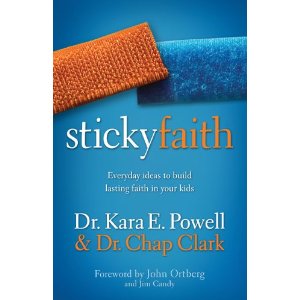
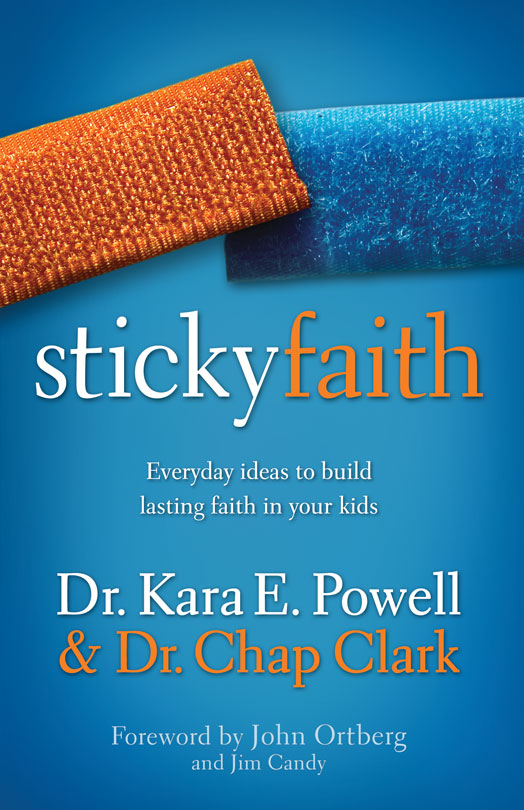
    Kristen and I would like to invite you to join us in an online book club here on my blog where we will be reading, writing about, and wrestling through a brand new book. It’s called, Sticky Faith: Everyday ideas to build lasting faith in your kids by Kara Powell & Chap Clark.

    About Sticky Faith

    Nearly every Christian parent in America would give anything to find a viable resource for developing within their kids a deep, dynamic faith that ‘sticks’ long term. Sticky Faith delivers. Research shows that almost half of graduating high school seniors struggle deeply with their faith. Recognizing the ramifications of that statistic, the Fuller Youth Institute (FYI) conducted the ‘College Transition Project’ in an effort to identify the relationships and best practices that can set young people on a trajectory of lifelong faith and service. Based on FYI findings, this easy-to-read guide presents both a compelling rationale and a powerful strategy to show parents how to actively encourage their children’s spiritual growth so that it will stick to them into adulthood and empower them to develop a living, lasting faith. Written by authors known for the integrity of their research and the intensity of their passion for young people, Sticky Faith is geared to spark a movement that empowers adults to develop robust and long-term faith in kids of all ages.

    Each Monday we will write a brief reflection and some questions specifically geared for ministry families. (It’s open to anyone, obviously all Christians are in ministry to some extent, right?)

    And then, just like a book club, we’ll open it up for discussion.

    How long will it last?

    The book is 8 chapters long, each week we will discuss a single chapter. Don’t worry– the chapters are pretty short.

    Here’s the schedule:

    October 10th – The not-so-sticky faith reality

    October 17th – The sticky gospel

    October 24th  – Sticky identity

    October 31st – Stick faith conversations

    November 7th – A sticky web of relationships

    November 14th – Sticky justice

    November 28th – A sticky bridge out of home

    December 5th – The ups and downs of the sticky faith journey

    Why this book?

    1. There are a lot of great books out there for parents, but this one is grounded in brand new research conducted by Fuller Youth Institute. Then they took their findings through a series of tests and dry runs to make sure that their learnings correlated. And only then did they boil it down into transferable principles. I think that sets it apart from most.
    2. Like I shared at the beginning, I think parents in ministry sometimes lose sight of their own kids. I’d like to help bring the focus on learning how to raise our own kids for a bit.
    3. I want to be a better dad. Kristen and I don’t have it all figured out. And we’d like the opportunity to learn from others so we can parent better.
    4. Kara Powell, Chap Clark, Brad Griffin, and the folks at FYI are amazing people. They have poured their heart and soul into this project. And I would love to see their hard work benefit families in my life.

    How do I join the book club?

    1. Fill out the form below so we can follow-up with you along the way.
    2. Buy the book; read the first chapter by October 10th. (It’d be great if couples joined us!)
    3. Agree to participate in the discussion and contribute to the group. (Guest posts totally encouraged!)

    Where do I buy the book?

    • Amazon.com – paperback or Kindle (I make 6% commission if you buy it this way)
    • DougFields.com – Pretty sure Doug is selling it cheaper than anyone, I don’t make anything from the sale but I did build his store, isn’t that cool?

    Join the Sticky Faith online book club

    It’s free, all you need to do is buy the book and keep up!
    • You don’t have to be married or even have kids to join. But if you are doing the book club as a couple we’d love to know that.
    • So we can follow up with you if you get quiet.

    Have questions? Leave a comment.

    Q1: I’m not in ministry, can I be in the book club? Absolutely! Just know that we’ll be gearing the discussion towards ministry families.