
“Why don’t I just take off my pants? This is getting ridiculous.”
These words rank right up there with some of the dumbest things I’ve ever said. I’d lost my cool and was about to pay the price with even more frustration.
It was November 12th, 2001. I’d just completed a 6-day trip to Germany to speak at a retreat for high school students on an American military base. I’d spoken 11 times in those 6 days, slept on couches and in sleeping bags, fought through a flu, and was completely exhausted and ready to go home.
What I didn’t know was that as I was checking in for my flight that morning from Frankfurt to Chicago, 260 people had just lost their lives in an accident over Rockaway, New York. Initial suspicions were that this was a terrorist act.
“Sir, since the time you acquired this bag, has it ever left your possession?”
“I’ve had it about 3 years. I’ve let some friends borrow it in that time. But I packed it myself last night.”
The American Airlines employee at the counter didn’t speak English very well. I couldn’t place her accent, but it was clear she was from Eastern Europe and not Germany.
She asked again, “Sir, at any time since you’ve acquired this bag, has it ever left your possession?”
“Yes, I’ve had it for 3 years. Of course it has left my possession. Do you speak German?”
She asked me in German. Honestly, it was just as oddly phrased in German as it was in English, the verbs were all out of order. Her German was just as bad as her English. With my travelers smile, I tried to explain the same thing. I’d owned it for 3 years, during that time friends had borrowed it, but during this trip it had always been in my possession. I packed it myself.
Wrong answer. Too many tries. She took my ticket and my passport and walked away.
She came back with an armed man in a uniform. Awesome. It was going to be that kind of day. For some reason I always have problems at Frankfurt airport.
20 minutes later, with my large internal frame backpack completely dismantled, the man in the uniform was finally satisfied that I was just a tourist in bad need of doing his laundry and not someone too dangerous to fly. And the airline employee gently handed me my boarding pass and passport.
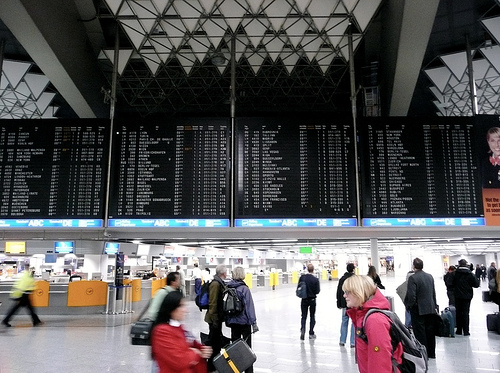
You could feel the tension walking through the terminal that morning. I had no idea that a plane had crashed. All of the TVs had mysteriously been turned off and there were security personnel everywhere. While I was starving and hoping for a final dose of German coffee and some pastries before flying home, all of the shops were closed. I guess I assumed it was a holiday or something.
So I went through security. The line was painfully slow. I was randomly selected for a secondary screening where another armed security guard went through my carry-on… like 20 minutes after it had just been searched.
Then, about 200 yards after going through security, they had set-up another checkpoint. This one manned exclusively by armed security guards. There wasn’t anything you could have done between the two security checkpoints. All of the shops were closed. And even the bathroom doors were locked. So we went through security a second time. (By this time, some of my fellow travelers had gotten calls from home, and we were all talking about what had happened in New York.) Just like the first time, I was randomly selected to go through secondary screening.
Then, I walked the rest of the way through the airport– eerily quiet and empty– to my boarding area just to go through security a third time outside of the gate. And it was at the third time that those famous words popped out of my mouth. Waiting in line to have my stuff searched for the fourth time in an hour, I’d lost my cool, and I kind of was serious about taking my clothes off. What else could they possibly find that hadn’t been checked already?
Checkpoints
In our jobs, marriages, and our faith, we each encounter these checkpoints all the time. We encounter a simple quandary: Are you in or are you out? In almost every instance this is a private, internal choice. We rarely are asked to verbalize these checkpoint decisions. Often our body, actions, and assumption carry us forward even if we are one-step-closer or one-step-further away from our faithfulness to the task at hand as a result of these checkpoints.
Sometimes these checkpoints occur rapidly and sometimes they occur gradually. But if you think about it you experience hundreds of these in hundreds of categories each day.
But sometimes we need to verbalize big decisions. We are getting married. We are changing careers. Or we are walking away from our faith.
Those decisions seem huge– even brash. As friends, we encourage friends to slow down, to not rush into it, and to consider other options without really realizing that there have been hundreds of smaller decisions which brought them to this space.
As a leader, boss, or friend you’ll never see the hundreds of checkpoints leading to a decision where they’ve stepped away. Checkpoint-by-checkpoint they’ve made small decision after small decision which leads to a logical conclusion. As they stand at the next checkpoint they think… I just don’t want to do this anymore. So they don’t.
Conversely, when we force a decision on people who aren’t ready we are making it easy for them to say no. Think about being asked to buy a car or house or get engaged or become best friends or even giving your life to Jesus too soon?
It might be where you are headed, but if it’s too many checkpoints too soon, most people will opt out. And along the way you’ve added a whole lot more checkpoints which move them backwards when your hope is to move them forward.
Photo credit: Richard Lemarchand via Flickr (Creative Commons)