Jeffrey and Joel were visiting with the people of a tent city in the town of Carrefour, Haiti when they heard periodic banging. Used to the sound of big diesel engines and definitely used to the sound of kids laughing and playing games, metal on metal banging was distinctive pang and piqued their curiosity.
Under a tree, away from the main tent area, they met Daniel. Daniel is a mason by trade. But right now there are way more masons than opportunities to do masonry so he began to improvise. With all of the aid flowing into the tent camp there was plenty of garbage generated. One thing that seemed like it was useful for something was all of the one gallon aluminum cans which brought foods like beans.
After some messing around and possibly scouting out what was selling in the city, Daniel started cutting open the cans and making flat sheets of aluminum. Then, using only a large square chunk of steel and a smaller, shorter chunk of steel, he began shaping the aluminum into little boxes and punching a hole in them.
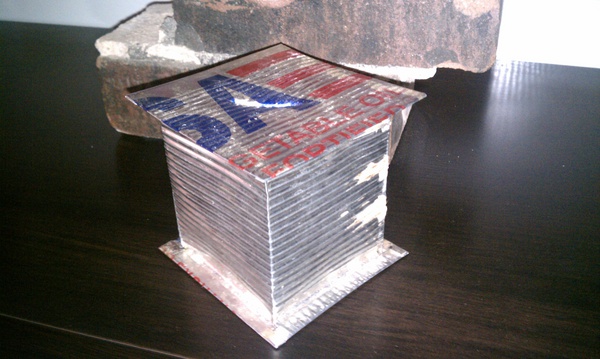 Bam. Instant piggy bank made from recycled cans.
Next, he began selling them to street vendors to sell up the hill in Carrefour. He sold them at 3 for 25 gouds. (3 for about 75 cents in US dollars) Each one took him about 2 minutes to make. So, in theory, Daniel could earn about 75 cents per hour. Remember, the average Haitian family earns less than $1 per day.
Jeffrey and Daniel bought about 6 piggy banks. (They paid him a little more than he was asking.)
Later that night as our team debriefed the day Joel brought up this story. And as the conversation morphed our team decided that we wanted to buy as many piggy banks as Daniel could make. Maybe, if we could get enough, we could use them to raise money for something like the Sons of God Orphanage?
The next day we went back to the tent city and found Daniel under his tree, banging away. We told him our plan and he liked it.
We will buy as many banks as you can make by noon tomorrow.
He thought he could make about 50. We said, no matter how many he makes… we’ll buy them all.
The next day, we were all a little apprehensive and hopeful. We had a feeling he’d have the 50 piggy banks. But we joked that we’d also walk into the camp and see tons of little kids with band-aids on their fingers from making these things all night long!
Daniel looked like a smart businessman. Maybe he’d hired the whole neighborhood to turn garbage into cash? Wouldn’t that be hilarious? I’d hoped we had enough money.
When we found Daniel under his tree it was clear that he was exhausted. He hadn’t slept. The interpreter tried to nice it up by saying that he thought Daniel had a fever. But it was OK, he had worked all night and we had come to buy what he had. His hard work was a good sign that he cared for his family.
He had 44 piggy banks. We counted them. We examined them. We made a big deal over how cool they were and well they were constructed. And then we talked about price.
You could tell he was nervous about that part. I don’t speak Creole but I could read his body language. Were the Americans going to try to offer him a bad price? And what would he do if we did?
The same price came up… 3 for 25 gouds. We told him no. We told him that he had worked all night and that we had rushed him. We told him that we didn’t feel right about paying him so little. We asked him if he thought it was fair if we paid him 25 gouds each. (It took a couple rounds of interpreting to get what we were saying.) He looked kind of confused by our proposition. I doubt anyone had ever told him they should pay him MORE because he had worked hard.
So, we counted them up and paid him just over 1000 gouds. (About $25 US) We shook hands, gave him the money, and walked away.
I don’t know what justice looks like. I can define justice. I can talk about it. But I don’t have a clue what it actually looks like.
I honestly don’t know if that was justice in action or just some silly Americans buying souvenirs thing. I just don’t know because I live in a world where basic justices are a given. But I do know business. I know that on that day, under that tree, that act of business felt like an act of justice.
I pray that more Daniel’s find more ways to recycle things. Turning garbage into money is good in any longitude or latitude.