Pastors often confuse leadership with discipleship. Our infatuation with leaders has stunted the development of disciples in our churches.
Tag: discipleship
-
Mark Riddle on Discipleship & Leadership in the Church
-
A rant on discipleship
A few week’s back Joel Mayward asked if I’d participate in his blog series on discipleship. He asked some great questions and really got my mind churning, plus I was in one of those pre-lunch moods. Here’s a taste of what ended up being a holy rant on the topic.
What is discipleship?
I’d like to start off with two push backs on your question itself.First off, discipleship is a made up word. Let’s acknowledge that for what it is. Every time I type it in Microsoft Word or on my blog it always pops up as a misspelled word. Because it isn’t a word. More to the point, it’s a made up word because we don’t really even have a word to describe what discipleship is.We are trying to smash the relationship that Jesus had with his disciples into a modern construct of a ministry model. The very problem of a lack of discipleship comes from trying to make it a quantifiable process that is replicable so that we can point to a person as church leadership and say, “This is how I know people are growing in their relationship with Jesus.” It’s a McDonald’s-style phrase that just falls flat in the face of what Jesus and the early church actually did, as documented in the New Testament. So I want to start off by pushing back on the very word, discipleship. Jesus told us to make disciples, (Matthew 28:19) not create a process whereby all people can follow 6 easy steps or run the bases or complete a wheel of discipleship. Those are modern simplifications which have proven to have horrible impact on the life of our churches.What is the greatest barrier to this in youth ministry?2. As I opened this with, we are living in a day where we’ve tried to create a process called discipleship as a replacement for how Jesus and the early church actually did it. So when we talk about making disciples we think of programs when Jesus never had that in mind. The disciple-making process is a lifestyle, not a program. So a major roadblock we hit as leaders is that our adult volunteers think they’ve been “discipled!” Moreover, we have a culture which is so “easy” focused that very few have the stomach to get involved. Decades of crappy “discipleship models” have created undiscipled, undisciplinable followishers of Jesus.And these are just two excerpts! You can read the rest on Joel’s blog. -
Fans are the enemy

Leading from Desperation Leads Us Astray
It’s counter-productive to lower the bar. I don’t know if it’s fear or flat-out desperation that leads us in church leadership to do this. But, in obvious and non-obvious ways, we think that more people will follow Jesus if we make it easier.
“If you’re ready to take the next step in your walk with Jesus, it’s real easy.”
“Take the next step in your walk with Jesus, just _____.” [Insert something non-committal, usually involving food]
What’s going through your mind at that moment is the felt need that you want as many people to follow Jesus as possible. (Which is good) And it seems like in order to do that you need to make it as simple as possible.
But you’re wrong.
Hit the pause button and open your Bible to John 6. Let’s see how Jesus handled his fans.
This is one of those upside-down Christian leadership principles: To grow disciples of Jesus I need to make it harder, not easier.
Jesus knew that fans came for the free magic show & food. They went from town to town. There was probably a guy selling glow sticks and two kids peddling t-shirts.
But when he told them that following him was going to mean eating his flesh and drinking his blood… most of them left. Jesus wasn’t out to make it easy. He knew that you need to test people and make it hard to find out who were the fans and who are the followers.
Christian leaders would be wise to follow Jesus’ example on this one.
Crosses Hurt
Luke 9:23 says, “Then he said to them all: “Whoever wants to be my disciple must deny themselves and take up their cross daily and follow me.”
Why don’t we take Jesus at his word?
Have you ever denied yourself, literally? I don’t mean skip a meal or do the 30 Hour Famine or skip a movie on HBO or choosing to go to a Christian college instead of a state one. I mean really deny yourself. Jesus’ early followers literally changed their zip code. They sold everything they had. (Acts 2:42-47) They gave up family life for community life. They redefind family. They ate what the deacons made. They suffered. Not because they had no choice… but because they had the choice and denied themselves!
Have you ever picked up a cross, literally? You should try it. It’s heavy to drag that thing around– even for a few minutes. They don’t sand down the edges of crosses. They don’t remove splinters. It’s not a fashion statement.
Carrying your cross should be burdensome. It’s should cost you social status. It should hurt. If it doesn’t than you’re a fan, not a follower carrying a cross.
Following Jesus shouldn’t be easy. If, as a leader, you are calling people to an easy, simple form of discipleship… that check is going to come back as insufficient.
Ultimately you aren’t leading people… you’re making fans of yourself and not followers of Jesus.
3 Ways that Form of Discipleship is Insufficient
- Fans of my ministry will kill my ministry potential – Fans just do what you say. Fans just want to hang out. Fans just want to say they know you. Followers of Jesus respect you as a leader, but spend their life copying Jesus and not you.
- Building my ministry around my church will kill my ministry potential – Seriously, the more time you spend hanging out at the Temple, the more time you get hung up in Temple life and deny the ministry Jesus has called all believers to… loving your neighbors as yourself.
- Fans build false assumptions of success – Having a full room and a stacked budget sure feels like success. But Jesus measures your success in ministry differently. He’s not impressed by what you’re impressed by. People showing up doesn’t mean lives changed. Jesus constantly tried to shake the crowd so he could meet the needs of the poor, practice healing, elevate the voice of the marginalized, on and on. Jesus never said… “Invite your friends to hear me preach at the Temple.” Never. Not once. And neither should you.
Let your life preach and go to church to celebrate what God’s doing. -
High schoolers passing in the night
I volunteer with the high school ministry at my church. Each Wednesday night I help to lead a small group of high school guys. And each Sunday morning I am one of the adults trying to engage our students in some sort of meaningful conversation.
Journey is of the size where you can successfully go for ages without ever actually talking to someone. And the high school group is much the same. I’d estimate weekly attendance to our weekend experience like this:
- 50% regulars (They come on Sunday and Wednesday nearly every week)
- 25% irregulars (They come on Sunday 1-3 times per month)
- 25% who the heck are you? (They come every 6 weeks or are a one-time visitor)
Journey is also the kind of place where you can grow as much or as little as you’d like as a leader. So we have students in many different areas of responsibility in the church. These are amazing young men and women who will make you turn your head 25 degrees to the right and say, “High schoolers can do that?”
Sunday morning is a expression of two students passing in the night.
- Students for whom Christ is at the center, He is changing them and they are growing fast.
- Students whom are checking out of their relationship with Jesus. As soon as their parents allow them, they’ll not come back.
It’s this sad-hopeful spot in which I sit each Sunday. Both students are on a journey– hopefully towards Christ. One is taking the more direct, obvious and measurable path, while the other is from Missouri, the Show Me State. They may re-engage later in life. But until they have the opportunity to check some things out they aren’t ready to give their lives to this thing.
I can see the unexpressed frustration on both ends of the spectrum. Those who are growing are looking at their peers and thinking, “When are you going to wake up?” And those who are looking to check out are thinking, “Why don’t you just shut up so I can get out of here?” It sometimes gets expressed through passive-aggression but it is most-often unspoken.
But it’s that tension, two students passing in opposite directions, which you can feel in our high school ministry.
Earlier in my ministry career I freaked out about this. I might have thought it was something we could correct. And I certainly would have thought it was something we needed to directly address. But as I’ve gotten a bit older (maybe wiser) I’ve learned that both types of students are on the same spiritual journey. Little I say and do can effect either of the groups. In the end, being loving and supportive and listening and respectful of their story is going to make way more impact.
Question: Do you see this same phenomenon in your ministry? Are you actively addressing it or passively observing it?
-
A Biblical Imbalance
 The default topic in Christian leadership circles today is balance.
We need to balance our work and family life. We need to balance ministry in our community with ministry at our church. We need to balance our budget. We need a balanced diet.
Something is wrong in your life? You are out of balance.
And that has me wondering. Is the very concept of balance a Christian concept or an Asian philosophy of Yin and yang?
When I look at the New Testament I see Jesus calling men and women to a holy imbalance. He asked his first disciples, who asked their disciples, to leave everything for the Kingdom of God.
Some Examples of Imbalance Celebrated
- Luke 5:1-10 – Jesus first asks Peter, James, and John to waste their time fishing in the wrong conditions. Than he asks them to leave their home, business, and everything they knew to follow him. Those nets, that boat, and the business all rotted.
- Luke 9:23 – “Then he said to them all: “Whoever wants to be my disciple must deny themselves and take up their cross daily and follow me.“
- Matthew 26:6-13 – A woman pours expensive perfume on Jesus, his disciples called that a horrible imbalance and Jesus affirmed her. “Why are you bothering this woman? She has done a beautiful thing to me.”
- Acts 5:1-11 – Dave Ramsey would have affirmed Ananias and Sapphira for their financial wisdom. They held a little back just in case. The Apostles weren’t interested in balanced devotion, they demanded all or nothing.
- Acts 7 – Stephen had an opportunity to defuse the anger of those in power, you know, balance things out. Instead he threw gasoline on the fire and was stoned.
There are hundreds more examples of this. The New Testament church embraced imbalance! It was celebrated. A call to follow Christ was extreme, never safe, and put your life permanently and joyfully horribly out of balance.
The very concept of balance is an avoidance of extremes. It’s holding something back. In many ways, our avoidance of extremes and calls for balance is the very thing that prevents us from truly experiencing the fullness of the weight of the cross on our shoulders.
If you ask me we need to ask people to count the cost. We need to call people not to a cheap version of discipleship but to one that is extremely out of balance. Jesus didn’t call us to balance. He calls us to pick up the cross– an instrument of death– and daily follow him.
“Christianity preaches the infinite worth of that which is seemingly worthless and the infinite worthlessness of that which is seemingly so valued.”
~ Dietrich Bonhoeffer
-
Free their minds…
Free their minds… and their hearts will follow. (Sorry En Vogure, I changed it.)
Is the primary task of my ministry to cram as much of what I know into their heads or is it to teach them how to think? Rhetorical, right?
Wrong. My actions say the former while my brain says the latter.
Think about the typical day of your students as it relates to adults.
- Early morning: An adult tells them to get out of bed and get ready for school. (Either by word or edict)
- Morning: A parent tells them to get in the car, get out of the car, to have a good day, etc. If they ride the bus they might make a couple words of small talk.
- School: Adults are largely in charge of the classroom and do most of the talking.
- Between class time: Students cram a few minutes of conversation with friends as they dash from place to place. (Adults dictate the parameters of this.)
- After school: Coaches instruct, students listen and obey.
- Home: “Have you done you homework? Your chores? How was your day? Tell me about….“
To overgeneralize, most interaction students have with adults is either structured or adults talk at students. They are almost always put in a position of learner or otherwise lack power.
We would all say that they have power to own their faith. But are our interactions with our students validating that or putting them in a powerless position?
It’s relatively rare that a student would have a conversation with an adult.
It’s even more rare that a student would have a conversation with an adult where the adult does the majority of the listening and the student does most of the talking. (The adult in the lesser role while the student is in the power role.)
Shaddup Already!
As this Fall has ramped up and I’m starting to get to know my small group of guys my inner dialogue is, “You don’t need to talk at, just listen. Listen. LISTEN.”
The best thing I can pass along isn’t what I know. It’s how I think. I don’t care that the guys in my small group know what I know or have answers for everything we’re talking about. But I desperately want them to know how to find stuff out for themselves, to compare and contrast what people are saying, to not just grab wisdom for the sake of acquiring knowledge but actually discovering the source of wisdom.
Sure, I want them to know what God’s Word says about this and that. But I really want them to know how to wrestle with things in a way that moves/changes them.
Curate vs. Dictate
I can’t do that if I do all the talking. I’m not helping them learn how to think critically if I tell them what I know. They will only grasp hold of their faith, truly own it, if they can articulate it for themselves. That means I am not in their lives to tell them the answers. I am there to teach them how to find the answers themselves.
My theory is that I need to talk less and less for them to think more and more. That means my job is less to provide answer and more to create questions. Which is good. Because I have lots of questions. And I’m really good at creating doubt.
-
Dear Church, You Can’t Buy Followers
There are dozens of services online that let people buy followers.
Prices start at about $15-$20 per thousand, with bulk orders costing less – 50,000 followers will typically run less than $500. Those followers, though, are often dummy accounts run by computers, some in a very obvious way, some in a more sophisticated fashion.
—
“If you’re not familiar with Twitter and someone says I can have 10,000 people follow you, that sounds great,” says Mack Collier, a social media strategist and trainer (and frequent speaker at events like South by Southwest Interactive). “They’re not going to talk to you about how to use Twitter to meet your goals and objectives. … When we don’t really understand something, we go back to ‘what’s the number?’ The biggest number always wins until we understand how something works – especially with social media.”
Follower for Sale: Buying Your Way to Twitter Fame, USA Today
While no church would attempt to buy Twitter followers, churches who want to grow often think that a really slick marketing campaign is the difference between their growth and their demise.
Church! You Do Not Have a Marketing Problem
Unless you are a brand new start-up, plenty of people in your community already know you exist. Marketing isn’t your problem.
You do a marketing campaign for one of three reasons:
- You have a product or service that is new to the market.
- You are trying to remind people who have used your product or service and not returned that you have something new.
- You are trying to convince people who already know they don’t want your product of service that they really do.

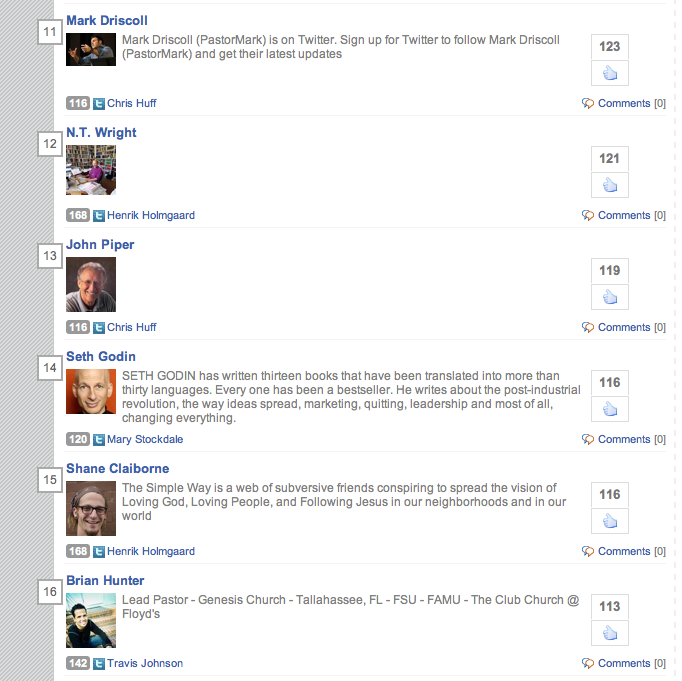
SAT Question: Which of the speakers in this set does not match? In the past two days church leaders from around the country have voted on who they’d like to see speak at an online leadership conference called, The Nines. Scrolling down the list from the top you’ll see a bunch of pastors and theologians until you come to #14… Seth Godin. A marketing blogger and conservative Jewish man.
The last thing church leaders need is to be convinced that they need a better marketing plan for their church.
Spending money on marketing without changing the reason people already aren’t coming to your church is just validating the message people already know about your church– That’s not for me.
Church! You Do Have a Follower Problem
We have bought into a lie that the way to grow a church is one of two extremes. (And our inability to grow is a marketing and not a discipleship problem.)
Extreme #1 – To lower the expectations we place on people who attend and follow us. Come as you are, listen if you want, that’s between you and God.
Followers are free but the cost of following is high. In John 6 Jesus fed five thousand people and walked on water and as a result had a whole slew of people who wanted to become his disciples. So Jesus held a quick disciple orientation class to explain what the cost of following him was.
Jesus said to them, “Very truly I tell you, unless you eat the flesh of the Son of Man and drink his blood, you have no life in you. Whoever eats my flesh and drinks my blood has eternal life, and I will raise them up at the last day. For my flesh is real food and my blood is real drink. Whoever eats my flesh and drinks my blood remains in me, and I in them. John 6:53-56
Yeah, that wasn’t going to work. They just wanted to follow Jesus for the free lunch and magic show. John 6:66 says, “From this time many of his disciples turned back and no longer followed him.”
In reality… that’s what a lot of people come to church for. The free lunch and magic show your church is offering. When you actually challenge them to count the cost and follow Jesus they just move on.
Extreme #2 – To raise expectations to a non-Biblical level by adding things to the Gospel message. To be a part of our team, you have to meet these 26 extra-biblical requirements as laid out in our church constitution…
Followers are free but you keep raising the cost. Acts 15 documents a case of this.
Certain people came down from Judea to Antioch and were teaching the believers: Unless you are circumcised, according to the custom taught by Moses, you cannot be saved.” This brought Paul and Barnabas into sharp dispute and debate with them. So Paul and Barnabas were appointed, along with some other believers, to go up to Jerusalem to see the apostles and elders about this question. Acts 15:1-2
This isn’t unlike what we see today in many churches. They add extra-biblical requirements to being on board with the church. You have to be baptized in a certain way, attend certain classes, volunteer a certain way, on and on. While none of those things are typically “bad” they are extra-biblical requirements which weed people out falsely.
In Acts 15:28-29, the council replied to these extra requirements that people were teaching with this, “It seemed good to the Holy Spirit and to us not to burden you with anything beyond the following requirements: You are to abstain from food sacrificed to idols, from blood, from the meat of strangled animals and from sexual immorality. You will do well to avoid these things.”
You don’t need a new marketing campaign to grow your church. The best growth plan you could ever have is to start eliminating the extremes. (Too little or too high.)
Question: If you have an existing congregation and the community has already decided they don’t need you. How do you change that perception?
-
Keep it simple
Discipleship – One of the most straight-forward concepts in Christianity. Instead of keeping it simple we turn it into a complicated mess. How hard is it? A person comes to you and wants to grow in their relationship with Jesus. Cool, tell them to find a Bible, read the book of John, and lets meet in 3 days. In the process of trying to make it easy (with a process) we make it hard.
Bible study – Another straight-forward concept. To lead a Bible study you need a couple of people, a Bible, and maybe a notebook. Pick a starting point, any starting point, read a section and ask the text… who, what, how, when, where, and why? In the process of trying to make it easy (with tools) we make it hard.
Community – We are hard-wired to form community in our DNA. It couldn’t get more simple than following your instincts. Share life with some friends, be open to making new friends, and take care of one anothers needs. The only thing hard about it should be the relational stuff. You don’t need a pastor to teach you how to do this, or a program at church, or anything else. You just need to do it.
Sometimes I wonder why we make things so dang complicated?
I know one reason: Making simple things complicated keeps people busy/employed/powerful/empowered.
When in doubt– keep it simple.
-
I play for keeps
 I keeps it real. And I play for keeps.
 It’s easy to be in ministry and lose sight of the big and obvious stuff. Such as, “Why the heck do I even do all of this anyway?”
So much of the actual task in youth ministry feels like that of a cruise director. When you lose sight of the bigger picture you start to evaluate by the evidence… Are people having a good time when they are around me? Are they showing up? Do they leave satisfied? Do they like being around me? Do they laugh at my jokes?
I’ve found those to be shallow evaluation tools. Those are like eating a Twinkie when your body is craving protein. It leaves you feeling temporarily full but hungry and unsatisfied quickly.
That’s why I say that I play for keeps. Youth ministry is meaningless without evangelism and discipleship at its core. Those two things are ultimately what I’m about in youth ministry. And as much as I like silly games, worship music, and road trips… I don’t do it for that.
This ain’t the Love Boat, friends. This stuff is for real.
-
A faith that costs you nothing is worthless
When Jesus had called the Twelve together, he gave them power and authority to drive out all demons and to cure diseases, and he sent them out to proclaim the kingdom of God and to heal the sick. He told them: “Take nothing for the journey—no staff, no bag, no bread, no money, no extra shirt. Whatever house you enter, stay there until you leave that town. If people do not welcome you, leave their town and shake the dust off your feet as a testimony against them.” So they set out and went from village to village, proclaiming the good news and healing people everywhere. Luke 9:1-6
You will be hated by everyone because of me, but the one who stands firm to the end will be saved. When you are persecuted in one place, flee to another. Truly I tell you, you will not finish going through the towns of Israel before the Son of Man comes. Matthew 10:22-23
On hearing it, many of his disciples said, “This is a hard teaching. Who can accept it?” Aware that his disciples were grumbling about this, Jesus said to them, “Does this offend you? Then what if you see the Son of Man ascend to where he was before! The Spirit gives life; the flesh counts for nothing. The words I have spoken to you—they are full of the Spirit and life. Yet there are some of you who do not believe.” For Jesus had known from the beginning which of them did not believe and who would betray him. He went on to say, “This is why I told you that no one can come to me unless the Father has enabled them.” From this time many of his disciples turned back and no longer followed him. John 6:60-66
When Jesus heard this, he said to him, “You still lack one thing. Sell everything you have and give to the poor, and you will have treasure in heaven. Then come, follow me.” When he heard this, he became very sad, because he was very wealthy. Jesus looked at him and said, “How hard it is for the rich to enter the kingdom of God! Indeed, it is easier for a camel to go through the eye of a needle than for someone who is rich to enter the kingdom of God.” Luke 18:22-25
When the members of the Sanhedrin heard this, they were furious and gnashed their teeth at him. But Stephen, full of the Holy Spirit, looked up to heaven and saw the glory of God, and Jesus standing at the right hand of God. “Look,” he said, “I see heaven open and the Son of Man standing at the right hand of God.” At this they covered their ears and, yelling at the top of their voices, they all rushed at him, dragged him out of the city and began to stone him. Meanwhile, the witnesses laid their coats at the feet of a young man named Saul. While they were stoning him, Stephen prayed, “Lord Jesus, receive my spirit.” Then he fell on his knees and cried out, “Lord, do not hold this sin against them.” When he had said this, he fell asleep. Acts 7:54-60
If I am laying my life on an altar… what is the sacrifice? What is the cost? What are people testifying about my life? Am I doing things worthy of a stoning?
Or am I just standing around, being religious, holding the jackets while my friends stone someone?