Tag: dream act

  • California Dreaming

    The American dream was affirmed yesterday– at least for some California residents. For tens of thousands of children, brought here illegally as children by their parents, Jerry Brown’s signing of  the California Dream Act, was a symbol of hope that their state cares about them.

    Qualifying students, regardless of their immigration status, can now apply for state financial aid. This was part B of a two-part law, part A passed earlier this year which allowed students to apply for private loans & financial aid regardless of status.

    This is great, but it isn’t enough

    While I’m thrilled with this new state law it isn’t the Dream Act we need at the federal level.

    • Qualifying students still cannot apply for federal financial aid because they lack legal immigration status.
    • Republicans continue to block measures which would provide a pathway to citizenship or even permanent resident status for children brought here by their parents.
    • Since the majority of financial aid for college comes from the federal level, this is more support but not a level playing field.

    Why this matters to youth workers and the church

    • It’s a matter of justice: It’s an injustice that a person raised in this country, who goes to school right next to your children, does not have the same opportunities to succeed that your child does. For many of these students, they had no say in whether or not their parents brought them here. But they have gone through our educational system, learned the language, competed with native-speaking peers, and this is their country in every way… except the one that truly matters, full legal status/rights.
    • It’s a matter of fairness: You want to pay $.99 for a pound of tomatoes or $1.29 for ground beef? Do you really think that $7 t-shirt you are making for your retreat was made by workers making minimum wage? Of course not. We both know it. Your standard of living is subsidized off of the back’s of cheap labor. To block those workers children access to post-secondary education & a pathway to legal status is embracing a system of oppression.
    • It’s a matter of numbers: Whether your church recognizes it or not we are still a melting pot country. The Latino population (whom the Dream Act primarily benefits) is exploding! Some predictions show that nearly 30% of the US population will be of Latino origon by  2050. On top of that, the census bureau is predicting a massive shift towards youth in the coming years. Currently, there are 59 children per 100 people in the US. By 2025 this will be 72. So our country is getting younger and more Latino… quickly.
    • It’s a matter of strategy: Let’s talk turkey. Let’s say you could care less about the first 3 things I listed. (Justice, fairness, and numbers) Let’s say you’re so hung up on the fact that their parents brought these children here illegally that you don’t want to give them anything like legal status, equal protection under our laws, or equal access to the same education your children have. (e.g. Arizona & Alabama lawmakers) With the population quickly shifting to give numerical power to legal people of Latino origin… do you really want to have your church as one of the agencies who held them back? Do you think that’s a good long term strategy for your church?

    For my youth worker friends: Let’s be reminded that our role in our community isn’t just to work at our churches. We are in our communities to advocate for all teenagers in Jesus’ name. God isn’t interested in the immigration status of students in your ministry. He’s interested in their status with Himself.

    The King will reply, ‘Truly I tell you, whatever you did for one of the least of these brothers and sisters of mine, you did for me.’
    Matthew 25:40

  • Immigration, Dreamers, and Youth Ministry

    Immigration reform is a political football. Unfortunately, it has become one of those things that you don’t talk about in polite company. And while I don’t claim to know enough to know how to fix the massive influx of people coming to our country illegally, I do know that we need a pathway to legal residence and citizenship for the students in our ministries who were brought here by their parents.

    I think when you get personally involved with students in this situation it becomes less an issue of politics and more an issue of justice. They are stuck. This stuckness kind of defines them and becomes the biggest obstacle they face.

    Here’s the story of one student, highly successful academically but otherwise stuck:


    No one actually prefers to risk their life crossing the border, leaving behind memories and childhoods, leaving behind their mothers and fathers and leaving behind their children. No one comes to this country because they want to be exploited, and treated less than human. No one migrates to this country and wants to identify as “illegal”. Their decision is not done out of thin air, there have been structures and policies that have pushed many to migrate (NAFTA, Bracero Program, Imperialism, privatization). My parents migrated to the United States because they wanted a better life for their children.

    My mom worked in factories, and my dad worked as a cook. They paid taxes (still do), hired lawyers, paid fines, got robbed by lawyers. But most of all, they lost many nights of tucking me to bed, many nights of reading me books, and combing my hair and seeing me walk for the first time. They sacrificed those nights for a better future for me. They are not illegals, they are my parents. They are strong courageous and admirable.

    I remember the time I was reunited with my parents; I was about 5 years old. I arrived in Harlem. They pushed me to be the best I can be; making sure education was a priority, motivating me to always be honor roll. And that is what I did, I excelled in school. I hoped time would soften the difference between others and me. I always knew that I was undocumented, but I trusted there was a fair system that would fix that up. My dad promised me my status would soon change, lawyers promised him that too. But no results. I knew my undocumented status put me on a different path than those friends I hung out with. There would be no Cornell University, no going away, no trips abroad, no teaching, no career, no fraternities, and no peaceful nights that did not consist of thinking of “deportation” or “illegal”.

    Read the whole story

    If Sonia were a graduating senior from your high school ministry, what advice would you give her?

    Do you agree or disagree that the Dream Act is more a justice issue than an immigration reform issue?

  • DREAM Act & Youth Ministry

    Everywhere I’ve done youth ministry I’ve met undocumented students. (Chicago, Northern California, Suburban Detroit, and here in City Heights)

    But it wasn’t until I started doing youth ministry here in City Heights that I truly started to understand the difficulty they had in furthering their education and starting their own American Dream.

    Think of the uphill battle a student in our neighborhood climbs towards adulthood. Their parents brought them here when they were very young. They were put into an elementary school where they didn’t speak the language. But they’ve overcome obstacles beyond language. A lack of health care, parents with unstable jobs, parents who struggled with the stress of starting a new life in a new culture, (the divorce rate is high) rough schools, the temptation of gangs, the reality of substance abuse, the allure of teenage pregnancy, few meaningful extra-curricular activities, on and on.

    And despite everything– these students have succeeded by every measurement tool. tudents with high GPAs, excellent standardized test scores, held offices in their class, been star athletes… the top of their class.

    Born in quick sand sucking them towards a failure no one would blame them for. They have struggled, clawed, and fought their way through high school. They are living proof that hard work pays off.

    But, as it stands now, the American Dream ends there for all but a few.

    As they reach graduation, a waypoint on their way to what they can become, they are faced with a new struggle they might not be able to overcome: Their immigration status prevents them from many academic/financial aid opportunities they would otherwise qualify for. Likewise, their immigration status prevents them from another viable option towards a career in the military.

    To put that in perspective in my neighborhood: Future community leaders hit a roadblock towards education and military service and are left with few options towards a bright future.

    What does this have to do with youth ministry?

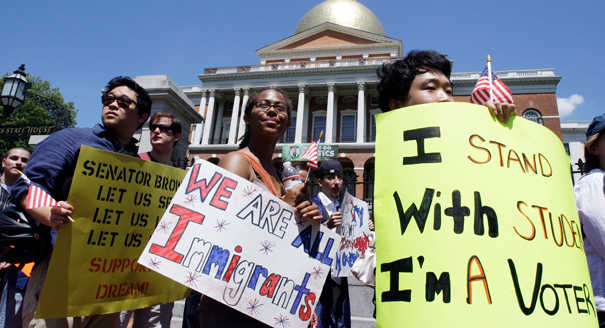
    The young adults in that video could just as easily be students in our youth group. And, in all reality, there’s a very good chance that there are students in your group facing the exact same problem. Our ministry isn’t just about preaching Good News, it’s about bringing good news to the neighborhood. See, this has everything to do with youth ministry here in San Diego and around the country!

    Photo from Politico (http://www.politico.com/news/stories/1110/45243.html)

    That’s where the DREAM Act comes in. Without going into a comprehensive immigration reform and all of its political pitfalls, it helps bridge a gap immediately that most people agree needs to get fixed.

    Purpose

    The purpose of the Development, Relief and Education of Alien Minors Act, also called the DREAM Act, is to help those individuals who meet certain requirements, have an opportunity to enlist in the military or go to college and have a path to citizenship which they otherwise would not have without this legislation. Supporters of the DREAM Act believe it is vital not only to the people who would benefit from it, but also the United States as a whole. It would give an opportunity to undocumented immigrant students who have been living in the U.S. since they were young, a chance to contribute back to the country that has given so much to them and a chance to utilize their hard earned education and talents.

    Would I qualify?

    The following is a list of specific requirements one would need in order to qualify for the current version of the DREAM Act.

    • Must have entered the United States before the age of 16 (i.e. 15 and younger)
    • Must have been present in the United States for at least five (5) consecutive years prior to enactment of the bill
    • Must have graduated from a United States high school, or have obtained a GED, or have been accepted into an institution of higher education (i.e. college/university)
    • Must be between the ages of 12 and 35 at the time of application
    • Must have good moral character

    Source

    For nearly 10 years the Dream Act has taken on many forms as it’s proponents have tried to get the law to pass through both the House and Senate. It has stalled or was killed every time.

    On December 8th, the bill was passed by the House of Representative. It was hoped that the debate in the Senate would begin immediately. Unfortunately, the Senate tabled a vote on the measure yesterday.

    Obviously, this is labeled a political issue.

    But in my world this is a social justice issue. These students have done everything right and the only country they’ve ever known prohibits them from pursuing their dreams. They have looked adversity in the eye and climbed past it’s sneering, snarling teeth and overcome everything to become  the embodiment of success our country adores.

    It’s time that this legislation passes and they are allowed to move on.

    More info:

    Wikipedia article

    Follow the story on Twitter, #dreamact

    Dream Act Portal (student activist site)