There are dozens of services online that let people buy followers.
Prices start at about $15-$20 per thousand, with bulk orders costing less – 50,000 followers will typically run less than $500. Those followers, though, are often dummy accounts run by computers, some in a very obvious way, some in a more sophisticated fashion.
—
“If you’re not familiar with Twitter and someone says I can have 10,000 people follow you, that sounds great,” says Mack Collier, a social media strategist and trainer (and frequent speaker at events like South by Southwest Interactive). “They’re not going to talk to you about how to use Twitter to meet your goals and objectives. … When we don’t really understand something, we go back to ‘what’s the number?’ The biggest number always wins until we understand how something works – especially with social media.”
Follower for Sale: Buying Your Way to Twitter Fame, USA Today
While no church would attempt to buy Twitter followers, churches who want to grow often think that a really slick marketing campaign is the difference between their growth and their demise.
Church! You Do Not Have a Marketing Problem
Unless you are a brand new start-up, plenty of people in your community already know you exist. Marketing isn’t your problem.
You do a marketing campaign for one of three reasons:
- You have a product or service that is new to the market.
- You are trying to remind people who have used your product or service and not returned that you have something new.
- You are trying to convince people who already know they don’t want your product of service that they really do.
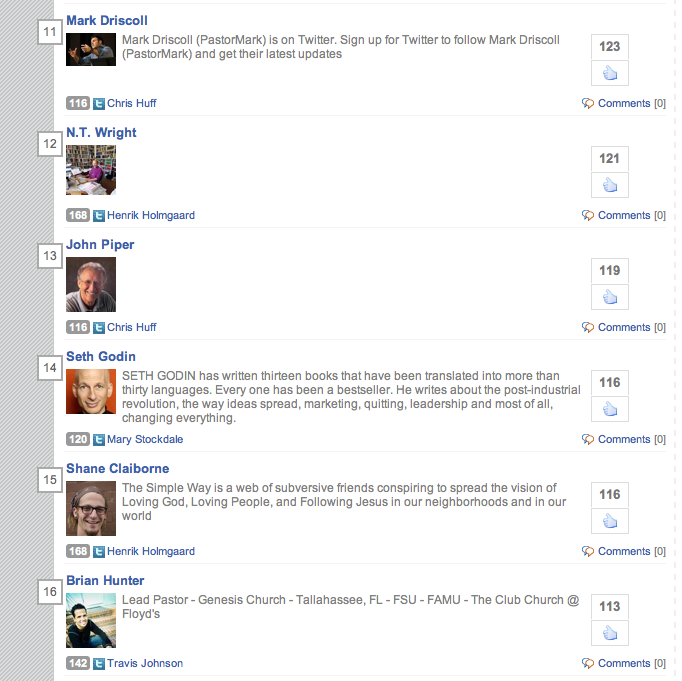
In the past two days church leaders from around the country have voted on who they’d like to see speak at an online leadership conference called, The Nines. Scrolling down the list from the top you’ll see a bunch of pastors and theologians until you come to #14… Seth Godin. A marketing blogger and conservative Jewish man.
The last thing church leaders need is to be convinced that they need a better marketing plan for their church.
Spending money on marketing without changing the reason people already aren’t coming to your church is just validating the message people already know about your church– That’s not for me.
Church! You Do Have a Follower Problem
We have bought into a lie that the way to grow a church is one of two extremes. (And our inability to grow is a marketing and not a discipleship problem.)
Extreme #1 – To lower the expectations we place on people who attend and follow us. Come as you are, listen if you want, that’s between you and God.
Followers are free but the cost of following is high. In John 6 Jesus fed five thousand people and walked on water and as a result had a whole slew of people who wanted to become his disciples. So Jesus held a quick disciple orientation class to explain what the cost of following him was.
Jesus said to them, “Very truly I tell you, unless you eat the flesh of the Son of Man and drink his blood, you have no life in you. Whoever eats my flesh and drinks my blood has eternal life, and I will raise them up at the last day. For my flesh is real food and my blood is real drink. Whoever eats my flesh and drinks my blood remains in me, and I in them. John 6:53-56
Yeah, that wasn’t going to work. They just wanted to follow Jesus for the free lunch and magic show. John 6:66 says, “From this time many of his disciples turned back and no longer followed him.”
In reality… that’s what a lot of people come to church for. The free lunch and magic show your church is offering. When you actually challenge them to count the cost and follow Jesus they just move on.
Extreme #2 – To raise expectations to a non-Biblical level by adding things to the Gospel message. To be a part of our team, you have to meet these 26 extra-biblical requirements as laid out in our church constitution…
Followers are free but you keep raising the cost. Acts 15 documents a case of this.
Certain people came down from Judea to Antioch and were teaching the believers: Unless you are circumcised, according to the custom taught by Moses, you cannot be saved.” This brought Paul and Barnabas into sharp dispute and debate with them. So Paul and Barnabas were appointed, along with some other believers, to go up to Jerusalem to see the apostles and elders about this question. Acts 15:1-2
This isn’t unlike what we see today in many churches. They add extra-biblical requirements to being on board with the church. You have to be baptized in a certain way, attend certain classes, volunteer a certain way, on and on. While none of those things are typically “bad” they are extra-biblical requirements which weed people out falsely.
In Acts 15:28-29, the council replied to these extra requirements that people were teaching with this, “It seemed good to the Holy Spirit and to us not to burden you with anything beyond the following requirements: You are to abstain from food sacrificed to idols, from blood, from the meat of strangled animals and from sexual immorality. You will do well to avoid these things.”
You don’t need a new marketing campaign to grow your church. The best growth plan you could ever have is to start eliminating the extremes. (Too little or too high.)