

Tag: going local

  • From information to action

    click to see full size
    click to see full size

    Our society is in desperate need of Good News

    Therefore, the question for church leaders is simple: Will you be the source of Good News in your community or will someone/something else?

    The Sunday Disconnect

    Like clockwork, we have trained our people that the place to be on Sunday mornings is the church. That is a great thing: People show up!

    There is expectancy in that. Something innately in us instructs us, “Sunday morning is the time we gather for corporate worship of our God.” Whether its your first Sunday, you’ve been in the church your whole life, or you work at the church, we all come together on Sunday mornings: We are going to the church to worship God!

    That togetherness ends in the parking lot. As we arrive at church I find that we each family & individual has a slightly different agenda as they come on Sunday morning.

    The difference in agenda is fascinating, mind-numbing, and ultimately a sign that we need corrective leadership.

    My Sunday morning agenda – aka “Things I am hoping for

    1. Get there, all of us. On time is preferable.
    2. Get the kids to children’s church.
    3. Corporate time of worship, prayer, and the reading of God’s Word.
    4. Drop off my offering.
    5. See some friends during the soft time after service, meet some new people.
    6. Avoid invitations to help out with things that don’t interest me. Check in with things I am interested in.
    7. Hear reports/testimonies of what God is doing in my neighborhood through His people.
    8. Hear about corporate opportunities to do something. I only have 2-3 hours available per week, but if something can be done, I want to do it.
    9. Hear what’s going on in my neighborhood.
    10. Share ideas, process what’s going on, and form action plans for the week to come.

    The Sunday morning agenda of the staff – aka “Things I perceive they need to see the morning as a success.

    1. Make sure the building is ready for visitors.
    2. Make sure all of your people are in the right places and they know what they are supposed to be doing.
    3. Invite people into a deeper relationship with God.
    4. Communicate God’s Word. (Song, sermon, prayer, etc.)
    5. Announce stuff.
    6. Check off the mental check list of people to reach out to (Some, to see how they are doing or follow-up. Others, to recruit or check-in about stuff you are announcing.)
    7. Make sure the service happens. (You want it to be worshipful for yourself, but largely it’s not because details overwhelm you.)
    8. Oversee staff, volunteers, and check-in with all of them after to see how it went.
    9. Count stuff. I don’t know why but church staff have to count everything.
    10. Troubleshoot. Something always manages to go wrong.

    See what’s happening?

    Largely, the people coming want to be called to action. Sure, they want to gather. But they also want to do something with their faith outside of the walls of the church in their own community.

    Largely, the church staff want to call people to help make church happen. They want to do stuff outside of the church, too. (Don’t read that the wrong way… the church staff largely is on staff because they want to impact the community!) But they can’t even think about that unless their bases are covered.

    Questions: What are some first steps to alleviating this disconnect on Sunday morning? What are ways you can transform Sunday morning from information sharing to a call to action?

  • Why Americans are Going Local

    Yesterday Kristen and I listened to an author, Andrew Potter, describe the American movement towards all things local and eco-friendly as conspicuous consumption.

    It felt like an elitist slap in the face.

    His book is called, The Authenticity Hoax. (I’ve not read it) You can see the transcript to the Marketplace segment, “The new holier than thou” here.

    Basically, the author claimed that the real reason why Americans are going to farmers markets, growing their own food, shopping at locally owned business, and otherwise supporting their local economy is really to show off our wealth publicly. The entire tone of the interview seemed to mock and misrepresent a major shift in public opinion. (For a more reasonable interpretation of the same movement, check out this link in Business Week.)

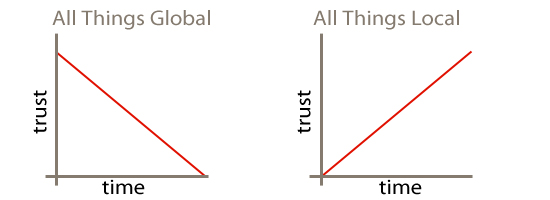
    I couldn’t help but wonder if the author was just a tool or if he was a corporate tool who didn’t understand how inverse relationships work? As people’s distrust in “global” increases, their trust in “local” increases proportionally.

    Some examples of inverse relationships in the going local trend

    1. We are social creatures. With access to worldwide communication, its a natural human reaction to seek out local connections. People going local is an inverse relationship to a global society.
    2. Micro-economics makes sense. It doesn’t take a PhD in economics to understand that if I choose going to a local eatery vs. McDonald’s more of my money stays in my community. People eating locally is an inverse relationship to a global economy.
    3. The general public is coming to understand that our food chain is under-regulated and unsafe. As I’ve written about before, thanks to some great documentaries the general public is now aware that corporations are more concerned with profit than public health. People growing their own food is an inverse relationship to a global, unregulated food supply chain.
    4. The food decision wheel is turning more quickly. Each time there is a flaw in the food chain it just emphasized what the general public is thinking already. Bad eggs leads to “I need to buy my eggs from a farmer I can trust.” Now that people understand that most of our corn products are genetically-modified, people are starting to look for products containing no corn product. Every bad news story about food spins the wheel a little faster for people and centrifugal force is tough to fight for long. People trusting local farmers is an inverse relationship to a distrust of mega-farmers.
    5. Conspicuous corruption leads to local consumption. Look at the case of “special foreclosure courts” being set up in Florida to supersede constitutional rights in favor of corporations making a quick buck. This isn’t some conspiracy theorist… it’s the New York Times! Apparently the 7th amendment isn’t the law when courts are busy? No one in their right mind would trust that the government will rule in favor of a common citizen right now. So, people are investing their money in local businesses and things they know they can understand and trust. People investing in local banks is an inverse relationship to our distrust of a global banking society and the governmental corruption it has inspired.

    What are other examples of inverse relationships that are leading more and more of us to go local?

    Do you think that the shift to local really is conspicuous consumption? Is this just yuppies finding new ways to show off?