Tag: justice

  • 1.5 Million Still Homeless in Haiti

    In a city of 3 million people roughly half are still homeless four months after the earthquake.

    Why is a country, once rich in natural resources, a nation whose slave population rose up and defeated Napoleon’s army for independence, and given aid for generations by rich nations like the United States and France, still steeped in such poverty?

    The answer is simple: Corruption.

    There is corruption at every level of government. There are oppressors and the oppressed. And the people with social status to do something about it? Their idealism is often overcome by greed.

    Even the relief aid workers who have gone— too many have succumbed to temptations. Too much talk, too much skimming, and not enough work getting done.

    According to this New York Times editorial, only 7500 of the 1.5 million left homeless have been moved to a resettlement site. Not even a permanent home.

    The cameras are gone. The news attention is now fixated somewhere else. (On the gulf oil spill.) The American publics attention, like that of a mosquito, is looking for the next story that bleeds.

    $1.5 billion in aid was given. About $1000 per person displaced. [In a nation where the average family makes under $200 annually] And yet no one has a new place to live. Tents? Yes. Homes? No.

    7500 people resettled. 1,492,500 still sleep on the ground tonight. Mothers will lay down their babies on dirt, under a tarp with your countries name on it in tent cities that would make your knees buckle when you see them.

    I’ve heard snarky Americans say, “Why is Haiti our problem?” Or “Won’t our help just further the problem?

    Haiti is our problem. We have funded the corruption. We have turned our attention away from the corruption there… we’d prefer to not think about it. We have stood by and gotten rich off of their natural resources. We have gleefully paid unfair wages to their workers for generations so that we can buy socks at $2.99 for six pairs.

    And while we wear their socks their children sleep on a piece of cardboard under a tarp tent with “USAid” flapping 12 inches above their face.

    Shame on us.

    Why can’t Haiti fix its own problems? Why can’t people just move? Why can’t they just go get jobs? Why can’t they rebuild their own homes?

    My reply to that is plain: Why don’t you go to Haiti and discover the answers to those questions for yourself. If the problem is so simple– why not go and fix it?

    This much I know. This I can assure you. One day a poet will rise up from the squaller of a tent city and cry out:

    How long, how long must we sing this song?

    One day the shame of our inaction will get to us. We will pay $100 to watch this poet pronounce shame and guilt on us for our inaction to a stadium of people who nod their heads in agreement.

    While your children sleep safely in their beds tonight I want you to think of this song…

  • It’s your turn to go to Haiti

    My trip to Haiti was two-fold.

    1. To serve the Haitian church. Each day of our trip was spent meeting with local pastors, meeting their people, and assessing/serving their needs. As I wrote about on the YS blog, “Jesus is the one feeding the people in Haiti.” As I documented over and over again, I was able to help be the hands and feet of Jesus– even though I have no special skills for disaster relief. God used my inability to show off his abilities.
    2. To mobilize you. Let’s face it, now that the film crews are rolling out of Port-au-Prince you are starting to forget about the need. While the disaster of January 12th fades into your memory banks, distracted by the Winter Olympics and testimony of Toyota’s president— 750,000 people are living in the open with no shelter, no regular source of food, and no clean water. They desperately need people like you to come to their aid.

    You witnessed my trip. I laid bare my anxieties and fears as I prepared. I documented my every day of the journey. And you’ve seen that I’m just a regular guy who went to Haiti to be the hands and feet of Jesus– and I came back safe and sound.

    I wasn’t traumatized. I wasn’t under-utilized. I wasn’t in harms way. I wasn’t in the way of “professionals.” And the place certainly isn’t crawling with American relief organizations or morbid tourists.

    Am I saying that God is calling every person to go to Haiti to serve? Of course not.

    But I am reminding many of my readers what they already know: If the Holy Spirit is prompting you to go, and you are finding reason not to go… you may need to toss aside those excuses and lean into what God is calling you to do!

    Find an organization and go. Soon. The need is getting greater, not less.

  • Confronting Segregation on Sunday Morning

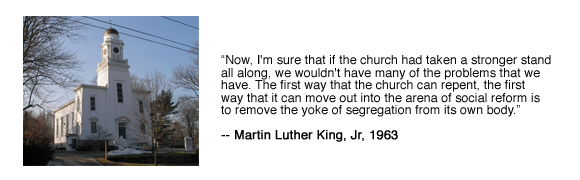
    church-segregation

    Sunday morning’s sermon at Harbor stirred in me the desire for the church to be a place of reconciliation.

    Stephen reflected on Revelation 7:9-12 in which people of every tribe, tongue, and nation will worship Jesus on His throne in Heaven and asked us to consider if we would attempt to do the same on earth? We live in a melting pot commununity. Literally, within 5 miles of our church are people of many tribes, tongues, and nations. The question brought forth was, will we intentionally worship together as a community or will we allow a church culture to prevail which prefers to seperate on Sunday mornings along racial lines?

    I was reminded of this exchange, in 1963, between Martin Luther King and the one-time president of Western Michigan University, Mr. Miller:

    Miller: Don’t you feel that integration can only be started and realized in the Christian church, not in schools or by other means? This would be a means of seeing just who are true Christians.

    King: As a preacher, I would certainly have to agree with this. I must admit that I have gone through those moments when I was greatly disappointed with the church and what it has done in this period of social change. We must face the fact that in America, the church is still the most segregated major institution in America. At 11:00 on Sunday morning when we stand and sing and Christ has no east or west, we stand at the most segregated hour in this nation. This is tragic. Nobody of honesty can overlook this. Now, I’m sure that if the church had taken a stronger stand all along, we wouldn’t have many of the problems that we have. The first way that the church can repent, the first way that it can move out into the arena of social reform is to remove the yoke of segregation from its own body. Now, I’m not saying that society must sit down and wait on a spiritual and moribund church as we’ve so often seen. I think it should have started in the church, but since it didn’t start in the church, our society needed to move on. The church, itself, will stand under the judgement of God. Now that the mistake of the past has been made, I think that the opportunity of the future is to really go out and to transform American society, and where else is there a better place than in the institution that should serve as the moral guardian of the community. The institution that should preach brotherhood and make it a reality within its own body.

    The truth is, 46 years later, not much has changed. Churches are still largely segregated in America. You could argue, as this CNN article points out, that we prefer our Sunday’s segregated.

    • There are major, separate, evangelical movements within the white, black, Hispanic, and Asian communities. There are relatively few places where those churches intersect. I will lovingly say that 5% of churches are truly mixed. But I am probably rounding up.
    • Within my own culture we tend to hold our personal preferences above all else. We are fine with other ethnicity coming to our churches so long as we don’t have to give up our style of worship or preaching. We hold our worship styles as canonical!
    • White males dominate the leadership landscape within American evangelicalism. Look at most conference line-ups or take a walk around a Christian bookstore or look at the top 20 Christian albums and you will see white male dominance. Are white males the only spiritual leaders? I don’t think so.
    • Open a phone book and you will likely see, in most communities, a white, black, Hispanic, and Asian version of the same church. 99% same doctrine, but we prefer to form different churches rather than deal with intentionally segregating. It’s not just a white church issue… it’s evangelicalism as a whole not dealing with this issue!

    Something about that is anti-Revelation 7, isn’t it?

    A few years ago I was at a leadership retreat in which we were asked to bring up our dreams for the congregation. The small Michigan town we lived in has a vibrant Hispanic population and a historic black community dating back to the Underground Railroad. I said that one of my dreams for the church was that there wouldn’t be three congregations in town separated by race (but not doctrine) but that we would figure our a way to have one church. I was laughed at and mocked for weeks. “We just aren’t ready for that.”

    And by “that” I suppose they meant dealing with their racist tendencies for the sake of the Gospel.

    In America, lines of segregation are alive and well. We all know it. People use their positions of power to invent new “legal” ways to segregate people all the time. But what are we willing to do about it?

    Want to see segregation alive and well in America? Head to a school board meeting when they talk about re-districting. Or head to a planning commision meeting when they talk about building an apartment complex. You will see the dominant culture take up arms so that “they” don’t allow “them” in their school or neighborhoods. Apply some nouns to those conversations and you are right back to Brown vs. Board of Education.

    It is amazing to me that no one I know would be upset– or even notice– if they worked with people of another race (or gender.) It wouldn’t even be an issue in the workplace. For the most part it wouldn’t be an issue in our own neighborhood.  Even in our own families race is not much of an issue. Six days per week our society has integrated. It’s not perfect but we’ve come a long way.

    And yet on Sunday morning… race (and gender) are major issues! This must change and we all know it. The question for leaders today is simply, “What are you going to do about it?”

    I am proud to call Stephen my pastor. He stood up on Sunday morning, not to cheerlead the efforts our church has made in the last two years, but to remind us that we have a long way to go. I hope the small successes we see at Harbor are just the beginning of a wider movement of reconciliation on Sunday mornings for the sake of the Gospel. First in our community, but also in America.

    Some questions:
    How do I need to be confronted on this issue. This is a “first me, than lead forward” deal.
    How does that reflect how I/we relate to Scripture?
    How does that limit the effectiveness of the Gospel in the community you/I live in?
    What are action items you/I will take to confront segregation in your/my church community?
  • Why I Stand Up to Bullies

    bullies-r-bad

    What if you found out that the principal had denied access to the gay/straight alliance because of some technicality… a rule the Christian club broke all the time? Would you take a stand for the gay/straight alliance? They have the right to meet at the school under the same rules that give the Christian group rights to meet. I asked this question to a senior pastor friend of mine over a cup of coffee. The conversation got to this point when he asked me why I was always standing up for the little guy. I told him that our role as Christian leaders was to help others seek justice to which he replied, “Well, some things deserve justice and equality while others don’t.

    And Christians wonder why some people hate them?

    Let me share a few reasons why I think more Christian leaders don’t stand up to bullies:

    1. They are wimps. Somewhere in all of our education we are taught to never fight the system, just to submit to the ruling authority, and smile at old ladies on Sunday mornings. I’ve met far too many church leaders whose only leadership skill is diplomacy. Diplomacy is great. But the desire to negotiate is worthless if no one takes you seriously. Just because you are a church leader doesn’t mean you have to be a pansy.

    2. They have horrible theology. In the above discussion you see it played out. That church leader was only interested in standing up for the Christian group. No one else in the community matters to him because they don’t directly benefit him. (Directly, meaning he doesn’t see the connection between justice and church growth!) You know, Jesus and his disciples only ever stood up for the religious folks, right? Just ask the woman at the well and that woman about to be stoned when caught having sex.

    3. They are afraid of their churches. Good Lord, imagine what would happen if the senior pastor actually stood up against injustice in his community! I mean, what would the board say? I mean… if I don’t do what they say I could lose my job! (See #1 & #2)

    4. Their worldview is jacked up. I could ask the pastor above if he was an absolutist or a graded-absolutist and he’d swear oaths to Josh McDowell that he was walking the absolutist straight and narrow. But based on how he answered the question above you’d see that he’s really a relativist. (gasp) He’d stand up for the Christian groups right to meet at a local high school because he agrees with them. But because he doesn’t agree with gay/straight alliance, he wouldn’t. Relativism in action. So what’s good for one group isn’t good for another, right pastor?

    5. Their priorities are out-of-order. The last cop-out I hear all the time is, “I’m so busy running the church.” Too many who work in churches are so worried about running the programs of the church that they forget their place in society. Think about it… most pastors make horrible neighbors. They are too busy to be a part of the community, they use their house as a meeting location, and they are preaching all the time that you should love your neighbor despite the fact that they don’t know their own neighbors names or love them one bit. It shocks me that the way evangelical churches operate that they are so out-of-balance with the community’s need.

    I know these are generalizations. And I know that people think that if they can dismiss one single point with a specific example they can dismiss all that I’m saying. Please don’t lose the point of the post by disagreeing with a single generalization. The point is that if you want to be a Christian leader in your community, you don’t need the title of pastor. What you need to do is look deeply at what’s going on, expose injustices, speak out for the weak and poor among you, and stand up to bullies. Whether that’s a school board, a government official, a nasty neighbor, a gang, the big donor at church pulling the strings, or even some bullies picking on kids as they walk to school.

    Jesus is a big fan of justice, are you?

  • How Should Church Staff Be Treated?

    One of the fascinating aspects of senior church leaders blogging is that you get an opportunity to see inside their minds a little. Sometimes it is encouraging and sometimes it is not. Recently, I’ve been disappointed by some comments and principles that would be considered unethical or illegal in the professional world in relation to their non-executive staff.

    It got me thinking about how churches treat their staff. Wouldn’t it be logical to think that a place which represent Jesus, the King of Justice and Mercy, would be generous to their staff? One would hope so yet we see over and over again that churches abuse the provisions of their charity status to avoid labor laws.

    Instead what I see is that non-executive staff are seen as expendable commodities. They are asked to have absolute dedication. They are asked to do their jobs plus “other duties as assigned.” They are asked to work long hours for less than market value. They are told that if they aren’t 10,000% sold out, they should quit. Worse yet, they are hired at low levels and told that higher education is a waste of time and money, thus locking them into that role until the leader tires of them. If they question leadership they are fired. If they try to move up in the world they are fired. If they do anything except what the leaders say, they are fired.

    Here’s why I am repulsed by this concept. This represents the very worst of business culture exemplified by the church as a best practice. This is aimed at short term gain instead of what studies consistently say… long term relationships matter in ministry. This leadership style says, “We have the right to hire and fire you at will, but you… as a low level employee… have no power to chose what you want.” This leadership style is confusing and hurtful to staff members and I can provide examples of hundreds of people who have been threatened, mistreated, fired, and manipulated into following a pastor’s will above God’s will.

    I promise you this. Mark my words.

    – The churches who will endure and endear this generation will be great places to work.

    – The churches who prevail into the next generation will invest in staff members through thick and thin.

    – They will pay for them to get higher education.

    – They will create opportunities for advancement.

    – They will constantly remind staff that the most important people are not the up-front speakers and performers but the front line servants.

    – They will give staff members time to find freedom from the grind and encourage staff members to love their families above all else.

    – They will work less that 50 hours consistently.

    – They will reward for things other than numeric growth.

    – They will facilitate innovation outside of the executive leaders.

    – They will be known in their communities as great employers.

    – They will pay a living wage and encourage staff to live within walking distance of the church.

    What do you think? Where do you see injustices as a staff member? What do you think churches of the future will do with the staff that they have? Will they even need staff?