Tag: local

  • A terrestrial calling

    “You’re crazy enough to change the world.” 

    Those were prophetic words spoken to me by an elder who wasn’t happy with me. Trust me, he didn’t mean that as a compliment. He said that because I was royally screwing up his country club. His nice little church who loved their closed circle of friends and hid behind and glass walled lie of, “We just want to protect our kids from the world” had been exposed to the realities of some radical transformation that can occur when you challenge students to read God’s Word uninterpretted.

    “What does a plain reading of this tell you to do?” 

    As I taught middle school and high school students how to do  that in a Christian school and the church that hosted it, kids started asking questions that freaked their parents out. And those freaked out parents called the elders. And the elders told me to stop teaching like that.

    Before you can change the world, you better change your block

    This has been a turn in my understanding of that phrase, of late. I can point to specific things that happen in my world and say, “Yes, I had a hand in impacting that. Those things have changed because of my being here.”

    But my conviction is becoming that none of that matters if I don’t love my neighbors enough to help them discover the truths that those middle school and high school students discovered way back when. If I don’t love my neighbors enough to royally mess up their lives by introducing Jesus’ insurrection of the heart, I say I love my neighbors but I really don’t.

    That’s my terrestrial calling. I can think and dream in planetary terms. But in reality? My calling is really, really local.


  • Do I have a vision problem?

    visionless: it is my claim that this is the most attractive but most insidious yeast undermining religious communities. Vision has a devious way of focusing our attention outside of ourselves to some lofty external goal, rather than keeping ourselves committed to love and service in the community, then as a result beyond the immediate community by the outpouring of the overflow. Jesus’ vision, if it could be said he had any vision at all, was to die… to hand himself over to the authorities, etc. Any other vision than the vision to be willing to die is one that decides who can play and who cannot for the longevity of the vision and it’s crafters. It defines the shape and nature of the community and the people within it, often with violence against the natural goodness and innate spirituality of its people. It is vision that eventually and inevitably changes an institution into stone.

    source

    Lately, I’ve been chewing on David Hayward’s work on becoming visionless. (His book on the subject)

    In so many ways this concept deeply resonates with my experience. And in so many ways it deeply offends my experience.

    On the one hand, my own words would argue that if you don’t have a clearly defined vision for yourself you’ll be paralyzed by your inability to say no to good/bad things that come your way. Vision permits lazer-like focus.

    On the other hand, I’m haunted by the reality that often times I’m saying no to things that are close to me, forsaking the organic opportunity for one cultivated in alignment with my vision.

    In my mind vision allows me to filter. That’s why David’s words are annoying me so much. Who am I to try to put a filter on what God puts right before me? Who am I to forsake the organic for the cultivated? 

    Question: What would your life look like if you were to reorientate yourself around Hayward’s words above. (Put aside your ability to disagree with him, just imagine what your life would be like if this were true and it became a guide. How would yourlife change?)

  • Radically Local

    Photo by Doc Searls via Flickr (Creative Commons)

    I don’t drive my car very often.

    We are a one car family and I choose to take the trolley to work most days. I’ve learned to love the slowness of riding my bike and taking public transportation.

    When I do drive it tends to be with the five of us crammed into our Passat. A fun and usually noisy experience that I’ve learned to adore.

    But, the other day was different and found myself in the car alone. And I did something even more rare… I turned on the radio and surfed some channels.

    I found a local station that just plays local bands. Their commericals said something like this, “Sure, we could be like everyone else and copycat the LA stations. But we’re local. We’re San Diego. We favor local music over commercial hits.

    It was cool. Fresh even. And something deep in me resonated with the knowledge that I was hearing music on the radio you wouldn’t hear on the radio anywhere else.

    Radically Local

    All of this is a movement towards local. Farmers markets have become popular across the country– a celebration of locally grown foods. Food trucks are all the rage– cooking up local eats in a way that is both local and mobile. Local food chains are a growing market. Local festivals are as strong as ever.

    In the past 3-4 years people have grown a taste for all things local. And increasingly people are radically local and radically loyal to locals.

    It is a pendulum swing against the rapid nationalization of the past decade. You could get a Chicago style pizza in LA. You could get buttered grits in Seattle. You could get a Krispie Kreme donut at any gas station in North America.

    And for a time I think people thought that was novel and cool. But people tired of this trend quickly. It was awesome that in the same restaurant they could chose between a Texas steak, a Pad Thai, or Kansas rub BBQ ribs until they woke up to the realization that while novel, it wasn’t authentic. People began to realize that convenience was coming at the cost of destroying what made their community interesting.

    And the pendulum has swung the other way.

    People’s preference now shifting towards local. And people are getting radical about local. It starts with food and music. But it won’t stop there.

    God’s call to become radically local

    I have an assumption that God is smarter than I am. He isn’t surprised by the street I live on or who my neighbors are. I’d like to think that God has you right where He wants you for His purposes. When Jesus was asked what the Greatest Commandment was Jesus said, “Love the Lord your God with all your heart, soul, and mind and love your neighbor as yourself.

    We aren’t called to hide from our neighbors. Or pretend they don’t exist. Or justify that since our neighbors are weird or jerks or old or drunks that they aren’t the neighbors we are supposed to love.

    That’s radically local. It’s too easy to focus on what we do at church or what we do when we are leading teams or what we do when people notice or even what we do to serve the greater community as “loving our neighbors.

    Loving your neighbor is often private, small, and even simple.

    Simple, minor, radical local— love.

  • How do we minister to the poor with integrity & grace?

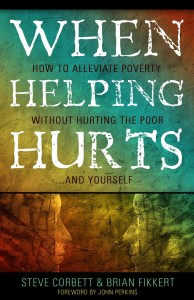
    It’s taken me nearly a year to work through the book, “When Helping Hurts.” The content and concepts weigh heavy on my heart.

    In my neighborhood the poor are easy to find. While not in the open, once you have eyes for it, you see poverty everywhere.

    We have people who squat in abandoned houses nearby. Another man lives in old RV in someone’s driveway. There are several people who live in their cars at the park. And the truly down-and-out sleep in bushes next to a fence of an abandoned shopping center. And that’s just the homeless.

    Poverty is big and real and within 100 yards of my house. And I wrestle with even the first step of a response to the point of paralysis.

    Here’s my current wrestling points:

    • I can’t serve the poor as an excuse to share the Gospel. I don’t have the stomach for it. When I’ve done that it’s felt self-serving. As if the point of serving was so that I could feel good about myself for having shared the Gospel?
    • Putting myself in the shoes of the poor, would I want to be preached at or guilt tripped in exchange for a handout? What if they are more faithfully living out a life with Jesus than I am? Who am I to think that someone else is more needy of a benevolent God than I am?
    • Do handouts really help people at all? Is that the most honorable way we can serve the poor?
    • Maybe serving the poor, taking a posture that I’m OK and they are not, reveals that I worship the gods of comfort and stuff and not the God who died penniless? Is being poor the enemy?

    Here are my starting points:

    • It doesn’t have to be big. I’ve started by simply being kind. As I ride my bike to the trolley each morning I’ve slowly gotten to know some names and begun exchanging pleasantries. It seems like just acknowledging someone’s humanity is a plausible first step.
    • Presence and consistency are probably more useful than handing something out. It’s easy for me to make a sandwich to hand out each day or maybe keep a couple dollars in my pocket for along the way. But I would have no way of knowing if that’s what they need or would give them dignity if I don’t actually know them.
    • My car doesn’t help me see them. Life wasn’t meant to be lived in the cocoon of a private car traveling at 35 mph. We are social creatures and we are slow creatures. Walking places in my neighborhood or riding my bike here and there has slowed me down to notice things/people/systems I wouldn’t notice in a car.
  • 10 Simple Ways to Change the World in 2011

    You don’t have to be the President of the United States, Bill Gates, or Bono to change the world. Here are 10 simple things you can do to help make the planet a better place to live in 2011 and beyond.

    1. Become a mentor or tutor to an at-risk youth. Every community has students who need help. For just a couple hours per week you can make a huge difference.
    2. Shop local. Skip the big box retail stores/restaurants for local establishments. While you might not get the best prices or the widest selection, you are investing in the future of your community.
    3. Start a garden. Even if it is just a square foot garden on your apartments balcony. Everything you grow and eat makes a big difference.
    4. Loan some cash to a small business owner using Kiva. Starting at just $25, supporting small business owners in developing countries is literally giving freedom from oppression.
    5. Buy a share in a Community Supporter Agriculture farm. (CSA) Redirect some of your grocery bill directly to the farmer by buying a share. You’ll get farm fresh fruits and vegetables and you’ll help ensure that local farmers stay in business. Shocker: Our grocery bill actually went DOWN in 2010. CSA’s are in every state, find one here.
    6. Get to know your neighbors. This is the single most important thing you can do to ensure your neighborhood is a safe, friendly place to live and raise your family. Start with the basics– name, how long have the lived here, where did they grow up, what do they do for a living. Then sit back and be amazed.
    7. Pick a local board and attend their monthly meeting. Most people only go to city council, zoning board, or school board meetings when they are mad. Choose a board of locally elected officials and go to their monthly meeting, just to learn the issues facing your community. It’s amazing the voice you will gain just by showing up.
    8. Convert one week of vacation to a week of service. Naysayers call this a twisted form of tourism. That’s all they are– naysayers. If your heart is to serve, you can give a week of service in nearly any place around the world. I’ve learned from experience that this is the most rewarding/relaxing type of vacation available.
    9. Step down to allow someone else to step up. If you hold a position of leadership, maybe this is a good year to intentionally raise a new leader while you still stay involved. I think you’ll find that this is what it really means to be a leader.
    10. Support local middle school and high school sports. You don’t have to give money! Just show up and cheer for your local team.
  • 10 Ways Your Church Can Be Good News to the Neighborhood

    I have a fervent belief that if we want to reach a post-Christian society, we have to be Good News before someone will listen to Good News.

    Here are 10 ways you can begin transforming your church into a place where Good News flows from:

    1. If you have a building, offer a public bathroom and shower that’s open to whomever needs it during your office hours.
    2. Ask every attendee to get in the habit of bringing a canned food item (you get the idea) to church every week. Then start a food pantry that’s open a couple days a week for people to drop in.
    3. Buy things for the church from local suppliers. Avoid the big box (probably cheaper) stores for ones that support a local company. Encourage your church attendees to do the same.
    4. Encourage people who go out to lunch after church to be generous with tipping servers and conscious of how long they are staying. You want wait staffs to desire the church crowd, they are avoiding it at all costs now.
    5. Require church staff to live within the area you are trying to reach.
    6. Add a requirement to all board and staff job descriptions that they attend public meetings. (Schools, city planning, city council, county government, etc.)
    7. Ask adults to volunteer at the public schools. (Give staff lots of freedom to volunteer)
    8. Participate in organized community events. Cleaning up, planting flowers, helping with parades, etc.
    9. Make church property open to the public. (Playground equipment, skateboard park, community garden, host local festivals, allow the schools to hold events in the auditorium.) Better yet, turn all of your property into a community center.
    10. Create a culture of saying yes to community involvement instead of no.

    These are my ideas. What are yours?

    How can your church (and the people who go to it) become Good News to your neighborhood?

  • Collaborate Locally

    Photo by jerobins via Flickr (creative commons)

    Among my people, the evangelical tradition, is an inbound weakness of separation. As a result our people naturally fracture.

    We tend to think that good leadership is creating a culture of people who agree with us– precisely. And seperating over something is seen as a sign of strength.

    Need to understand this better? Study the history of how most U.S. Denominations were created. Many were formed after one group of people was dissatisfied about something unrelated to the Gospel. (Sin of personal preference)

    We have it backwards.

    Read Revelation 2-3.

    Jesus will judge us on our ability to build the Kingdom in our community.

    Jesus is not impressed with our ability to separate locally and collaborate nationally.

    He is impressed with our ability to collaborate with people we may not always agree with and reach our community.