Tag: matthew 7

  • Love God, Hate People

    In 2003, on my last day attending the first church I ever worked at, an elder cornered me in the parking lot in an attempt to affirm me. “Adam, one thing I really like about you is that you seem to really love all different types of people. Where did you learn to do that?” 

    Stunned, I didn’t know another way to say it. “I learned that from Jesus in the Gospels.

    Sadly, in the 18 years I’ve been involved in church life, I’ve learned that there are far more Christians defined by their hatred for people than there are those defined by their love for all people.

    Do not judge, or you too will be judged. For in the same way you judge others, you will be judged, and with the measure you use, it will be measured to you. Matthew 7:1

    God is bigger than my opinion

    We live in an age of opinions. Everyone has something to say about everything. And since we live in a reactionary society with an instant ability to speak our mind to thousands of people via Twitter, Facebook, and the like. This means we live in rude, violent times where the tongue is not tamed. (James 1)

    To make matters worse, we live in a time of great pressure. When people are under pressure they reveal their weaknesses. Money is causing some of this pressure. But so is an open acknowledgement that some of the stuff we’ve done successfully in the past is failing today. And while that pressure, in community, should fuse us together to make a diamond it is too often burning away and leaving worthless coke.

    As I read Jesus’ Sermon on the Mount this morning one thing stuck out to me: I can’t love God and hate people. It’s impossible.

    I don’t have the right to hate a single person. I’m not the judge of anyone. I’m not better than my neighbor. Instead, the Gospel lives through me when I practically acknowledge with my actions that my neighbor is worthy of my love and service. To hate my neighbor would be to hate the God who created my neighbor.

    My opinions aren’t really that important to God. I won’t one day get a pat on the back from my Heavenly Father for having a great apologetic for the matters of the day. I won’t impress Jesus with my ability to divide people over things that don’t really matter.

    But if I love my neighbor. But if I serve my neighbor. Then what? 
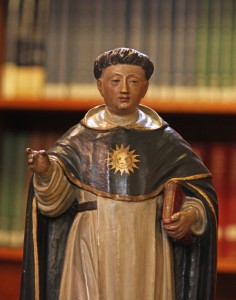
  • Grace is a form accidental to the soul

    Any substance is either the nature of that of which it is the substance, or a part of its nature. In this sense, matter and form are both called “substance.” But grace is higher than human nature. It cannot then be its substance, nor yet the form of its substance. Grace is a form accidental to the soul. What exists as substance in God occurs as accident in the soul which shares in divine good, as is obvious in the case of knowledge. But since the soul shares in divine good imperfectly, this participation itself, which is grace, exists in the soul in a less perfect mode than that in which the soul exists in itself. Such grace is nevertheless nobler than the soul’s nature, in so far as it is an expression or sharing of the divine goodness, even though it is not nobler than the soul in respect of its mode of being.

    Nature and Grace, Thomas Aquinas, Summa Theologica, Question 110 Article 2

    Photo by Lawrence Lew via Flickr (Creative Commons)

    Four questions:

    • Is grace a quality of the soul?
    • Was it in us at birth?
    • Is every action of grace learned behavior?
    • Or is it given to us as an exhibition of the Holy Spirit’s work through us?

    Last night, I was driving home from Costco and Ikea with Megan, and we listened to an interview with Jessica Chastain about her role in Tree of LIfe. She made a few interesting points which I’ve been chewing on.

    • The film is spiritual, not religious as it’s not calling someone to conversion. I don’t know if she was just trying to be politically correct or not. But Jesus made an important distinction between those who know about God and those who have a relationship with God in Matthew 7:21-23. In Jesus’ eyes, knowing about God without looking to conversion is pointless.
    • Grace is at war with human nature. I really like this distinction. It’s not Ms. Chastain’s– she doesn’t take credit for it, it comes from Aquinas. Her example had to do with getting slapped. When you are slapped by someone your nature’s response to to fight back. But graces response is to return a slap with love and compassion. What’s revealing to me about that is how little of that I see in Christian culture. Oh, that we may be a people who respond to one another with love and compassion.
    • Grace is not owned by Christianity. While Ms. Chastain made an attempt to argue that grace is a universal religious expression she couldn’t be further from the truth. This is a uniquely Christian response. While I’m certain other religions have a form of grace… the response she described  is uniquely Christian grace.

    Here’s what I know: When God’s grace shows up it takes your breath away.

    You experience it or you witness it and– in your humanity– you try to replicate it in how you live your life.

    But when grace arrives and it’s from God it comes out of no where and leaves you in awe.