Tag: mission

  • Sometimes You Have to Cheat the Church to do Ministry

    Let’s start with this reality. If you think ministering to teenagers is easy, simple, turnkey, low commitment, or something you can package into a program you are sunk. 

    That’s why I’d rather teach youth workers transferable principles than give them prescriptive solutions to the things that I talk about.

    Question: Adam, I just read your Immerse Journal article about re-embracing the priesthood of all believers and I don’t know where to start. Can you give me five action steps?

    Adam: No. Because if I give you what those 5 things are for your ministry that’s all you’ll hear and you will ignore what the article was challenging you to do… reject the preisthood of the staff and embrace the high trust, low control environment the New Testament teaches.

    I’m OK with ideas. And I’m OK with exploring case study. But giving you 3 quick things to try to get your students excited about their relationship with Jesus? It’s just not that easy.

    Entertainment vs. Transformational Ministry

    At this year’s National Youth Workers Convention I made an intentional, strategic decision about my time. As I hung out with my fellow youth workers between my seminars, at meet-ups, and so on I knew I wanted to get past the “nice to meet you and connect a face to a name” spot and talk about this concept of looking for philosophical, missiological solutions to the problems our ministry is facing. Maybe you don’t need a new small group curriculum? Maybe you don’t need a new worship display device or a new way to design t-shirts? I tried to guide these conversations to one of philosophy of ministry– maybe what you need isn’t a round of encouragement but and encouragement to stop working so hard on a strategy that makes you tired?

    At the same time I’m always careful to point this out. We know it’s not the church that is the problem. We know it’s not that the program is bad.

    It just isn’t enough. Jesus didn’t give his life so we could create religious organizations and programs to serve people interested in attending an institutionalized church and it’s programs.

    Jesus died for something so much bigger and better, didn’t he?

    Sometimes You Have to Cheat the Church to do Ministry

    A few years ago Andy Stanley shared a message at the Willow Creek Leadership Summit with the main point being about family. He said, “Sometimes you need to cheat the church for your family.

    Agreed. We all need to embrace the reality that our job is just a job and it can’t take over our life.

    Yet, as I meet more and more frustrated youth workers stuck in the reality that their employment is tied to running a program only 2%-5% of the general population is interested in, my encouragement becomes… “Maybe you need to cheat the church to do ministry?

    In other words: Maybe the solution to your frustration with your role running the program is to give it less of your time so you can redirect your time to reaching the lost in a missiologically appropriate way for your context?

  • The Mission of Less

    Planet Wisdom Chicago was great. 2000 kids slammed into a building to be challenged by the word of God is always awesome. Going into it I knew that the team was passionate about the conference and I saw first hand why. It’s really cool! Lives were changed. It doesn’t get any better than that.

    At the same time I felt really challenged by the church that hosted. It was one of those brand new megachurch $10 million deals. I don’t know how long it has been open but it was massive and it was gorgeous. It had that new church smell. And I thought to myself, “I’m glad I am not on the leadership team of this church.” I would never question the integrity of a church leadership team and I am certainly not doing so now. Yet, I wondered how I would process the excess as it correlates to the excessive need of the gospel in their community. Would I have stood behind the decision to build? This is more a reflection of where I am in my walk with the Lord than it is an indictment on a church. In fact, I want to fully acknowledge that I am positive that it’s a great building for them. And I want to make it clear that I am positive the gospel is advanced as a result of that church. And this post has way more to do with big church buildings generally than it does the particular church who hosted us. Moreover, driving around the Chicago suburbs that particular church merely did what dozens of others did… build a bigger building to better suit their needs. OK, enough apologizing for what I’m about to say!

    Here’s what I was left thinking about. For $10 million how many churches could they have planted in their community? For $10 million how many kids could they mentor at the local schools? For $10 million how many homeless people could they feed? How many families could they help? Assuming they paid cash for the building, for the $10,000-$20,000 per month it likely costs to heat, cool, and light the building how much kingdom work are they prevented from doing with those same dollars?

    Now that we go to a church with no building, my perspective has changed. All of my life I’ve said “the church is the people and not the building.” And yet fiscally, the churches finances reflect that the church is the building and the staff. (90% of spending, more or less.) When a person diverts giving to advance the kingdom, a building based church says “No, that money needs to pay our light bill! We have staff to pay!” And as a result the kingdom work the Holy Spirit has compelled a giver to give towards is thwarted by a churches building needs. Now that we go to a church with no building, we can worry about building the kingdom of God in our community and not a building. It’s freeing and wonderful and we are thankful for this time that God has placed us here.

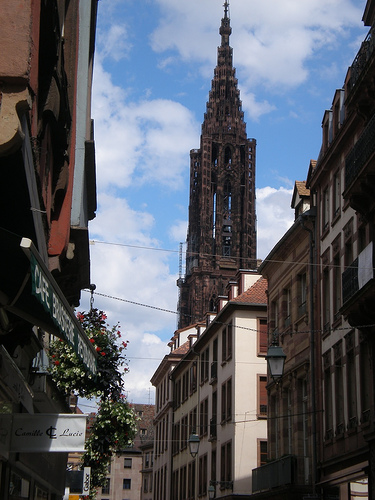
    As I’ve shared before, my perspective on big fancy churches always makes me think of my time in Europe. Congregations spent generations building trillion dollar cathedrals that are largely empty today. They were so busy showing their community that they were the city on a hill that they forgot to be the city on the hill!

    What do you think? Is a big, nice building needed to advance the gospel? Or is it preventing the people from being the church?