Tag: poverty

  • Homeless Teenagers Among Us

    [Video enclosed]

    The poverty rate for those under 18 will soon hit 25% in America.

    This video from 60 Minutes broke my heart yesterday. While riding the trolley to work I listened to the audio and wept.

    16 million kids in our country are currently living below the poverty line. That’s an increase of 2 million in just 2 years as families slip from “middle class” into poverty.

    It’s where you live. In your city, town, suburb, gated community, or rural area. And it’s people who never thought they’d struggle. And certainly never thought they’d become homeless.

    As the video shows, millions of kids are now homeless. We hear about foreclosures and we think of the housing market. We forget that those are also displaced people. Families who lost everything.

    5 Ways You and Your Church Can Respond

    As I listened to this story, I thought about how can the church NOT respond?

    I thought about how churches and youth ministries could easily do a few things that could make a big difference. Ministry life just can’t go on as normal with a quarter of the families in our community unsure where their next meal might come from, or unsure if they can stay in their apartment another month, or unsure if they can even keep their families together.

    It’s one thing to preach Good News. It’s another thing to actually be Good News.

    What are some things you can actually do?

  • Start a food closet. There isn’t a church door in America that doesn’t get knocked on every week asking for food. If your church doesn’t have a food closet, start one. If the church doesn’t want one, just start bringing non-perishable food items to church every time you visit. They’ll figure it out when it starts to pile up.
  • Get out of your car and look around. In your routine where you drive everywhere, you won’t ever see the problem among us. Stop driving everywhere! Commit to start walking or riding a bike, and you’ll see things you never thought existing in your community. It’ll do your heart good.
  • Take a family in. There’s a part in the 60 Minutes piece above where they say that most families foreclosed on move into a neighbor or family members house. I know it’s easier to pretend you don’t see what’s happening. But a lot of people in a lot of churches have more bedrooms than people in their homes. Maybe you’ve got a big crib for a reason?
  • Convert some classrooms into temporary housing. It’s sickening how many churches have so much space that goes unused for 6.5 out of 7 days. Spend a tiny amount of money to convert under-utilized space into temporary housing for families so they don’t get split up. Convert a bathroom stall to a shower, buy some used basic furniture, and allow families a place to regroup for 60-90 days.
  • Open your youth room 5 days per week after school. There are some things that are so simple to do, yet we don’t do it because we get hung up by thinking too small. It would cost you nothing to have a volunteer staff your youth room after school every day from 2:30 – 5:00 PM. Hang some signs up at the middle and high schools. You already have space, just make it available to kids who need a safe and quiet place to study overseen by a caring adult.
  • How about you? What are some things you can do, as an individual or as a church, in the next 30 days?
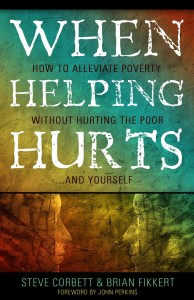
  • How do we minister to the poor with integrity & grace?

    It’s taken me nearly a year to work through the book, “When Helping Hurts.” The content and concepts weigh heavy on my heart.

    In my neighborhood the poor are easy to find. While not in the open, once you have eyes for it, you see poverty everywhere.

    We have people who squat in abandoned houses nearby. Another man lives in old RV in someone’s driveway. There are several people who live in their cars at the park. And the truly down-and-out sleep in bushes next to a fence of an abandoned shopping center. And that’s just the homeless.

    Poverty is big and real and within 100 yards of my house. And I wrestle with even the first step of a response to the point of paralysis.

    Here’s my current wrestling points:

    • I can’t serve the poor as an excuse to share the Gospel. I don’t have the stomach for it. When I’ve done that it’s felt self-serving. As if the point of serving was so that I could feel good about myself for having shared the Gospel?
    • Putting myself in the shoes of the poor, would I want to be preached at or guilt tripped in exchange for a handout? What if they are more faithfully living out a life with Jesus than I am? Who am I to think that someone else is more needy of a benevolent God than I am?
    • Do handouts really help people at all? Is that the most honorable way we can serve the poor?
    • Maybe serving the poor, taking a posture that I’m OK and they are not, reveals that I worship the gods of comfort and stuff and not the God who died penniless? Is being poor the enemy?

    Here are my starting points:

    • It doesn’t have to be big. I’ve started by simply being kind. As I ride my bike to the trolley each morning I’ve slowly gotten to know some names and begun exchanging pleasantries. It seems like just acknowledging someone’s humanity is a plausible first step.
    • Presence and consistency are probably more useful than handing something out. It’s easy for me to make a sandwich to hand out each day or maybe keep a couple dollars in my pocket for along the way. But I would have no way of knowing if that’s what they need or would give them dignity if I don’t actually know them.
    • My car doesn’t help me see them. Life wasn’t meant to be lived in the cocoon of a private car traveling at 35 mph. We are social creatures and we are slow creatures. Walking places in my neighborhood or riding my bike here and there has slowed me down to notice things/people/systems I wouldn’t notice in a car.
  • Correlating Poverty to Religion

    Image by Charles M. Blow / New York Times

    “A Gallup report issued on Tuesday underscored just how out of line we are. Gallup surveyed people in more than 100 countries in 2009 and found that religiosity was highly correlated to poverty. Richer countries in general are less religious.”

    Interesting stuff.

    Jesus told the rich man, “If you want to be perfect, go, sell your possessions and give to the poor, and you will have treasure in heaven. Then come, follow me. When the young man heard this, he went away sad, because he had great wealth.” Matthew 19:20-21

    Second thought

    I’d really like to see a similar chart correlating the amount of money a religion spends vs. the number of participants per capita. I have a feeling that all of the spending in westernized Christianity doesn’t correlate to increased impact.

    HT to How to Break Anything & New York Times

  • Christmas in the City

    Yesterday our church hosted an event called Christmas in the City. It was one of the most unique expressions of God’s love I’ve ever witnessed.

    We are an unashamedly urban ministry. Situated in City Heights, a diverse working poor community, we reach out to the neighborhood in ways that just wouldn’t work in the suburbs. This is a great example.

    How it works

    The organization that actually presents Christmas in the City [er, I forgot what it’s called!] encourages church, schools, and businesses to give toys in a way that is very similar to Toys for Tots or Operation Christmas Child. Additionally, previous year’s proceeds go to purchase more toys.

    On the day of the event volunteers from all over come to to create a store, checkout areas, and wrapping stations for the presents. Additionally, our church set-up some play areas, snacks, live music and activities for shoppers and their kids to enjoy while parents shopped.

    This is where the line comes in. Since they’ve done this event for a few years people in the city know and depend on the sale to buy gifts for their kids. So think of this line a lot like a Black Friday line. People literally showed up at 7:00 AM for this event… which started at 12:30 PM. Thankfully, this was more civilized than a typically line at Wal*Mart.

    When the store opens, gifts are sold at 10-20% of retail prices. ($2, $5, or $10) The idea behind Christmas in the City is that they don’t just want to hand parents a random gift to give to their children for free. While that is nice and many organizations do that, this is different in that they allow parents to choose some gifts for each of their children and also give them the ability to buy presents for their kids. The hope is that by doing it this way they can help the working poor while helping the recipents maintain their pride and dignity. They chose the gift. They bought it with their own money.

    How did it go?

    I had read about this type of event in community development books. So I had some idea that there would be a big line, that there would be a lot of toys, that there would be a lot of smiles.

    I guess I wasn’t prepared for the volume. On a typical Sunday our church has 150-200 attendees. (About half non-English speaking, the other half English speaking.) There were at least that many who were in line to come to the Christmas shop. Tons of different ethnic background, tons of different stories, tons of people helped.

    Another thing I wasn’t prepared for was that we’d have to turn people away. I know the need is great out there… but I never presumed that we wouldn’t have enough gifts for those who would come. We could have easily sold twice as much stuff! Now that I know how it goes I think I’ll have to do a better job promoting how people can get involved.

    I’m still getting the pictures and video together. I will share that when I have it all ready.