Tag: small groups

  • Blessed are the nobodies

    At that time Jesus, full of joy through the Holy Spirit, said, “I praise you, Father, Lord of heaven and earth, because you have hidden these things from the wise and learned, and revealed them to little children. Yes, Father, for this is what you were pleased to do.

    Luke 10:21

    Jesus gave the ordinary extraordinary power as he prepared them to do his work. A massive decentralization of power. (Even the demons submitted to their authority, v. 17)

    ‘Love your neighbor as yourself.’

    Luke 10:27

    Jesus didn’t say to love everyone the same. He said to love your neighbor as yourself. That’s not as crazy as it sounds if you think about it.

    • Jesus took power away from the somebodies.
    • Jesus took position away from well-positioned.
    • Jesus took hospitality serious and dropped bombs on those who didn’t.
    • Jesus removed barriers to getting involved in the messiest of ministry.
    • Jesus weeded through the fans to find the followers by raising the bar, not lowering it.
    • Jesus used priests and levites as the butts of his jokes.

    These were the observations and learnings of my high school small group last night. Reading the Bible, out loud, and in community… it’s pretty powerful. 

    This post isn’t a commercial for Community Bible Experience, but if you want to try it… CBEmini is a free 9-day taste of CBE walking your small groups through Luke-Acts.

  • Free their minds…

    Free their minds… and their hearts will follow. (Sorry En Vogure, I changed it.)

    Is the primary task of my ministry to cram as much of what I know into their heads or is it to teach them how to think? Rhetorical, right?

    Wrong. My actions say the former while my brain says the latter.

    Think about the typical day of your students as it relates to adults.

    • Early morning: An adult tells them to get out of bed and get ready for school. (Either by word or edict)
    • Morning: A parent tells them to get in the car, get out of the car, to have a good day, etc. If they ride the bus they might make a couple words of small talk.
    • School: Adults are largely in charge of the classroom and do most of the talking.
    • Between class time: Students cram a few minutes of conversation with friends as they dash from place to place. (Adults dictate the parameters of this.)
    • After school: Coaches instruct, students listen and obey.
    • Home:Have you done you homework? Your chores? How was your day? Tell me about….

    To overgeneralize, most interaction students have with adults is either structured or adults talk at students. They are almost always put in a position of learner or otherwise lack power.

    We would all say that they have power to own their faith. But are our interactions with our students validating that or putting them in a powerless position?

    It’s relatively rare that a student would have a conversation with an adult.

    It’s even more rare that a student would have a conversation with an adult where the adult does the majority of the listening and the student does most of the talking. (The adult in the lesser role while the student is in the power role.)

    Shaddup Already!

    As this Fall has ramped up and I’m starting to get to know my small group of guys my inner dialogue is, “You don’t need to talk at, just listen. Listen. LISTEN.

    The best thing I can pass along isn’t what I know. It’s how I think. I don’t care that the guys in my small group know what I know or have answers for everything we’re talking about. But I desperately want them to know how to find stuff out for themselves, to compare and contrast what people are saying, to not just grab wisdom for the sake of acquiring knowledge but actually discovering the source of wisdom.

    Sure, I want them to know what God’s Word says about this and that. But I really want them to know how to wrestle with things in a way that moves/changes them.

    Curate vs. Dictate

    I can’t do that if I do all the talking. I’m not helping them learn how to think critically if I tell them what I know. They will only grasp hold of their faith, truly own it, if they can articulate it for themselves. That means I am not in their lives to tell them the answers. I am there to teach them how to find the answers themselves. 

    My theory is that I need to talk less and less for them to think more and more. That means my job is less to provide answer and more to create questions. Which is good. Because I have lots of questions. And I’m really good at creating doubt.

  • 5 Steps to Finding Family in Your Community

    Divorce. Single parenthood. Extended singlehood. Living away from home. Broken relationships. Loneliness.

    None of these are surprises. None of these are ideal. All of them are our reality and bond.

    All of them are (by design) normative in the body of Christ. (James Dobson’s ideals are great. But they aren’t our reality.) We are a people tied together primarily by our brokenness. The church is the only institution on the planet where everyone is on the same playing field. We are all sinners. We all admit that left to our own devices we’d screw it up so we have a desperate need for a community that can help us screw it up less. That’s our bond as believers. We need each other because we are busted.

    And yet– sadly, working in a church is one of the loneliest jobs in America.

    It doesn’t have to be that way.

    Without sounding like a 5-step program too much– here are 5 hard steps you can take to find community (and, ultimately contentment) while working on staff at any church.

    Step One

    Admit you aren’t perfect, can’t be perfect, and are lonely. No really. It starts with a healthy understanding of who you are and your lot in life. One of my frustrations with making pastors look like celebrities is that too many pastors start to believe that their poop doesn’t stink. (Conversely, to aspire to be a “great pastor” you have to pretend that you fell from heaven onto a community and you have no needs and you somehow embody a perfection that you really aren’t.)

    You aren’t bulletproof. You need friends. You need accountability. You need people your own age in your life. Admit it.

    Step two

    Find people your own age. This one makes people’s head tilt 10 degrees to the side when I say it. “My youth group is like my family.” No, they aren’t. They are adolescents and you are an adult. Not only is it really unhealthy for your long-term health for you to consider the youth group your family because they graduate and go to college– it’s creepy for an adult to depend on a bunch of students to be his family. Creepy with a capital C.

    Find people within 10 years of yourself. (On average) Honestly, common interests are cool but not really primary.

    Note that I’m being careful to say that you don’t need to find this in your church. It’s great if it can happen there. But I’ve worked at smallish churches my whole life and I know that there might actually not be a group of adults in your age range. But every community has people your age. You might just have to do something outside of your church. Join a softball team or a golf league or something going on with people your own age and go there. (Just don’t go dancing, that leads to sex.)

    Step three

    It’s better when you aren’t in charge. I don’t know why… but for us the magic mojo of our finding family/community in San Diego has been that I’m not in charge. The joke has been, “we’re just the hosts.

    I think the truth is that we, as pastors, like to be in charge a little too much. We want to set the agenda. We want to be the center of attention. We want to be the expert. We love it when everyone looks to us. In short, we have a validation problem. We hide behind the persona and expectation because we like it and feed off of it.

    But you will never feel like part of a community if you are walking around thinking that you are the man on the white horse who has come to save the town from itself. All you are really doing is walking around with a false view of yourself and leaving yourself on a very lonely island. (And I know too many pastors readily fired who have made themselves entirely expendable at their church by living on a very long island.)

    Step four

    Develop inter-dependency. A false presentation of who we really are (see above) leads us to think we don’t really need to depend on our community of friends. (And elevating our need to develop dependencies on our work. Raise your hand if you’re a work-aholic.)

    It’s OK to be a pastor and have needs that you have to depend on others for. It’s OK to admit that in the safety of your community. In fact, what you will discover is that once you level the playing field and admit that you need to depend on people– you’ll actually be a seen as a much stronger leader. This goes beyond just depending on people to do stuff for you. This means that you’ll need to join and participate in being part of a family as an equal. You know, be a servant to your friends and allow them to reciprocate. Just as you need to lean on other they need to be able to lean on you.

    The question being answered by every single person over and over again about you (and behind your back) as a pastor is, “Is that person for real?” When you become part of a community of people (aka– a family) that really knows you, where you can just be Adam and not Pastor Adam, then those people will help answer that question in a way you’d like it answered. “Yeah, Adam is a legit guy. He and Kristen have their struggles, but they are just like anyone else.” That’s a whole lot better than, “All I really know about him is what he’s preached. He keeps to himself.

    Step five

    Relax, you’re with family. The goal is simple. You know you’ve arrived when you’re just a dude (or dudette) with a job. (And people aren’t saying, “I’m in the pastors group.“)  It will hit you when you get there.

    And you won’t be healthy in a community until you find a group of people who look at you as such. My goal every time our community group (our real family in San Diego) gets together is to shut up and listen. Literally, that’s what I’m telling myself over and over again as I prepare for Monday night. “Shut up Adam, no one cares.” But these people really do care about Kristen and Adam– the family that hosts us on Monday nights. That’s how I know we’ve arrived.

    This is more important than any job you are doing

    Everything you do as a pastor depends on your health emotionally and spiritually. If you don’t have this, stop everything! Your ministry will not succeed until it flows out of a healthy life.

    The simple reality is that you need a place to just be instead of being the pastor. And I think I’ve shocked people when we sit across the table for coffee and I tell them this has to become their #1 priority.

    Yes, I’ve even told people they need to stop being a pastor if they can’t make this happen.

    It’s that important.

  • Cool book for small groups

    Earlier this year I posted a review of Tony’s Jones book about the Didache.

    I’m still thinking about this book and its effects on community life.

    So take this as a random recommendation. If you’re in an adult small group and you are looking for a book to get your group talking about what it means to be an authentic community– The Teaching of the Twelve is what you are looking for. It’s only about 120 pages, I read it in two sittings.

    I know, I know, I know. A lot of people see or hear the name “Tony Jones” and that makes them think of all the controversy. Read my review from February as I hit that head on.

    After you read the book you may need to re-think what you think about Mr. Jones. I know I did.

  • 3 Things I Love About My Community Group

    When Stephen asked us to host a small group at our house, one week after attending Harbor Mid-City for the first time, we begrudgingly agreed. In fact, when he told us that Harbor was a church consisting of a few community groups… we were skeptical.

    My faith in small groups had been shaken. I was pretty close to making the statement public that I’d felt for a while… “Small groups don’t work.” Most of my adult life I had either lead a teen small group or adult small group and they had always functioned but never “worked” quite like the books on small groups said they would. We had always met, done some sort of Bible Study, prayed for one another, shared food and some laughs– and that was it. The community thing never happened. The caring for one another or feeling connected… it never happened. Those groups were functional and great, but left me longing for that small group experience everyone talked about in the books.

    I wondered if small groups were a myth!

    Then I met these people. I don’t know how else to explain it but our group just gelled and it’s been a great group from our first meeting. Here’s a few things that I love about having the group at our house each Monday night:

    1. We keep the agenda in check. The agenda is that we’re in community together. There is likely a church agenda. Probably that we’d talk about the Sunday sermon or that we’d pray for one another. And sometimes those agendas converge while other times they don’t. Our group has done everything from adopting a refuge family to watching Monday Night Football. Most often we get together and talk about the past weeks message and pray for one another. We’ve had incredibly deep conversations and we’ve had a chili cook-off. I actually think the magical component that has made our group work is keeping the community agenda the only important agenda while keeping all the other agendas in check.
    2. We’re game for “one another. The core people of this group hasn’t changed that much in the last 12 months. In that time we’ve welcomed probably 25 different people who’ve come and gone. That really is how small groups go. Heck, that’s how churches roll! I don’t know exactly how to describe it, but this group has really taken care of one another.
    3. We don’t take ourselves very seriously. Last Monday, we spent about 10 minutes joking about the name of the restaurant we’re having lunch at on Sunday, Pho King. (Pho is a Vietnamese soup meal, pronounced “fu,” exactly like the first half of the F word.) We talk about serious things. We have serious moments. But laughter and hilarity are always within reach.

    Each Monday, on my way home, I think to myself… “I’m glad it’s Monday.” This little group has been a testament that small groups can work.

  • The greatest small group night ever

    ob_small-group1I’ve done small groups in one form or another most of the last 15 years. I’ve been in high school, college, and adult small groups. I’ve lead middle school, high school, college, and adult small groups. I’ve always wanted a small group that gelled and did awesome things… and I could never make it happen as a leader. Just when I had nearly given up on small groups, along came Harbor and my stupid insane idea to say “yes” to hosting this group after visiting a church one time.
    It’s been about 8 months and I can’t imagine a better community group to be a part of. I’m growing. We’re growing. And I think we’re making an impact on the people around us. Moreover, I can’t think of a better church to be a part of in this season of my life. That may sound like hype… but you need to understand what happened tonight to see why I dig Harbor so much.

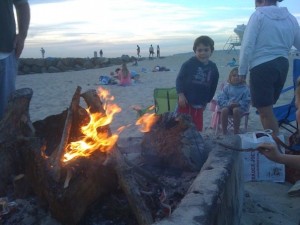
    Last week we decided that it would be fun to meet at Ocean Beach for a bonfire. For those who read this outside of San Diego all you need to know if that OB is kind of a leftover surfer area full of artists, hippies, beach bums, and those who can afford to live down there who probably secretly wish they were one too. The beach has these fire pits that are open to the public, just bring wood and claim one and you’re good to go.

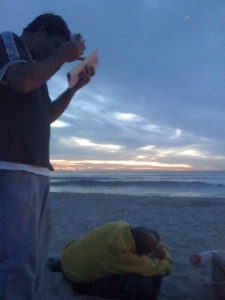
    ob_small-group2So our group met at 6:30. In typical form everyone brought something. Wood, hotdogs, a cooler full of water, etc. We got our fire going and started to enjoy an awesome sunset laughing and catching up. Then Keith showed up. Keith is a homeless guy who asked if he could sit by the fire. Soon enough another person from our group struck up a conversation like he’d known Keith since grade school. Hotdogs eaten, water drunk, more sunset enjoyed. Pretty soon Keith asked us why we were hanging out at the beach. He didn’t really wince too much when we told him we were a small group from a church. “So, what do you guys talk about?” That’s when Richard pretty much told Keith the entire sermon from the day before. He read all of the Scriptures and then retold him all of the illustrations and all of us agreed… we were pretty much hypocrites and we were construction zones… we all settled on Stephen’s description of “holy mess.” Yeah, that pretty much explains me too.

    Just when we were all settled into a nice quiet moment another person shows up. This sort of thing happens in OB all the time. (This kind of thing happens to our community group all the time as well.) 10 people having a good time on the beach naturally draws others looking for a good time. So a guy walks up with a couple of his friends. “Hey, would you guys mind if I practiced my fire twirling?” Um… no!

    So here we are. A hodgepodge group, a holy mess, huddled around a fire enjoying s’mores, the perfect sunset, waves traveling thousands of miles across the open ocean and crashing on the shore 50 feet in front of us, and a guy with a boom box twirling fire. “This is the best night ever,” Amy says. She’s right. We all exchange high fives. He does his performance while we all look on. His friends are not sitting with us but are cheering him on. After a couple of routines our entertainer comes over to us and says, “You are in for a treat… a lot more people are coming.

    ob_small-group3Within 15 minutes ten more fire twirlers show up. Each of them has a few of their friends. 20 or so of us huddle around the fire while people with flaming sticks, fireballs, and numbchucks wait their turn to show off their skills. More hotdogs eaten by anyone hungry. More s’mores by those who needed a sugar fix. And our hodgepodge small group, the holy mess, is completely surrounded by awesomeness. We’re all grinning ear to ear.

    Fire twirlers, hippies, girlfriends, and us. I post a couple of pictures and tweets onto Twitter… and my co-worker Mandy and her husband who live in OB come walking over. How could they resist, right? That’s when it hits me: This is the best small group night ever in the history of human existence!

    You can’t put small group mojo in a bottle. You can’t buy community at a conference. All of the training in the world couldn’t put this magic in a bottle and sell it. We’ve got the real deal in our community group and all we can do is enjoy it.

    As Kristen and I pulled out of the parking lot we roared with laughter. We knew full well that in most ministry contexts, including the ones we’ve served in, tonight would be viewed as an utter and complete failure. “What do you mean you had a bonfire? What do you mean you just talked to a homeless man all night? What do you mean you watched people twirl fire? I heard there were people their smoking drugs, is that true?” I’m glad to be a part of a church looks at tonight and screams SUCCESS instead of hides in shame, calling an elder meeting to discuss how to break those people up.

    As I drove home it hit me. The magic of our small group isn’t about an agenda. Don’t get me wrong, our leaders try to keep us moving forward. It’s never been about pounding out curriculum. It’s not about the hottest small group resource or DVD series. All of those things are great and I’m happy to have them. But when a small group hits the stratophere like ours has lately… all of those things just seem irrelevant. We get together. Not as a holy huddle but as a holy mess. We invite others in. It’s infectious. We need each other and we all secretly live for Monday nights. For me, this group is a magnet. Who wouldn’t want to be in a group that dyes Easter eggs one week and hosts Burning Man the next?

  • Stumbling buddies

    Last night we hosted our first community group with Harbor. I don’t have much else to say but this.

    #1 It’s fun to host a small group after going to a church 3 weeks.

    #2 I’m looking forward to having some people like me to stumble towards a deeper walk with Jesus with.