Tag: statistics

  • Marriage can’t be the common denominator anymore

    Church programming is largely based on segmentation. In other words, most churches build their programming based on some assumptions about:

    • Age
    • Gender
    • Marital status

    There is a general assumption in church programming that when a person hits their 20s that most will head towards marriage and having kids. And for most of human history it’s been that way, so it’s not discriminatory to base programming on that assumption at all. It’s been a safe bet. (Just like it’s a safe bet that if you have a lot of young married couples you should invest in your nursery, etc.)

    But here’s the problem.
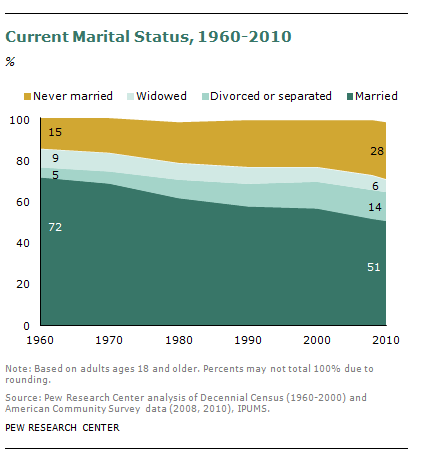
    For a wide variety of reasons fewer adults are choosing to get married. To really grasp this I’d encourage you to read Derek Thompson’s, “The Death (and life) of Marriage in America” featured in The Atlantic last week. As he says, the reason fewer people are getting married is complicated. But the basis of this discussion is that as the wage gap between men and women continues to shrink, fewer women need marriage for economic stability. I’d never thought of the washing machine as a reason for a lower marriage rate, but he makes an interesting argument!

    [Sidebar: From a Christian perspective we’d likely want to introduce sexual morality into that. But if we’re honest we know that few people, even in the church, are waiting until marriage for sex. That’s an influence on marriage but not the fulcrum we often see it as. When I do pre-marital counseling, most often, the couple is either sexually active or obviously lying to me about their sexual activity.]

    So what’s the problem with building church programming around the assumption of marriage?

    You’re eliminating 48% of the population of people over 18 automatically. They aren’t married. And with the age of first-time marriage rapidly moving towards 30 it’s safe to say that nearly half of the adults in this country aren’t walking around in a huge hurry to get married. We can lament about that all we want, but it’s the world we actually live in!

    Yet, if you listen to both the words coming from the mouths of leaders and the metastory  of assumption that every adult is either married or wants to be married, you can see why the 48% of people who aren’t married might think, “Church isn’t for me.”

    Hang out with Christian adults who are single and you’ll quickly notice that they see the favortism in the church towards married people.

    Even if you think that there should be a marriage assumption, can you see how this is a messaging problem for the church to wrestle with? Can you see how empowering the marriage assumption could be a wedge for a huge percentage of the population and what they think about God? (The church is living evidence of Christ, right?)

    Questions

    What does your church do that drives you nuts on this issue?

    What, if any, success have you had in helping your church deal with the statistical realities of the country we live in? Have you been able to adapt?

  • New ideas wanted

    The numbers are staggering.

    • 5%-10% of the population are actively engaged in church in our country. (With some geographical variations)
    • The United States population continues to grow, the U.S. Census bureau estimates that we’ll have 392 million by 2050. (Currently 307 million)
    • There seems to be an deepening inverse relationship between the amount of money spent on “church stuff” (staff, buildings, programs, etc.) and the amount of people who are active.
    • There are now so many megachurches that we need to differentiate between the mega (under 10,000) and others gigachurches. (10,000+) At the same time, these big organizations are difficult to navigate, don’t work for everyone, and are by definition not on the cutting edge.
    • Our nation continues to become more ethnically diverse. Our churches? Not so much.
    • More and more people are moving to urban centers. The mega and gigachurch movement typically does best in the suburbs. It’s cost prohibitive to build a 10,000 seat auditorium in an urban center.
    • Meanwhile, a church planting movement continues to explode in suburbs and urban contexts, starting churches of all shapes, sizes, and denominations. (Some prioritize youth ministry, but most seem to emphasize their worship service and children’s ministry, youth ministry is a necessary afterthought.)
    • Adolescent culture continues to evolve, devolve, morph, repeat and fragment. One size doesn’t fit all more now than ever. More and more there are children growing up today who not only don’t go to church, but their parents have never attended church, nor their grandparents.

    All of this to say one thing: We, the church in America, need to keep innovating just to survive!

    None of the items are “bad” except the first item. We are reaching a decreasing amount of people while our population explodes.

    All of these things are cries for new ideas, new innovation, and new adaptations.

    Why? Because we know the church is Jesus’ chosen vehicle to carry His message of redemption, restoration, forgiveness of sins, and promise of eternal life to the population.

    No excuses. Get to it.

    1. If you know Christ you are on the team. (1 Corinthians 12 implies that we are handicapped without you.) No other prerequisite is required. Soft innovation typically comes from front-line workers. Hard innovation typically comes from complete outsiders.
    2. It starts with ethnography. You need to know who your people are, what their needs are, etc.
    3. It continues with prayerful ideation and research to test your concept. Don’t go it alone, you’ll never make it.
    4. It’s empowered/driven by success stories and a healthy dose of “we’re out to stick it to the man.
    5. It’s sustained by good people doing it for the right reasons.

    The time is now. Today is the day.

    What are you waiting for?