
Tag: truth

  • I like Katy Perry’s Teenage Dream

    Currently, Katy Perry’s Teenage Dream is top 10 on iTunes. It’s huge. And I am not ashamed to admit that when it pops up on my iTunes I listen to it 3-4 times in a row.

    While I’m sure most youth workers groan when they hear this song… I take a totally different perspective.

    I want this to be my students dream, too.

    Well, not exactly— since the video leaves a lot to the imagination. Here’s what I mean by “I want this to be my students dream, too.

    • I want my students to have a fun, audacious, spontaneous, and exciting sex life. (Until they get married- “Pre-sex lives.”)
    • I want them to fall in love and be happy with that person for a long time. I want their love life to be fun, like a teenage dream.
    • I want them to fall in love early in life. I want them to grow up (meaning, take full responsibility for themselves) and get married ASAP. I believe we’re creating a self-fulfilling prophesy that they aren’t ready when they are.

    Perhaps the reason this song speaks to so many people is because we tell people to wait too long for this type of relationship? Perhaps there was no room in our lives at 18 or 19 years old for a no-regrets love affair? Perhaps our parents scared us out of teenage dreams with statistics about divorce and telling us we needed to go to college first?

    But this dream, I believe, is quite similar to God’s desire for us. The Bible is clear about sex before marriage. But it is equally clear about early marriage.

    I just know when I watch this video I think about my relationship with Kristen. We were almost 19 when we met. We took lots of walks on the beach. (aka- free dates) Outside of the motel line– that video was us! Our parents both told us we were too young and we ignored them. (Just like they ignored their parents warnings!)

    When we got married at 21 we fulfilled the dreams of this video and it was great. (Though, Kristen grew up baptist so skin tight jeans were out of the question.)

    My prayer for youth ministry is that we are crazy enough to tell our students and their helicopter parents that they need to have teenage dreams for themselves. I pray that we become culture creators and truth tellers in such a way that gives our society a wake-up call. Teenage Dreams isn’t shameful. We would not exist as a people if it weren’t for generations of teenage dreamers. We don’t need to shame teenagers from their sexuality, we need to teach them appropriate ways to embrace it.

  • Myth: God opens and closes doors

    I’ve heard this phrase to the point where I think people actually believe this is somehow a biblical concept.

    God has opened the door for me to ____.

    I was pursuing something I really felt called to, but God closed the door.

    That’s not in the Bible folks. It is a non-biblical, non-Christian philosophy called fatalism.

    I believe this little phrase, God opens and closes doors, has lead to people falsely blaming God for missed opportunities. We put this philosophy of open and closed doors above biblical concepts like perseverance, patience, and long-suffering.

    Instead, many have bought into a mentality that it’s meant to be, God will open doors. If it isn’t meant to be, God will close doors.

    Again, that’s fatalism. That isn’t how God works. Nor is it how God’s people are asked to look at the world.

    This is what God says about opening doors:

    Here I am! I stand at the door and knock. If anyone hears my voice and opens the door, I will come in and eat with him, and he with me. Revelation 3:20

    • Did David tell his friends, “Yeah, I was anointed as the next king, I don’t know though. Clearly, Saul doesn’t like me so I think God is closing that door?
    • I don’t think God cared too much about Jonah’s “closing the door” on going to Ninevah.
    • I don’t remember Jesus telling Paul the whole blinding thing was an open door to a life in ministry.
    • And a ship-wreck was clearly a “closed door” if I’ve ever seen one. But did that stop him?
    • Persecutions of the first apostles weren’t seen as God closing doors. The only door that ended their ministry typically involved lions.
    • Pharaoh refusing to release the Jews for the first 9 plagues wasn’t God closing a door.
    • Shadrach, Meshach, and Abednego had an open door to a fiery furnace. But that didn’t stop them, did it?
    • Seems like the doors were closed around old Jericho, weren’t they? Did that stop God’s people from taking action?

    On and on we see that Scripture is not fatalistic about vocation, doing good, doing right, or fulfilling our call!

    But God does work in us and through us when we persevere, when we are patient in affliction, when we long-suffer for doing right.

    God rewards the righteous. God smiles on those who seek justice. God hears and answers prayer. God wants us to seek wise-council. God’s calling is true. God can move literal and figurative mountains for the faithful.

    God calls us and asks us to depend on Him and Him alone.

    He could care less about our education. (Paul) He could care less about our abilities. (Moses) He could care less about our lack of faith. (Jonah) He could care less about our past failures. (David)

    When God asks us to do something open and closed doors are meaningless.

    If He is asking you to do something He will make a way.

    Rather than worrying about if the door is open or closed we are asked to open the door. We may have to kick it in. And we may need to buy a sledge-hammer to make a way where there is no way.

    But waiting for doors to open or doors to close is meaningly, dangerous, and destructive. The only door you should be closing is on fatalism. The only door you should be opening is to Jesus, “Here I am, use me how you want. I am yours. You are my Savior and Lord.

    Do not conform any longer to the pattern of this world, but be transformed by the renewing of your mind. Then you will be able to test and approve what God’s will is—his good, pleasing and perfect will. Romans 12:2

  • Is this a safe place?

    Photo by ekai via Flickr (Creative Commons)

    About 10 months ago a group of people sat on Chris’ back porch talking about starting a youth ministry for our church, Harbor Mid-City. As we chatted, dreamt, and prayed about this ministry one of the things that came out was… “We want it to be a safe place for students to explore a relationship with Jesus.

    That phrase stuck. It actually became a part of our ministry description which we recite during every meeting. “IOB is a safe place for students to explore a relationship with Jesus.

    That phrase got tested a bit last night.

    Stephen, our teaching/senior pastor, came to youth group last night to teach on and invite students to participate in baptism. His teaching was pretty simple… this is what baptism is, this is what it symbolizes, this is who should get baptized, this is how our church does it, we’d love it if you would consider getting baptized. He did a great job.

    I could tell during his teaching time that some students were uneasy about this whole thing. They didn’t feel safe. It wasn’t that Stephen was teaching anything bad or that they were intimidated in any way or even that he was manipulating them to make a decision they didn’t want to make– there was just something about the truths of Scripture that Stephen was saying that gave the room a funny, rare vibe.

    You could see it in their posture. You could see it in the way they looked at him. You could see it in the way they listened to his talk.

    To follow-up, we broke up into small groups and the leaders were asked to dig a little deeper with the students and ask if any of them would like to be baptized.

    Three responses from my circle that tested me in my response.

    • Is there any way I can get unbaptized? My parents baptized me as a baby and I don’t want to follow God.
    • I’m not ready to get baptized. I understand the Gospel and I get what Stephen was talking about, but I’m just not ready to put my faith in Jesus yet.
    • Why did my parents baptize me? If they made a covenant to God than they didn’t live up to it at all.

    Mince no words. These were questions that pushed me back to that discussion 10 months before. Was IOB really a safe place to explore Jesus? If so, how I responded either validated that statement or invalidated it.

    Open questions for readers:

    What would be answers to these responses which would communicate that IOB isn’t a safe place?

    What would be some “this is a safe place” answers to these questions?

  • The Goal of the Staffless Church

    DSC_0027

    Which came first? The staff who ran the programs or the programs which required the hiring of staff?

    No offense to my friends who work at churches– but I wonder if their goal is to secure a job for life or to work themselves out of a job as quickly as possible?

    When I read church growth strategy books and articles I’m always amazed that they only talk about getting larger budgets, larger buildings, and larger staffs. Never mind that it’s a horrible strategy. Most think tanks only think about one strategy… how to get bigger. The idea of getting more efficient is ludicrous.

    When I read about the church of the first 100 years after Jesus I see a church growth strategy of “get in, train people up, and get out as fast as possible.

    Here’s a centuries old tried and tested church growth strategy we have rejected: With no staff your church will grow.

    The “if you build it they will come model” of the last 50 or so years has lead to utter devastation of the church. Numbers are down big time. Sure, you can point examples of big churches. And no doubt people will leave comments saying how awesome their programs are. But the percentage of Americans regularly involved in the local church has declined sharply in the current multi-staff model.

    The fact remains that a church with less staff will be forced to be the church more than a church with programs where people show up and everything is done for them. This “worked” for thousands of years. What we are doing now isn’t working and we all know it.

    At some point someone decided that everyone needed to be on staff at the church. So we hired a music pastor. A worship pastor. A youth pastor. A children’s pastor. An associate pastor. An administrative pastor. A senior ministry pastor. And all of that staff required administrative support. Oh- and they’ll need offices and space– so we’ll need a bigger building.

    If I put my businessman’s glasses on I examine this trend and say: You’ve added a lot of overhead. Your business multiplied by 25 times, right?

    Wrong. The strategy didn’t work. But now we have an entire industry of church workers in an environment where they are reaching fewer and fewer people with bigger, more expensive programs. Now we’ve created an entitlement that simply isn’t sustainable nor is it leading to the growth long ago predicted.

    It’s almost too easy for me to point to examples of this in other countries. (We certainly saw this in Haiti.) But it’s also true among the exploding Latino and African-American churches in the United States. With almost no infrastructure they reach thousands. In your own community it is likely that there is a church kicking butt with nearly no overhead of staff or a building.

    I’m well aware of the biblical justifications that church staff deserve to make an income. Yes, I’ve used that myself. I’m not arguing that you have a right to claim that to be true. I’m merely questioning the strategy and inviting you to recognize that this strategy has seemingly paralyzed the church.

    Even those who bring up the Pauline argument for getting paid in ministry often neglect to mention that Paul also didn’t implement this strategy in all the places he ministered. Nor did he ever buy a house and start a family.

    Some questions to get you thinking

    • Where does the offering at your church go?
    • Where did the funds in Acts go?
    • How much has your church grown in the last 10-30-50 years using the current staff-heavy strategy?
    • What would it look like if say… 90% of that offering were given away in your community to feed the poor, care for the sick, take in orphans, protect widows, on and on?
    • Don’t you think that would be good news to the neighborhood?

    What I’m not saying

    • The church is wrong to have staff
    • The church should fire staff
    • All of my friends who do associate level ministry are bad/dumb/hurting the ministry of the church in their community
    • My own church is bad, filled with money hungry punks who make fat salaries. (Um, they all raise their own support!)

    What I am saying

    • A church as effective as the Book of Acts is possible today.
    • Churches should ask hard questions about meeting the needs of their community.
    • A lot of church growth strategies are really “church growth industry” growth strategies.
    • Church leaders should challenge their assumptions of what they know vs. what they know to be true in Scripture.
    • It is possible for the local church to reach 90%+ people in your community.
    • We should not be satisfied to “pay the bills” and reach 5-10% of our community.

    Wake up, O sleeper,
    rise from the dead,
    and Christ will shine on you.
    Ephesians 5:14

  • What to Say When the Youth Pastor Leaves

    the-truth

    It’s June. Professional youth ministries most dangerous month. I’ve served in three churches and all the hiring, firing, quitting, and retiring with the youth ministry seems to happen in June. It’s a wicked combination of the end of the school year and for a lot of churches, the end of the budget year. I could offer some theories as to why so many churches hire and fire in June… but that’s not the point of this post.

    “What do we say when the youth pastor leaves?”

    Church leaders: Tell the truth. If the person quit, just say they quit. You don’t have to spin it. Just tell it like it is.

    But if you are firing them, I can’t tell you how many people I have talked to who were fired and then asked to enter into an agreement (never in writing) that for a sum of money they will say that they have decided to quit. Hundreds. If you are man or woman enough to fire a person than be man or woman enough to tell the congregation. You don’t pay severence to someone you are firing to cover up the fact that you are firing them. You pay them severance because they are self-employed and ineligible to claim unemployment benefits. It only makes matters worse when you fire a person and then put on a charade that you are sad to see them go. You throw a party, you say all sorts of glowing things in public when you know full well that you sat in a board room and decided this person needed to be fired. If you lie, your lie will be found out. Your sin will be exposed and the embarrassment you were trying to avoid will come back to haunt you for years. If you made a brave decision as the leadership of the church then it is a sign of your strength as leaders. When you try to wuss out, it shows what kind of leaders you are.

    The truth always wins.

    Church staff: Tell the truth. If the leaders of your church dismissed a person don’t ever lie about it. It’s perfectly acceptable to say, “The leaders decided to go another direction.” You don’t have to go into the specifics of why the person was fired. But don’t participate in the leaders lie if they are trying to spin the truth. That makes you party to the lie! Your corroborating the leaders story and remember, the truth will come out eventually. And remember, this is exactly how you will be treated if they let you go later.

    The truth always wins.

    Youth Pastor: Tell the truth. I have been in your shoes. I know what it’s like to have that meeting where the leaders tell you that you aren’t the person they want pastoring their kids anymore. I have felt my world crash around me in that moment. I’ve looked across that table when they told me what to say. They are going to wave a big check in front of your eyes and you are going to think, “How else can I feed my family? How will I pay my rent? How will I have enough money to get the heck out of here?Just don’t get bought by Satan. Think about it… would Jesus ask you to lie in His name? Not telling the truth is telling a lie! Church leaders who ask you to lie for a little bit of money are doing the work of your sworn enemy. Walk out of that meeting with integrity. Do not cave to their pressure and promise of financial security to further their lie. They will end up offering you the same severance check anyway… because it is the right thing to do and the congregation will demand it. Moreover, your telling a lie to the congregation will only make matters worse. They are trying to get you to take the fall because they know you are leaving the church.

    Candidates for youth ministry positions: Find the truth. Your well-being and the well-being of your family and future ministry depend on you discovering the truth! If you are interviewing at a church you need to talk to the former youth worker. During the interview process ask the search committee about the previous person. Then ask for their email address or phone number so you may contact them. This is 2009, you can find them in 10 minutes on the internet. Be a detective and get to the truth as to why that person left. If there is a lie… don’t take the job. This is precisely how you will be treated. If the previous youth worker was fired and the pastor and the elders participated in that lie, confront them! No matter how good they make that job sound, that entire relationship will be based on lies unless they come clean. Confront their sin and then don’t take the job. Show them what a leader looks like.

    Some may read this and think, “Boy, Adam McLane has a chip on his shoulder about this. You would be correct. I am sick of seeing my friends in ministry asked to lie for a few thousand bucks. I am sick of churches hiding the fact that have fired a person. I am tired of the Bride of Christ doing things that are worse– even illegal— than what happens in the business world. I know that a healthy ministry can only be built on the truth. And it is time to speak up and get some truth out there.

  • Don’t Promise, Deliver

    gm-logoIf you live in the United States, you are the proud owner of the second largest pool of retirees next to the federal government. And as a bonus you also get a small and dying breed of cars formally known as General Motors. We just spent over $80 billion to bailout a company that is only worth $7.3 billion. You can walk onto a dealers lot right now and participate in the largest liquidation of assets in the history of the world.

    And we still haven’t fixed the one thing that forced them into the red in the first place: 500,000 retirees.

    General Motors is the classic case of over promising.

    Over-promise #1: I remember talking to a GM executive about the business model as he gave me a tour of their Warren Tech Center. I asked him how often a customer was supposed to buy a new car according to the company? His answer made my jaw drop. They built their business model on the assumption that you would buy a brand new car every 3 years. No wonder their cars sucked! They only expected you to own it 36 months. No wonder they failed! No one in their right mind could afford to buy a brand new car every 3 years. They were absolutely lying to themselves. Their competitors built cars that lasted 10 years or more. Honda and Toyota owners hit 100,000 miles and knew that their cars will easily make 200,000 miles. Meanwhile, GM was building cars that were meant to be traded in at 36,000 miles.

    Over-promise #2: In the mid-1980s, when Toyota and Honda made it big in the United States market, GM was stupid to continue the retirement program. There was simply no way that they could afford to continue the program… but they lied to their employees and sold them the lie that if they took care of GM, GM would take care of them for life. The smart thing to do back then would have been to convert the program to 401k and make no promises of retiree health care. Instead, they oversold a promise they couldn’t keep. Worse yet, to deal with payroll issues they started early retirement programs which meant people in their mid-50s were walking away from GM with a “guaranteed” pension and health care. There are currently tens of thousands of people in the United States who have now been retired from GM longer than they worked for GM. No company can bear that burden. Companies struggle just to pay benefits for current employees… How did they think they could insure 500,000 non-wage earning retirees?

    My point isn’t really about GM, it’s about over-promising. Here are some ill-effects of over-promising.
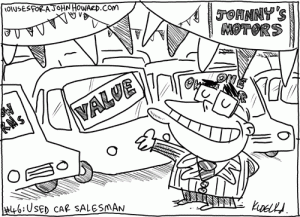
    usedcarsalesman– Advertising becomes useless. It doesn’t matter how much money you spend on ads as people won’t believe you anymore.You can’t hype up a product launch or an event that you’ve oversold forever. When you don’t deliver you are just reminding customers how much you betrayed them.

    – Your word becomes useless. When you break promise after promise, soon people won’t trust that your on their side. They will see that you only want their money and you don’t care about them.

    – Your product becomes a joke. I was in a meeting yesterday about search engines and someone used the word Yahooeveryone laughed. Yahoo has become a dinosaur of a search engine. The only thing memorable about Yahoo is that stupid song, Yaaahhoooooo. You can’t advertise and promise a web service, you can only deliver. This is the #1 reason you can’t trust Bing.com to be any good. If it was so good why are they spending $100,000,000 to advertise it?

    Shifting gears: The evangelical church has become a classic example of the over-promise. Part of the church becoming more about programs and business models is that it has fallen into the trap of needing marketing and advertising like the business models they copies. The result is a lot of over-promising. “Come to the marriage retreat, it’ll fundamentally change your marriage.” or “Sign up for our next church production, it’ll be awesome.” or “Bring your friends to the revival and they will get saved.” In a world where the awesome is so readily available churches do nothing but give away trust when they advertise promises they can’t deliver. I’ve seen church events marketed like they were going to be on par with Disney or Broadway or Oprah and deliver like a trip to the town carnival, a middle school play, or a cable access show. At the end of the day the church spent more effort marketing the event, production, or program than they did making the program awesome. It is a sick cycle that is killing thousands of churches.

    The better way: Wouldn’t it be refreshing if churches just delivered? Wouldn’t it be amazing if they didn’t sell themselves but just helped people? What if they invested in training their volunteers and staff so much that the church didn’t need to make promises, that their programs and ministries truly worked to change lives? You wouldn’t need to advertise a life-changing marriage retreat… because results would advertise themselves. You wouldn’t need to hold a revival because every church service, small group, and youth group meeting would see people come to know Jesus. You wouldn’t need to hire a killer band and create a worship experience because people were authentically worship Jesus. The best advertising a church could ever invest in is a changed life.

    If you are a church leader I want to challenge you to think about your programs. Think about how you talk about them. Think about how you market them. And remember:

    Don’t promise, deliver.

    Don’t hype, deliver.

    Don’t sell, deliver.

    Don’t measure, deliver.

    Don’t sub-contract, deliver.

    Don’t advertise, deliver.

    In a low trust, high expectation world the best way to succeed is to undersell and deliver.

  • How to respond to critics of your ministry?

    So you’re minding your own business and doing your thing. Then the phone rings and a friend calls saying something like this, “Did you know that someone in the church wrote about you on their blog? They didn’t say nice things! What are you going to do about it?

    I can understand. For one thing, I’ve been contacted by my fair share of people who aren’t happy about something I posted here on my blog. I’ve even been contacted by the concerned party who was just worried that I might blog about something. On the other hand I’ve seen my fair share of criticism. I’ve been blasted many times on blogs, facebook, myspace, forums, and of course the old fashioned way… church gossip.

    So… what’s Adam’s strategy for dealing with public criticism? I’ll let you in on my secrets. But just keep these secrets between us, OK? I wouldn’t want any f my critics to know how I will respond.

    Secret #1 I see everything. Thanks to the wonder of the internet I am typically alerted automatically within an hour of something posted about me, my family, or things I care about. That means I am almost never surprised by a phone call like I mentioned above. Almost always I’ve already read the critique and decided what I’m going to do! There are both paid and free options for doing this… unless you’re Joel Olsteen the free options should do the trick.

    Secret #2 I ignore almost everything. That’s right. Even the worst criticisms are worth ignoring. Let’s say someone didn’t like what I said in church and they blog about it. Is that swipe really hurting me? Not really. I don’t perpetrate myself as perfect. And I’m big enough to take a couple of shots. I’m also not concerned about “online reputations” too much. If I ran around with a chip on my shoulder about every negative thing being said about me, my people, or my work… I’d end up looking pretty stupid wouldn’t I? Here’s the dirty secret of criticism online: A link is a link. Google could care less if it’s a positive link or a negative link to your blog. All links help your online reputation.

    Secret #3 When a lie resonates, invite a discussion. In my life, about 1:100 criticisms do get responded to because that same lie or critique is starting to pop up on other blogs, discussions, articles, or other places. In other words… if I ignore a criticism 99% of the time it will go away quickly. That’s really the beauty of the internet! There are so many blogs out there that 99% of posts really aren’t remarkable. People read blog entries so fast that chances are no one even noticed the critique. But that 1% of bad things said will get picked up by other bloggers. When that happens I need to think about a response strategy. When I do respond my first step is always to invite a person saying something publicly to contact me privately. I give them my name, the link to the critique, my phone number, and personal email address. If that blog has an email I send them a message there. If not, I leave a comment inviting them to discuss the criticism privately. Some disagree with that, but I prefer to discuss a criticism privately.

    Secret #4 I vent about it, privately. I don’t care how important you are… getting slammed hurts. Even the trivial “who, said what? hahahaha!” ones hurt a little. As a pastor you put everything you’ve got into your ministry so any critique seems intensely personal. I fight my self-righteous attitude to say something here on my blog or to call and demand a person take it back. Further, most pastors don’t realize that they are in the public eye… you may be the most famous person most people in your church know! Here’s the trick. You need some outlets for that anger… and the people around me know full well what this is like. I will read something, make a “huh” little laugh and then talk to one of the people close to me about it. Try it, it helps. that way if I end up responding it is never out of anger.

    Secret #5 Truth always wins. The fact of the matter is that you will do some dumb things. I know I’ve said, written, and done some incredibly idiotic things. If you only ever do safe things you will never be criticized. But the good news is that if you’re a good guy, you’ll always be a good guy. You can’t please everyone and it’s not worth trying.

    Secret #6 There is an ounce of truth in every criticism. That’s why I read them all. WIth an understanding that all criticisms have something to teach me, I think I’m getting a little bit smarter!