
This is like something out of an action movie. Half of me expects Bruce Willis to run by with a 9 mm.
Month: July 2009
-
Bring on the Thunder
 We’re going on vacation. I know it sounds a bit weird for people who don’t live in San Diego… but we need a vacation from living in this vacation wonderland! And since I’m going to Washington D.C. for DCLA, we figured it just made sense to go “back east” for a family vacation.
We’re doing 5 days in DC, 3-4 days in New York City, and a day in Philadelphia. This is Kristen’s big trip back to her homeland and she’s very jazzed about it.
Looking at the forecast brings up something we are all secretly craving. A thunderstorm! While San Diego has a rainy season it’s been months since we’ve seen (and heard) a thunderstorm. We can’t wait. I’m sure everyone will be saying how green everything is as well.
Bring on the thunder!
-
Big God Theory
 I’m not ashamed of my conservative roots. I am a proud graduate of Moody Bible Institute. Yes, it is a Bible school with a dress code, code of conduct which prevented all sorts of fun, they even make their graduates sign a doctrinal statement. A big crazy one, too. I think most would label my theological positions somewhere between “conservative” and “very conservative.” I hold to the inerrancy of Scripture. I believe that Jesus is the only way to heaven. I believe that in order to walk with Jesus one must make a personal decision for Jesus. I even believe in a 6 day creation. I’m pretty stinking conservative theologically and I’m proud of that.
But there are practices from within my tribe I’m not proud to associate myself with. And most of them can be boiled down to a little God theory of the world.
Little God theory [I made this term up] is the belief that people are only “truly Christian” if they happen to agree with your views of God, church, Jesus, and how you worship.
I remember Ray Pritchard illustrating this with a joke when we attended his church in the Chicago area:
A man is driving across a bridge late one night when he comes upon another man standing on top of the railing of the bridge, positioned to commit suicide. He stops his car and cautiously walks up to the man. “Mister, I don’t know what’s happened in your life but I can promise you that whatever it is, killing yourself won’t fix anything.” He proceeds, “Sir, do you believe in God?” The man replies, “Why yes, in fact I
am a deacon in a Lutheran church.” Amazed, he replies “Well, me too! Tell me, what synod of the Lutheran Church are you a deacon in?” The man on the ledge says, “I’m a lifelong member of the Missiori synod, how about you?” Angered by this reply, the Good Samaritan lunges forward and pushes the man off the ledge. As the man plunges to his death the man shouts, “You heretic, there is only one true synod… the Wisconsin synod of the Lutheran Church!”
That story illustrates just how silly a small God theory is in the hands of a mighty, sovereign God. Small God theory is willing to separate over things that aren’t that big of a deal. Music, methodology, gray areas, etc. Small God theory elevates minor things to major thing status. It takes these things and blows them out of proportion. It assumes that people who don’t like bluegrass/hip hop worship can’t possibly worship the same God as those who live for it. It assumes that people who want to have an altar call before you get your food at Chick-fil-a couldn’t possibly fellowship with people who aren’t sure if altar calls are ever appropriate. I wouldn’t be surprised to learn that there are people who just don’t think they can worship with those crazy skim milk fans. Small God theory can’t get over the 2% difference between two groups of people… that 2% really, really matters! [Just wait, someone will leave a comment about that 2%, what if it’s ___.] From that reasoning they can justify building a church across the street. This separation thing is one of the hallmarks of being protestant, isn’t it? We love to take our 2% ball and go somewhere else!
 I’m a big God theory dude. The way I see it, God’s love is super big-wide-deep-tall for His people. He has created some people to speak in tongues, some who hate tongues speaking folks, some who like gangsta rap worship and some who like to chant in church. I think God loves the diversity of His body. I see Jesus as a loving groom who greatly enjoys His funky, off-the-wall bride. We speak all languages, worship in thousands of fashions, have theological views which clash and clang against one another, but together are wildly in love with the groom… big eye shadow and all. I don’t even have a huge problem with my small God theory cousins. They just add that little spice that keeps the party interesting.
To be honest, I’m longing to find friends who enjoy the big God theory ecclecticism. I’m happy to make friends who shrug their shoulders at differences– even significant ones– yet rally around a love for Jesus. And when those small God theory folks call me names– I get a kick out of that too. Everyone has a know it all relative, don’t they?
-
Free vs. Paid Content in the Church

Whether you are aware of it or not, there is a raging battle going on about the concept of free vs. paid content on the internet. Big names in media like Rupert Murdoch have drawn the line in the sand– they are going to make people pay for news content. Others have embraced the Google model of an advertising-based system of free content. Last week Seth Godin took the debate to a new level. He is firmly in the free camp while Malcolm is in the the paid camp. Of course, most of Seth’s income comes from consulting, speaking, and book proceeds– so Seth may be in the free camp for some things, but his paycheck comes from paid content too.
Inside the church the same debate has just begun. And all of these questions lead back to the same two central questions that newspapers are wrestling with, “Since creating content isn’t free, who is going to pay?” “In a world of free content, where is the ethical line?”
Two Sides to the Content Coin
1. Gospel-oriented content should be freely available. As someone who has successfully started an internet business in the last five years I know the power of free. Ask Tim Schmoyer. Ask Ryan Nielsen. Nothing draws traffic to a youth ministry website quite like free. In the youth ministry world there is an expectation of free content. There is a righteous indignation when you question the ethics of free, too. No one cares that it costs me thousands of dollars to create, host, and market “free” content. There is a general consensus that stuff about youth ministry should be free and you shouldn’t expect anything in return for free lessons, videos, music, etc. “Don’t ask me to click on an ad. Don’t ask me to sign up for a newsletter. I need something free because I don’t have budget to buy stuff.” I’ve gotten nasty emails from folks who insist that all content about ministry should be free. These same people often are in paid ministry. So they want to get paid for using someone’s free content. Talk about wanting your cake and eating it too! Sheesh.
2. Gospel-oriented content should cost something. Of course, the ironic thing about the free thing is that the people who think ministry content should be free want to get paid by their churches, ministries, or non-profits. If I told you that you shouldn’t get paid for being a youth pastor you’d get angry with me! There is a certain immaturity to the free thing. At the end of the day there is no such thing as free content on the internet. Someone sits down to write something, they save it as a PDF, they post it on a website, and they offer it for free to anyone who wants to download it. It seems free when it isn’t. That computer cost you something. The education that powered your thoughts cost you something. The time you spent creating it… was it for work you were being paid for at the church? If so, does that content even belong to you? If it was your free time, isn’t that time worth something? If you don’t think your time is worth something why should I use your stuff? When you posted it somewhere on the web, who paid for that server space? If it’s on a well-known site, who is paying for the building of that site/brand? Who is paying for maintaining it? If you added graphics to the content, who paid for that? If you had someone proofread it, who paid for that persons work? That doesn’t seem free to me.
There is no such thing as “free” content, even Gospel-oriented content, so people should expect to pay something for the works they use. The real question is, “Who should pay?” In the old media world the user was expected to pay for the content. You subscribed to a newspaper to get the content and the profit in the model came from advertising. You wanted a book so you went to a bookstore and bought it. In the 1980s and 1990s most of us in ministry would have thought it immoral to copy books and give them to friends, copy cassette tapes and give them to students, etc. But now there is an expectation that advertising will somehow pay for all the content I want/need. That’s the new media age. Free to me, let advertisers foot the bill. Wouldn’t it be funny to see a pastors salary supported by advertising? He’d preach in an outfit that resembled a Nascar driver’s suit! It’s always funny to think about real world applications of stuff we do on the internet everyday, isn’t it?
Digital media has created an ethics dilemna for people in ministry, hasn’t it? There seems to be a feeling that the parable of the talents can’t possibly relate to actual money. People who advocate for free content will concede… “It’s OK to break even, just don’t get rich!” So if content cost me $500 to produce a lesson… why is it wrong to want to return $1000? (Like the parable) Don’t you remember the parable… Jesus called the man who just broke even a wicked and lazy servant. What then would Jesus say to people who intend to invest $500 in content and give it away? Super wicked and super lazy?
We would never walk up to an auto mechanic and expect him to change our oil for free simply because we are in ministry. We would never go to the dentist and insist that he give us free dental. We would never go to the grocery store and expect the grocer to pay for the pastors food. And yet we have no problem with this when it comes to Gospel-oriented content. Something is out of whack, isn’t it?
As with all things that seem to leave us in a quandry– I am wondering if there is a 3rd way. Is there a way that is both ethically satisfying and free? Is there a way that is both affordable for ministry folks and pays for itself?
Chime in. I don’t pretend to have all the answers. If you’re in the paid camp– speak up! If you think everything should be free, give me a counter-punch.
-
Does the church love my child?
This video is from the blog of Andrew Marin. If you haven’t read his book, Love is an Orientation… shame on you!
-
Butt Call Etiquette

As someone with an “A” name I get a fair number of butt calls. What is a butt call? A butt call happens when someone forgets to lock the keypad on their phone and unintentionally calls someone when the phone is placed into a pocket, jacket, purse, or the like. Since “Adam” happens to land as the first contact on a lot of people’s phones I tend to get a lot of these.
It’s happened three times in the past 24 hours. I find it comes and goes. Typically, it’ll happen with the same person in a string… especially when someone gets a new phone.
Most often I screen my calls. (Especially if someone is a notorious butt caller. You know who you are.) So this means I end up with lengthy and fun voice mail. They sound a lot like testimony tapes from an FBI wiretap. Muffled, unclear, scratchy. They sound a lot like the Watergate tapes. Almost all of the time I listen for about 5 seconds and then delete it. But lately I’ve been thinking it would be fun to remix them or mash them up into a dance mix.
What is the proper etiquette when you discover you have butt called someone?
1. Ignore the problem. It really isn’t a big deal. People like me are used to it. Think of me as your accountability partner.
2. Apologize. If you know you were probably talking mad crap about the person when you butt called them, you might want to clean up that mess. Chances are they have saved that message.
3. Fix the problem. Every single cell phone has a screen lock. Get used to using it. Check your cell phone bill. If your pocket has been calling the same person 4-5 times per day you can fix this problem by modifying your behavior. Make the first contact on your phone “911” and I guarantee you’ll get used to using the screen lock by the time the paramedics leave your house for the third false alarm.
4. Talk louder. If your purse is going to call me, speak up for crying out loud so I can mock you better! If you are in your car and you want to crank up some REO Speedwagon while your pocket calls someone… you’ve got to make it more entertaining. Sing loudly in your car.
-
How to fart in public
There is actual value in this below. I mean, if you work with students at some point you’re going to be in a van way too long and need to release some pressure.
HT to an unnamed co-worker
-
Beat up by my elderly neighbor
This story rocks. It’s living proof that you can’t judge a book by its cover. Apparently, this 24 year old man thought he could intimidate his elderly neighbor. Instead he got the beating of his life.
 Gregory McCalium, 24, was left with severe facial wounds after the knife-wielding thug attempted to rob his elderly neighbor in tBotley near Oxford, England, Britain‘s SkyNews reported. The would-be burglar broke into the home of Frank Corti last Aug. 19 – without realizing the 72-year-old was a retired boxer.
A mug shot released by the Thames Valley Police reveals the results after Corti disarmed his attacker, let loose with two punches to the face and restrained McCalium until the police arrived on the scene.
On Tuesday, McCalium was sentenced to a 4 1/2-year sentence for the crime. link
Please tell me this will be made into a movie? Rocky 10?
HT to Boing Boing
-
Two views of the local church
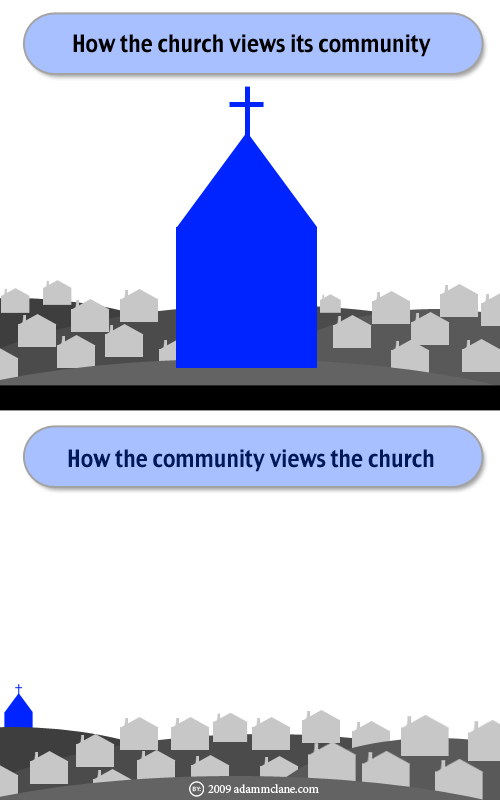
There are two sides to every coin, aren’t there? I’ve had this post stuck in my head for several weeks– and I think the illustration says it all.
Church leaders: Complacency sneaks in. We surround ourselves with people who go to church. We spend a lot of our time at the church. Our perspective becomes that the community revolves around activities at the church. Pretty soon we become ambivelent about the neighborhood we live in. Our schedule is defined on what’s convenient to those who come to church. Our agenda becomes to serve them.
We perceive our ministry as a “city on a hill” when in fact the people living in our neighborhood are completely unaware of our existence. Before we know it, we are so comfortable with our programs, budgets, staff, and people who come to church we forget reality.
The reality is that in most communities about 5% of the population attends a church. And yet we are comforable with that. Go ahead do the math yourself. Spend 30 minutes calling every church in your community and get actual attendence numbers. Next, simply divide that number by the population of your community. In most places that number is 5% or less of people who attend church on any given weekend. And we all know that just because someone attends church on Sunday doesn’t mean they are Christians, right?
Why not take some time to get to know how 95% of the population views your church? Think of it like this. Count the next 20 cars that drive past your house. Only the 20th car will attend a church this weekend. In the illustration above there are 18 houses in view of that church. And none of them will attend that church this weekend. If your theology is like mine, you recognize that Jesus died for all 20 of the people in those cars and all 18 of the people who live in those houses. But who is our ministry serving? The 5% who show up. Most of our money and time is spent serving Jesus from the perspective of the 5% and not the 95%.
That perspective should change things. 1 in 20 people will attend church this weekend. Any church. Even that church that is so bad you won’t even meet with the pastor to pray.
I’m speaking to you out of deep gratitude for all that God has given me, and especially as I have responsibilities in relation to you. Living then, as every one of you does, in pure grace, it’s important that you not misinterpret yourselves as people who are bringing this goodness to God. No, God brings it all to you. The only accurate way to understand ourselves is by what God is and by what he does for us, not by what we are and what we do for him. Romans 12:3, The Message
And yet church leaders reassure themselves that numbers don’t matter! This is the state of the church and people say we don’t need to fundamentally change how we do ministry. We worry about offending the 5%. We worry about changing too much too fast while our sworn enemy puts up victory statues all over. We follow leaders who look at this reality, shrug their shoulders, and move on with their lives. We go to denominiational meetings which agree to spend more money on organizations which are smaller every year. In short, we invest all of our time and energy in a broken model.
And then when someone really breaks through. And that community reaches 6% of the population so we flock to hear how they did it? Got a book? Teach a seminar? Our perspective is jacked up, isn’t it?
New leaders are needed. I dream of church leaders coming to the forefront who are drastically interested in the 95%. I long to surround myself with leaders who keep the 5% in perspective. We celebrate those lives changed! But I want to be with men and women who think differently. Where are the leaders who look at those 5% as just the beginning? Where are the people who recognize that a model cannot be built around an individuals talents? Where are the leaders who know they need to start a swarming movement?
Point me to those people. I am tired of those who are satisfied with the failure of 5%.