Category: Church Leadership

  • Moving towards the polite middle

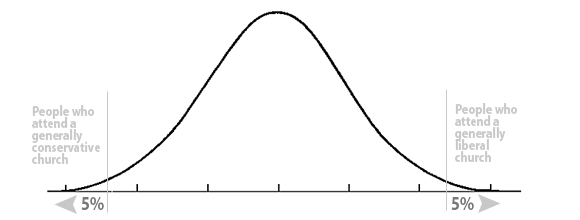
    As I think about the church and the 5%-10% of people we reach in the community I wonder where we fall on the bell curve.

    Something tells me that it looks a little like this.

    I wonder if the positions we take attracts, appeals to, and connects a certain type of people? And I wonder if church leaders are going for the sucker pin of thinking of going more conservative (politically/socially/by American cultural definitions) or more liberal is going to lead to growth in their congregation? However, this is counter to what we know about behavior from the bell curve. This just means that to attract more people “like us” we need to have a wider reach and draw people from a larger and larger geographic area.

    Sidebar: Now, immediately I have some people who will read this upset because they don’t really like my labels. And they especially don’t like that I’ve lumped nearly all churches into two categories. And some are going to be quick to point out ways that their church is neither liberal nor conservative. That’s OK. This is just some generalization and hyperbole to make a point.

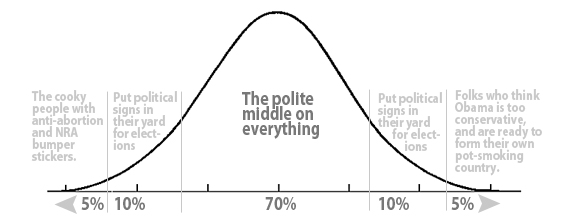
    Here’s my neighborhood on the bell curve. Again, full of hyperbole and generality.

    Our neighborhood is not unlike any other urban or suburban neighborhood I’ve lived in. We have our cooky people on the fringes, we have our people who are just a little bit political, but who will quickly drop it for the sake of community… and we have the vast majority of people who probably have some personal opinions but just want the neighborhood to be a nice place to live, are willing to politely disagree on some stuff, and otherwise would rather be defined by their neighborliness than their political leanings.

    Think strategically church leader!

    Instead of trying to out-conservative or out-liberal ourselves, where we will find decreasing populations and have to incur the expense of widening our reach, the reality is that reaching the majority of the population will come as we lay aside our ideals and move towards the middle.

    As Stephen Phelan, my pastor, put it yesterday– The two extremes will come together when we focus on a common mission. For instance, if we focus on feeding and housing the poor, both extremes agree that we should do it for their own ideologies, and people in the middle are just happy to participate in something cool. The happy middle will agree to be a part of it because everyone knows it’s good to take care of the poor in your community.

    For example. I’m an egalitarian. I would love to see more women in the pulpit. And I’ve turned down positions on boards that were all male with the exception that I’d join the board if they moved towards 50% board membership by females. But I go, love, and support a church in my neighborhood that is PCA. (Which doesn’t allow women to preach or hold pastoral roles.) How do I deal with that contradiction between what I believe the Bible teaches about women and the church I attend? It’s easy… I’m in love with the mission of our church! Just like we overlook the flaws of our spouse because of our love, so I overlook this disagreement because of my love for the church. While I disagree with that one position, I am in full agreement with their strategy to reach our community and I love the staff as brothers and sisters in Christ. That over-powers my personal preferences.

    How to reach more people

    If you want to grow, from a population standpoint, you need to better represent your zip code and move to the middle. To do  this, you’ll need to take a sober judgement of your congregation. Walk around the place with centrist eyes. Ask yourself, “What is in this building that could be offensive to the general population? What would make people feel uncomfortable? What would make them feel like they didn’t fit in?

    Over the past few months people have approached me and said that I present both radical and simple ideas… that their church would never go for. The reality is this: Move to the middle to find growth and those naysayer voices will be overcome by the reality of your strategy. Focus on what we all know to be true… Jesus called the church to be good news to the neighborhood. It’s a centrist position that only feels extreme to people on the extremes scared to be pulled towards the middle!

    To move towards the middle you may need to realize that your leadership might just be on the leading edge one way or the other. That doesn’t mean that they can’t hold those positions. But it might mean that they can’t represent those personal convictions on behalf of the church.

  • The great hope of the American church is…

    Photo by Gary Ericson via Flickr (Creative Commons)

    Neighbors loving neighbors.

    The funny thing is that if you read enough church leadership blogs or read enough books by big-time church people you start to think that they believe the great hope of the American church is the church organization and its staff.

    We know Jesus was a big fan of all things mega, right… (read John 6 to see an example of Jesus’ mega model.)

    And we know that he sometimes went to the Temple or local synagogue but he just as often met out in public spaces, in a field, or in homes.

    As a member of my faith community I’m reminded of the words of Paul in Romans 12:3-5.

    For by the grace given me I say to every one of you: Do not think of yourself more highly than you ought, but rather think of yourself with sober judgment, in accordance with the faith God has distributed to each of you. For just as each of us has one body with many members, and these members do not all have the same function, so in Christ we, though many, form one body, and each member belongs to all the others.

    What about people? Do you know any people?

    Healthy organisms are marked by their ability to grow.” – A church leadership mantra.

    Apparently they skipped botany and biology. In my garden the goal of a maturing organism is reproduction. If something grows too big, is not pruned, and doesn’t reproduce… I pull it out of the ground and add it to my compost pile. A plant not reproducing is a waste of good soil, space, and time.

    Understanding species

    See, big churches or small churches or whatever your church species choice/preference is, were never designed to be the solution to reaching people. I’m a fan of churches of all sizes and shapes. But the species of a church was never the point in the Gospels.

    The church is a gathering place of worship where we celebrate what God is doing in us and through us. In nature, the health of any organism is measured by its ability to reproduce. I believe the same is true in the church.

    The solution is you. Your love for your neighbors is infinitely reproducible. Jesus death tore the veil between priest and citizen. Jesus freed Hope from the descendants of Aaron and gave us each equal access to the King. You have been empowered to reach your neighborhood. And thanks to the hard work of generations of scribes and translators you have, in your possession, the greatest tool you could ever need to reach your neighbors– the Bible.

    Jesus could have chosen to spread his message by force. (Some of his disciples really wanted that!) But Jesus knew that hope doesn’t spread by force. Change only happens when the heart is transformed. (Our military has learned that in Iraq and Afghanistan.) [If you want to see the power of a message of hope vs. a message of force, just compare the exploits of David in the Old Testament to the exploits of the apostles in Acts.]

    A message of reconciliation to the Father was a message of the heart best transferred neighbor to neighbor. It was never intended to be a come and see message. It was only meant to be a go and do message. It’s not dependent on a top-down leadership structure. Instead, Jesus empowered the people to change the world from the bottom up… from neighbor to neighbor.

  • If you don’t want to play with the big boys…

    Photo by Callan Christiano via Flickr (Creative Commons)

    Stay on the porch.

    I remember my mom saying this when I was a kid. One of us would come home crying because we got a bloody nose or a scraped knee from playing 2-hand-touch football or 21 in basketball, and she’d just kind of sarcastically say, “If you don’t want to play with the big boys… stay on the porch.” I think she said it with a smile– but the message is still the same.

    Getting roughed up is just part of life. When the kids come to ask who wants to play– the wimps stay home and play inside.

    The same is true for church leaders today

    I’m 34 years old. I’m not getting any younger or more energetic from here on out. Welcome to middle-age, baby.

    I know a whole lot of people who work in churches who are about 5 years above or below me. They have all the education and experience they need to lead their churches from the mire they find themselves in. And yet they sit on the porch like little brothers. “I’m not on the board.” Or “I’m not the lead pastor.” Or “I don’t like conflict.

    They levy excuses like, “I could never say things like you say and keep my job.” Or “I really admire the stand you take on ____.

    If you are 29-39 years old… welcome to the prime time. If no one else is saying it to you, I will: This is your opportunity. Everyone is waiting for you to do something. If you need permission… it’s not going to happen. Make your own permission!

    I’m tiring of people who are sitting on the porch, waiting to get in the game, being told that they don’t have quite the correct age or position or rank to do anything significant.

    That’s a lie from the mouth of the devil. Wake up! Game on!

    Leaders lead people to where they would otherwise not go on their own. Period.

    Leaders don’t sit on their hands politely and bide their time waiting for someone in leadership to bestow on them magical powers to lead. They lead. It is who they are more than a position they hold.

    In other words, they see that getting your nose bloodied here and there is part of playing with the big boys. That may mean you get fired. So what? That may mean people say mean things about you. So what? That may mean you might have to stand down a group of older men/women in charge. So what?

    At least you got fired doing something. It’s better than getting fired for doing nothing.

    The power to change things is rarely given to you by sitting back and being patient. Just ask Prince Charles how well that is working for him. Power is taken. Power is awarded. But power is rarely given to really good middle managers.

    And the secret is that the people in power are waiting for you to stand up to them and take it. How else will they know you are ready to lead?

    Sitting around on your hands and watching the big boys play until you are viewed as old enough is just going to result in your doing nothing another year. Stop sitting in your corner, reading another Christian leadership book, and get in the game.

    Your community is dying because of your passivity.

    Today is the day. Now is the time. Lace up and get in the game.

  • No more country clubs

    Photo by Elliot Brown via Flickr (Creative Commons)

    Quick facts

    Cumulatively, the American church is likely the largest private land owner in the country. Most zip codes contain at least one house of worship. In my zip code alone there are more than 30. In many communities around our nation the church occupies some of the prettiest property in town. It’s square footage competes with all other public buildings in girth and consumption of natural resources.

    Cumulatively, the American church is likely one of the largest private employers in the country. Each of those congregations in my zip code employ at least one individual. But when you include secretaries, janitors, and associates, the number goes up. Nationwide hundreds of thousands of people are employed by churches.

    And yet…

    • Churches pay no property taxes
    • Most church staff do not pay full payroll taxes.

    Think about the fiscal crisis your state is going through… not taxing churches and their staff comes at a pretty high cost, right?

    Why is that so?

    Have you ever thought about it? Why don’t churches pay property taxes? And why are clergy taxed differently than other types of employees?

    The best I can tell there are two main reasons for this:

    1. In the last 70 years, there has been an increasing desire to keep church and state separate. The Supreme Court has, again and again, affirmed a desire to not sniff around in the churches business too much. Collecting property and payroll taxes would probably require audits which the federal government wants no part of.
    2. Historically, there was an understanding that the local church was the primary provider of social programs. It didn’t make sense to tax the entity taking care of the sick, feeding the poor, and often providing meeting space for the community.

    (More on this from the L.A. Times)

    Closed to non-members

    If I were to walk to the front door of most churches in our country today and pull the handle of the door I’d find it locked. (And not because it’s a holiday, it’s locked nearly every day. Even if unlocked I don’t have access to use the space.) I’ll quickly be told it is private property.

    The simple truth is that the church is one of the largest private land owners and largest private employers, but it is generally closed to the public. The possibility of its existence is financed by 100% of the community whereas the benefits of the property, staff, and resources, are functionally only available to the 5% or so who attend.

    For years I’ve heard the local church referred to as a country club and scoffed. But largely, it is true.

    The public is not welcome.

    My dream for the church

    It’s Martin Luther King, Jr. Day. I will watch the speeches. (And make my kids watch them, too.) I will remember the effects of his ministry. And I will be inspired by the quotes on Twitter.

    More importantly, I am empowered by Dr. King’s message to keep dreaming.

    When I close my eyes these are the things I dream about:

    Photo by Brian Hawkins via Flickr (Creative Commons)

    One day, the churches facilities will embrace the implications of its tax status. It will be a place truly separate from the world because it serves the world. So separate that people coming into her doors will wonder if they are in an alternate reality. I dream of a church who flings it’s doors open to the public Monday – Saturday from 6:00 AM until 10:00 PM. It’s a place the poor are served. A place the sick go for healing prayers. A place the elderly use as a resource. A place high school volleyball teams practice. A place kids go for tutoring. A place of civic debate. A place the arts are celebrated. A place local business people use for meetings. And a place where people go to find out how they can serve their fellow neighbors.

    One day, the churches staff will see themselves as employees of the community. The skills Paul talks about in Titus 1 & 1 Timothy 3 will be used not just to run programs attended by the faithful but cast upon the community for the common good of all people. Sure, there will be sacramental duties performed by the staff. But they will be kept in focus by the needs of the community. The pastor will see himself as not just the pastor of the people who come on Sunday morning, but as the pastor of the community he’s been called to serve. (Using “he” in an inclusive mode, my egalitarian friends.)

    The church will no longer be dictated by fears of lawsuits. They will rise above the desire to protect its assets in realization that the assets came from and belong to the community in the first place. The church will no longer be stricken by a separation of church and state because it is too busy embracing the needs of the state’s citizens. You want to sue us? Then sue us because we have made our property open to all. You want to close our doors? Then you are closing the doors on the place of refuge for refugees and the place of stability for those lacking the stability of a family. Let our good works be our best defense.

    The church will be a physical manifestation of the redemptive work of the Holy Spirit. The church will be a continuation of the ministry of Jesus. It will be a place every person can both be served and serve in the fullness of their spiritual gifts.

    What will we see than? We will see Jesus at work. We will see the irresistible draw of our Savior on the hearts of the community. The church will cease being a place for the 5%-10% on the fringes and regain its place as the centerpiece of our communities. We will see that the church will be the waypoint when giving directions to people around town. We will see that the community will look at offering tax breaks to churches and clergy will be a bargain and a burden its people happily bear for the greater good of the community.

    This won’t wallow in a social gospel. Instead it will embrace that the Gospel is social. It’ll be the embrace that the Gospel isn’t just about renewing of our hearts but also a renewing of our community.

    Let the religious among us be skeptics of what can happen when we embrace our role in society. In the meantime, when we step into these things, we will see today’s skeptics give their hearts to Jesus when they finally see the Gospel alive with their very own eyes.

  • Being Good News

    Today’s video post is a synopsis of about 10 conversations I’ve had in the last 60 days. All of them get to the question, “Adam, something has changed inside of you. I like it sometimes and I don’t like it sometimes, what is it?

    One thing I’ve learned to get comfortable with in the last 10 years of ministry is people asking me hard questions, diving into my motivations, and even offering critical responses. I can handle it. I am not intimidated by it. In fact, questions like this actually encourage me.

  • Putting your worst foot forward

    Photo by Kevin Trotman via Flickr (Creative Commons)

    Which of these introductions garners the most trust to you?

    • Hello, my name is Adam McLane. Thank you for inviting me here today. As an expert in my field, I look forward to sharing with you this morning 7 insights which will revolutionize ________.
    • Hi. I’m Adam. I guess you’ve invited me here this morning because you’ve tried everything and looked around and found the one guy in the world who has tried more ways to _________ than you have. Well, I guess a broken clock is right twice a day. Let’s get started.

    Chances are you like the first one a little better. The first introduction would cause you to reach into your bag and fish out a pen and some paper. But the question isn’t who would you like better or who would give you the most stuff to write down, it’s which introduction garners the most trust?

    An experts role is to teach 5 things in an outline, collect his check, and move on to the next place. But a teacher creates questions inside which spurs on your own thoughts and solutions to the problems you are facing.

    I have a tendency to trust the second introduction a lot more. I might not write down as much stuff… but that second introduction will cause me to lean in. Something about that humility tells me he has something to say.

    It tells me that this person isn’t just rolling out their presentation… but they are probably going to take me somewhere I need to go. They are going to help me recognize that while I’ve failed in the past I can keep trying and searching for the answers I need.

    And they aren’t going to lie to me and tell me that success is just 5 bullet points away. I already have mountains of notebooks filled with outlines on things that didn’t work. The second person is going to share the truth that the journey to success is paved with many pitfalls and traps along the way.

    I can trust that person.

    I think this is one subtle way the world has changed.

    • Expert = distrust
    • Humble guru = trust

    We laugh at the irrelevance of the person who stands on the street corner proclaiming into a bullhorn that he has all the answers to life. Turn or burn, that’s all you need to do. Stop fornicating and you’ll be fine.

    Let’s face it… it’s a stupid way to communicate. But it’s not unlike what we do in our churches. We hide behind our degrees, we point to our bookshelf, we hide from tough questions and real ministry by filling our schedule with meetings, and we gather as a staff to celebrate how awesome we are. But in the quiet moments, sharing coffee with a friend, we are no more faithful or have the answers than the person sitting in the pew behind us.

    Trust me, but how?

    I think most of us were raised in a time when we were told to always put our best foot forward. So we do that.

    But times have changed. We can no go faster and further with people in building trust when we start by putting our worst foot forward.

    “My name is ___________. I’m no better than you. I don’t have all the answers.”

    Go ahead, repeat it out loud until it feels natural. It just might lead to something unbelievable.

  • L’agenda

    The longer I walk with Jesus the more complicated my life seems to get.

    Kids, ministry, job, dreams, bills, skills, personality flaws, responsibilities… the list is endless. Life is complicated. Scary. Confusing. Worrysome.

    At the same time, the longer I live the more simple the application of God’s Word gets.

    When things seem really complex and over my head I am reminded of how Jesus spoke into the complexities of a “religious life.

    One day Jesus was talking with a group of religious people. And, as religious people are known to do, they all carried a specific agendas. They wanted to know if Jesus was on their team. As they sat around testing Jesus on his belief on the issues of the day they were flustered by his ability to respond with Option C on an Option A or B test time and time again.

    They were upset with him because he had taken the things that divided people… agendas with teams, financing, factions, and power… and given simple answers with a new agenda.

    So they put their heads together and nominated the biggest religious expert in the room to trap Jesus. This question was the 1st Century equivalent of, “If God is a good God, why do bad things happen in the world to good people?”

    Here’s the agenda-laden trap:

    Hearing that Jesus had silenced the Sadducees, the Pharisees got together. One of them, an expert in the law, tested him with this question: “Teacher, which is the greatest commandment in the Law?”

    Jesus replied: “‘Love the Lord your God with all your heart and with all your soul and with all your mind.’ This is the first and greatest commandment. And the second is like it: ‘Love your neighbor as yourself.’ All the Law and the Prophets hang on these two commandments.”

    Matthew 22:34-40

    Baffling simplicity.

    L’agenda

    Jesus’ agenda for your life is quite simple. As we see above, all of a God-pleasing life flows from those two bullet points:

    1. Love God with everything.
    2. Love your neighbor as yourself.

    A popular phrase in Evangelical circles, full of agenda, has repackaged Jesus’ words and simplified it too far by saying we are called to “Love God, Love People.” But I think Jesus is smarter than they are. And his agenda rings clear enough for me.

    Jesus’ agenda for my life is to love him with everything I’ve got. (From my skills, to my personality, to my family, to my vocation… everything) And the action of that agenda is to love my neighbors as myself. (You know, the people I live near, see in my daily life. Neighbors implies really close to me, and is specific to a group of people I’m to have regular casual contact with. It’s the people on my block, not the people in the pews or in my youth group.)

    All of God’s word is to be applied through that lens. Jesus sets the agenda.

    When I study Scripture I’m left to ask myself, “How is God calling me to love him?” and “How can I love my neighbors as myself because of this teaching?

    It’s personal and communal– but not religious

    Anyone who knows me knows that I have a deep love for the church. In the same passage of Matthew 22 and other places in the Gospels, Jesus refers to his relationship with the church as his bride. To disrespect the church is de facto disrespecting Jesus. (If you said you loved me but disrespected my wife… I’d punch you in the face. What kind of husband wouldn’t?)

    I’d prefer not to get punched by Jesus for disrespecting his bride.

    At the same time, I wonder if many churches have made the agenda about them? There’s nothing more annoying than a selfish bride. Sure, there is love there… but there are a lot of strings attached to that love.

    Other churches are defined by their size… hardly a respectful description for a bride. We’d politely say things like, “She must be a good cook.” Right?

    Other Christians are defined by the political bedfellows they keep. Their agenda is confused with the issues of the day. Their leaders espouse vocal support of things like a right to own a gun while all the world desperately needs of them is to embrace their right to love their neighbor.

    Still others are defined by their application of Revelation 2-3. They look at Jesus’ proclamations of judgement and they say… “Wait a minute. Jesus isn’t judging First Baptist of San Diego any different that he is judging San Diego Church of the Nazarene or even the Diocese of San Diego… Jesus loves and judges us by where we live in community, not where we individually gather to worship.” And those churches are defined by the agenda of neighbors loving neighbors, churches loving churches, and sharing in the great love of their Savior in the L’agenda.

    My prayer today for the bride of Christ is that we would be a people defined by our world-changing L’agenda for our neighbors and not the trappings of a religious life.

  • Two positive trends in youth ministry

    I’m on the tail end of a one week tour of the East Coast. (Catching up with youth workers; talking about PlanetWisdomYS Palooza, and all things youth ministry.)

    One of the things I like to do when I meet with youth workers around the country, whether individually or in a group setting, is ask the same two questions. I frame the question differently depending on the group. But these are the two questions I’m asking and comparing answers to others to see if I can sniff a trend.

    1. What is a new problem you are facing in your own youth group in the past 12 months?
    2. What are you doing that is making a difference?

    For question #2 I am continuing to hear the same things all over. While I heard these in 2009 and 2010– it wasn’t emerging quite as strongly as a trend until this trip.

    For me, it’s very exciting because the two trends that I’m seeing are actually quite healthy and sustainable.

    First trend: Bigger churches (Congregations of 1000+) are continuing to see their youth ministries grow numerically. They are reaching more and more students. (Largely unchurched) And their ministry is asking hard questions which shape how they minister to students, parents, and train their teams. The lead youth worker at these churches are typically highly experienced, highly trained, and exceptional at both leading staff teams and replicating themselves to maximize impact & set-up long-term impact.

    Second trend: Smaller churches (Congregations of  >500) are ditching models altogether and approaching their ministry from a more missiological perspective. They are saying things like, “We still meet on Wednesday night, of course, but I have a small group of guys who get together every week to visit a homeless shelter. My students won’t bring a friend to Wednesday night– but they are bringing 2-3 to that.” Even if they aren’t articulating it in words quite yet, they are saying that the traditional ministry model they grew up on is fading in effectiveness. As such, they are adapting by maintaing status quo while finding new ways to reach students while meeting a real need in the community. I’d label this a shift from meeting felt needs to meeting obvious needs. Meeting actual needs is leading to growth and they are forming their ministry around those areas of growth… which look very different in every community.

    The hallmark of both big & small of these are the same— their spending, dollar per student, is quite low. Bigger churches have staff spread over large numbers; smaller churches lost their paid staff due to the economy and are adapting their ministry to a much cheaper model.

    The uncomfortable middle

    The pain seems to be in the middle. What I label “medium-sized churches” of 500ish-1000ish are all over the place. Some are fine while some are in crisis mode. I can imagine that their dollar per student ratio is high enough where they are feeling a big pinch. They seem to be feeling a lot of pressure as their midweek program isn’t doing as well, (a hallmark of a smaller church) they are too large to invest their time finding a pocket of mission that would likely lead to new students coming into the fold, and they don’t have the money to go to a staff-size that might take them into that big church team model which would likely put them into growth, as well. This is the size church where I’m seeing lots of people lose their paid staff jobs. This is also the size church I’m hearing that the leaders (church wide) are shifting to a model like their favorite megachurch.

    Quick disclaimer: I’m not a sociologist. (But I did stay at a Comfort Inn last night.) And I don’t have hard data for things I’m writing here. [This is my blog…] These are notable things I’m learning by talking to youth workers around the United States. Feel free to engage with them, but don’t assume that I’ve got data to back this up or that this is some sort of scientific process. I’m labeling a trend as something that just keeps coming up without my prompting.

  • 5 Steps to Finding Family in Your Community

    Divorce. Single parenthood. Extended singlehood. Living away from home. Broken relationships. Loneliness.

    None of these are surprises. None of these are ideal. All of them are our reality and bond.

    All of them are (by design) normative in the body of Christ. (James Dobson’s ideals are great. But they aren’t our reality.) We are a people tied together primarily by our brokenness. The church is the only institution on the planet where everyone is on the same playing field. We are all sinners. We all admit that left to our own devices we’d screw it up so we have a desperate need for a community that can help us screw it up less. That’s our bond as believers. We need each other because we are busted.

    And yet– sadly, working in a church is one of the loneliest jobs in America.

    It doesn’t have to be that way.

    Without sounding like a 5-step program too much– here are 5 hard steps you can take to find community (and, ultimately contentment) while working on staff at any church.

    Step One

    Admit you aren’t perfect, can’t be perfect, and are lonely. No really. It starts with a healthy understanding of who you are and your lot in life. One of my frustrations with making pastors look like celebrities is that too many pastors start to believe that their poop doesn’t stink. (Conversely, to aspire to be a “great pastor” you have to pretend that you fell from heaven onto a community and you have no needs and you somehow embody a perfection that you really aren’t.)

    You aren’t bulletproof. You need friends. You need accountability. You need people your own age in your life. Admit it.

    Step two

    Find people your own age. This one makes people’s head tilt 10 degrees to the side when I say it. “My youth group is like my family.” No, they aren’t. They are adolescents and you are an adult. Not only is it really unhealthy for your long-term health for you to consider the youth group your family because they graduate and go to college– it’s creepy for an adult to depend on a bunch of students to be his family. Creepy with a capital C.

    Find people within 10 years of yourself. (On average) Honestly, common interests are cool but not really primary.

    Note that I’m being careful to say that you don’t need to find this in your church. It’s great if it can happen there. But I’ve worked at smallish churches my whole life and I know that there might actually not be a group of adults in your age range. But every community has people your age. You might just have to do something outside of your church. Join a softball team or a golf league or something going on with people your own age and go there. (Just don’t go dancing, that leads to sex.)

    Step three

    It’s better when you aren’t in charge. I don’t know why… but for us the magic mojo of our finding family/community in San Diego has been that I’m not in charge. The joke has been, “we’re just the hosts.

    I think the truth is that we, as pastors, like to be in charge a little too much. We want to set the agenda. We want to be the center of attention. We want to be the expert. We love it when everyone looks to us. In short, we have a validation problem. We hide behind the persona and expectation because we like it and feed off of it.

    But you will never feel like part of a community if you are walking around thinking that you are the man on the white horse who has come to save the town from itself. All you are really doing is walking around with a false view of yourself and leaving yourself on a very lonely island. (And I know too many pastors readily fired who have made themselves entirely expendable at their church by living on a very long island.)

    Step four

    Develop inter-dependency. A false presentation of who we really are (see above) leads us to think we don’t really need to depend on our community of friends. (And elevating our need to develop dependencies on our work. Raise your hand if you’re a work-aholic.)

    It’s OK to be a pastor and have needs that you have to depend on others for. It’s OK to admit that in the safety of your community. In fact, what you will discover is that once you level the playing field and admit that you need to depend on people– you’ll actually be a seen as a much stronger leader. This goes beyond just depending on people to do stuff for you. This means that you’ll need to join and participate in being part of a family as an equal. You know, be a servant to your friends and allow them to reciprocate. Just as you need to lean on other they need to be able to lean on you.

    The question being answered by every single person over and over again about you (and behind your back) as a pastor is, “Is that person for real?” When you become part of a community of people (aka– a family) that really knows you, where you can just be Adam and not Pastor Adam, then those people will help answer that question in a way you’d like it answered. “Yeah, Adam is a legit guy. He and Kristen have their struggles, but they are just like anyone else.” That’s a whole lot better than, “All I really know about him is what he’s preached. He keeps to himself.

    Step five

    Relax, you’re with family. The goal is simple. You know you’ve arrived when you’re just a dude (or dudette) with a job. (And people aren’t saying, “I’m in the pastors group.“)  It will hit you when you get there.

    And you won’t be healthy in a community until you find a group of people who look at you as such. My goal every time our community group (our real family in San Diego) gets together is to shut up and listen. Literally, that’s what I’m telling myself over and over again as I prepare for Monday night. “Shut up Adam, no one cares.” But these people really do care about Kristen and Adam– the family that hosts us on Monday nights. That’s how I know we’ve arrived.

    This is more important than any job you are doing

    Everything you do as a pastor depends on your health emotionally and spiritually. If you don’t have this, stop everything! Your ministry will not succeed until it flows out of a healthy life.

    The simple reality is that you need a place to just be instead of being the pastor. And I think I’ve shocked people when we sit across the table for coffee and I tell them this has to become their #1 priority.

    Yes, I’ve even told people they need to stop being a pastor if they can’t make this happen.

    It’s that important.

  • Titus 1 & 1 Timothy 3: Six Things the Bible doesn’t say

    Here are the two most often quoted passages from the New Testament about the qualifications of a pastor.

    Titus 1:5-9 [Brackets, mine]

    The reason I [Paul] left you [Titus] in Crete was that you might put in order what was left unfinished and appoint elders [some translations use the word leader] in every town, as I directed you. An elder must be blameless, faithful to his wife, a man whose children believe and are not open to the charge of being wild and disobedient. Since an overseer manages God’s household, he must be blameless—not overbearing, not quick-tempered, not given to drunkenness, not violent, not pursuing dishonest gain. Rather, he must be hospitable, one who loves what is good, who is self-controlled, upright, holy and disciplined. He must hold firmly to the trustworthy message as it has been taught, so that he can encourage others by sound doctrine and refute those who oppose it.

    1 Timothy 3:1-7 [Brackets mine]

    Here is a trustworthy saying: Whoever aspires to be an overseer [elder, pastor, overseer are basically the same word] desires a noble task. Now the overseer is to be above reproach, faithful to his wife, temperate, self-controlled, respectable, hospitable, able to teach, not given to drunkenness, not violent but gentle, not quarrelsome, not a lover of money. He must manage his own family well and see that his children obey him, and he must do so in a manner worthy of full respect. (If anyone does not know how to manage his own family, how can he take care of God’s church?) He must not be a recent convert, or he may become conceited and fall under the same judgment as the devil. He must also have a good reputation with outsiders, so that he will not fall into disgrace and into the devil’s trap.

    6 things that Paul doesn’t say that American church culture often says are qualifications to be considered a pastor.

    1. You have to be a leadership expert, a proven leader with years of experience, a reader of books on leadership, aspiring to be a leader, and a regular at Willow Creek’s Leadership Summit and/or somehow tangentially related to John Maxwell.
    2. You have to be an employee of the church. The same passage describes the biblical qualifications for a pastor as they do positions the American church almost never considers staff-level. (Elder, overseer)
    3. Aspiring to be a well-known preacher. “Able to teach” is a pretty low standard. I am fully “able to run” but you won’t catch me out there doing it too often.
    4. Be in possession of an Masters in Divinity from a denominationally approved seminary prior to seeking ordination. That said, education was a high priority in the early church. You couldn’t even be baptized or label yourself a Christian until you’d gone through about a one year process of intense discipleship. (Prior to baptism, new believers were called catechumen.)
    5. Be a great manager of programs and projects. Since the early church was organized around the idea of family, you didn’t need to take classes in organizational leadership to understand the dynamics of a family.
    6. You have to be an amazing self-promoter of both the church and your “personal brand.” Paul didn’t have a blog, Twitter, or Facebook. And yet he somehow managed to be spur on the most powerful viral message of all time.