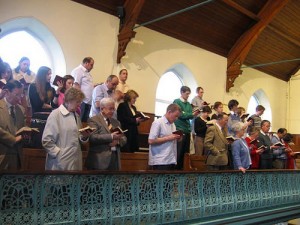
A youth worker in Minnesota asked me to share my definition of worship with her as part of a lesson she’s preparing for her youth group. I thought it’d be fun to post my response to her (with her permission) for a couple of reasons.
I hadn’t thought about it like this before.
I like it when people call me a heretic.
What is worship?
I think the English word for worship is limiting versus what God asks of us. So I break up the act of worship into a bunch different categories. (Not limited to this list)
We come together to worship God in community.
We spend time in prayer, fasting, song, reading of Scripture individually.
Our work is worship.
Our attitude is worship.
When I give my talents and treasure to God, that is an act of worship.
When I journal, that is worship.
When I am alone with my wife, that is worship.
Everything I do… I can do as worship of God.
Now, how do I define worship? Worship is any intentional human actions which bring glory and honor to God.
What do you think? Is the intention what makes an act worship? Or have I overstated what worship can be?
New pastors quickly learn that ministry life is full of big questions.
Questions that make you feel very small and insignificant. Questions that make God feel massively huge and almost out of reach. Questions that are so loaded and full of pain that they prime tears just to get the words out. Questions that have layers and layers of answers.
Questions in which the answers will define a persons walk with Jesus for years to come.
In those moments it is tempting to rattle off a pat answer. Or the denominations party line. Or what the board would rule as the right answer. Or something you read in a book. Or what you think the person wants to hear. Or a mechanical theological opinion.
My encouragement is that often times, the best first answer is simply… I don’t know.
Why did my dad die?
I don’t know.
Why did God chose me to get this disease?
I don’t know.
Was I born gay?
I don’t know.
Why did God allow my parents to divorce?
I don’t know.
Why can’t I have children and all my friends can?
I don’t know.
Why can’t the Cubs win the World Series or Brett Favre stay retired?
I don’t know.
Why did I lose my job?
I don’t know.
Why does God answer some people’s prayers but not mine?
I don’t know.
The list never ends. It gets longer and deeper every day.
Why say “I don’t know?“
I’ve found that when someone comes to me with a big question like that they really do need to know the answer to that question. But my responsibility, and what is ultimately helpful for them, isn’t to give them “my answer.”
I’ve found it most helpful in those situations to comfort, console, reaffirm, and point them to Jesus as the author, answer, and hope for those big questions.
With those questions I always point them to Scripture. I always make time to pray with them. I always follow-up later. I always affirm where the Bible is clear on a topic and where it isn’t. I always look in their eyes and say, “I do know this, that God always shows up. He always loves you. His ways aren’t always meant to be known by you.”
But my first response is almost always, “I don’t know.”
The temptation
I bring this up because it is incredibly easy to pretend to have all the answers. As if, a seminary degree is permission to have all the answers. It makes you feel powerful. It makes you feel like you know what you are talking about. It feels good when people come to you with big questions.
But the role of a pastor is not to be the Bible Answer Man or to just to give the hard, cold facts. (There is a place for that, for sure. But an initial meeting isn’t it.) More often, our job to point people wandering the desert in their pain, sorrow, and longing to the Grace Giver. To the only answer to life’s hard questions. To remind them that no matter what, Jesus thought they were worth dying for.
Still proud to call Andy a friend. I love his missiological heart and I love how he’s making a deep impact in a place where most Christians are totally afraid. Kristen and I are not just fans of The Marin Foundation, we lend our practical support wherever we can.
What do you think about this video? Am I the only one that wanted to know what Pat Robertson had to say off camera?
It’s idealistic. It’s over-the-top. It’s incomprehensibly arrogant simplicity. It’s stupid fun to be around.
And that’s why I love my church.
This little church in the city truly believes they can be instrumental in seeing a new San Diego rise up to be an amazing place to live.
Right now, we’re in a sermon series on the book of Nehemiah.
As I read the narrative I can’t get past step one.
Step one of rebuilding your city? Chapter 1… lay on your face and be honest in confessing to God.
O LORD, God of heaven, the great and awesome God, who keeps his covenant of love with those who love him and obey his commands, let your ear be attentive and your eyes open to hear the prayer your servant is praying before you day and night for your servants, the people of Israel. I confess the sins we Israelites, including myself and my father’s house, have committed against you. We have acted very wickedly toward you. We have not obeyed the commands, decrees and laws you gave your servant Moses. Nehemiah 1:5-7
What I love about Nehemiah and its message to the church is obvious… it’s not about your church, people. The purpose of the church isn’t to build a little empire. It’s to bring life to a dead and dying city. It’s to see the gospel bring renewal.
When I look out over the landscape of church culture I can’t help but see that we’re missing step one.
We need to deal with our own hearts. And we need to focus on the city and not our fiefdom.
This next passage absolutely wrecked my view of the local church. At the end, when Jesus comes to judge the church, Revelation 2-3 gives us a glimpse of how he judges the church… it should change how you and I do business.
v. 1 “To the angel of the church in Ephesus write”
v. 8 “To the angel of the church in Smyrna write”
v. 12 “To the angel of the church in Pergamum write”
v. 18 “To the angel of the church in Thyatira write”
3:1 “To the angelof the church in Sardis write”
v. 7 “To the angel of the church in Philadelphia write”
v. 14 “To the angel of the church in Laodicea write”
In case you missed it. Jesus isn’t judging the work of a single, local church. He’s judging the work of His body in each city.
Photo by bitsnpixels via Flickr (Creative Commons)
Perhaps this recession really has taught us some things?
I’ve noticed some trends softly changing in the past 2-3 years that are enlightening a cultural shift in our work-home-success life quotient. And they are encouraging.
Here’s a few things I would label under “the new corner office.” (Things that todays worker use to label that “they’ve made it.”)
No fear of self-employment. You’d think that a serious downturn in the economy, a tightening of credit, and exploding health insurance costs would scare the bejeezers out of people starting their own business? That’s just not happening in my circle of friends. And these new businesses, self-ventures, and new careers are all doing pretty well.
Working from home, working remotely, and location independence.Within the workforce, I think these are becoming status symbols. Kristen works from home as much as she likes. I like to work remotely about one day per week. And I know plenty of people who don’t even live in the same state as their company but work remotely permanently and just come in when needed. The net result for the company is that employees are actually more productive and the company needs less/different work space. The way technology is now… there’s a whole breed of worker growing less and less dependent on the traditional work environment. It’s a win-win.
Choosing “right job” over “big pay” jobs. [Note: I’m not talking about unemployed/unemployable recent college grads holding out for dream jobs that don’t exist at their level.] Plenty of people in my world have left jobs they pursued for years for something that was better suited for their personality/gift match. In many cases, that means they are pursuing a new career that pays less but feels right over a job that pays more but sucks the life out of them. That’s awesome for everyone.
Hard work is now and will always be the grease that makes the machine of success work for 99.9% of workers. At the same time, these new trends seem to show a desire for a simpler life. The new mantra seems to be, “I don’t mind working hard for the right things.“
Devote yourselves to prayer, being watchful and thankful. And pray for us, too, that God may open a door for our message, so that we may proclaim the mystery of Christ, for which I am in chains. Pray that I may proclaim it clearly, as I should. Be wise in the way you act toward outsiders; make the most of every opportunity. Let your conversation be always full of grace, seasoned with salt, so that you may know how to answer everyone. Colossians 4:2-7
Influence without motivating others to action is a wasted opportunity.
That verse and that phrase haunt me. I want to live my life in such a way that leverages whatever influence I may have on this planet to move people closer to the heart of Jesus. As Paul says, I want to proclaim the mysterious Jesus in a world where the simple Jesus is all people know.
But how do you influence people with influence over others? For me, that’s the question. It’s one thing to have a role that puts you in contact with influencers. It’s another to influence those influencers.
Here are five quick ways I’ve found (this isn’t wisdom, it’s me stumbling towards figuring it out) to influence influencers towards things that truly matter:
Proclaim the whys. I’ve found that a lot of influencers are so busy that they need help connecting the dots and being told “why” something is important much more than how to do it. Influencers are smart and know how to get things done. But you need to have them own why it is important for them to do something.
Heart tugs. A person has influence over others because they have a huge heart. If I can expose that heart to the need… they can make mountains move. A challenge for me isn’t putting them in that situation, it’s finding out what will tug a leaders heart to action. What, you thought this was easy?
Biblical truth. Call me a crazy conservative all day. I don’t care what you label me– the Bible holds truth I cannot fathom. When I have the opportunity to bring up biblical truth, or remind a leader what the Bible says about the situation they are in, that moves them.
Appeal to pride. You thought I’d say humility? Heck no, I play dirty if it means that they will take action. Have you read the Bible? The Old Testament is full of examples of prophets and friends motivating a leader with a well timed rib shot. Why? Because it works.
Challenge them to take responsibility. I’ve noticed that highly influential people are very happy to disassociate themselves from opportunities. Surely, their plates are full. It helps to look them in the eye and challenge them– if not you, than who?
It’s such a good comment, and it’s almost like a 95 theses calling me out, that I asked him if he minded if I posted it as a stand-alone blog post. I’ve been getting to know T.C. and his unique view on what the church ought to do/be. Adams Avenue is not your typical church. My own description of their ministry would be that it is a Christ-centered unchurch. Unlike me, T.C. is more of a do-er than a talker and he’s someone I’d label as “Crazy enough to change the world.”
Be the Church:
another good post and now i’m praying we can move past theory and see more practice, everywhere, every city, as adam envisions.
i/we’ve been doing it for 2 years now: no building, no long sermons (7 minutes max); lots of conversation; no music, except on a couple occasions with a guitar and singer unplugged; lots of picnics, meals, coffee, picking up trash, tutoring kids, walking around, volunteering with organizations. it’s actually very confusing much of the time so i am not speaking as a paid expert or anything (ah yes that’s another thing, this does not attract a whole bunch of money or people, by the way). there’s no guidbook, other than maybe hirsch’s forgotten ways handbook and a few others; lots of material out there on theory and many ideas but indeed the workers are few and the enemy is dead set against the kind of movements that adam is inferring.
a few interrelated opinions as i work this out for myself in collaboration with people like you who i love and appreciate so much:
– do it. stop talking about it. leave your church and do what you are saying. that’s the message i keep getting, and increasingly i have less time writing about church reform because there is, as you say, so much work to be done. people want this but we are on the leading edge and it is hard work. nonverbals are the message – what is our message – go out and get it done and build it; know that it will take a long time so you have to start now, stop writing about it folks.
– remember that jesus resisted the temptation of feeding everyone. it’s about more than just feeding hungry people. it’s about feeding some hungry people, but it is about more than that. man does not live on bread alone. there is a ministry of the word. how do you do that in the context you are imagining? don’t answer, do it. let me see how it looks. this becomes the riddle to solve once you jump out of the building. you have to create things, against people’s comfort and habit; how do you minister the word out there in the world? this isn’t haiti, this is the usa – how do you preach, when only 5 percent as adam says, are listening to the preacher? go for it. get it done. it’s possible. hint:the people who need the word are not reading this blog.
– can you really go to a church and not give money? like NOT giving money will cause them to do what you say? perhaps, but why are you following a pastor who won’t listen to this message without such coercion; when will he get it? you are feeding the problem just by being there; your vote is your butt in the chair, more than your money. … this is just devil’s advocacy. i know the line about reforming from within. yet we really need more people who flee from their church and see it as more than an opportunity to just go to the beach. we need warriors building this new kind of thing. reform from outside.
– a big trend that has to be bothersome is this rising chorus of critique against the church without a rising army of folks living out the alternative. gen x got its name from being meaninglessly, non-committal, and complacent. and i know too many of us who are not really engaged and fighting the good fight with a covenant community, we’re just saying things like “church is everywhere” and “love your neighbor” and yet it looks like a ministry of convenience more than anything. i like to write so i blog; i like to feed the hungry so i do that. i like beer so i drink with my neighbor. … all fine and good, but: are we becoming a generation of disciples and disciple-makers? is this generation being shaped and formed into Christlikness against he prevailing tides of individualism, hard-work, consumerism, well-touted charity, etc.
– i really suggest we all tithe and then some, just simply give everything we can; and see the tithe more than just giving to the poor but also giving to the word; i would uphold a levite + sojourner/needy/hungry tithe. don’t throw the baby out with the bath water is what i’m saying. yes stop paying for pyrotechnics and excessive a/v and megabuildings (or buildings at all) but do pay your pastor. have a pastor! have a church! be the church! commit. covenant. be a family. share everything.
– to sum up folks at some point we really have to turn these diatribes into something that we can show the world and be accountable to the broader church and say, “this is what we’re talking about. it’s a work in progress but here it is. join us. work with us. help us. fund us. serve with us. get messy and live dangerously too.” there must be very soon a large network or web of such churches all around, every city, so when folks like daryl are asking the question, “where is this?”, there will be many options.
– i’m reading Eugene Peterson’s Practice Resurrection which uses Ephesians as a launching pad to discuss ecclesiological issues. i suggest it as a tonic to the missional material so prevalent today. let’s not worship mission or create an idol out of food or coffee or anything else. let’s not just react to what’s at hand. let’s endeavor to be the church in all it’s fullness.
For those who work in the church, we all know it. Those who make it for the long haul either succumb to a lifetime of loneliness and don’t have any real friends or we learn to adapt and find deep connection outside the walls of the church.
But loneliness doesn’t have to be a part of the job. You really can have deep friendships and be in full-time ministry.
Acquaintance vs. Friendship
The first few years I worked at churches I confused church members hospitality with true friendship. Sure, I really enjoyed being close with people in the church… but at the end of the day (and certainly in retrospect when you step away from a church) a lot of those people I thought were my friends turned out to be just positional acquaintances. As soon as I stopped being their Pastor Adam they stopped wanting to hang out. Once I stopped investing in their kids there were no more invitations to dinner, golf, and BBQs.
Of course, we have been able to transition a few of those church acquaintances into true lifelong friendship. (For which we’re totally thankful!) But I think getting there took some time and wisdom.
A spouse helps but doesn’t really count
Kristen is my best friend. That goes without saying. But Kristen could never fill the void I needed in ministry as a friend and confidant. When I meet with people young in ministry, I often see them putting their spouse in the friend category. Of course, your spouse will help you curb loneliness! But don’t forget your spouse needs to find true friendship outside of you, as well.
So, what works?
Here are five things that helped me get past loneliness and find some healthy friendship while in church leadership.
Find a ministry network locally. Believe it or not, there are people just like you in your own community! Joining a network is a great way to meet people. Go a couple of times, see who you connect with, then take the first step and take that one person out to lunch.
Join a sports club or league. I don’t mean a church league either. Join a league and get outside of your church social circle. Get to know contractors and realtors and other normal people.
Connect with long-time friends intentionally. Some of my best friends in ministry, I only see once or twice per year. The few days we spend together per year are awesome and fill up our tanks. Going to the same conference really helps. But even meeting up for a weekend somewhere goes a long way.
Ignore other leaders who live unhealthy lives. For whatever reason, church ministry attracts workaholics. Looking through job postings at YS I can’t believe how many of them will admit that they want someone to work more than 40 hours per week. Don’t work at those ministries. Go home on time. Make wise use of your ministry time and you’ll have tons of time for real friendship. Never forget that its Jesus’ job to grow the church.
Take the first step! I think I spent over a year completely lonely and out of my mind crazy because I was waiting for fellow ministry people in my community to come find me. It’s not going to happen. The assumption is always going to be that you are busy and your life is full of relationships until you step out first.
C.S. Lewis is to Christians what McDonalds is to American children. C.S. Lewis is to Christians what beer pong is to college students. C.S. Lewis is to Christians what Dave Ramsey is to those who suck with money.
I first heard of C.S. Lewis in 6th grade. Lori, the girl who sat behind me and I had a crush on, read the Chronicles of Narnia. Every day during our free time she ignored me so she could read these books. I was trying to impress this girl with my witty humor and dashing 6th grade looks and these silly books were getting in the way.
From there, I never heard him referred to until college. He was never referred to in an English or literature class. As a freshmen at Moody Bible Institute I got exposed to the cult of Lewis. My roommate had the full set of weathered and dog-eared Narnia books. He claimed he re-read them every year. In classes, people referenced him in nearly every speech and practice sermon. I took a literature class where a professor read from a Lewis book with a quivering voice before reverently closing the book and clearing her throat. I heard story after story from people who had profound experiences with Mere Christianity or the Screwtape Letters.
On and on it went. Through college it just seemed to get more intense. After college the child-like fascination I saw as a student mushroomed into something more bizarre as I stepped into church leadership.
Here’s what I’ve learned from being in the church 18 years…
American Christians have a love affair with C.S. Lewis.
We quote him like he’s a 4th member of the trinity. Lewis is that authoritative in most Christian circles.
A C.S. Lewis quote book might as well be the 67 book of the Bible in most preachers hands. Not sure how to move a point? Quote Lewis!
I’d be willing to bet that on any given Sunday in America there are more references to C.S. Lewis in sermons than there are references to the Old Testament. Do a study… my money is on Lewis.
As you can tell, I’m a little tired of Clives. (OK, a lot) I’m happy for those who have had profound experiences through his words. It is really cool to me that his books have meaning to so many people. I’m not a hater. I don’t hate Lewis. I’ve read Lewis’ stuff. (How do you think I graduated from Moody?) I just don’t revere his work as magical. I think he’s OK, but mediocre compared to authors of his era.
But lets keep Lewis in perspective. He is not God. His words are not to be more revered than Scripture. His words shouldn’t be quoted as if they are Scripture. I think he’d probably be ashamed of how highly he is revered in some Christian circles. Let’s call it what it is… idolatry.
A dose of reality for fans
C.S. Lewis is not the great literary genius Christians claim him to be. Comparing him to his contemporaries reveals it. Is he of greater literary significance than any of these?
I could go on. I went through some lists of the top authors/books of the 20th century… you won’t find Lewis in any top 20 list. Random House doesn’t even have a Lewis book in the top 100 of either their editors or readers selections.
But the point is simple: There’s a lot of hero worship of C.S. Lewis going on.