HT to Mint

Seth Godin answers his own question:
What is the reason social media is so difficult for most organizations? It’s a process and not an event. Events are easier to manage, pay for and get excited about. Processes build results for the long haul. link
Why do pastors and other church leaders need a social media presence?
If you need a biblical justification for investing your time and energy in social media, look no further than the incarnation of Jesus. John 1:14 says, “He came and dwelt among the people.” The way church is run today… pastors do not dwell among the people. They dwell among their flock and their offices. (2-3% of the population of your community is hardly “the people.”) Look at the example of all of the Apostles in the New Testament. They all dwelt among the people. Most of them worked vocationally in the cities they ministered in.
A public presence, 1 hour per week, preaching in front of an audience, is simply not enough of a presence to know if you are fake or not. The fact is, if that’s all people see of you than they know you must be fake.
Recently, I had a conversation with someone at convention that went like this.
Someone: So, you did the blog design for Andrew Marin’s blog?
Me: Yep. I had a lot of fun doing that. I really believe in Andrew’s ministry.
Someone: Well, you make money on stuff like that. So of course you like it.
Me: Well, yeah I do make money doing that kind of thing. But I didn’t get paid for that one. I did it because I believe in what he is doing.
Someone: What? You didn’t charge him? That’s crazy talk.
Me: Of course not. Why would I?
Someone: Because that’s how you make money.
Me: But that’s also how I give money. Money he didn’t spend on a blog he can spend doing ministry. I don’t have the cash I want to give to his ministry, but I can give something that costs money so that he doesn’t have to spend it.
Someone: Oh. Wow, I never thought about it like that. I bought his book…
I don’t bring this up to make myself look good. In fact, I really wish I had the cash to write checks and support The Marin Foundation. I know, like any non-profit, cash is tight right now and he really does need cash donations. But the simple fact is I don’t have the cash to help The Marin Foundation like I wish I could.
I bring this up because too often we say we love someone’s ministry, or that we’re behind them, or that we’re excited about what they are doing… but we don’t do anything to actually further their ministry. The tribe of people that I hang with– youth workers– often don’t see the connection between “I’m supporting that person” and “I’m putting my treasures behind that person.” Because we’re fairly low on the church totem pole we feel a little weird about the money thing when it comes to church… and we carry that forward into other areas of life.
The challenge here is not simple. In fact, it may require some creativity on your behalf.
The challenge is to tangibly support the things you love with your treasures.
For me, my commitment to Andrew has been like this. He has my friendship, my support, my prayers, and anything he asks of me I try to make happen. In the past year that’s meant that I pray for Brenda and Andrew daily, Kristen and I have hosted him in our home when he’s in town, I help him with his blog and tech stuff, I talk about him to my friends, I keep my ears/eyes open for things I think are opportunities for him, I tell every ministry leader I know that their staff needs to wrestle through his book. On and on. I find ways to tangibly support his ministry.
I believe in what he is doing and I try to back it up. Like I’ve said, I don’t have the cash to back up my love for what Andrew is doing to change the church… so I give him my time and talents where I can. The stuff I help him with would both cost him cash and I forego earning cash from helping other people. So, it’s not cash but it is like cash. That’s why I’m saying… if you support something give it your treasures.
If you’ve heard about Andy’s ministry of bridging Evangelical culture and the GLBT culture, and you’d like for it to continue to help these two communities learn to love one another, it’s time to support The Marin Foundation. Don’t just say you are behind him, get behind him.
Learn more about Andrew’s story and The Marin Foundation.

This may come as a shock to people who go to church– but being a church leader is a very lonely job. Sure, if you work in a church with a large staff it probably isn’t that lonely since you have co-workers who can become friends. But by-and-large, friends are hard to come by for ministers.
Loneliness is a major issue for church staff.
Reasons
Solutions
 In 6 weeks it will be 2010. And as many pastors climb into the pulpit on January 3rd, 2010 they will give the annual State of the church message, as well as a road map of the 2010 church agenda.
Lots of churches do this. The first weekend in January is perfect for it as Christmas is in the rear view mirror, people are naturally looking at plans for the year… and most importantly the pastor has had a few days of R&R. I love this practice.
My beef is that too many pastors give a State of our church message as opposed to a State of the church in our town message.
Set Your Agenda on Local Matters
Read Revelation 2-3 from the perspective of the church in your community. You will see that Jesus did not judge those churches by their local individual meetings. He judged the church by a collection of churches in a city. Jesus was looking forward prophetically. He knew that before he came back we would be fractured into hundreds of thousands of groups… and yet his prophesy was tied to a community, not a local church. How can you deny that? I hope this drastically changes how church leaders look at their role. Likewise, I hope they set an agenda for their church body that is reflective of Scripture and not what they know within their denomination or theological tradition. Scripture is always right!
Maybe this changes how we look at our role as a pastor in the community?
Phrases from Revelation 2-3 to meditate on as you set your churches 2010 agenda. First love. Perseverance. Rich in poverty. Faithful to the point of death. Overcome. Service. Hold on to what you have until I come. You have a reputation for being alive, but you are dead. Wake up! Dressed in white, for they are worthy. You have kept my word and not denied my name. Endure patiently. I am coming soon. Buy from me gold refined by fire. Those whom I love I rebuke and discipline. Be earnest.
What if, on January 3rd 2010, your church delivered a new kind of message? What if you called a meeting with some like-minded pastors in your community and set a common agenda for what the church will do in your town? I’m not talking about 100 things you will do… I’m talking baby steps. Here are 3 things we will do as “the church of our town.” And then on the first Sunday in January your agenda for 2010 includes a couple of things for what happens within your four walls… but also includes a few things that WE as the body of Christ in our town are doing together to be the Gospel to our town?
Now there is an agenda worth rallying around! I’d give to that. I’d stick around for that.
That creates new energy. Well, in me at least.
 After 18 months of working at Youth Specialties and interacting with youth workers around the United States (and everywhere else) it’s finally sunken in: There are two different things called “youth ministry” with a major gap in the middle.
Professional vocational youth ministry: When I talk about youth ministry this is often my default. These are youth ministries and youth ministry leaders who have formal education, continued training, experience, and live their whole lives thinking about youth ministry. When you talk to them about youth ministry they think of models, books, authors, speakers, ministry ideas, successful programs, historical viewpoints, on and on.
This youth ministry is pretty sophisticated. Like any profession people fall into schools of thought. They have models for doing youth ministry. They have personally written and can defend philosophies of youth ministry. They run programs which implement their well thought out and defended philosophy of ministry. They train volunteers to be proteges for their school of thought. They have opinions about whether a certain models is getting stronger or dying.
For the 20% or so of youth workers in America in this category those nuances matter to them. They are on the leading edge of thinking about Youth Ministry 3.0.
My Church Youth Ministry: They just want to know how to minister to the kids in their church. When they e-mail me or call our customer service line they don’t want to talk philosophy or are even aware that there are different ways of doing youth ministry. They are calling because they have 15 seventh graders in their Sunday School class and they need a curriculum that will work for them. When you ask them about what they are trying to do with the group… you’ll hear the dead air or the exhale and then they’ll say, “We’re Methodist, what works for Methodists seventh graders?”
They don’t know or care about philosophies of ministry. They don’t know or care about ministry models. They haven’t heard of Saddleback or Willow Creek. They go to First United Methodist Church of Middletown– that’s it. They may know that some churches have full-time youth workers but they don’t really care. They have a full-time job outside the church. They have a kid in high school. And the pastor thought they were pretty loving towards teens and asked them to minister to their kids friends. They give of themselves to invest in the kids in their church and that’s amazingly awesome.
 For the 80% or so of youth workers in America who fit this category, youth ministry is pretty matter-of-fact. There are kids who show up on Sunday morning or Wednesday night and they do what they can to minister to them.
Minding the gap: There are not big steps in between the two groups of youth workers. It’s a gap with a chasm, not a ladder to the next or even a bridge.
It is literally two different things we call youth ministry in America. They all care about the kids in their church. One group is purely interested in the kids in their church. While the other also cares a lot about the greater profession of youth ministry.
Sunday morning’s sermon at Harbor stirred in me the desire for the church to be a place of reconciliation.
Stephen reflected on Revelation 7:9-12 in which people of every tribe, tongue, and nation will worship Jesus on His throne in Heaven and asked us to consider if we would attempt to do the same on earth? We live in a melting pot commununity. Literally, within 5 miles of our church are people of many tribes, tongues, and nations. The question brought forth was, will we intentionally worship together as a community or will we allow a church culture to prevail which prefers to seperate on Sunday mornings along racial lines?
Miller: Don’t you feel that integration can only be started and realized in the Christian church, not in schools or by other means? This would be a means of seeing just who are true Christians.
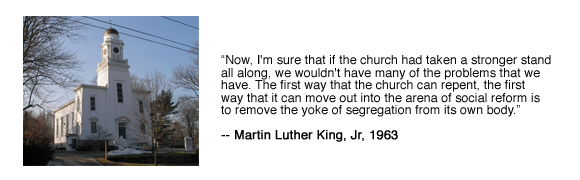
King: As a preacher, I would certainly have to agree with this. I must admit that I have gone through those moments when I was greatly disappointed with the church and what it has done in this period of social change. We must face the fact that in America, the church is still the most segregated major institution in America. At 11:00 on Sunday morning when we stand and sing and Christ has no east or west, we stand at the most segregated hour in this nation. This is tragic. Nobody of honesty can overlook this. Now, I’m sure that if the church had taken a stronger stand all along, we wouldn’t have many of the problems that we have. The first way that the church can repent, the first way that it can move out into the arena of social reform is to remove the yoke of segregation from its own body. Now, I’m not saying that society must sit down and wait on a spiritual and moribund church as we’ve so often seen. I think it should have started in the church, but since it didn’t start in the church, our society needed to move on. The church, itself, will stand under the judgement of God. Now that the mistake of the past has been made, I think that the opportunity of the future is to really go out and to transform American society, and where else is there a better place than in the institution that should serve as the moral guardian of the community. The institution that should preach brotherhood and make it a reality within its own body.
The truth is, 46 years later, not much has changed. Churches are still largely segregated in America. You could argue, as this CNN article points out, that we prefer our Sunday’s segregated.
Something about that is anti-Revelation 7, isn’t it?
A few years ago I was at a leadership retreat in which we were asked to bring up our dreams for the congregation. The small Michigan town we lived in has a vibrant Hispanic population and a historic black community dating back to the Underground Railroad. I said that one of my dreams for the church was that there wouldn’t be three congregations in town separated by race (but not doctrine) but that we would figure our a way to have one church. I was laughed at and mocked for weeks. “We just aren’t ready for that.”
And by “that” I suppose they meant dealing with their racist tendencies for the sake of the Gospel.
In America, lines of segregation are alive and well. We all know it. People use their positions of power to invent new “legal” ways to segregate people all the time. But what are we willing to do about it?
Want to see segregation alive and well in America? Head to a school board meeting when they talk about re-districting. Or head to a planning commision meeting when they talk about building an apartment complex. You will see the dominant culture take up arms so that “they” don’t allow “them” in their school or neighborhoods. Apply some nouns to those conversations and you are right back to Brown vs. Board of Education.
It is amazing to me that no one I know would be upset– or even notice– if they worked with people of another race (or gender.) It wouldn’t even be an issue in the workplace. For the most part it wouldn’t be an issue in our own neighborhood. Even in our own families race is not much of an issue. Six days per week our society has integrated. It’s not perfect but we’ve come a long way.
And yet on Sunday morning… race (and gender) are major issues! This must change and we all know it. The question for leaders today is simply, “What are you going to do about it?”
I am proud to call Stephen my pastor. He stood up on Sunday morning, not to cheerlead the efforts our church has made in the last two years, but to remind us that we have a long way to go. I hope the small successes we see at Harbor are just the beginning of a wider movement of reconciliation on Sunday mornings for the sake of the Gospel. First in our community, but also in America.
Some questions: For a variety of reasons I know a lot of people in church transition. Some were on staff at a church which has let them go for budget reasons and they need a new church home. Others have moved to new states for a job. Still others just can’t stand their current church situation anymore and are looking for a new church home in their town.
So the question presented to me, as a friend is: What do I look for in a church? (We’re talking about believers looking for a new church, not people brand new to the faith.)
I like to immediately rephrase the question to be about the pastoral staff. You simply cannot go visit a church and make a judgment on whether or not you want to be a part of it based on a site visit and observation of programs or even the weekly service. The quality of a church is determined by the quality of leaders. If you want to see the heart of the church and get exposed to what is really going on– you will need to meet senior leaders. If the church is so big that you don’t get to meet the senior leaders if you request a meeting… decide for yourself if that’s the type of church you’re OK with being a part of. Me personally? That tells me everything I need to know. If I can’t get a meeting for a cup of coffee with the pastoral staff they don’t want me to be a part of their church, got it!
Things you are trying to figure out when you meet a pastoral staff member.
1 Timothy 3:1-7 outlines the Biblical qualifications for being a pastor. (overseer) This becomes the basis for my bullet points below.
Here is a trustworthy saying: If anyone sets his heart on being an overseer, he desires a noble task. Now the overseer must be above reproach, the husband of but one wife, temperate, self-controlled, respectable, hospitable, able to teach, not given to drunkenness, not violent but gentle, not quarrelsome, not a lover of money. He must manage his own family well and see that his children obey him with proper respect. (If anyone does not know how to manage his own family, how can he take care of God’s church?) He must not be a recent convert, or he may become conceited and fall under the same judgment as the devil. He must also have a good reputation with outsiders, so that he will not fall into disgrace and into the devil’s trap.
If you want me to get even more practical than this, leave me a comment! We’ll start a “thumbs up” or “thumbs down” voting system!
Not like the brazen giant of Greek fame,
With conquering limbs astride from land to land;
Here at our sea-washed, sunset gates shall stand
A mighty woman with a torch, whose flame
Is the imprisoned lightning, and her name
Mother of Exiles. From her beacon-hand
Glows world-wide welcome; her mild eyes command
The air-bridged harbor that twin cities frame.
“Keep, ancient lands, your storied pomp!” cries she
With silent lips. “Give me your tired, your poor,
Your huddled masses yearning to breathe free,
The wretched refuse of your teeming shore.
Send these, the homeless, tempest-tossed to me,
I lift my lamp beside the golden door!”
—Emma Lazarus, 1883
With another NYWC kicking off this morning, this is exactly how it feels. Youth workers are the most misunderstood tribe of church workers. Maligned, misrepresented, dispatched to the corners of the building these resilient men and women endure a lot to be in youth ministry. They do it because they’ve answered a calling to minister to the tribe of people often cast aside as lepers in the church, teenagers.
And they come to convention looking for rest, ideas, and encouragement. Convention is a place of shared known where we can laugh, cry, and celebrate what God is doing. As they come today, I hope to pour what I can into them.
This is a homecoming for them and I intend to welcome them home!