Category: Church Leadership

  • Going lean and mean

    lean-and-mean

    Yesterday’s church service was a celebration of what God is doing in our community. For those who don’t know, I attend a church plant called Harbor Mid-City. It’s an effort to do the impossible task of bridging cultures in one of San Diego’s most diverse communities. Mid-city is home to roughly 60 language groups and it’s socio-economic demographic stretches nearly as wide. In short, it is a place which embraces the awkwardness that these people don’t normally come together for the sake of living out the Gospel message of justice and equality while being surrounded by injustice and inequality.

    No church has ever challenged my way of thinking more. In theory, I love everything Harbor is about. But in practice, I’m a wuss and have to actively fight my tendency to make church about my kind of people worshipping in my kind of way. I thank God for His challenging our to invest there for now.

    For the last few weeks the church– and a hodgepodge of other ministries in the neighborhood– have run what they call The Urban Project. Essentially, this is a justice in action project. I don’t know all of the details of everything that was done but I do know that for these few weeks the whole church put forth an effort to do really cool stuff. They fixed stuff that was broken. They pointed out to local government injustices in our working class poor neighborhood. They employed high school students and taught them leadership skills. They ran a free day camp for the children of the community. I’m sure they did a lot more, too. But that’s the stuff I know of.

    Here’s the point of this post: The church couldn’t do this if they didn’t operate lean and mean. Here are three ways they operate lean and mean that are worth thinking about:

    1. No property. I think a lot of churches would be wise to sell their property. They have no idea what a distraction an office is for the staff nor how much time/effort/money is wasted simply by maintaing a building. It’s a gross inefficiency that most ministries don’t truly need. By not having property to hang at, maintain, or pay for… the church is able to focus much more attention on their actual ministry.

    2. Low-tech service. If you are used to high production church you’ll be shocked to see how simple the services are at Harbor. Seriously, shortly after arriving at Harbor a couple of staff asked me to get involved helping them catch-up. My counter-point to them is that a pretty, produced service has little net gain for the amount of time invested in making it great. I’d rather them stay focused on what makes the church great than get distracted in trying to get pretty. It’s 90 minutes of people’s lives each week… to people in the pews it’s not nearly as significant as people in church leadership think it is. I’m glad to see that Harbor continues to keep the worship service in perspective and keeps it simple. (Yet powerful in its simplicity!) Moreover, I think a lot of churches think their worship service change lives and over do it. If there is one area of regret from my time in church ministry its that we wasted so much time producing a worship service. I kick myself for that all the time.

    3. Preaching rotation. This is something I greatly appreciate about Harbor. You see, the lead pastor is very gifted. I’d put him on par with most of the people we bring in at YS events. And yet Stephen’s main ministry is not preaching. It’s leading the church and ministering to the people. If Stephen concentrated on preparing 50 sermons a year the churches overall ministry would suffer. A major reason we’re seeing so much success is that when he shares the pulpit with other qualified people he essentially has created an additional part-time position at the church! I wish more preaching pastors gave up the pulpit at least once per month for the sake of the church ministry. At the end of the day, life-on-life ministry has  long-term impact while up-front preaching ministry tends to have short-term impact.

    What are ways that you could re-evaluate your ministry to get lean and mean in the ministry season to come?


  • College Ministry 101

    college-ministry-101aToday, I am driving up to Los Angeles to meet with fellow YS blogger and YS author, Chuck Bomar. Chuck’s new book, College Ministry 101, is an important read for the church today. While church leaders have known of a significant drop-off of kids from high school into college few church are doing anything serious to rectify it.

    Some churches run programs like glorified youth groups that really just delay the problem.(Eventually you do need to transition them to an adult-like ministry, right?)

    Most churches do nothing. Their action provide an implied rumschpringer where Christian children go off and experience the worlds delights and horrors. (And 20% or so return later.)

    Some churches expect 18 year olds to join adult Sunday school or small groups.

    Long story short, Chuck has spent a lot of time helping churches figure out the college-aged ministry and now he has a book. Today I am meeting up with him to do some filming for the podcast as well as some stuff about his book.

    I’m looking forward to meeting him. And I’m looking forward to what he has to teach youth workers about college ministry.

  • Multi-Generational Communication

    multi-generationWhen I was in New Jersey, I had an intriguing conversation about communicating to multiple generations during the Sunday morning sermon. Kristen’s uncle, Fred Provencher, is a senior leader and one smart cookie. I loved this conversation on a lot of fronts. Fred is a great communicator, he is a great pastor, and yet he is doing bucketloads of research to try to figure out… “How do I become a better communicator and pass on some best practices to others?” How many senior leaders are really wrestling with this? I think most feel that their messages aren’t that effective, but very few will actually take the time to learn why and how to fix it.

    The task is nearly impossible!

    When I was on staff at a church we always had this feeling that Sunday was-a-coming. Like clockwork. It was always in front of you like a ticking time bomb. The local preacher has to prepare 50 messages a year, keep the attention of loads of different communication preferences, evaluate the effectiveness of last weeks message, prepare this weeks message, begin planning for stuff 6 weeks out so the worship team is can prepare, on and on. On top of all of that the preacher must try to factor in a way to communicate to builders, boomers, and all the rest of the generations… all of whom have strong preferences for how the sermon should be delivered. You can see why some teaching pastors just give up and do what their talents and preferences dictate. Which is why I’m so excited for Fred’s research.

    The task is wholly necessary!

    For 2000 years the Sunday morning sermon has been the primary communication tool of the church to the church body. Going forward I think it’d be hard to argue that the sermon will be less important in the future. The real question is, will it be as effective in leading the church going forward as it has been to date? Or will it fade into a tradition we do but see little fruit from?

    It’s about technology!

    The sermon is not about video, audio, big screens, dramas, special music, or even a talented speaker. But it is about finding the right technology for each audience. A communication style is a technology. Adapting to your context is a technology. The words you use to convey biblical truth are technology. The Bible is the content and the technology is how the communicator delivers that content.

    Context, context, context

    As I think about this I think about it as 3 contexts.

    Context of where you are: If your church is in suburbia and your audience is hooked on Facebook, YouTube, and are business people I’d think that you’d want to communicate differently than the church I go to which is mostly working class poor. I’m always shocked to see people emulating the communication styles and technologies of churches that just don’t fit the local context in which the church operates. That’s why Erwin McManus’s stuff is so powerful in his context but falls flat in other places. In the context and shadow of Hollywood, storytelling and visual arts are powerful technologies. I don’t think that would fly in rural Kansas.

    Context of the passage: I’ve been shocked to see misuse of technology in relation to the passage of Scripture the preacher is teaching. How can you teach the beatitudes… blessed are the poor, blessed are the meak… while using a $100,000 A/V system and by hiring professional actors to do a skit? Sometimes we get so worried about being hip and relevant that we actually offend the context of what we’re trying to teach. Imagine you are a working-class poor person attending a service that is supposedly teaching me that its OK to be poor. How can I undertand that message in a $20 million building from a pastor who makes $100,000 more than me! Sometimes we forget to look at the context of the passage through the lens of the the technology we use to deliver it.

    Context of who you are: Another shocker is seeing a communicator try to go outside of themselves. I’ve seen communicators put on a public persona or try to communicate in a fashion that just isn’t them. We visited a church in which a very type A, direct and to the point preacher tried to close his message with an artsy prayer experience. He fumbled through the instructions. He felt awkward telling people to get up. And he never stopped talking while people were supposed to be praying. The biggest thing a preacher should do is to be who they are. If you are hip, be hip. If you are a nerd, be a nerd. If you are artsy, show us. But if you can’t send an email don’t try to tell us you found this video on YouTube. When you do things that are out of context for you, it doesn’t matter if it was done to appease a generational expectation.. it just makes you look stupid.

    It matters who you are the other 6 days.

    The Sunday morning sermon is important. But it is validated by who you are when you aren’t preaching. Otherwise, they are just words. We live in a high expectation, low trust world. The true measure of your Sunday morning words must be lived out through your actions. That communicates to every generation that your message is worth listening to.

  • Balancing an attack-oriented life

    In this world there are people who attack life and people in which life attacks them. It’s a rational choice that becomes habitual and sets the course for your story. I am a person who attacks life. Most of the people reading my blog are people who attack life! Early in my Christian life I memorized a verse and this phrase stuck out to me, “make the most of every opportunity.” That struck me because I never thought Christians could be aggressive, but Paul makes a very aggressive statement!

    I just got back a 24 hour trip to Michigan. I am exhausted and pumped up at the same time! Basically, 12 months ago I did the same trip in opposite fashion so it’s not like I’ve never done it before. The truth is I’ve done that type of trip many times before. For example in October 2001, I flew from Chicago to Heidelberg, Germany for a five day trip in which I spoke 10 times. The mindset of, “I’m going there to do business and than coming home” is not new to me.

    The flip side of this is the notion of living a balanced life. A key reason we want to live a balanced life is sustainability. Which begs the question, “How do you live an attack-oriented life” It seems anti-balanced life to have some of your calendar year balance between family, friends, service, and work while other– big chunks– of your life is spent out attacking a project.

    I think its easy to over-compensate on both fronts. You meet people on the road who attack life too much. And you meet people at home who play the role of the attacked. The key is determining which things are opportunities that you need to make the most of because they advance your life’s purpose (whoppertunities) and which are just plain-old opportunities that will gain you some more income, notoriety, or just be an item to check off your list. And then there are things that masquerade as opportunities but are really distractions.

    In other words, part of being a leader is discerning which things are opportunities, whoppertunities, or distractions.

    Whoppertunities don’t come along often and they are worth dropping everything for. Opportunities come along fairly often and you need to take the time to discern if they are worth pursuing towards your stated goals. And ones that aren’t worth pursuing you need to label (at least mentally) as distractions.

    You ability to do that determines whether you can balance it all. Invest in too many distractions and you’ll soon be too busy to see whoppertunities or even opportunities you need to jump on.

    My stated goal is to change the world in which I live. By very nature that is an attack-oriented life as the only type of change the world does on its own is negative, entropy-driven change. Change for the betterment of an ecosystem is hard work. But it is never impossible!

    My advice to anyone who wants to change the world in which they live is to not give into the notion that you can’t be both balanced and driven by your work. That’s plain nonsense.

  • Ah, ministry to students…

    Before Thursday night, I had spoken to exactly zero groups of high school or middle school students in the past school year. None. Zip. Zilch. For the most past that was intentional. I needed a break.That part of my life felt tired when I left Romeo. The grind of preparing 1-2 talks per week, year after year, really does wear you down. I was also feeling the type of exhaustion that lead me to say repeatedly, “I’m qualified to lead and teach, just too tired.” I’ve been especially thankful to the leadership of our church for being patient with me. They’ve allowed me the freedom to rest!

    So when Chris from Harbor asked me to host and teach his group of summer interns I was a little apprehensive. I always felt rusty after taking a vacation… how would I feel after taking a year off? Plus, I didn’t know any of the students so I couldn’t lean on relationship. Ah, the excuses I had created in my mind for failure!

    It all went great. Kristen completely rocked the hosting part. She made lasagna and salad… keeping it simple always seems to work best. The house was ready, the kids seemed to have a good time. 25 smiling faces when they came, while they were here, and when they left. Success! The only little bump was Stoney getting frisky with some guests. But that’s completely in character for him! The talk part went pretty smooth. If I had practiced a couple of times I wouldn’t have needed my notes at all and I would have had a better feel for some of the material. But I think I maintained their attention and the whole thing was pretty fun. (I was relieved that they actually did the discussion part… I never know how that’ll go.) Hopefully, I gave them something memorable, something worth thinking about, and something applicable to their service when they lead camp next week.

    As I’ve shared, the last year has really jacked with my identity in a good way. Switching from a full time role where my ministry was primarily to students and their parents to a role where I interact with a lot of youth leaders but not a lot of students… it’s given me a chance to think a lot about who I really am in Christ. Am I my work? Is my ministry outside the home more important than inside? What is it like to not be labeled “pastor” anymore? One thing Thursday night reminded me of… I was made to work with high school students. I can do a lot of other things at a high competency. And for this season of my life I am perfectly comfortable not working with high school students vocationally. Yet, this was a reminder that I need to be more intentional and giving in volunteering my service to high schoolers. I’ve got to figure that part. Reality tells me that I don’t have oodles of time. But reality also  tells me that something will be incomplete if I don’t find 3-4 hours per week to do something with high school students.

    That’s what I’m thinking about this Saturday morning. Now off to the beach so Stoney can hump his own kind.

  • Fix what is broken

    broken-chair

    I’m always a bit surprised when I encounter something that is obviously broken that hasn’t been fixed.

    For instance.

    I went into a small bookstore. While I was there I noticed a steady stream of customers who walk into the shop, take two looks around, and walk out. The two people working there continued doing what they were doing. One person dutifully shelved books while the other stood by the counter. It doesn’t take a genius to see that something is wrong but the people working there are working on the wrong strategy, aren’t they?

    I walked into a church and immediately felt overwhelmed with options. There were booths everywhere in the foyer, each competing for my attention. There were greeters handing me things. There were churchgoers asking my name. There were people trying to get my children’s attention. Five minutes into the visit all I could think of was GET ME OUT OF HERE! This was a broken welcome area. It was meant to make people feel welcome but just confused people. But I highly doubt that church staff spends more than 5 minutes a week thinking about the welcome area. They are working on the wrong strategy, aren’t they?

    Dropping our kids off at school is absolute chaos. With no bus service every parent must either drop off their child by car or walk them from the neighborhood. Mix in 500 kids and their imagination-driven walking patterns with a few hundreds cars driven by people from all cultures and walks of life and you have one chaotic mess on a small two-lane street. While the school focuses on keeping kids safe and trying to make pick-up and drop off more efficient you can’t help but see that the whole thing is doomed. They are working on the problem instead of trying to fix what is broken.

    Sometimes I visit people blogs and see things that are obviously broken. Bad links, colors that literally makes my eyes water, and no way to subscribe via RSS so I don’t have to ever go back. I don’t care how great your content is! Chosing to leave the bad design there while the content is great is the wrong strategy.

    Great leaders pay attention to the most obvious stuff. In whatever you lead you have to stop on a regular basis and say, “Are the basic things running perfectly?” Can customers find what they are looking for? Do visitors feel like this is a church they can belong? Can I drop my kids off at school without them getting hurt? Can I read your blog?

    If you don’t take care of the basic things– strategy doesn’t matter. No one will care about your company, church, school, or web content unless you have the basics covered. It’s like talking to a football coach who says that his number one priority is implementing the west coast offense. No one will care about your offensive strategy unless you take care of the real number one priority… making sure no one gets hurt.

    When I was about 20 years old I got a job working on equipment that produced ID cards for a health insurance company. The truth was that the department was so lost in procedure and doing things right that they had no ability to get work done. The other people operating the equipment didn’t understand how the equipment worked and could only see the piles of mounting backlog. A machine that was supposed to print 900 ID cards an hour struggled to get 1500 produced in a day. Sometimes we’d have orders for 50,000 cards and be left with no choice but to outsource the work. It was bad. Pressure was mounting. And I knew that if we didn’t focus on the basic things my tenure there would be short. When I started my mantra was, “Just keep the machine running.” We started focusing on that one simple thing… keep the cards printing. We started training the operators on how to maintain the equipment. I showed them how to fix the most basic things themselves so that we didn’t have to wait 2-3 hours for a repairman to come in. By focusing on that one mantra of “keep the machine running” we were able to catch-up and eventually eliminate outsourcing the work. Pretty soon we went from one machine running one shift to 24 hour shifts, to a bigger office with 2 machines, to eventually 3 machines that could run 24 hours a day producing more per hour than the outsourcing companies could on their best day. Our team fixed what was broken and that opened the door of opportunity and expansion.

    A good starting point for any leader is to look at the day and say, “What’s most obviously broken?” Work on that first.

  • Realistic Expectations for Church Staff

    realistic-expectation

    Most of my adult life I have been on church staff. But the last 13 months I have not worked at a church and it has provided me with a wealth of insights into what I thought people expected out of me versus what I expected out of myself. I think people working at churches have unrealistic expectations for their churches just like the people in the pews have unrealistic expectations for what their church staff should be doing.

    With that in mind, here are some of my realistic expectations of my church staff: (Please note I lump all staff together as equals.)

    – Remind me of the churches vision. Let’s face it, it’s hard out there raising a family and earning a living. That makes it very easy to forget what the church is all about. My default vision for the church is always going to be “meet MY needs.” If the churches vision isn’t about my default, I depend and expect the staff to remind me what it is. In our church’s case I need to hear and see tangible manifestations of the church’s vision… bridging cultures, bridging hearts.

    – Teach me from where you are in your walk with Jesus. We live in an age where Christians have access to the very best communicators of biblical truth on the planet with a single click of the mouse. Consequently, I think church staff feel compared to these other ministries all the time. But I don’t expect my church staff to be John Piper, Andy Stanley, Francis Chan, or any of the others. Those are all great leaders and I am thankful for them… but I expect my church staff to lead me locally right from the pages of what God is doing in their lives. Jesus didn’t select those people to be here in my neighborhood! But He did select this staff for this time– and I know Jesus is smart enough to place the right people in the right places.

    – Be professional. I know church staff feel an all encompassing, mind-swirling, burdening pressure to be all things to all people. The dumbest thing you can do as church staff is to buy into that lie. It’ll cost you joy and sanity! I don’t expect church staff to meet my every whim. I don’t even expect the staff to “be my friend.” Their role in my life is to be a spiritual leader– if the friendship thing happens that is fine– but it’s not an expectation I have. And I never expect their families to be at an event, or even Sunday morning worship. I do expect the staff to be prepared, to lead their ministries effectively, to be on time, to be courteous, and to represent the church to the community.

    – Set the pace. I am always leery when I see church staff buy into the now, NOW, NOW!!! mode. I just don’t think that is a sustainable pace. Very few churches in this world can sustain exponential growth. Moreover, I expect that each church has a “right size” when we should stop thinking about growing and start thinking about planting. I mourn the satellite movement. It’s as if they got the idea they should plant but don’t have the nerve to cut the strings from the communicator… as if the lead communicator is the reason 4,000 people show up to church!

    – Lead movements, not programs. It’s easy to focus on a tanglible program as a church staff. “This week I am leading VBS” or “This week I am taking students on a short-term ministry project.” While those are great, I don’t give a rip if they happen or not. If my church staff told me they were killing children’s Sunday School because it wasn’t helping them bridge cultures and hearts with City Heights… I’d be cool with that. The reason is that I have an expectation that the church will focus on a Gospel-driven movement in my community. Programs can be the enemy of people movements.

    – Remain biblically qualified. When I look at 1 Timothy 3 I don’t see anything unrealistic. I expect those things to be boundaries. Don’t whore around. Don’t be a sloppy drunk. Don’t blow money. Don’t cause trouble. Don’t be a hot head. Be a decent teacher. Be respectable and have an open heart.

    With all of that said, I think it becomes clear what our role is as the body. My job is to keep my expectations reasonable. And when my expectations aren’t met, my job is to go back and check my expectations against what is reasonable. As I look over this list I kept saying to myself, “This list needs someone to be the gatekeeper!” Each church needs a person who knows the staff intimately enough to help them establish boundaries. The church needs that same person to be an advocate for the staff to the church at-large, as well. It’s almost as if Paul, inspired by the Holy Spirit, knew what he was talking about.

    What are expectations you have for church staff that are different from my list? If you are on church staff, is my list helpful or harmful to you?

  • Free vs. Paid Content in the Church

    free

    Whether you are aware of it or not, there is a raging battle going on about the concept of free vs. paid content on the internet. Big names in media like Rupert Murdoch have drawn the line in the sand– they are going to make people pay for news content. Others have embraced the Google model of an advertising-based system of free content. Last week Seth Godin took the debate to a new level. He is firmly in the free camp while Malcolm is in the the paid camp. Of course, most of Seth’s income comes from consulting, speaking, and book proceeds– so Seth may be in the free camp for some things, but his paycheck comes from paid content too.

    Inside the church the same debate has just begun. And all of these questions lead back to the same two central questions that newspapers are wrestling with, “Since creating content isn’t free, who is going to pay?” “In a world of free content, where is the ethical line?

    Two Sides to the Content Coin

    1. Gospel-oriented content should be freely available. As someone who has successfully started an internet business in the last five years I know the power of free. Ask Tim Schmoyer. Ask Ryan Nielsen. Nothing draws traffic to a youth ministry website quite like free. In the youth ministry world there is an expectation of free content. There is a righteous indignation when you question the ethics of free, too. No one cares that it costs me thousands of dollars to create, host, and market “free” content. There is a general consensus that stuff about youth ministry should be free and you shouldn’t expect anything in return for free lessons, videos, music, etc. “Don’t ask me to click on an ad. Don’t ask me to sign up for a newsletter. I need something free because I don’t have budget to buy stuff.” I’ve gotten nasty emails from folks who insist that all content about ministry should be free. These same people often are in paid ministry. So they want to get paid for using someone’s free content. Talk about wanting your cake and eating it too! Sheesh.

    2. Gospel-oriented content should cost something. Of course, the ironic thing about the free thing is that the people who think ministry content should be free want to get paid by their churches, ministries, or non-profits. If I told you that you shouldn’t get paid for being a youth pastor you’d get angry with me! There is a certain immaturity to the free thing. At the end of the day there is no such thing as free content on the internet. Someone sits down to write something, they save it as a PDF, they post it on a website, and they offer it for free to anyone who wants to download it. It seems free when it isn’t. That computer cost you something. The education that powered your thoughts cost you something. The time you spent creating it… was it for work you were being paid for at the church? If so, does that content even belong to you? If it was your free time, isn’t that time worth something? If you don’t think your time is worth something why should I use your stuff? When you posted it somewhere on the web, who paid for that server space? If it’s on a well-known site, who is paying for the building of that site/brand? Who is paying for maintaining it? If you added graphics to the content, who paid for that? If you had someone proofread it, who paid for that persons work? That doesn’t seem free to me.

    There is no such thing as “free” content, even Gospel-oriented content, so people should expect to pay something for the works they use. The real question is, “Who should pay?” In the old media world the user was expected to pay for the content. You subscribed to a newspaper to get the content and the profit in the model came from advertising. You wanted a book so you went to a bookstore and bought it. In the 1980s and 1990s most of us in ministry would have thought it immoral to copy books and give them to friends, copy cassette tapes and give them to students, etc. But now there is an expectation that advertising will somehow pay for all the content I want/need. That’s the new media age. Free to me, let advertisers foot the bill. Wouldn’t it be funny to see a pastors salary supported by advertising? He’d preach in an outfit that resembled a Nascar driver’s suit! It’s always funny to think about real world applications of stuff we do on the internet everyday, isn’t it?

    Digital media has created an ethics dilemna for people in ministry, hasn’t it? There seems to be a feeling that the parable of the talents can’t possibly relate to actual money. People who advocate for free content will concede… “It’s OK to break even, just don’t get rich!” So if content cost me $500 to produce a lesson… why is it wrong to want to return $1000? (Like the parable) Don’t you remember the parable… Jesus called the man who just broke even a wicked and lazy servant. What then would Jesus say to people who intend to invest $500 in content and give it away? Super wicked and super lazy?

    We would never walk up to an auto mechanic and expect him to change our oil for free simply because we are in ministry. We would never go to the dentist and insist that he give us free dental. We would never go to the grocery store and expect the grocer to pay for the pastors food. And yet we have no problem with this when it comes to Gospel-oriented content. Something is out of whack, isn’t it?

    As with all things that seem to leave us in a quandry– I am wondering if there is a 3rd way. Is there a way that is both ethically satisfying and free? Is there a way that is both affordable for ministry folks and pays for itself?

    Chime in. I don’t pretend to have all the answers. If you’re in the paid camp– speak up! If you think everything should be free, give me a counter-punch.

  • Does the church love my child?

    This video is from the blog of Andrew Marin. If you haven’t read his book, Love is an Orientation… shame on you!

  • Two views of the local church

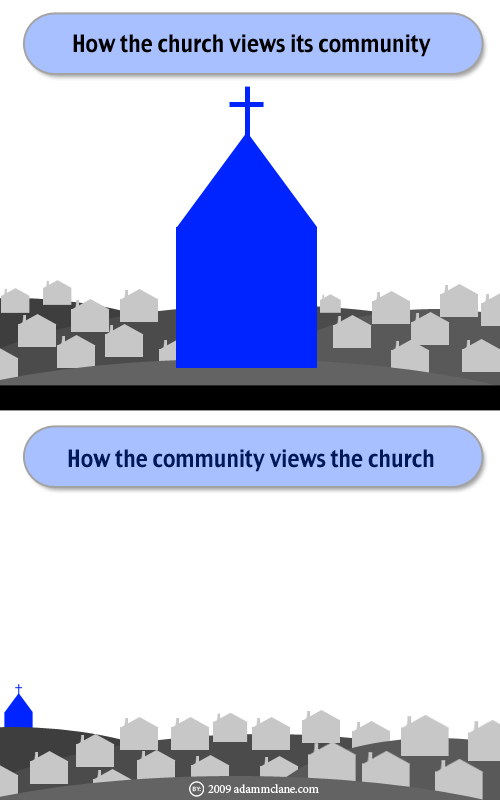
    church-views

    There are two sides to every coin, aren’t there? I’ve had this post stuck in my head for several weeks– and I think the illustration says it all.

    Church leaders: Complacency sneaks in. We surround ourselves with people who go to church. We spend a lot of our time at the church. Our perspective becomes that the community revolves around activities at the church. Pretty soon we become ambivelent about the neighborhood we live in. Our schedule is defined on what’s convenient to those who come to church. Our agenda becomes to serve them.

    We perceive our ministry as a “city on a hill” when in fact the people living in our neighborhood are completely unaware of our existence. Before we know it, we are so comfortable with our programs, budgets, staff, and people who come to church we forget reality.

    The reality is that in most communities about 5% of the population attends a church. And yet we are comforable with that. Go ahead do the math yourself. Spend 30 minutes calling every church in your community and get actual attendence numbers. Next, simply divide that number by the population of your community. In most places that number is 5% or less of people who attend church on any given weekend. And we all know that just because someone attends church on Sunday doesn’t mean they are Christians, right?

    Why not take some time to get to know how 95% of the population views your church? Think of it like this. Count the next 20 cars that drive past your house. Only the 20th car will attend a church this weekend. In the illustration above there are 18 houses in view of that church. And none of them will attend that church this weekend. If your theology is like mine, you recognize that Jesus died for all 20 of the people in those cars and all 18 of the people who live in those houses. But who is our ministry serving? The 5% who show up. Most of our money and time is spent serving Jesus from the perspective of the 5% and not the 95%.

    That perspective should change things. 1 in 20 people will attend church this weekend. Any church. Even that church that is so bad you won’t even meet with the pastor to pray.

    I’m speaking to you out of deep gratitude for all that God has given me, and especially as I have responsibilities in relation to you. Living then, as every one of you does, in pure grace, it’s important that you not misinterpret yourselves as people who are bringing this goodness to God. No, God brings it all to you. The only accurate way to understand ourselves is by what God is and by what he does for us, not by what we are and what we do for him. Romans 12:3, The Message

    And yet church leaders reassure themselves that numbers don’t matter! This is the state of the church and people say we don’t need to fundamentally change how we do ministry. We worry about offending the 5%. We worry about changing too much too fast while our sworn enemy puts up victory statues all over. We follow leaders who look at this reality, shrug their shoulders, and move on with their lives. We go to denominiational meetings which agree to spend more money on organizations which are smaller every year. In short, we invest all of our time and energy in a broken model.

    And then when someone really breaks through. And that community reaches 6% of the population so we flock to hear how they did it? Got a book? Teach a seminar? Our perspective is jacked up, isn’t it?

    New leaders are needed. I dream of church leaders coming to the forefront who are drastically interested in the 95%. I long to surround myself with leaders who keep the 5% in perspective. We celebrate those lives changed! But I want to be with men and women who think differently. Where are the leaders who look at those 5% as just the beginning? Where are the people who recognize that a model cannot be built around an individuals talents? Where are the leaders who know they need to start a swarming movement?

    Point me to those people. I am tired of those who are satisfied with the failure of 5%.