Category: Church Leadership

  • Youth workers are nuts

    DSC_0046I guess I’ve always known this. Heck, I know I’ve been nuts a long time. But this weekend I got a lot of glimpses at just how crazy some youth workers are. In fact the craziest youth workers are volunteers who wil bring 45 kids from Kansas to Los Angeles for an event– by car– is absolutely insane. It’s one thing to do that for money. It’s an entirely new level of nuts to take your own vacation time to do that.

    Isn’t it interesting that people who are crazy enough to change the world look absolutely nuts? I suppose that’s a fair assement of an everyday superhero as well? While most sane adults do everything in their power to flee from the presence of sweaty teenagers wondering the streets of Los Angeles, God has created a special group of people who gleefully serve them.

    Acts 2 says: (emphasis mine)

    That’s when Peter stood up and, backed by the other eleven, spoke out with bold urgency: “Fellow Jews, all of you who are visiting Jerusalem, listen carefully and get this story straight. These people aren’t drunk as some of you suspect. They haven’t had time to get drunk—it’s only nine o’clock in the morning.

    DSC_0001People who are faithful, full of the Holy Spirit, and willing to take big risks for the Kingdom of God often look crazy. It’s a good kind of crazy. It’s the kind of nuts that gets me excited.

    This past weekend I was able to watch students get a little nuts too. On the first night they were pretty reserved. This is typical of an event as they are excited and into it– but they aren’t quite willing to look nuts just yet. But by Sunday afternoon kids crowd towards the front in order to express their nut-itude. This is the type of memory they can take home with them and memory bank for the next time they feel awkward about their faith.

    This weekend was a powerful reminder for me that we need more people who are absolutely out of their mind lunatics for the cause of Christ. Not fired up in a fake way. Not full of nonesense. Just legit willing to do whatever it takes. The world needs people who encounter the Word of God, catch a vision for how God wants them to respond, and are crazy enough to lean into its realities in their everyday life.

  • Back to the Garage

    garage

    Last night I was listening to the latest episode of This American Life about origin stories of new industries and companies. Many well known companies have a myth that they started in a garage. Even if it really isn’t true, people want to believe that their company was created by someone with a crazy idea who invested her last $2000 on an idea and got started in their garage. For some companies, like Hewlett-Packard and Apple, there is truth to it and the garage has become a corporate icon for innovation. In the case of Google, they have tried to capture that feeling so much that in 2006 they actually purchased the garage which housed their offices for a few months in the early days.

    It made me think of the virtual garage in which YMX was built. A few friends sat around in an AIM chat room one night and envisioned a new place for youth workers to hang out. That night the idea went from light bulb to a URL and was a big moment. Just 2-3 weeks later I pulled an all-nighter when we opened the site and in 12 hours went from idea to profit. For me, that was an iconic experience I will look back on for the rest of my life.

    It made me think of garage start-ups right now. I thought of Bob Carter who started The Pod Drop in his basement. In just three years he has taken his small iPod repair business from his basement to franchises. I thought of Derek Johnson who started Tatango. In just 2 years he has taken his idea of a group texting service from his parents basement to hundreds of thousands of customers. We don’t need to think of the garage story think it couldn’t happen today. Today’s economy has forced the brightest minds on the planet from the board room to the garage. Out of this recession will come the next great innovations that shape the next 30 years. The question isn’t if it will happen. The question is, “Will I take my idea and run with it or will I end up working for the person who took his idea and ran with it?

    More importantly it made me think about the fact that for most people– there is never a garage. There may be dreams of a time when you are passionate about a new idea– about thumbing your nose at the man and going on your own— but for lack of something [money, time, guts] it never happens. Most of us, even leaders of great organizations, never get to be a part of it in the beginning. The garage is merely a legend. We get hired some time well after the good ‘ole days of wheeling, dealing, and turning heads. If you got hired today by Apple or Hewlett-Packard you would never be allowed the freedom to truly innovate in a garage to try to make something happen as it’s simply too complicated now. You have to make payroll, you have to mitigate loss, you have to protect the brand, you have to guarantee the shareholders a return, etc. Certainly these jobs require leadership, but a type of leadership that knows how to innovate in mature ecosystems.

    My challenge for you is simple. Whether you a leader for a government agency, school district, church, non-profit, or even a small business– my challenge is the same. Spend some time in the garage. Ask big questions. Thumb your nose at the status quo a little. (Even the status quo for excellence you created.)

    Starter questions:

    If we were to start a church today in this community, knowing what we know now, what would it look like? Where would we meet? What programs would solve the most systemic problems in our community? How could we manifest the Gospel best? What behavior would we thumb our noses at? Who would be the most crucial people to invest in? Who would we not care if we pissed off? Who is the most unreached people group in our town?

    This doesn’t have to be about a church, does it? Make your own questions for what you are passionate about and go to the garage.

    Are you ready? 1-2-3 GO!

  • What to Say When the Youth Pastor Leaves

    the-truth

    It’s June. Professional youth ministries most dangerous month. I’ve served in three churches and all the hiring, firing, quitting, and retiring with the youth ministry seems to happen in June. It’s a wicked combination of the end of the school year and for a lot of churches, the end of the budget year. I could offer some theories as to why so many churches hire and fire in June… but that’s not the point of this post.

    “What do we say when the youth pastor leaves?”

    Church leaders: Tell the truth. If the person quit, just say they quit. You don’t have to spin it. Just tell it like it is.

    But if you are firing them, I can’t tell you how many people I have talked to who were fired and then asked to enter into an agreement (never in writing) that for a sum of money they will say that they have decided to quit. Hundreds. If you are man or woman enough to fire a person than be man or woman enough to tell the congregation. You don’t pay severence to someone you are firing to cover up the fact that you are firing them. You pay them severance because they are self-employed and ineligible to claim unemployment benefits. It only makes matters worse when you fire a person and then put on a charade that you are sad to see them go. You throw a party, you say all sorts of glowing things in public when you know full well that you sat in a board room and decided this person needed to be fired. If you lie, your lie will be found out. Your sin will be exposed and the embarrassment you were trying to avoid will come back to haunt you for years. If you made a brave decision as the leadership of the church then it is a sign of your strength as leaders. When you try to wuss out, it shows what kind of leaders you are.

    The truth always wins.

    Church staff: Tell the truth. If the leaders of your church dismissed a person don’t ever lie about it. It’s perfectly acceptable to say, “The leaders decided to go another direction.” You don’t have to go into the specifics of why the person was fired. But don’t participate in the leaders lie if they are trying to spin the truth. That makes you party to the lie! Your corroborating the leaders story and remember, the truth will come out eventually. And remember, this is exactly how you will be treated if they let you go later.

    The truth always wins.

    Youth Pastor: Tell the truth. I have been in your shoes. I know what it’s like to have that meeting where the leaders tell you that you aren’t the person they want pastoring their kids anymore. I have felt my world crash around me in that moment. I’ve looked across that table when they told me what to say. They are going to wave a big check in front of your eyes and you are going to think, “How else can I feed my family? How will I pay my rent? How will I have enough money to get the heck out of here?Just don’t get bought by Satan. Think about it… would Jesus ask you to lie in His name? Not telling the truth is telling a lie! Church leaders who ask you to lie for a little bit of money are doing the work of your sworn enemy. Walk out of that meeting with integrity. Do not cave to their pressure and promise of financial security to further their lie. They will end up offering you the same severance check anyway… because it is the right thing to do and the congregation will demand it. Moreover, your telling a lie to the congregation will only make matters worse. They are trying to get you to take the fall because they know you are leaving the church.

    Candidates for youth ministry positions: Find the truth. Your well-being and the well-being of your family and future ministry depend on you discovering the truth! If you are interviewing at a church you need to talk to the former youth worker. During the interview process ask the search committee about the previous person. Then ask for their email address or phone number so you may contact them. This is 2009, you can find them in 10 minutes on the internet. Be a detective and get to the truth as to why that person left. If there is a lie… don’t take the job. This is precisely how you will be treated. If the previous youth worker was fired and the pastor and the elders participated in that lie, confront them! No matter how good they make that job sound, that entire relationship will be based on lies unless they come clean. Confront their sin and then don’t take the job. Show them what a leader looks like.

    Some may read this and think, “Boy, Adam McLane has a chip on his shoulder about this. You would be correct. I am sick of seeing my friends in ministry asked to lie for a few thousand bucks. I am sick of churches hiding the fact that have fired a person. I am tired of the Bride of Christ doing things that are worse– even illegal— than what happens in the business world. I know that a healthy ministry can only be built on the truth. And it is time to speak up and get some truth out there.

  • Getting Started in Investing, Part 4

    money_stuff4

    Free money! How often do you hear that phrase? Not very often. But generating free money in a bank account is essentially what investing is.

    I’m surprised how many people are scared of the whole topic. Among people under 30 in ministry there are three groups.

    1. I’m too young to worry about savings and retirement. These folks are typically focused on their mountain of college debt. And in their minds they shouldn’t save anything until they pay that off.

    2. I don’t know anything about investing so I just don’t do it at all. Essentially, this is who this series is for. This group of people plead ignorance or try to pretend it is all too complicated for them.

    3. I’m in it to win it. These folks understand the basics of investing and know that starting young means more free money down the road.

    It’s all about the interest. Do you remember back to 5th grade where we learned about compounding interest? The teacher would say, “if you put $500 on a credit card with an APR of 22% interest, how much would you owe at the end of 12 months? Essentially, investing is the same process in reverse. The earlier you can put money away the sooner interest will start compounding for you.

    This is critical for those in ministry. We have to start earlier than our peers since we will make less over a lifetime than those in other industries! Fortunately for us, there are some great tax benefits that help us save for tomorrow today.

    401k, 403b, 529, Traditional IRA, Roth IRA, Education IRA… where do I start?

    The basics: Essentially, all of those accounts are going to allow you to defer when you pay taxes on your savings. Theoretically, you could save for retirement with a savings account. Three problems with that. First, the interest rate generally stinks. I’ve never seen a savings account at a bank offer more than 4% interest. Second, you can get to that money way too easily. This is long-term savings so you don’t want to be able to access it with your ATM card. Third, each year you will pay taxes on the interest you earn. A retirement plan of any variety is going to allow you to earn a higher rate of return, the money isn’t readily accessible to you, (unless there is an emergency) and will allow you to defer paying income tax on interest until you withdrawal.

    401l/403b: These are essentially the same thing. These are retirement plans for “regular employees” of either for-profit (401k) or non-profit (403b) companies. The great news is that 99% of the time you can invest in 401k/403b through payroll deduction, the money will go into the account pre-tax, and your employer will likely match a certain percentage of your investment. For instance, if they match 100% up to 5% of your income and you make $1000 per week… they would take $100 out of your check and give you an additional $100… depositing $200 per pay period into your account. ($4800 per year) With a 100% match you make 100% interest on day one! There is no better investment on the planet. To not accept this offer of free money is foolish. Since it is payroll deduction you won’t even miss the money. Typically, if you enroll in the program and do nothing else they will automatically select a very conservative mutual fund for you, guaranteeing a small return with minimal risk. Remember, by putting in a little you get free money automatically on the first day. Even if your employer only matches 50% up to 4% of your income… that’s still better interest than you will get anywhere else. The bad news is that you won’t be able to touch that money until you are 59.5 years old. Technically, you can withdrawal early but that will come with some nasty penalties. It is important to understand that money invested in your 401k/403b has almost nothing to do with your employer. Sometimes they will allow you to buy stock in the company through your retirement plan (never do that) but otherwise you are putting money into a bank. This means that the savings belong to you. If you change jobs the money is still yours. (We’ll just not talk about vesting right now to keep it simple) We’ll also talk about investment choices another time. For now, keep it simple.

    IRA: (Individual Retirement Accounts) For some reason this one is scarier to people. It shouldn’t be as it is way more fun! This is the most obvious retirement savings option for those church workers who are “self-employed.” These savings are not pre-tax, but when you file your return you typically reap the same benefits so it all works out. Most people end up with an IRA because they change jobs and want to withdrawal money from their previous employers 401k/403b program. (Called a rollover) Kristen and I did this in 2002 to consolidate about five 401k programs, it was simple and pain free. Unlike a 401k, an IRA is going to depend on you depositing money into the account. If you are absolutely unwilling to make any choices, find a broker and have them set it up for you. Any U.S. citizen can have an IRA (or IRAs). Essentially, it is just a savings account that allows you to purchase investments.  Technically, you can invest in all sorts of things with IRA money. But the most common things people invest in with an IRA are stocks and mutual funds. While your employer doesn’t typically match your investment most churches I have worked at will include retirement savings in your contract with them. So, each quarter or month they will give you a check for the agreed amount of money and it is up to you to invest that money. I use E-Trade for my IRA and they allow me to transfer money from my savings account to my IRA. But even writing a check to your broker or mutual fund is a snap.

    Which IRA do I want? Unless you have some serious cash, you want a Roth IRA. There is an investment cap for how much money you can put in every year, I’ll be honest, as a youth worker you don’t have to worry about that.

    529/Education IRA plans: A 529 is basically a 401k for your kids college education. You make an investment and they manage the funds. When the time comes for your kid to go to college, the college withdrawals the money from the account. If you invest in your state’s 529 plan there may be state tax benefits for you. Typically, the money can be used at any college that is accredited. So if you plan on sending your kids to an non-accredited training school or Christian college… this may not be the best option for you. An Education IRA is basically an IRA for money dedicated to your kids college. (You manage the investments.) So if grandma dies and leaves your kids $10,000… this is your best bet to allow it to earn interest without paying taxes.

    Kristen and I don’t believe it is our responsibility to fund our kids college. But we do have a 529 plan for them with the intention of helping out a little. (Books?) We make a simple investment each month… the same dollar amount since Megan was born… and it adds up really fast! We have a few thousand bucks in that account already and it was completely pain free. Also, we’ve always taken the small checks for their birthday’s ($10, $20) and added that to their monthly investment. We still give them the money (of course!) but we want them to know later on that grandma and grandpa invested in their education and every little bit counts.

    The key to all of this is starting now. It’s all about compounding interest to make your small investments today work for you later. (Remember 5th grade!) If you are 22 and just out of college…. this is the right time to get started! If you are 32 and haven’t gotten started… get on your horse and get it done.

    Still got questions about this stuff? Ask a question in the comments and I’ll hunt down the answer.

  • Don’t Promise, Deliver

    gm-logoIf you live in the United States, you are the proud owner of the second largest pool of retirees next to the federal government. And as a bonus you also get a small and dying breed of cars formally known as General Motors. We just spent over $80 billion to bailout a company that is only worth $7.3 billion. You can walk onto a dealers lot right now and participate in the largest liquidation of assets in the history of the world.

    And we still haven’t fixed the one thing that forced them into the red in the first place: 500,000 retirees.

    General Motors is the classic case of over promising.

    Over-promise #1: I remember talking to a GM executive about the business model as he gave me a tour of their Warren Tech Center. I asked him how often a customer was supposed to buy a new car according to the company? His answer made my jaw drop. They built their business model on the assumption that you would buy a brand new car every 3 years. No wonder their cars sucked! They only expected you to own it 36 months. No wonder they failed! No one in their right mind could afford to buy a brand new car every 3 years. They were absolutely lying to themselves. Their competitors built cars that lasted 10 years or more. Honda and Toyota owners hit 100,000 miles and knew that their cars will easily make 200,000 miles. Meanwhile, GM was building cars that were meant to be traded in at 36,000 miles.

    Over-promise #2: In the mid-1980s, when Toyota and Honda made it big in the United States market, GM was stupid to continue the retirement program. There was simply no way that they could afford to continue the program… but they lied to their employees and sold them the lie that if they took care of GM, GM would take care of them for life. The smart thing to do back then would have been to convert the program to 401k and make no promises of retiree health care. Instead, they oversold a promise they couldn’t keep. Worse yet, to deal with payroll issues they started early retirement programs which meant people in their mid-50s were walking away from GM with a “guaranteed” pension and health care. There are currently tens of thousands of people in the United States who have now been retired from GM longer than they worked for GM. No company can bear that burden. Companies struggle just to pay benefits for current employees… How did they think they could insure 500,000 non-wage earning retirees?

    My point isn’t really about GM, it’s about over-promising. Here are some ill-effects of over-promising.

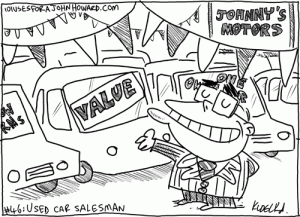
    usedcarsalesman– Advertising becomes useless. It doesn’t matter how much money you spend on ads as people won’t believe you anymore.You can’t hype up a product launch or an event that you’ve oversold forever. When you don’t deliver you are just reminding customers how much you betrayed them.

    – Your word becomes useless. When you break promise after promise, soon people won’t trust that your on their side. They will see that you only want their money and you don’t care about them.

    – Your product becomes a joke. I was in a meeting yesterday about search engines and someone used the word Yahooeveryone laughed. Yahoo has become a dinosaur of a search engine. The only thing memorable about Yahoo is that stupid song, Yaaahhoooooo. You can’t advertise and promise a web service, you can only deliver. This is the #1 reason you can’t trust Bing.com to be any good. If it was so good why are they spending $100,000,000 to advertise it?

    Shifting gears: The evangelical church has become a classic example of the over-promise. Part of the church becoming more about programs and business models is that it has fallen into the trap of needing marketing and advertising like the business models they copies. The result is a lot of over-promising. “Come to the marriage retreat, it’ll fundamentally change your marriage.” or “Sign up for our next church production, it’ll be awesome.” or “Bring your friends to the revival and they will get saved.” In a world where the awesome is so readily available churches do nothing but give away trust when they advertise promises they can’t deliver. I’ve seen church events marketed like they were going to be on par with Disney or Broadway or Oprah and deliver like a trip to the town carnival, a middle school play, or a cable access show. At the end of the day the church spent more effort marketing the event, production, or program than they did making the program awesome. It is a sick cycle that is killing thousands of churches.

    The better way: Wouldn’t it be refreshing if churches just delivered? Wouldn’t it be amazing if they didn’t sell themselves but just helped people? What if they invested in training their volunteers and staff so much that the church didn’t need to make promises, that their programs and ministries truly worked to change lives? You wouldn’t need to advertise a life-changing marriage retreat… because results would advertise themselves. You wouldn’t need to hold a revival because every church service, small group, and youth group meeting would see people come to know Jesus. You wouldn’t need to hire a killer band and create a worship experience because people were authentically worship Jesus. The best advertising a church could ever invest in is a changed life.

    If you are a church leader I want to challenge you to think about your programs. Think about how you talk about them. Think about how you market them. And remember:

    Don’t promise, deliver.

    Don’t hype, deliver.

    Don’t sell, deliver.

    Don’t measure, deliver.

    Don’t sub-contract, deliver.

    Don’t advertise, deliver.

    In a low trust, high expectation world the best way to succeed is to undersell and deliver.

  • Dominant Culture in Evangelicalism

    what-is-cultureI’m now a few chapters into Andrew Marin’s Love is an Orientation. I have to tell you I am fascinated by two aspects of the book.

    1. How much homework Andrew has done. He knows his stuff. He knows the GLBT culture pretty well (from what I can tell) and he definitely knows Evangelical culture pretty well.

    2. How much missiology he pours out. This captures my imagination! Viewing the GLBT community as a different culture helps me, a ton!

    The thing that has jumped out to me so far the most has been the concept that white evangelicals dominate the church. In essence, our cultural mores  control much of our church, dominate the culture, and define the agenda.

    At the church we go to the leaders really get this concept and fight hard to push back against “white evangelical expectations.“The result is a church that is ethnically reflects the neighborhood we worship in.

    Here are a couple things that I see us fighting for cultural reasons.

    – The service will be tightly scheduled, so as to look and feel like we know what we are doing. To our Hispanic, African-American, and Souteast Asian brethren this just doesn’t work!

    – The church should offer programs that are both entertaining and educational for children and youth. I see this as the biggest struggle our church faces. It’s an expectation of white evangelicals, but not as strong of a value to the other cultures we worship with. As a youth ministry person I see this struggle with parents of the people we’re reaching. The key is going to be creating a youth ministry that compliments the mission of the church.

    – The music should be easy to sing. Yeah, this isn’t the case in our church by a mile.

    – Small groups should be clusters of people just like me. Yeah, this isn’t happening and I hope it doesn’t.

    See, there is much power in the dominant culture recognizing their position and making room to be uncomfortable for the sake of the Gospel. It is silly to expect other cultures to assimilate to us simply to hear the Gospel message!

    No one would applaud a missionary who went to Africa and forced converts to sing Chris Tomlin songs in English, preach in English, and wear Western clothes. We would call that missionary a fool. We would pull his funding. And yet we applaud white evangelical pastors for creating churches who are comfortable only to other whites?

    I have been a part of churches who made legitimate efforts to bridge cultures on Sunday mornings and I have been a part of churches who were ambivelent.

    The question is: What are the things that churches need to be cognizent of as they reach out to various cultures?

  • Getting Started in Investing, part 3

    money_stuff3

    Hey honey, are you spending more money at the grocery store or something? This was something I found myself saying to Kristen over and over again in our tenure in youth ministry. With a growing family it just seemed like every month we made a little less money. We had a budget. We did our best to control spending. But before we knew it our expenses exceeded our monthly income and we had too much month and not enough paycheck. At first it was $100 here or there. But by the end we found ourselves several hundred dollars per month short each month. This slowly depleted our savings and towards the end, with no savings, we had little choice but to use a credit card to make ends meet.

    In Part 2 of this series we talked about dealing with the monster of debt & savings. But this is how we acquired this debt in the first place! It wasn’t that we didn’t control our spending and lived a lavish lifestyle worthy of acquiring debt. It was that the price of groceries, gas, utilities, and taxes that shot up by 3-4% per year and our income remained stagnant. As years go by this compounded and we actually made less than we thought.

    COLA stands for “Cost of living adjustment.” I need to spell it out because so few of us in ministry never experience it. Some churches try to call it a raise, it is not. Each year actuarialists at the federal government determine cost factors and determine what increase in income you would require in order to maintain the same standard of living. In other words… not getting COLA means that each year you take a pay cut! The assumption by utilities and tax boards is that you will receive this increase, which is why all of your expenses “magically” go up by about that amount each year. It’s not optional or imaginary, it happens.

    Here’s an example of the last 5 years and what a COLA should look like for a typical youth workers income. For someone hired in 2004 with a base salary of $35,000, this is what the last 5 year’s would look like.

    Year COLA Adjusted Income
    Non-Cola Adjusted Income
    2005 (4.1%) $36,435 $35,000
    2006 (3.3%) $37,637 $35,000
    2007 (2.3%) $38,503 $35,000
    2008 (5.8%) $40,736 $35,000
    2009 (6.2% est) $43,262 $35,000

    And this isn’t even considered a raise in salary! This is just to keep up with inflation over the last 5 years. Looking at it from a monthly budget perspective, the difference between a COLA adjusted and non-COLA adjusted income is $636 per month. So if this employee feels like there is a lot less paycheck to go around… it is because there is! They are being faithful to a ministry that is paying them a decreasing amount every month.

    Just to rub some salt in the wound, here is what it would look like if over that same period you averaged a modest 3% raise with your COLA.

    Year COLA Adjusted 3% Annual Raise
    2005 (4.1%) $36,435 $37,485
    2006 (3.3%) $37,637 $39,487
    2007 (2.3%) $38,503 $41,580
    2008 (5.8%) $40,736 $45,229
    2009 (6.2% est) $43,262 $49,391

    Yes, that would mean that this same employee would be taking home $1200 more per month than the employee who did not receive a raise or COLA just 5 years into a tenure. How much more comfortable would you be with $1200 more in your pocket per month? This isn’t excessive, this is just what your peers experience in the business and government sector. This is what your neighbors receive. This is what it is expected you receive.

    In all honesty, this is the difference between a sustainable income that will keep you in ministry for decades and an income that will bury you in financial burden and burn you out in five years. If you want to be in ministry for a long time, you need to get at least a COLA annually or you are accepting a pay cut.

    But my church is in financial trouble, what do I do?

    Listen, I know that no one goes into ministry to get rich. Having worked for years in Michigan I know what its like to work at a church in recession. (Michigan’s recession started in 2005, now it is deep in a depressionary state.) But while the short-term makes sense to take a cut here or there or not accept a COLA or raise… you are really not helping the church. In fact, what you are doing is contributing to the problem by having a staff stressed out with money worries!

    So, what do you do? Some negotiation options. Provide some reasonable alternatives to cutting your pay. (Remember, no COLA is a pay cut!)

    – Tell them no.

    – Tell them to cut somewhere else.

    If they have no choice but to suspend your COLA or even cut your pay here are some options that I would suggest.

    1. Get the leaders to spell out the plan to you.With decreases in monthly giving this is where we are at, this is what we are doing to get things in line.” Find out how your COLA fits into their plan. If they don’t have a plan, ask them to formulate one so your family doesn’t suffer from their lack of foresight. Be a leader to those leaders.

    2. Have the leaders acknowledge verbally that they are asking you to accept a pay cut. Get them to be honest, is this a result of poor performance or is this the result of poor planning, unexpected expenses, unexpected decreased giving, etc. Often times church leaders are so passive-aggressive that they will suspend stuff like COLA or increases because they feel you are under-performing but won’t actually tell you this to your face. If that’s not the case… get them to spell that out to you. Because accepting a pay DECREASE feels a lot like punishment.

    3. If COLA simply isn’t possible, tell them you will accept a suspension of COLA in lew of receiving it now. Ask them to sign a promisary note for their plan. If you didn’t get a 2008 COLA and won’t get a 2009 COLA, that’s a 13% DECREASE in income to you. If they can’t provide you with a 2010 COLA, will they promise you $10,000 in make-up and 3 months notice for you to find a new ministry?

    4. Negotiate for a lesser COLA. The 2009 increase is likely to be over 6%! If they can’t swing it, meet them half way at 3%.

    5. Accept the suspension of COLA as a loan. Again, ask them to enter into a promisary note with you. If they don’t have the increase now allow them the option of paying it back to you over time.

    6. Negotiate for time off to earn income somewhere else. In lew of a COLA for 2008-2009, ask for 4 weeks of paid time off where you can supliment that income by working at a camp, another ministry, or even a part-time job. Would they allow you to work 8 hours less per week so you could get a job at Starbucks?

    Some of these may seem extreme. But remember the goal… your goal is to do ministry for a LONG time. And a big part of being in ministry for the long haul is not constantly being stressed out about money. There are times when you should be meek and humble. But when it comes to feeding your family you should be aggressive to protect them. The reality is that during your career you will earn much less than your peers in for-profit business. Demanding that your ministry pay an annual COLA is hardly robbing a ministry. In fact, it is investing in their most valuable resources… their staff.


  • The pastoral personality choice

    hybelsHave you ever noticed that somewhere out there, someone has chosen what the ideal pastor looks like— sounds like— speaks like— dresses like— acts like— or thinks like? Somewhere I am going to open a door and there is going to be a mannequin dressed like the pastor we are all trying to emulate. If you go to a conference, networking event, or any place a lot of church leaders gather you will see and meet a lot of people trying to fit into an ideal that just isn’t them. The simple reality is that each person serving in ministry has to decide… “Am I going to be me or am I going to emulate someone else?

    I first noticed it in college when my pastor started dressing like Bill Hybels. He didn’t wear a suit or even a tie to preach in… he wore a sweater. Why? Because he went to a conference and saw that a leader he looked up to dressed business casual. It’s perfectly natural and scientifically proven that you will emulate people you look up to. I’ve known pastors who have changed all sorts of things about themselves because they want to preach like Andy Stanley or wear cool glasses like Rob Bell or tell great stories like Erwin McManus.

    The problem is that if you put on a personality that isn’t you, you’re a fake. Hopefully you have friends in your life who will slap you and tell you that you look stupid in that crazy get up. Judging by the sheer volume of emulators out there though… more pastors need friends like Len in their lives. (Yes, his role in my life is  to swiftly kick me in the nuts on a regular basis… whenever I need it. And he’s allowed to enjoy it.)

    Today, I watched this video from Ed Young and it really annoyed me. He says that pastors use words like “crap” or “sucks” or “hell” just so they can sound cool. Typically I’m fine with generalizations… and I throw out my fair share as well. But my response after watching his video was simple: It’s more important that I be myself in ministry than that I try meet a standard that Ed Young sets. If I  tried to be Mr. Prim-n-proper– Len would give me a swift kick. Plus, when I’m fake every sees right through it anyway! Prim-n-proper I am not.

    If I were submitting myself to his leadership, I’d take notice. Otherwise I took his video with a grain of salt… just another person creating another mannequin of what a pastor ought to do, be, or look like.

    But this post isn’t just about the standard that Pastor Ed is trying to set. It’s bigger than that. Plus, I like Ed and I wouldn’t want anyone to think otherwise. He’s just a single voice in a mighty chorus of leaders trying to tell people what that mannequin looks like. I find that so many leaders try to control others based around their personal preferences or convictions. So often leaders in the church are personally convicted about something and they misinterpret that work of the Holy Spirit to include everyone on their staff, all the leaders in their church, or even the people who attend the church. And that is, at its simplest form, where legalism begins. A conviction of the senior leader does not automatically become the conviction of his flock!

    Here is the big problem with living your life trying to look like a perfect mannequin. One day you will wake up and realize that you are not the person you desired to be. If you try to take a square peg and jam it into a round hole you will just end up miserable. You may talk right, look right, have the right hair style, have smoking cool Rob Bell glasses… but if your heart isn’t right, you’re just a mannequin and not the man or woman God has created you to be.

    I’d rather be a cussing pastor who spoke truth into people’s lives than a fake because I tried to live up to standards that weren’t meant for me.

    – If God wants you to be a pastor who wears a tie and keeps the straight and narrow… be that leader!

    – If God wants you to be pastor bad gangsta who gets mistaken for Eminem… be that leader!

    – If God wants you to be a mom who puts her kids in front of her flock… be that leader!

    So, rather than looking to emulate the perfect pastor… Why not just focus on who God is asking you to be today and reminding the people in your ministry that you are just as messed up as they are? You need Jesus every day as much as they do. None of us really has it more figured out than anyone else.

    Let’s get busy living that out!

  • Getting Started in Investing, part two

    money_stuff2

    Here’s a scenario for you. You are serving at a church and things go sour. I mean, they go really sour. Meetings are arranged behind your back. Students stop coming to events and making excuses to avoid you. Your weekly staff meeting with the pastoral team becomes a finger pointing competition. And all roads are leading back to you. You’ve done nothing wrong but everyone hates you. You leave the meeting and head back to your office. You know your ministry at this church is coming to an end. You have felt it ending for a long time. And you are sweating the reality that a job search is imminent.

    All spiritual realities aside. In these moments, and all vocational people in a church will one day be in these moments, there are two positions you can be in.

    Position A: You can make a rational decision, knowing that you will be financially OK whether you stay at this ministry or not.

    Position B: You can make an irrational decision, knowing that if you get fired you are screwed financially.

    [Of course, I’m simplifying this as there are lots of options.] The point is that when things hit the fan at work you need to be able to make a decision that is ultimately best for you and your family. And being knee deep in debt with no savings is not going to help.

    Having worked in churches for nearly 10 years I know that there is rarely much margin between income and expense. And this makes saving money hard and acquiring debt easy. Add to that mix that many people in youth ministry brought college debts into ministry… and you have a recipe for disaster!

    So, practically speaking, what can you do?

    #1 Most Important Thing: You need to figure out how to get a few grand in the bank. You hear every single personal finance person say this and there is a good reason. Having 2-3 months living expenses in the bank allows you the freedom to make decisions that are best for you and not just what will get you through the next couple of months. Living paycheck to paycheck just leads to you acquiring more and more debt. I believe for folks in ministry this is more important than paying down debts… our jobs are just that insecure. And this goes beyond just job issues. I don’t think you can seriously build a budget until you have this little bit of breathing room.

    With almost no margin, how do I get that much cash in the bank? Some ideas…

    – Sell stuff. Have a garage sale. Have a bake sale. Sell used books on Amazon. Sell your baseball cards on Ebay. Sell your extra car.

    – Make more money. We’ll talk more about this in another post. But practically speaking, if there is no margin between what you bring in and what goes out you will need to find another source of income. For Kristen and I this meant that Kristen watched a child from the church four days a week. It wasn’t much… but it helped us widen the margin. If you’re single… you’ll need to look for alternate forms of income. Again, we’ll talk more about this in part five.

    – Spend less money. That’s easier said than done, I know. Our friends mocked us, but in Michigan Kristen and I learned that by heating our house less we could find a bit of margin. Also, cutting back on things you don’t really use that much can make a big difference. Remember this is just temporary until you get a few grand in the bank. 6 months without DVR or trips to Starbucks will be worth it.

    – Decide a dollar amount to save per paycheck. I take great pleasure in transfering a prescribed dollar amount to savings every payday. But if you lack the discipline to do that, there are more forceful options. If you have direct deposit simply direct a set amount to your savings account so you never actually see it as spendable income! A more manual way to do this is to ask the person who cuts paychecks at the church to write you two seperate checks. One goes in checking and the other goes in savings. If you really lack discipline… go ahead and have the take out your tithe/offering too!

    #2 Most important thing: You need to stop using your credit cards. When Kristen and I got married we didn’t have any debts. About a year later we bought a car and went into debt big time to make it happen. But that wasn’t the really dumb thing. The dumb thing is that a few weeks later I said “yes” to an offer for a Discover Card. That thing has been a thorn in my side ever since. At first we paid it off every month and I only used it for gas purchases. Then, we took 3 months to pay for a laptop. Then we bought some furniture. And started using it everywhere we went. Then the monthly balance was so high I couldn’t make myself pay $1000 per month so we let the debt build a little. Before we knew it, it was almost maxed out and we were screwed! The point is… until you take the first step and take using the credit card as part of your buying habits… it’ll own you.

    – Stop carrying it with you if its a temptation.

    – I like using plastic for every purchase, that’s why I use my debit card.

    – Come up with a repayment plan on your own. Currently, we dedicate one of Kristen’s paychecks to savings and one to paying down debt each month.

    – As you pay down the balance, call the card company and ask them to lower your limit. While you’re at it ask them to lower your interest rate.

    – Try to pay at least double the minimum payment… you need to get the principle down ASAP to incur less interest payments.

    – Once you get a few grand in the bank, turn all your efforts to getting rid of credit card debts. If you have more than one debt, pay the one with the highest interest rate off first.

    #3 Most important thing. Reward yourself! Look, our jobs are hard. And I think some of the reason so many of us get ensnared in debt and no savings is because we overcompensate and reward ourselves too much. I think there is ample reason to celebrate your successes and take time to celebrate. My beef with Dave Ramsey’s style of personal finance is that he’s too aggressive. He sets you up for a fad diet… and once you reach your goals you have starved yourself so much that you are liable to go buy something stupid just because you can. I go for a more reasonable style of savings/debt repayment. I’m OK with it taking a few months longer if it means I make sustainable changes to my life. That’s why we reward ourselves regularly along the way. We save up a little something outside of our “plan” and then do fun things! Our family has a date night each week… it’s frivolous, but it is a nice reward. I think you deserve to treat yourself for doing a good job! I know in youth ministry there aren’t many other people who will reward you, so reward yourself.

    Here’s the good news. Getting a few grand in the bank will probably only take you 6 months if you make it a legit goal. And from there you can turn your DVR and your heat back up! But a little bit of pain is going to go a long, long way for you sustaining in youth ministry into your 30s and beyond.

  • Getting Started in Investing, part one

    money_stuff

    I’d like to let my youth ministry friends in on a dirty little secret. While pay has dramatically improved for youth workers in the past two decades the most consistent reason people leave youth ministry once they reach their mid 30s and above is mounting financial pressure. In other words, there are some glass ceilings on the personal income side of things that will eventually cause you to look for higher paying work in the church or not in the church if you don’t plan ahead. Plan ahead and you relieve the pressure bit by bit. Don’t plan ahead and that pressure builds and leads to a catastrophic failure.

    Here is a short list of those pressures:

    – Housing expenses skyrocket: That rental gets old, doesn’t it? Buying a house can be great when you land in the same place for 10 years or more. But buy and sell a house a couple of times when you change jobs and you’ll quickly see that’s a bad strategy for financial security.

    – Retirement savings becomes important: Most churches either don’t offer a retirement plan for their associate staff or it is extremely inadequate. Even if you are in a denomination that pays into a pension fund… getting ordained in order to get vested in that fund can be more costly than the pension you’d earn in the long run! (And with many mainline denominations tanking financially, you really need to wonder if that money will be there in 30 years.)

    – Kids get more expensive as time goes on: When you first have babies you think diapers and formula is a blow to your budget. Just wait! Eventually those kids will need braces, outgrow clothes every two weeks, want to go to camp, need a car of their own, and gulp… want to go to college.

    – Medical insurance won’t cover it all: Again, when you are young and/or first married this doesn’t seem important. But with premiums soaring churches are cutting back on benefits. So as you age into needing good insurance chances are your church is increasing co-pays and other out-of-pocket expenses.

    – Pressure to keep up with your peers: There’s only so long you want to live like college kids. Eventually, you are going to want grown up furniture, go on nice vacations, and have a little extra something here and there. I don’t mean that you’ll get more materialistic as time goes on… but you just get sick of scrounging.

    If you do nothing, eventually these pressures will leave you with no other option but to leave the ministry. You can do everything right in the 9-5 activity of working at your church. But if you don’t have a plan to address these mounting pressures, it will sneak up on you and the pressure will grow so intense that you may have no other option but to leave the job you love for a job that pays better. If the choice is lose your family or lose your ministry you will chose lose your ministry 100% of the time, right?

    My goal for this series is to encourage those in youth ministry– you don’t have to bail out!

    If you want to join along I will help you with a few basic strategies that will lessen these pressures. My hope is to help you stay in youth ministry longer. While things like soul care and youth ministry strategy are super important for staying in it for the long haul… I’m going to help you deal with the dirty little money secret that could eventually knock you out of ministry.

    Part two: Dealing with debt and savings

    Part three: COLA-  and I don’t mean Pepsi or Coke.

    Part four: 401ks, IRAs, 529 and other numbers that are important

    Part five: Outside income opportunities