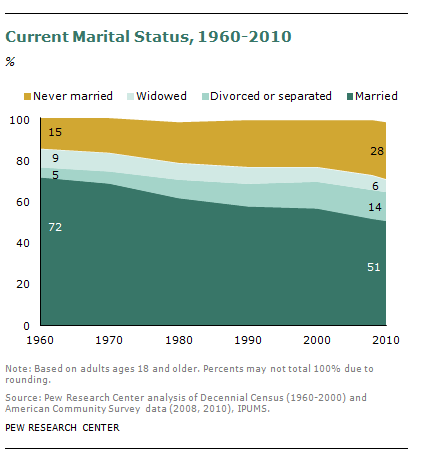
click image for full-size
Church programming is largely based on segmentation. In other words, most churches build their programming based on some assumptions about:
There is a general assumption in church programming that when a person hits their 20s that most will head towards marriage and having kids. And for most of human history it’s been that way, so it’s not discriminatory to base programming on that assumption at all. It’s been a safe bet. (Just like it’s a safe bet that if you have a lot of young married couples you should invest in your nursery, etc.)
But here’s the problem.
For a wide variety of reasons fewer adults are choosing to get married. To really grasp this I’d encourage you to read Derek Thompson’s, “The Death (and life) of Marriage in America” featured in The Atlantic last week. As he says, the reason fewer people are getting married is complicated. But the basis of this discussion is that as the wage gap between men and women continues to shrink, fewer women need marriage for economic stability. I’d never thought of the washing machine as a reason for a lower marriage rate, but he makes an interesting argument!
[Sidebar: From a Christian perspective we’d likely want to introduce sexual morality into that. But if we’re honest we know that few people, even in the church, are waiting until marriage for sex. That’s an influence on marriage but not the fulcrum we often see it as. When I do pre-marital counseling, most often, the couple is either sexually active or obviously lying to me about their sexual activity.]
So what’s the problem with building church programming around the assumption of marriage?
You’re eliminating 48% of the population of people over 18 automatically. They aren’t married. And with the age of first-time marriage rapidly moving towards 30 it’s safe to say that nearly half of the adults in this country aren’t walking around in a huge hurry to get married. We can lament about that all we want, but it’s the world we actually live in!
Yet, if you listen to both the words coming from the mouths of leaders and the metastory of assumption that every adult is either married or wants to be married, you can see why the 48% of people who aren’t married might think, “Church isn’t for me.”
Hang out with Christian adults who are single and you’ll quickly notice that they see the favortism in the church towards married people.
Even if you think that there should be a marriage assumption, can you see how this is a messaging problem for the church to wrestle with? Can you see how empowering the marriage assumption could be a wedge for a huge percentage of the population and what they think about God? (The church is living evidence of Christ, right?)
What does your church do that drives you nuts on this issue?
What, if any, success have you had in helping your church deal with the statistical realities of the country we live in? Have you been able to adapt?
Lots of cool things happening with The Youth Cartel. Here’s some new things to point out.
Long story short, these are exciting days for our brand new little start-up. We are growing like crazy. Marko and I just keep looking at each other in awe– holy smokes this is a blast!
Pray for us as we deal with the realities of our growth. We have many massive decisions in the coming weeks/months.
At that time Jesus, full of joy through the Holy Spirit, said, “I praise you, Father, Lord of heaven and earth, because you have hidden these things from the wise and learned, and revealed them to little children. Yes, Father, for this is what you were pleased to do.
Jesus gave the ordinary extraordinary power as he prepared them to do his work. A massive decentralization of power. (Even the demons submitted to their authority, v. 17)
‘Love your neighbor as yourself.’
Jesus didn’t say to love everyone the same. He said to love your neighbor as yourself. That’s not as crazy as it sounds if you think about it.
These were the observations and learnings of my high school small group last night. Reading the Bible, out loud, and in community… it’s pretty powerful.
This post isn’t a commercial for Community Bible Experience, but if you want to try it… CBEmini is a free 9-day taste of CBE walking your small groups through Luke-Acts.

We’ve all heard this. And most people I know in youth ministry are very well read. They read a lot of books and attend a lot of training stuff.
But I also think one reason people can’t think outside of the box to solve problems is that their context is so tiny. They only really know how to “do youth ministry” one way. Sometimes I’ll sit down at a conference or spend an hour on the phone with a friend and we’ll agree… their current strategy isn’t working. But they’d rather get fired than change.
Why is that?
It’s usually because they’ve only ever seen youth ministry done the way they do it. They grew up exposed to a style. They went to college or seminary and were fostered in that methodology. Then they got hired by churches who want them to run a program that same way. And they hang out with people who do ministry like them. And when they go to conferences, they go to conferences who do ministry just like them.
You know the mantras— We do Sunday school and small groups. Or we do a midweek program. Or something like that.
These are all viable methods. But there are TONS of other methods available in youth ministry. Chances are good that you never even took the time before you started the job to figure out, “Does the method I know even work in this context?” Oh no, we usually come at it the other way. “This method worked for me in another context, it’ll work here.”
It’s not a lack of learning holding them back. It’s the lack of contextualization, study, observation, and experimentation that’s killing you.
If you want to consider this a profession, you need to expose yourself to a wide variety of methods. It’s like going to a doctor who only wants to cut people open. He might know there are other types of surgery out there, and he might have heard about some pills that you can take, but he’s really into cutting people open because that’s what he knows how to treat your problem.
You wouldn’t go to that guy would you? He’s a 1-trick pony.
But that’s how we roll in youth ministry. We have tribes of people who are 1-trick ponies. It’s not that they don’t know there are other methods out there. They just do what they do. We hide behind terminology like “primary giftedness” and other ways of self-convincing ourselves that we can only do ministry the way we grew up doing it.
Learning that isn’t diverse in its approach isn’t really learning, it’s reinforcing what you already know.
You need to get out more.
If learning is a value and all you’re doing is reading books or going to conferences reinforcing what you already know, you’re not a learner. Spend some time observing other methods. Go visit other churches who aren’t like yours. Go see youth ministry in another culture. Make the time to do so. Set up some experiments. Create some brand new theories and test them out.
Whatever you do. Don’t keep working on something you’ve proven doesn’t work in your context.
That’s not professionalism, that’s insanity.
When my family moved into the College Area 3+ years ago we had no idea how much impact San Diego State would have on us. We just knew that we were going to embrace SDSU because it was the neighborhood we live in and we always have hopes of being Good News wherever we live. (Yes, being season ticket holders is being Good News… right?)
What we didn’t know is that in these 3 years the entire university has begun a transformation no one could have anticipated.
In 2009, the major news story on campus was about a campus-wide, one semester ban, on the consumption of alcohol. (Including on campus fraternities and sororities.) There was concern about how this rule would impact the school’s Playboy’s Top Party Schools ranking and the economics that went with it.
SDSU was a party school and defined by it.
Truth be told SDSU is still a party school. It’s a fun place to be a student. But partying is not the first thing people think about anymore when they hear SDSU anymore.

San Diego State is currently the most winning college in major sports. Football had back-to-back 8-4 seasons. Basketball was 34-3 in 2011 and is currently 20-3.
Winning has redefined campus. 3+ years ago you saw far more frat/sorority t-shirts than SDSU gear. Now, most students rock SDSU gear multiple times per week. Each home game 12,414 pack into Viejas Arena to cheer on the basketball team. Last year saw a huge increase in student involvement at football games. Students aren’t just coming to campus to party anymore. Now they want to be part of The Show.
Increased interest has created a groundswell of students trying to get into SDSU as their first choice. Consequently, the admissions standards have gone up, making SDSU more and more of an academic school beating it’s “fall back school” reputation.
As the video shows, winning also transformed the type of student-athlete SDSU attracts. Tim Shelton has been on campus long enough to see this transformation first hand. It’s obvious to point out that this transformation is part of his legacy. Steve Fisher, SDSU’s Hall of Fame-bound coach, sometimes refers to Tim in press conferences as “coach.” Tim has lots of talents and lots of influence on campus and with his teammates. (Case in point, Tim wrote and produced Aztec Motto, the video played during pre-game introductions at home games.)
So what is he doing with his talents and influence?
Raising money for kids after school programs. $26 at a time, one t-shirt at a time, Tim is helping to fund an after school program to keep kids in school. $15,000 so far. He’s aiming at $26,000– enough to fund the program for 100 kids for 1 year.
Winning attracts winners and Tim Shelton is a winner.
Get daily updates via RSS or email. It’s quick, easy, and free.
When I was in middle and high school I spent a lot of time home alone. My mom worked crazy hours and my older brother joined the Air Force when I was in 8th grade. A million nights home alone will lead you past boredom. While I always kept the TV on so I didn’t feel alone I rarely watched it. (A habit I often fall back on today, to the annoyance of Kristen.) And there’s only so many nights in a row you can play video games before the loneliness of solo gameplay sets in.
In fact, there comes a point where boredom leads to creativity. Creative with things you can do alone.
In those years I would take as long as I possibly could to eat meals. I’d take forever to cook it. Or I’d cook it out of order or one thing at a time. Anything to make it last longer and give me something to do.
One little food oriented fascination I had was with communion. I don’t know why but I’d play around with communion elements. I’d tear bread, or a tortilla, or a tortilla chip… and mimic the motions of communion that we’d do in church. I’d recite the verses, dip the bread, the whole nine yards.
I wasn’t mocking it and it wasn’t quite the real thing. Actually, I used to worry that it was sacrilegious. And I would never have told a soul about this back then. In fact, I’m a little nervous about writing about it today.
Here’s the thing: It wasn’t really communion. Sure, it was the motions of communion. I got a certain feeling during communion at church, one worth trying to replicate.
But you can’t do communion alone. Even if you nail the elements and the words and everything. Because you can’t do communion alone.
The very word communion has the same root word as community, with a different suffix. Just like you can’t be in a community alone you can’t experience communion alone.
This is something for those of us in evangelicalism to wrestle with. We have a personal pronoun issue. Our relationship with Jesus is about communion, not ourselves. Communion with the Father, communion with the Son & Holy Spirit, and communion with one another. It isn’t about you it’s about we.
I’ve often found the way we evangelicals do communion to be a lonely shadow of the experience found in other types of churches. We have reshaped communion into being about me and my relationship with Jesus, uncomfortably giving space to create a private moment, instead of allowing communion to be about a communal thing, our collective relationship with Jesus.
Satan wants nothing more than us to look out for our own best interests. Never forget the table. The table drives us to communion.
Photo by Pierre Porte via Flickr (Creative Commons)
Support this blog! Get regular updates from adammclane.com via RSS or email.
Brilliant.
Putting a flywheel on a bike to store lost energy? I ride my bike quite a bit, it’s the cheapest and fastest way I can get around town. This is a relatively simple solution for wasted energy of stopping for a red light.
Here’s what I know about innovation. It’s never come out of a big companies R&D department. Professional R&D departments are a waste of corporate dollars largely because there is a tie between desperation and innovation.
There are only 2 reliable sources of innovation, in my experience.
What does that have to do with you? Everything. Our society is desperate for brand new freshly minted inventions. And those of us who manage people need to develop regular ways to listen to the front-line workers– elevating their ideas to the position where they can create the sof-innovation you need.