I’m proud to be a part of the youth ministry session of this project with Ginny Olson. Together we talk about ministering to LGBT students in your youth group, creating a safe environment, and bullying.
Our society celebrates the lone wolf. We have a unique ability to pin the success or failure of a group effort on an individual.
In all of those cases we celebrate an individual who has become the figurehead of a much larger effort.
Deep in each of those statements is a cultural lie. As we idolize those individuals and aspire to become them we look past the reality that none of them is a lone wolf, but we see that in order to get to those positions of “respect” we need to act alone.

We’ve grown up celebrating the first person perspective. When Duke Nukem came on the market in the mid-1990s it revolutionized the video game experience because you, the player, became Rambo. Instead of looking at a strategy game from a 3rd person perspective they put you in the 3D world of first person.
Thousands of hours of acting as the lone wolf behind first-person shooters sends a powerful psychological lie to your brain, retraining it to believe that you can best control your destiny alone.
If there’s anything disturbing about today’s smart phone craze, it’s the new posture we take in public settings. While it was once considered anti-social behavior to seek isolation in a crowd, we are now a crowd of isolated humans staring at our phones. The flickering pixels in our pockets are more alluring than the real world around us.
These devices aren’t just statements of convenience or entertainment, they reflect a great cultural reference to the first-person perspective.

As a Christian I know that individualism is the enemy of communion.
Communion is a powerful technology that changes everything.
While our culture celebrates and romantacizes the lone wolf, Jesus calls us into something greater. It’s reflected back to the Garden of Eden. God looked at his creation and one by one said, “It’s good.” But when he looked at the man, who was alone, he said “It’s not good for man to be alone.” So he made woman. We are so hardwired to think about the sex part of that statement or even the idea that God made a helper (completer) for Adam that we miss the first part… it’s not good for man to be alone.
Satan wants you alone. He wants to convince you that you are better off acting as a lone wolf. He whispers in your ear– “You don’t need them. You want to change the world, do it your way.”
Satan’s technology is getting you alone where you are vulnerable. God’s technology is communion, where you are never alone.
Jesus’ life calls you and I into communion. We don’t merely take communion as a representation of our 1-1 relationship with God. We take communion as a representation of our 1 billion – 1 relationship with God. We actually don’t take communion… we ingest it as a rejection of Satan’s technology of the lone wolf and exchange it for God’s technology of communion.
When we stand, in communion, with a billion other believers we are an unbelievable force for change. We have the power to make a busted world right.
That’s why we share communion in community. You simply can’t do communion alone, it’s impossible.
Jesus isn’t calling you or I to merely take communion in remembrance of what He did. He is calling you and I to live communion together.
Life is full of unexpected, frivolous, everyday beauty.
But you’ll only see it if you slow down enough to notice.
You don’t take time to notice beauty. You make time.
May I seek this today. Amen.
UPDATE
Shortly after I posted this I put Jackson in the Baby Bjørn and headed off for a trip to the bank. (Praise God for checks!) Our bank is about half a mile away, an easy walk. I cruised over there, made my deposits, and was cruising home. About half way back it hit me. I wasn’t acting on my prayer. I was rushing right by so much ordinary beauty. Worse yet– poor Jackson was just along for the ride.
So we stopped. Right on our walk. And looked at leaves on trees. The tiny creases. The pretty colors. I put leaves in JT’s hands. We looked at them closely. Next came flowers. Yellow ones, purple ones, burgundy ones. We took turns smelling the flowers and grinding the petals between our fingers.
I can’t wait to play with this around the office.
$78. Here.
The mantra of a daily devotional has been used as a holy guilt trip for as long as I can remember.
Let’s examine this sacred cow.
I think with a little examination we’ll get to the bottom of what we’re trying to accomplish while granting us the ability to re-imagine better ways to accomplish the same end goal without all of the weird, cultural baggage.
Here’s what I’ve heard from students recently.
“I’m a good Christian if I read a chapter of the Bible every day.”
“I haven’t really read the Bible recently, but I learned a long time ago it’s easier to just lie about it and say I have. That’s all my parents want to hear.”
“I try to read the Bible every day, but it doesn’t make any sense and seems kind of pointless.”
“Yeah, I read the Bible every day. But I’m just kind of picking a random chapter from somewhere and reading it.”
Because I’ve actually read the Bible several times I know that there is no command anywhere in Scripture to do an individual daily devotional. (Such as daily Bible reading or reading a commentary.) That very concept is completely a cultural creation bearing little historical context.
If Protestants really want to dig into this phenomenon they need to understand it in context of the Reformation and not necessarily something the early church did. (There are lots of great books and commentaries about early church culture if you’d like to dig into this more, likewise there are many wonderful books about the Reformers.)
Is reading the Word of God good? Absolutely. Is a daily devotional life a biblical command worthy of the holy guilt trip we lay on people? Not so much.
Let’s understand that the very notion of “doing a daily devo” is a cultural creation. And let’s rethink that in light of what we are actually hoping to accomplish with the daily devo… a love of God’s Word.
As I mentioned above from comments from students, we emphasize the daily devotional as a measuring device for spiritual well-being. Very quickly, students and adults learn that to be seen as spiritually mature they either need to actually do a daily, individual Bible study OR learn how to lie convincingly enough to make it appear that they do.
That’s legalism at its finest, right?
Instead… let’s think of ways to teach a love for God’s Word. And, as James says, not just a love of God’s word but a love for obeying and applying biblical principles into our lives.
Do not merely listen to the word, and so deceive yourselves. Do what it says. Anyone who listens to the word but does not do what it says is like someone who looks at his face in a mirror and, after looking at himself, goes away and immediately forgets what he looks like. But whoever looks intently into the perfect law that gives freedom, and continues in it—not forgetting what they have heard, but doing it—they will be blessed in what they do.
What are some ways we can pass along a love for the Bible without defaulting to a method which (could) lead someone towards hypocrisy and/or legalism?
I can’t speak for you… but I know when I think about the adults, students, and even my own kids… I want to pass along a fervent, ravenous, sickeningly healthy, blood bond love for the Bible. (And the Christ it points to!)
The question to wrestle with is: How do we do that?
I’m coming to Chicago for a small release party for the Love is an Orientation DVD curriculum on Saturday December 17th… so I thought I’d expand the trip a little by coming Tuesday night and leaving Sunday evening.
Here’s what is scheduled so far:
December 17th – 2 classes now open for registration
10 -12 pm – Growing Your Business with Mailchimp
2 -4 pm – Blogging 101
That’s right. That means I have all of December 14th, 15th, 16th, and most of the 18th wide open.
I’m spending a couple of nights with my cousin in Oak Park and a couple of nights with Andy in Wrigleyville. Kristen and I lived in Chicago for 8+ years so I don’t really want to fill my days sight seeing or visiting museums, I’d much rather spend my time connecting with you. (Though I am willing to attend the Bears game on December 18th, just tossing it out there!)
Let me be blunt. Since I’m already going to be in Chicago and I have so many free days, that means that you can get my services pretty cheap. Some things you could have me do at a cut rate.
I’m open to spending up to a full-day outside of the city, as well. Maybe you live in Northwest Indiana or Southern Wisconsin or downstate Illinois and would like me to come teach my classes? I’d actually love an excuse to spend a day in the South Bend area.
Of course, if you want to hang out and grab a cup of coffee or an italian beef… let me know. I’m obviously down for that.
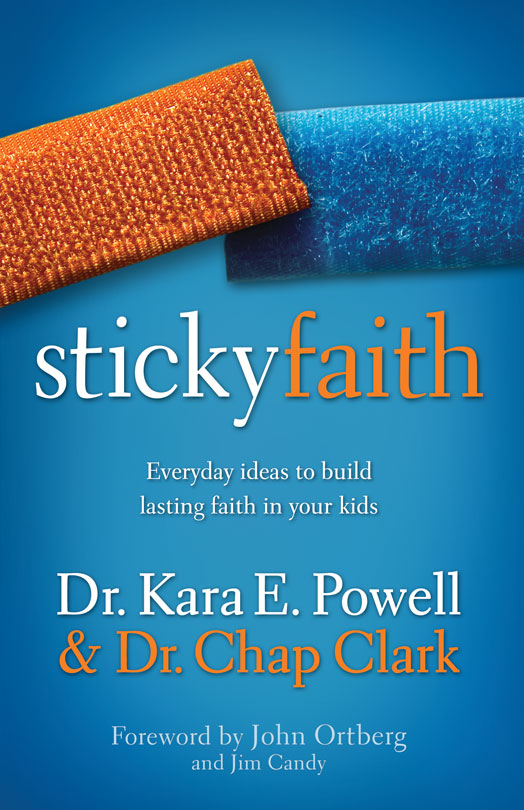
This is part 5 in an 8 part series on Sticky Faith. Join our book club by signing up here. (part 1, 2, 3, 4)
Let’s be careful about Chapter 5. It’s easy to read this and think about our ministry by default. To not apply what we are learning to our home would be a shame.
A couple quotes from this chapter jumped out at me:
Kristen: I think that I give up too easily by assuming that my children don’t want to sit at the grown-ups table. I grew up sitting in church with my family. At the time there wasn’t a simultaneous children’s church or youth service option. I’m sure there were times where I was disengaged although I can’t recall specific occasions. What I do remember even several years later is being together as a family, observing my parents in worship, and talking about the sermon on the drive home. Nowadays I almost feel apologetic if one of our children sits with us in the main service. While I’m thankful for fun, “age-appropriate” learning opportunities for my children, this chapter has me re-considering ideas to integrate them better at church.
Adam: When I think of my first interactions with the Tuckers (Kristen’s parents) I can’t help but laugh. I’d never been around a family like them. They hung out together all the time. They intentionally did stuff as a family… cheesy stuff like go to the library or park or zoo together. They all listened to Christian praise music on Sunday mornings to get their hearts ready for worship. And after church, I kid you not, they talked about the sermon. I sarcastically referred to them as The Swiss Family Robinson.
Of course, there was nothing wrong with the Tuckers. I just had no idea that there were actually families like that in real life who talked to one another and genuinely liked being together. In truth, they were just ahead of their time… developing Sticky Faith in their girls way before Kara & Chap wrote the book.
Kristen: I love the concept of purposely surrounding each of my children with five adults who care about them. I feel like this is especially important since we don’t live near extended family who would otherwise help fill that role. Reading through this portion of the chapter also prompts me to want to be “that” adult for my friend’s children. This chapter has so many great ideas. I particularly love the idea of forming an intergenerational group of families to invest in one others families.
Adam: I need to confess that this is an area we need to improve in. This chapter came with some good/convicting ideas we need to try. As I reflect on God’s Word in regards to parenting it is so clear that God intended plurality in parenting. As Kristen said, while that naturally involved extended family, we don’t live close to grandparents, aunts, uncles or cousins. So that means we need to be more intentional about building that web of relationships for our kids.
5. How would you explain your 5:1 goal to your kids?
My dad took me to lots of games at Notre Dame. Later in middle and high school it became more about football than the other sports. But I have lots of fond memories of spending time with my dad at Notre Dame basketball, hockey, and football games. I even remember a couple baseball and soccer games along the way.
Even though no one in my family went to Notre Dame, we lived so close and experienced so much there, that I have a pretty strong connection to the campus. My friends and I rode bikes all over campus. (Don’t tell my mom!) We played hide-n-seek near the Grotto and skateboarded the trail around St. Joeseph’s Lake. We yelled and made echoes between the giant buildings and dared one another to go into the administration building. (aka Golden Dome) I spent hundreds of hours in the library (aka Touchdown Jesus) during my senior year of high school and still have 10-15 unpaid parking tickets for parking in the basketball coaches spot when he wasn’t there.
But most of my memories of Notre Dame are from Saturday’s in the Fall. My dad had a group of friends who put on epic tailgate parties. 75-100 people would hang out and party between 3 motor homes starting before dawn and going until dark. When I was really young we went to almost every game because you could always find a ticket for free or almost free. That changed in the late 1980s and early 1990s when Lou Holtz had them in National Championship form year after year. But I managed to find a way in to a lot of games in those days. My stepdad had a brother who was an usher who could sneak me in. I’d get to the stadium several hours before the kickoff and sit in his usher seat during the game. When it was too cold or I’d get bored I’d climb into the scoreboard and watch the game from that little window, listening to the TV cameramen shuffle their feet above my head as they operated the endzone camera. For a couple of years my stepmom was an MBA student and we had tickets at the front of the student section. During those years I got to go to the games it was too cold for my dad and stepmom to enjoy. Cemented in my memory for a lifetime is freezing my butt off and hunting for hot chocolate during the 1992 snow bowl.
There’s no comparing Notre Dame to San Diego State. Pretty much everything that could be different about the two schools is different. But what isn’t different is the proximity of where we live. I grew up about a mile from Notre Dame’s campus and my kids are growing up about a mile from San Diego State’s campus. So I want my kids to experience the campus. (Um, the positive sides of campus activities!) That’s why I’m commited to taking them to football and basketball games and other fun/educational things offered on campus for kids.
I’d love for my kids to build happy memories about a place with their dad. Just like my growing up around Notre Dame… every moment isn’t memorable and not everything is going to make a lasting impression.
What are you doing to build memories with your kids? What kinds of things did you do with your parents which built lasting memories?
Here’s a little lesson on hype for all my wanna-be self-promoter friends.
If you hype something you’ve got a vested interest in it’ll come off as fake.
If someone else hypes it for you, even if you lose some level of control, it’ll go a lot better.
Times have changed. It used to be that having access to an author or a speaker somehow validated their message. But now, since everyone is instantly accessible that is no longer the case. In many case the best way to hype something is to limit access to the creation process. (Apple is the master of this, all the hype is in the speculation)
Think about your actual decision-making process. Take a few minutes to do some self-examination. I think what you’ll see is the power of recommendation. A recommendation is infinitely more powerful in my day-to-day life than hype.
Right now, it’s all about recommendations.
If you want to (or need to) hype something, focus all your energy on recommendations. And stop with the self-hype.
The movie Moneyball brought to light something that has happens in a lot of areas of our culture: We make decisions all the time based on information that doesn’t really impact the result we are trying to get.
Two examples from today’s newspaper:
Other examples from this weeks news:
What are some things in your life that are measured using an index that doesn’t really effect the outcome?