• What is Happening in Alabama?

    This video is shocking. It makes me wonder, “Have the people of Alabama learned anything from the civil rights movement?

    Here’s the full content of the law.

    Listen carefully to the statement. They have taken the Arizona law and added to it more stringent requirements. Essentially, you have to provide a state issued ID proving your immigration status for any and all business transactions in the state of Alabama. Further, they put strict penalties on businesses which sell things to, rent to, or even provide transportation for, people who do not have legal status in the country.

    Let’s get practical. Do you think that the grocery store is going to ID a white woman and her children at the checkout counter? Do you think a landlord is really going to look up the immigration status of a black family? Do you really think that a bus driver will ask for ID from a retired white male? Or the car dealer down the block, will he e-verify the identity of Mr. Johnson whom he has sold cars to in the past?

    The law would also penalize people who knowingly harbor or give transport to illegal immigrants, a provision that many religious officials say would criminalize churches that heed what they believe is the Biblical obligation to feed, clothe and shelter the needy.

    Read the rest here

    Please tell me I’m misunderstanding what this law is about? It seems to me that this is segregation all over again.

    And how is this constitutional? 


  • Make it Count

    http://vimeo.com/26442053

    Dan Stevers, the video guy at our church, made this for church. You can buy this one here. ($15)

    So powerful.

  • I’m not a commodity and neither are you

    Photo by green kozi via Flickr (Creative Commons)

    In the past 3+ years I’ve known countless friends who have lost their jobs in ministry. 

    One day they are a centerpiece of the churches living room. The next, like a couch, they find themselves on the curb. Alone. Broken-hearted. Trying to figure out what’s next or if there is even a next.

    Their hope is that someone picks them up before the rains come and ruin them. They know they still have some life in them. But being taken out of the living room and dumped on the curb hurts. Bad.

    Sure, it hurts to not have a place to serve. And it definitely hurts to lose a paycheck. But what really hurts these folks suddenly displaced, often blamed on the economy or a new vision, is that it reveals a hidden side to their relationship that had never been revealed before.

    Somewhere, in hushed tones, they were talked about like a commodity. A thing and not a person. I line item and not a minister of the Gospel.

    They gave their heart. They gave time money couldn’t buy. They invested time in other people’s kids at the expense of loving themselves or even their own kids. They proudly told people which church they worked at. They stood up for the pastor when it all went to pot. They prayed with countless people about countless things.

    Until one day they discovered that all of that had a revenue goal tied to it. Or an unspoken expectation. Or that their ministry was just a line item on a budget. And somewhere. Somehow. Some way. Somebody didn’t look at their ministry as doing life. Instead, they looked at them as a role, something to be bought or sold or traded or dispatched.

    And suddenly, in a letter or in a meeting or yes– on a sticky note, they have found themselves on the outside looking in.

    Friends- you aren’t a commodity. Jesus doesn’t look at you that way. And I’m sorry that the church has treated you that way.

    It’s not supposed to be this way.

    If you’ve been left out on the curb I want to hear your story. Leave a comment with your story or drop me a line at mclanea@gmail.com. 

  • 5 Ways Your Church can be Good News to Unemployed Young Adults

    A Bureau of Labor Statistics report released Wednesday said 745,000 more job seekers between 16 and 24 years old were unemployed from April to July. That compares with an increase of 571,000 among the same age group last summer.

    In July, the share of young people who were employed was 48.8%, marking a record low for the second straight year. July is traditionally the peak month for summertime employment. Another Summer Chill for Youth Employment- USAToday, August 24th 2011

    Photo by London Permaculture via Flickr (Creative Commons)

    If I do the math correctly this means 51.2% of Americans between the ages of 16-24 don’t have a job. Half of people 16-24, when they are physically strongest and most able to work… can’t find a job.

    You can’t care about the youth of America and not wonder what you can do. You individually. You as a leader in the church. And you as an advocate for the young adults in your community. You can do something. You have to do something.

    We live in a post-Christian society. Young adults have heard of the church. They likely know who Jesus is. But, in many cases, they won’t have anything to do with Jesus or the church because both seem irrelevant. In short, before they are willing to hear the Good News of Jesus Christ they need to know that the Gospel really is good news for them. If you can help them find employment– that’s good news.

    Here’s 5 ways you can be Good News to unemployed youth in your community

    1. Start a childcare fund for single parents in your church struggling financially. One of the biggest challenges a single parent faces is consistent and affordable childcare. (Affordable doesn’t mean free.) If you set up a fund to employ 3-4 people through your church to either watch children in their homes or to set-up a 10 small daycare facility in your church, you’d be surprised how easy funding could come together. This would help single parents and it would help the young adults you’d hire to run the program. (There’s Federal/State grant money available for this kind of thing as well. Ask a librarian for help.)
    2. Sponsor a local grant for small businesses in your community to offset the cost of hiring part-time help between the ages of 16-24. One of the best motivators you could offer to small business owners in your community is a grant to offset some of the costs of employing a person. Work with your local Chamber of Commerce to help get the word out, pitch the concept to business people in your church, and ask your congregation to rally behind the fund. Keep it simple. If a small business hires a qualifying young adult, you verify that they worked 500 hours, you award the employer $2,000.
    3. Host job readiness seminars in your church. While the unemployment rate is shocking, equally shocking is the amount of young adults who are unemployable. Partner with Junior Achievement, the Chamber, and other like-minded local community organizations to put together a series of helpful seminars for job readiness. Teach the basics like, interview skills, resume` building, work expectations, etc. (Again, there’s grant money out there for this kind of thing.)
    4. Hire someone in your home. We’ve just completed our second summer of having a regular, summer babysitter. Last summer we hired someone full-time who also lived in our home. We found that was a bit too much for us, so this summer we “shared” a full-time babysitter with another family in our church. No, we couldn’t afford it. But this sacrifice was worth it– and helped us out a ton. Maybe you don’t need childcare? Hire someone to do yard work or complete the projects around the house you’ve wanted to do but can’t find the time.
    5. Start a job pool. A church is a great connecting point. If you acted as a connecting point between people looking for work and people who need work done, you could help a lot of people. More than simply having a job board… Set-up a simple screening process, set work expectations like timeliness and appearance, and coordinated both supervision and payment between people in the community who need work done and young adults looking to do work. If that’s too much work for your staff to handle ask a business person in the congregation or members of the local Chamber of Commerce to sponsor a 10 hour per week position from May – September to coordinate.
    Will you commit to helping find employment for people ages 16-24 in the next 12 months? 
  • Be Intent

    The last seven weeks I’ve had laser focus on one thing: Be ready for September 1st. 

    Buy office equipment. Set-up a home office. Lease part-time office space. Create financial systems. Set-up a business infrastructure. Write business plans. Write marketing plans. Lay the groundwork to build a customer base. Write proposals. Sign contracts. Get consulting. And a whole lot more stuff like that.

    This has been my life. And I’m exhausted. Last night was another day when I started at 7:00 am and went until 1:00 am with only a few breaks in the middle. It will be like this until Labor Day weekend when I finally get to disconnect and reward myself.

    Here’s an observation I’ve made during this season: When you’re starting something from scratch you have laser-like focus and unlimited energy because you can grasp the big picture all at once. What’s next is what is right now.

    The flipside is: Existing organizations have a unique ability to lose focus at the exact wrong time.

    What’s next takes priority over what’s right now and visa versa. A big project is coming up and right before it happens a key decision-maker goes on vacation. Your biggest sales opportunity of the year? You missed it because you scheduled an internal meeting instead. On and on. Mental errors cost you in an existing business because you can’t see the whole organization anymore.

    It’s like observing an island from a plane before you land, when you’re at 30,000 feet you can see the whole thing. But when you land you can only see what’s in front of you. 

    In life, just like in business, the difference between success and failure in life is razor thin. Watch any sporting championship and you’ll see it. A single mental mistake at the wrong can cost you a championship, or a deal, or whatever your measurable is for success. That same mental mistake a thousand times during the season never hurt you before. But in the wrong moment? You’re dreams are wiped away.

    When those moments come. Be intent. 

  • The weird side of Christians and politics

    Preamble: Understand in reading this post that I’m a swing voter and my #1 criteria for voting is, “Can this person lead in the role they are running for?” Side issues mean almost nothing to me in light of that one framing question.

    I cringe when I hear evangelical Christians being grouped together as a block of voters for two reasons.

    First, it’s a self-indicting judgement in how we view ourselves that we would only identify people with a certain political ideology when Jesus has commanded that we reach all people, all neighbors, with the Good News of Jesus Christ. Second, many of the solutions to issues Christian seem to care about from established political parties have been proven to both not work in society; the people who are elected because of their viewpoints on single issues often come with baggage that is distinctly against Christian values.

    Some examples: 

    • Gay marriage is no more an attack on my marriage than the billboard for no fault divorce I pass on my way to work. Actually, the guy with the handgun next door is far more dangerous to my marriage than the gay couple across the street. Violent crimes in America are way, way down versus 2 decades ago. But handgun sales are way, way up.
    • There are millions of children in this country brought here as children who went to school with our kids, who have said the pledge of allegiance every morning next to our kids, and who have dreams just like our kids. But because there is no pathway to becoming a legal resident they are stuck. I can think of no fathomable reason Christians don’t advocate for them. Those kids aren’t dangerous– their homeland, the United States of America, doesn’t love them back. It’s heart-breaking. We are all immigrants to this country. We should be advocates for the Dream Act.
    • Health care costs are killing people. Literally. People are dying because they can’t afford basic health care. And yet, doctors are reimbursed less now than 20 years ago. Privatized, for-profit health care coverage and agressive pharmaceutical companies built on 19th century patent laws are bankrupting our society while getting tax breaks on their profits from the government and distributing tiny dividends into your 401k. You can’t argue for both a balanced budget and decreases in corporate taxation. The same companies that caused this current economic crisis are continuing to profit from it while trying to shirk their most basic responsibilities as corporate citizens. That’s what happens when you let the wolves run the chicken coup. They think about eating meat tomorrow with no source for tomorrow’s eggs.

    What’s the point? 
    The point is this, you can’t be a single issue voter and think you’re part of the political process. These are complex problems and deserve our attention. We can’t walk into a voting booth, in good conscious, and cast a vote over abortion or gun control or tax reform or the economy and think that we’ve done our part.

    Doing our part means getting involved at the local level. It means advocating for the sick and oppressed on your block. It means standing up for the powerless in your life.

    When you get to know the people these things effect your perspective will change. When you get to know the gay couple across the street you’ll see that they love each other just like you love your spouse. When you get to know the crazy guy with the guns you’ll see that he has guns because he has deep-seeded fears that a gun can’t fix, a counselor can. When your kids best friend can’t get into college because he has no way to get a green card, it won’t be an issue it will be Joseph’s story. When your next door neighbor dies because she couldn’t afford the medicine anymore it won’t be a matter of corporate rights, it’ll be an injustice.

    Doing our part and doing the right thing might mean not getting what we want or doing what we’re comfortable with all the time. When we take things out of the rhetoric of issues and get to know the people they effect, we’ll see our perspectives shaped by a deep desire to help.

    Friends, we weren’t called into ministry just to love the people who show up at our church or whose kids show up to youth group.

    We were called to a messy ministry of loving our neighbors as ourselves.

  • Five ridiculously hard steps to a better you


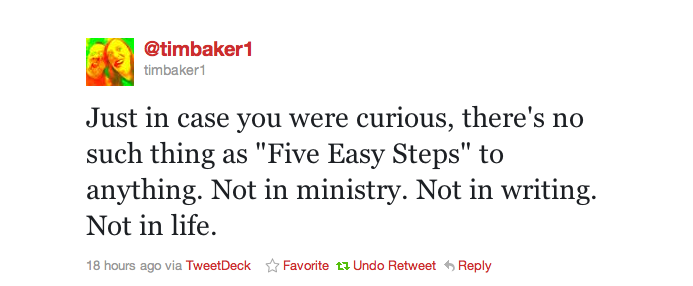
    Tim is right. There is a whole lot of lying for the sake of SEO in blogs these days. While there might be five easy steps to creating a Facebook page for your business, there aren’t five easy steps for everything.

    Becoming a better you is ridiculously hard. I know it not from issuing advice but from walking through a few difficult seasons in my own life and finding success, happiness, and satisfaction on the other side.

    Here are five ridiculous hard lessons I’ve learned towards become a better me:

    1. You often have to say no to the wrong opportunity when you have no idea when the right one might come along. For me this has meant, several times, shoving off into the great Lake of the Unknown with no idea if I’d end up where I needed to or have the financial resources to keep going.
    2. Sometimes you have to do things you are dispassionate about in order to get to things you are passionate about. Sure, I probably look like I’ve lived a storied life. But I’ve had jobs I hated. And I’ve done countless things I hate in order to finance what I love. Walk around any art museum and you’ll see that most of those people didn’t become famous until they were dead. All of their life they did work they hated to pay for the work we adore after they are gone.
    3. Being the smartest person in the room is not nearly as important as being the hardest worker in the room. Some of my friends joke with me that I never sleep. That’s not true. But success has never come easy for me. Any success I’ve achieved has been the result of ridiculously hard work. And today’s success only got me here. To get somewhere else I’ll need more and more hard work.
    4. You can’t figure it out on your own. When I make big decisions on my own I usually make a mistake. But when I take the time to add plurality to my decision making process I make wiser , better informed choices. That’s a frustrating, personal, slow, arduous, and humiliating experience. It’s not that I don’t know what’s best for me. It’s that I’m so “in it” emotionally that I have a hard time seeing the bigger picture or asking the really obvious questions of myself. Left to my own, I make a decision and then generate a full-proof construction to justify my decision.
    5. Failure is not the enemy. Failing to see the opportunity in everything is. Albert Einstein said, “In the middle of every difficulty lies opportunity.” Thomas Edison said, “Opportunity is missed by most people because it is dressed in overalls and looks like work.” We consider them both genius’ but maybe they mixed their natural born intelligence with a unique ability to fail well better than their peers?
    What are some ridiculously hard lessons you’ve learned on your way towards success? Let’s learn from the wisdom of the crowd by sharing a comment. 
  • Stop. Collaborate. And Listen.

    August beckons new life in ministry. 

    School starts. Our programs relaunch. We recruit and train (hopefully) a batch of volunteers. And we find ourselves, emotionally, in this weird place of hopeful dread.

    We’re hopeful because fall is our spring. Fall is full of new life, new energy, new commitment, and new dreams for the school year to come. Dread because we’ve felt this way before. We’ve printed the agenda, met with parents, trained volunteers… and it’s not gone as expected. 

    We need this year to be different. We are tired. We are weary. We need some success to come easily. We need our strategy to work. Because we don’t know if we can take another year like last year. Which was like the year before. And the year before that.

    In order for this year to be different we need to be a different type of leader.

    Stop.

    I remember in my first semester of classes in youth ministry being told that as the youth pastor it was my job to be the leader. And being the leader meant that I was in charge and ultimately responsible for everything that happened. The reality is that people don’t trust this type of leadership anymore. It might feel familiar or comfortable to them, it might make you look good to the board, but this type of leadership is only going to deliver the results you’ve already seen.

    To grow you’ll need to change.

    To clarify, an autocratic leadership style work great if you’re an ultra dynamic leader. I’m not. And most of the people I know in ministry are not. I’ve found it to be a growth limiter.

    Collaborate.

    I suck at telling people what to do and inspiring them to be all that they can be. But I’m pretty good at working as a leader in a flat, collaborative environment.

    I think that the old style of leadership, especially in the church, feels like a collaborative style is weak leadership. We make the mistake of believing that giving up the headship or giving up the microphone is giving up what we’re paid to do.

    Instead, I see it as forcing new leaders to emerge. It takes no leadership ability at all for me to say… “This is what we need to do, this is where we are going, and this is how it will work.” And if I do all of the teaching and speaking I’m communicating a style of leadership that Jesus didn’t foster with his own disciples.

    Conversely, it takes all of my leadership skills to say, “We all need to work together, we need the best ideas to come out of the group, and we all need to share responsibility.” While the first feels better because I’m taking all of the responsibility, collaborating with a team allows the team to dream a whole lot bigger.

    Listen.

    Nothing makes me tune out faster than being asked to come to a meeting to listen to the leader talk. (Or read from his notes which he dutifully sent to us all in advance.)

    I am willing to be lead. But to be lead I need to be listened to. And I need to see that the leader doesn’t just listen to me, he listens to everyone. The primary task of the leader of a movement is to listen. Ask open ended questions. Sit in a circle on the same level. Provide an open-ended agenda. And make listening your primary task. Listening isn’t passive leadership, it’s where leadership begins.

    It’s fall. Our spring. Are you ready to…. Stop. Collaborate. And Listen?

  • We need non-digital adventure

    Photo by Christine K via Flickr (Creative Commons)

    A couple weekends ago I told Megan and Paul to get in the car, we were going on a secret adventure.

    Anticipation in the car was high. Were we going for ice cream? Was dad taking us to a movie? Were we going to buy new video games?

    All were possibilities. But none were realities.

    Dad’s plan– Spend an hour at Barnes & Noble picking out books.

    I thought you were taking us on an adventure, dad. This sucks.” Those were the words of my 8 year old son as we entered the store.

    I explained, “You need to take your brain on a non-digital adventure. And books can take you there.” Every time they picked up a book it was tied to a video game or cartoon. “Non-digital adventure. Longer, older, think about the classics.” They complained, “I don’t want to read an old book. I want to read something new. New stuff is good, old stuff is boring.” 

    In the end we made a compromise. They could each pick out whatever book they wanted. And dad picked out two books for them. (The first two books in the Narnia series.)

    Megan took the compromise. Paul didn’t pick out a book and went home empty handed on principle.

    I went home and planned our camping trip– A non-digital adventure of the mind, body, and soul.

    Besides restricting use, what are ways you help your kids take their brain on non-digital adventures?