Summer 2011 has been the lost summer. Especially for me. Leaving YS and starting up 2 businesses meant that we didn’t take a vacation over the summer and I’m pretty much fried as a result. In the last 90 days I’ve worked 12+ hours probably about 75 of those days.
Our family is in desperate need of R&R– away from projects, school, and anything digital. Why? Because after next weekend the fall gets going like crazy with conferences, cool projects, youth group retreats, yada yada yada. If we don’t do this we won’t get a break until Thanksgiving.
Here’s the deal
Kristen and I were into backpacking before we had kids so we know the nuts & bolts stuff about setting up camp. But since we’ve had kids (10+ years) we’ve never gone camping without taking 40 middle/high school kids.
What we need is help with fun things to do with our kids while camping beyond the obvious stuff like hiking and s’mores and exploring the woods. We know we need to try geocaching…. but what else?
Leave me a comment with your favorite camping tip and help our family make some memories next weekend.
I’m not an alumni of San Diego State. But I am a neighbor and fan. I love the winning attitude you feel when you walk around campus.
On a campus of 20,000 people it might not feel like you can make a difference. But 12 guys on the basketball court and 50 guys on the football field have helped bring a new level of pride on campus that wasn’t there 3 years ago when we moved in.
I know you are tired. Despair is an exhausting existence. As you know I was a resident there for many years.
I know that each day is much the same. You spend countless hours looking for nourishment, feeding on things of no nutritional value, then falling asleep with the horrifying hunger reality that the next day you’ll awaken just to look for food that food won’t fill you up. It’s a life of unsatisfying hunger which lead me to malnutrition of my body and soul.
There is nothing left for you there. It’s time to flee the life you know in Despair and join me here in a place named Hope.
The land of Hope only seems scary because Despair is so familiar. After a couple of days you’ll get used to it. It’s nice here. The air is clean. The beds are soft. You won’t be hungry over here, there’s plenty to feast on.
People are more friendly, too. Instead of gnawing on the food of the past they are eagerly building tomorrow. I love talking to the people of Hope. Sometimes, just in casual conversation with a Hopeful, my eyes will well of with tears of Joy.
It took leaving Despair behind to discover that the people over there are murderers. They fixate on happiness in order to steal your Joy. Then they feast on your joy, mocking its value while consuming it like a taste test at a Chinese buffet. All my life it felt like the people of Despair would finally turn around and their hunger would be satisfied. But they are like zombies, dead men walking.
If you moved to the land of Hope we could be neighbors. I know we’re friends now. But imagine how much closer we’d be if we lived in the same place? Heck, our kids could go to school together. Maybe they’d even call you aunt or uncle? I’d love that… but it’s just not practical with us living so far apart.
Join me in the land of Hope. Leave Despair behind.
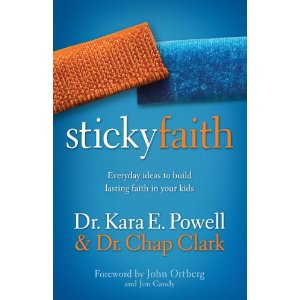
Of all the books that are new this fall, here are three that I’m recommending you buy:
Parents
Sticky Faith: Everyday ideas to build lasting faith in your kids – Put together a 6-week parents discussion group with the parents in your youth group and work your way through Sticky Faith together. You don’t want to see students leave the church; parents don’t want to see that either. Kara Powell & Chap Clark put together an amazing study of 500 students and their transition from high school faith to college faith. Sticky Faith shares their learnings plus robust ideas for helping reverse the trends their research revealed. Check out this article about Sticky Faith in yesterday’s Washington Post.
Small Groups
The Jesus Creed for Students – I loved Scot McKnight’s best seller The Jesus Creed. This is an excellent adaptation of that work for middle/high school small groups. Chris Folmsbee and Syler Thomas, two youth workers with years of experience, help students grasp what it means to love the Lord with everything and love their neighbors as themselves.
Youth ministry strategy
Youth Ministry on a Shoestring – Let’s quickly have the chuckle. Yes– it’s a bit funny that the Lars Rood works at one of the most resourced churches in the world in one of the wealthiest communities in the world. What the title doesn’t convey is a fantastically freeing strategy: How to do amazing things for no, or almost no cost. Lars’ ministry strength is creating unforgettable experiences and moments in the lives of his students and he will share with you how to do that, generally at zero cost to your youth ministry budget. The back section of the book is full of real-life examples from youth workers around the country applying the strategy.
Question: What’s your favorite new youth ministry resource?
Growing up in the city meant that horses just weren’t part of my life. I remember seeing horses as a kid at parades. At the county fair in the horse barns. Or occasionally at big football game when the police brought in horses for crowd control.
And I wasn’t one of those city slickers who dreamed of the open range wrangling up some cows.
I was 19 years old the first time I rode a horse. And I rode a horse because I had to for a college class.
It was an intimidating experience. This animal was 10 times bigger than me. It was taller than me. And it was infinitely stronger than me. Somehow I was supposed to sit on it and “control” it with a tiny piece of leather and some kicks?
Yeah, right.
The horse I rode could have cared less that I existed. It was an old camp trail horse who had seen a million riders over a million years and barely even acknowledged my existence. It was one of those horses that you could tell used to be big, strong, and attractive in its youth but now its best description would be, “tired.”
Before I put my foot in the stirrups I tried to get to know him and pat him on the head. He just took a leak and looked away.
I wish I could describe the experience as enjoyable. It wasn’t. It was uncomfortable and bumpy and I felt completely stupid on the horse. It didn’t seem to matter what I “told” the horse to do as it just walked the trail. When it got behind it trotted up ahead to catch up with its friends. Whenever it wanted to– it stopped to eat grass. And when it was done with me it used trees and branches to try to knock me off its back.
To make matter worse everyone else seemed to be having a great time. All I felt like was kicked in the gonads 200 times. I tried to make the best of it but it just wasn’t fun and I couldn’t wait for it to be over.
Standing in the barn after the trail ride I asked the person who ran the trail rides why I hated it so much. She just kind of laughed. “Probably because you fought the horse the whole time. And probably because you were scared. It would have been fun if you’d just held on tight and relaxed.”
That’s a lot like my relationship with God
When it’s unpleasant, when I’m scared, when I’m intimidated, and when I’m trying to be in control… walking with God is like getting kicked in the gonads 200 times.
Often times God just wants us to hold onto the reigns real tight and relax.
“For my thoughts are not your thoughts, neither are your ways my ways,” declares the LORD. “As the heavens are higher than the earth, so are my ways higher than your ways and my thoughts than your thoughts. As the rain and the snow come down from heaven, and do not return to it without watering the earth and making it bud and flourish, so that it yields seed for the sower and bread for the eater, so is my word that goes out from my mouth: It will not return to me empty, but will accomplish what I desire and achieve the purpose for which I sent it.
One of the truly fascinating things about the Bible is that our interpretation of it morphs so much over time. When we say the Bible is living and active… it’s actually living and active.
For example: 40 years ago most people would agree that Christians should avoid the casual consumption of alcohol. This vantage point was supported, enthusiastically, from the Bible. Today? Those same arguments could be taken apart by anyone. It’s that culture has shifted on the issue and we are looking at the topic through a different hermeneutical lens.
Just As I Am is becoming Just As We Are
Over the past five years, in my observation, individualism has begun to fade. Messages that are about “us” are connecting a lot stronger than messages aimed at “me.” The tone has been subtle but the resonance has been noticeable.
The rise of the neo-reformed movement has lead to a general acceptance that the Good News of Jesus Christ isn’t just meant to make my personal life better, it’s an understanding that Christians in culture should be living the Good News in their neighborhood. As Jesus renews our hearts we help renew our community.
But this isn’t limited to the neo-reformed movement. It’s everywhere you turn. Out with the individual and in with community. And that, my friend, is changing how we read the Bible.
A Tribal Understanding of Response to Jesus
From an individual perspective, Acts 10 is hard to comprehend. I remember teaching through Acts several years ago and struggling through chapter 10 because I had a need to call students to accept Christ individually. But I couldn’t do that with any integrity… through the lens of my hermeneutic it was clear– Cornelius’ family came to Jesus as a tribe of people and not really as individuals. It was a corporate response. Do a word study on this passage and you’ll see the parallels between “I” statements and “we” statements.
Through the strict lens of “You come to Jesus individually” this passage is difficult. But through the lens of “sometimes we act as a tribe in making decisions” it makes total sense. Each individual decided to follow Jesus because it was good for all.
From I Speak to We Speak
In our high school ministry we are careful to have a plurality of voices. We’re finding that today’s students distrust the talking head. 24 hours per day for their entire life they have been able to compare and contrast vantage points on TV news, sports, and everything in between. “That’s what CNN is reporting about that… but I read ___ on Huffington Post.” Or “ESPN is saying this about that player but they wrote ____ on Twitter.” Students need to know that what we have to say stands up to scrutiny because they have ready access to scrutiny.
If our high school pastor were to stand up every Sunday and present God’s Word as “I’m the person the church has put in authority so you should trust me” than that would actually foster a sense of distrust. Howver, one reason we are seeing the response we are seeing from the students is because we use a plurality of voices. We don’t just talk at students… we invite them to speak and think for themselves. Why? Because that’s how you encounter truth in a pluralistic society! If Brian just talked students would walk away with Brian’s perspective on things. But if we open it up and allow them to participate, the truth of the Gospel isn’t just Brian’s perspective it’s our perspective.
For discussion:
“A Gospel message about me is no Gospel at all. Let’s kill individualism and embrace community.” Agree or disagree? And why?
Maybe it’s because I have a deep connection to the cold, dark sea and waves crashing on the shore? But I was totally infatuated with the filmmakers vision for this piece. My only wish is that there had been more surfing shots!
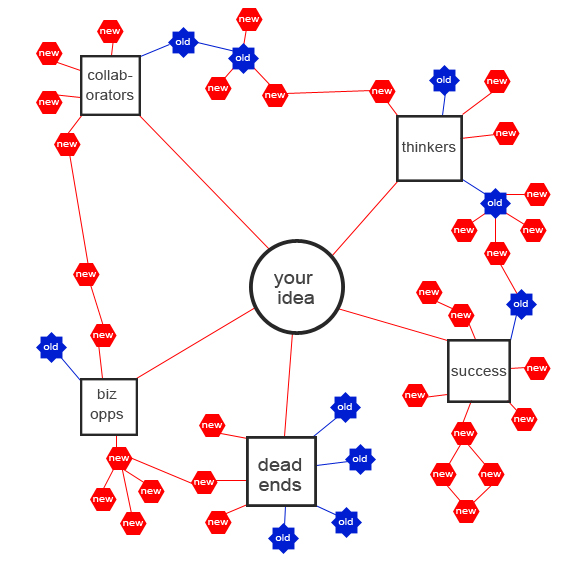
You have ideas. We all have ideas. Some of them are brilliant and some of them aren’t. But every idea (pursued) is a network.
As you explore your idea you bump into people. Some are new people to you and some are old friends. Each of those connections makes connections with other people based on the concept of your idea. And you might bump into people who have a very similar idea, something the 18th century philosopher Johann Gottfried Herder called zeitgeist.
The result of your idea– something you conceived of while sitting on the toilet or in a dream or while you were bored in a staff meeting– can create a vast network of interconnected people whose primary connection is your idea.
A good idea generates energy and momentum. Sometimes even a dead end generates new connections which further energize the idea. Can you help my idea? Can you collaborate on it? Can you make the idea successful? Can you help me think about the idea?
Here’s the deal: Whether you have an idea that will make your neighborhood a better place to live or an idea that will make you a bagillionaire… you need to give your idea the freedom to breath, to live, and to take on a life of it’s own.
The difference between an idea that changes things and an idea you have on the toilet? The network you allow that idea to ignite.
I woke up anxious. At 5:00 am I got up to start re-working my WordCamp talk– scheduled for 4:00 pm. I added all new slides, completely reworked the content, and I seriously considered calling the organizer and telling him I was sick. Like all fears it was completely illogical.
Why was I nervous? I was nervous because I knew that this was a big moment for my fledgling business, McLane Creative. The last thing I wanted was for the Southern California WordPress community to think I was lame or didn’t know what the heck I was talking about.
It was a risk. And the closer my time got the more it felt like a stupid risk to take. I’d never even been to a WordCamp… much less spoke at one. What the heck was I thinking?
After lunch I went to my car and went through the talk 2 times all the way through. After the first time I actually started the car to drive home. I had sat in on a couple other sessions and I knew my talk was drastically different from the style of everyone else’s. This compounded the risk. And it felt like a dumb risk to take. My instinct was saying, BAIL, BAIL, BAIL!!! But my integrity would never allow that. That’s not the Adam McLane I want to be.
4:00 pm arrived. Feeling completely unconfident I stood there and realized that it was time to fake it. My last thought before my talk began was, “Just shut up and deliver.”
And it went great. The audience was engaged. They asked great questions. And I think that for a few people, those who I was targeting with the talk, were really equipped.
Last week I talked about jumping out and starting my own thing. And how glorious and scary it was at the same time. Yesterday I felt the amazing joy of free fall! And it was beautiful.
I walked off that stage proud of myself. I looked a scary moment in the face. Risked it all. And it paid off.
3 Tips for fellow jumpers
Being afraid – There’s no shame in having fear. Fear is natural. But if you allow fear to drive your decision making you’ll live a life of regret. Learn to look at fear, recognize it for what it is, and push through it.
Being myself– There were elements of my talk that referenced being a youth pastor and even the defining question of my blogging life. I was open about the role of my faith in Christ in my life, the positives and the negatives, and the audience was appreciative of that. (And not shy about affirming my decision to go there.)
Being welcomed- As someone who “is known” within my niche` it was very scary to walk onto a stage as a complete unknown. The organizers knew that and welcomed me into their tribe, my fellow speakers were very gracious, and the audience was amazing in making me feel welcome on their stage.
“Be strong and courageous. Do not be afraid; do not be discouraged, for the LORD your God will be with you wherever you go.” ~ Joshua 1:9
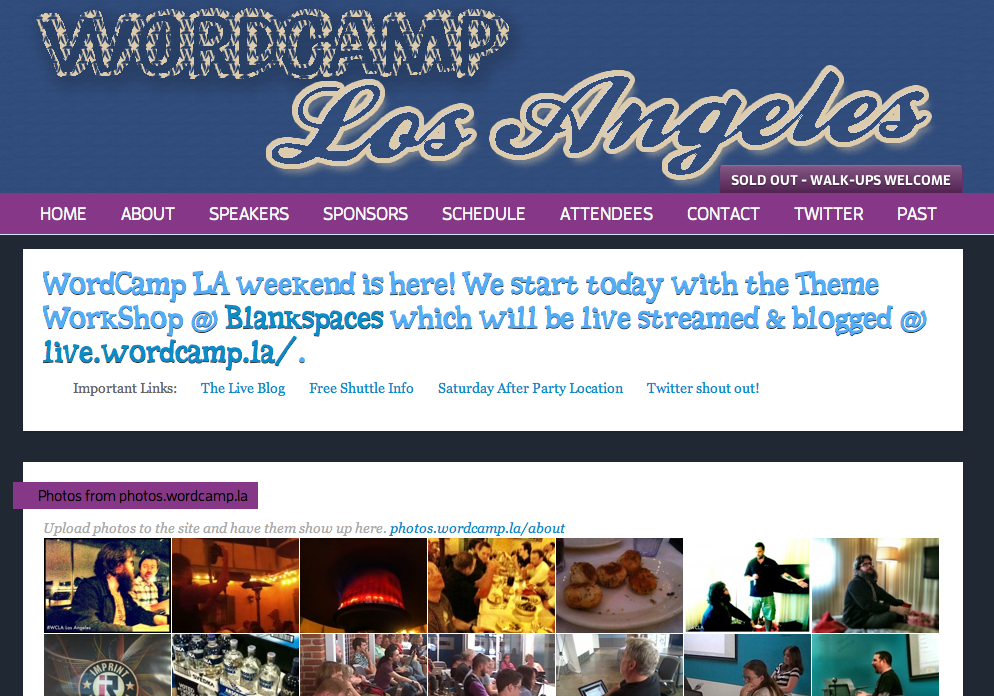
Today finds me at WordCampLA. WCLA is a one-day conference for WordPress users, developers, and fans.
Last night I had a great time getting to know some of the speakers and sponsors of the event. If anything, it was a reminder of just how far WordPress/blogging/small business development has gone in the past 5 years. When I first did some meet-ups with WordPress users in the Detroit area it was dominated by amateur bloggers and novice developers (more like modders) who would gather to talk about very basic stuff. Last night, I sat at a dinner table with serious developers, designers, and highly honed entrepreneurs.
Over and over again I was asked what my talk is about. (Since I’m new to the WordCamp circuit.) My talk is called, “” Typically, when I bring up this topic people will say things like, “Oh, so you tell people what’s hot and what the trends are?” No, actually I teach the opposite of that. Fads fade. Trends change. Tools age. Instead of teaching trendy things that come and go I try to give people a philosophical framework of principles to build and sustain a presence. That way, when something trendy like Google+ or Klout or the next SEM/Affiliate marketing scheme pops up, you know how to frame the trend instead of the trend framing you.
If you want to be a part of this workshop, I am presenting it next at NYWC.
Which is more important in your communication? Principles or trends?