For the last two years I’ve been riding the pine at church. This time has taught me a lot about what it means to be in church leadership.
From age 16 until 31 I had always aspired to be an up front leader at church. I like being visible. I love speaking, teaching, and preaching. I truly enjoy the grind of regularly doing those things as my vocation.
Over the past two years I’ve gone from being the person everyone on our church campus knew to being a relative nobody. In athletic terms, I went from being a starter to being a player who sits the bench.
And just like in athletics, when you put a starter on the bench, the Coach always does it so the starter can learn.
Here are 5 things I’ve learned from riding the bench at church:
Every attendee gets something different out of a Sunday morning, you can’t control the takeaway or topic one bit. I can’t believe I ever thought I could control that.
The more a church offers the less people are involved in their community. Growing a church by doing less doesn’t make logical sense, but its 100% true.
Never assume people know what a term is or who an author/speaker is that you reference. People in church leadership live in a different world, with different heroes, than the rest of the congregation.
Visibly valuing people is really important. This manifests itself in a lot of different ways. But it demonstrates the church leaderships character in what they put up front.
People in the pews care way more about the staff and their families than I ever imagined. It’s not creepy, it’s not some American idol worship, it’s actually quite sweet.
If you’ve gone from church staff to church attendee, what are some things you’ve learned through that process that could help people in church leadership?
I want to see church culture change. I know that if we’d just apply what we believe the church would be the most attractive option on the planet.
And I also know that in order to change the leadership culture within a church you have to do three things.
You have to play along to gain access to the people who can change things.
You have to gently prod leadership with ideas that are approachable.
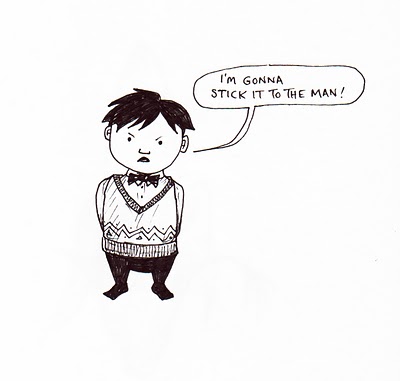
And sometimes you need to show them your middle finger and just plain stick it to the leaders by giving them glimpses of your vision for reform.
Here are some examples of moments in history when visionaries have extended the middle finger (mostly figuratively) to the man and changed the culture forever.
William Wallace lead a band of warriors against King Edward in a fight for independence for Scotland. “I’m not your slave, I’d rather die than serve you. Here, look at my butt.“
On December 1st, 1955 Rosa Parks sat down in the front of the bus in Montgomery, Alabama. “What are you going to do about it?”
George Whitefield lead massive outdoor revivals in staunch opposition to the established church and local laws which required permits to preach. Much of the American evangelical church was born from his disobedience. “We are going to meet outside, where the people are… you know, just like Jesus did. You OK with that, sucker?“
Martin Luther recognized he could barely move the needle an inch in his lifetime if he worked within the rules of Rome. So he wrote some things down and made his own appointment with the Pope Leo. “You’ll be changing one way or the other, Mr. Fancy Hat.“
Instead of ignoring the Pharisees and their muttering, Jesus teaches his band of cultural losers that they should go out and try to reach Pharisees. “Sometimes you stick it to the man by going out and loving the man while sticking it to him.”
What’s the problem with this?
A lot of us are the man.
In nearly all of those situations, the established religious leaders were on the wrong side of history. Oops.
We stand in a long time of people who realize… awful hard to stick it to ourselves.
The reason I’m saying this is to remind people like myself that we are, oftentimes, the biggest agents against change. We have our ways. We have our culture. We look at prominence and degrees. As the established religious leaders we give a million excuses why the pains in the neck are wrong and we are right.
World changing men and women come into our lives, observe our behavior and practices, and give us the middle finger.
The lesson from the examples above is simple: When people come to you to give you the middle finger of no-more-fellowship… you need to listen to them. You need to give them the opportunity to be heard.
They may be right and you may be wrong.
You need to look at those people with sober judgment.
Do not think of yourself more highly than you ought, but rather think of yourself with sober judgment, in accordance with the measure of faith God has given you. – Apostle Paul, Romans 12:2
More than 3 months have passed since 200,000 people were killed and a million people were displaced in Port-au-Prince.
For a news item that’s an eternity ago. It’s just how we’re hardwired. We hear a news item, we are shocked by it, we do a fundraiser, we move on. And we want to block it out until late December of that year when our favorite news agency does “2010: A Year in Photos.”
For lack of a better term I’ve been calling this “Haiti fatigue.” The news cycle has passed. People are thinking about economic recovery. Health care reform. Earthquakes in San Diego, Chile, and China. Larry King and Tiger Woods sex lives. iPads. On and on. Anything to distract ourselves from the good and bad that is happening just a few hundred miles south of Miami.
Talking about what’s happening in Haiti just isn’t that interesting to people any more. They are sick of it.
But I’m not fatigued.
I’ve not forgotten.
I’m praying about how to wake up those echoes. Stay tuned.
17th hole at TPC Sawgrass | Photo by nsaplayer via Flickr (Creative Commons)
One of the hardest skills to teach a competitive golfer is what I call The Sucker PinPrinciple.
A sucker pin is a pin placement that is inviting you to take a dangerous or unnecessary risk. This takes advantage of an aggressive player.
The sucker pin principle rewards the patient golfer while punishing the aggressive. Application of this principle is what separates a talented high school golfer from an all-conference high school golfer.
For most golfers sucker pins are irrelevant because they just aren’t good enough to worry about pin placements. But for competitive golfers on every hole they are not just trying to hit the ball on the green from the fairway or the tee box on a par 3, they are trying to hit the ball to the area of the green where the pin is so that they can try to score. (e.g. birdie the hole)
Sucker pins come mostly into play on a par 3 hole. If the greenskeeper wants to make a hole more difficult, he may place the pin to a comfortable distance, say 150 yards, but place it far to the right of the green near a bunker. The safe and smart play in that situation is to play the ball to the center of the green. But the aggressive player will be tempted to play to the right and flirt with the being in a short-side bunker.
When I coached high school golf I would always say, “Play to the middle of the green, don’t fall for the sucker pin.” In practice this was fine. Players would amuse their coach. But in a match, particularly if they had bogeyed the hole before, they were tempted by the opportunity to get a stroke back. The lure of an easy birdie would be too much, they’d go for it, inevitably miss the green, and bogey another hole.
If you watch golf on TV you will see that professional golfers pick spots on the course where they can be aggressive. But they show respect to certain hole and their pin placement, go for the middle of the green, and pat their caddy on the back as they walk to the next tee box with a par.
Commentators talk about it all the time. “He picks his spots well.” or “He manages the golf course like Seve.”“Golfers are attacking this pin placement today.”
More often than not, the golfer who picks his spots to be aggressive is going to win while the golfer who is overly aggressive is going to take too many risks, pay too many penalties, is going to lose.
If you watched the final 9 holes of The Masters this year you saw a case study in this principle. Tiger Woods climbed up the leaderboard, chose a spot to be aggressive and came up short. Lee Westwood tried to be conservative all day and he was too patient. But Phil Mickelson chose to be aggressive on the 12th hole (I screamed at the TV) and he nailed it and hoisted the green jacket.
The same principle applies in life. Life is full of sucker pin opportunities. Any major transaction in life is doubly full of sucker pins. You may just have to pay a price for your aggressiveness. But if you are patient and pick your spot, you can come out ahead.
I have a fervent belief that if we want to reach a post-Christian society, we have to be Good News before someone will listen to Good News.
Here are 10 ways you can begin transforming your church into a place where Good News flows from:
If you have a building, offer a public bathroom and shower that’s open to whomever needs it during your office hours.
Ask every attendee to get in the habit of bringing a canned food item (you get the idea) to church every week. Then start a food pantry that’s open a couple days a week for people to drop in.
Buy things for the church from local suppliers. Avoid the big box (probably cheaper) stores for ones that support a local company. Encourage your church attendees to do the same.
Require church staff to live within the area you are trying to reach.
Add a requirement to all board and staff job descriptions that they attend public meetings. (Schools, city planning, city council, county government, etc.)
Ask adults to volunteer at the public schools. (Give staff lots of freedom to volunteer)
Participate in organized community events. Cleaning up, planting flowers, helping with parades, etc.
Make church property open to the public. (Playground equipment, skateboard park, community garden, host local festivals, allow the schools to hold events in the auditorium.) Better yet, turn all of your property into a community center.
Create a culture of saying yes to community involvement instead of no.
These are my ideas. What are yours?
How can your church (and the people who go to it) become Good News to your neighborhood?
Photo by richardmasoner via Flickr (Creative Commons)
Perhaps the reason your church isn’t growing is because you are boring? Your church is boring. Your faith is boring. The Jesus you’re presenting is boring.
People’s faith isn’t challenged by your ability to keep them busy. It is transformed when they are sent out to do God’s work in their daily life.
The last thing most people need is another sermon. The last thing they need is another worship experience.
The first thing they need is to apply the last thing you taught them. I guarantee you that your next worship service will be exciting if your community of believers is coming to worship Jesus after they have dipped their toes in the River of Grace and seen Him act.
That is exciting. That grows… Quickly.
No more songs about moving mountains until you show people– God moving mountains!
I don’t need Microsoft Office anymore. Actually, I’ve used it decreasingly less for a few years now. Instead, I use Google docs for that. (Or Evernote on my iPhone.) The first thing group of editors do when they receive a new article for youthspecialties.com? Upload it to Google docs. When they are ready to share it, they don’t have to email it, they just share it and everyone on the team has it. When I need to write some copy on the fly, I just open a Google doc, invite a collaborator, and start writing. I can’t tell you how many times I’ve been writing a paragraph ahead of someone who is editing. I finish writing the copy and 30 seconds later its edited and ready to go out.
I don’t need a server at work anymore. If you opened up my personal folder from work you’d only find a few old back-ups. Why store stuff there and go through the awkwardness of connecting to a VPN when I can access it anywhere using Dropbox? As long as I have an internet connection my office is accessible. My file cabinets are mostly for show. Well, I hide gear in them. But no file folders. If I need it, I scan it and save it in the cloud.
Photo by zarprey via Flickr (Creative Commons)
Speaking of Dropbox, when I’m making stuff for McLane Creative, I just ask anyone else on the team to save their stuff on a shared Dropbox folder instead of on their computer. Dropbox installs on a Mac just like a folder… so that’s a snap. No more “can you email me the logo” stuff… everything from the entire project is right there. They make a change, everyone already has it. They want the creative brief? Done.
I’m looking forward to more and more of my creative desktop applications moving towards the cloud. I don’t know that I’d like to be 100% dependent on a solid internet connection for everything I do with Photoshop, Dreamweaver, Illustrator, and Final Cut. But it would be pretty sweet to have the option of working off of a cloud-based drive and thinking about replacing the full version of them with a cloud-based version.
Why on earth would a start-up company buy a physical server (with ridiculous hardware and software costs at your scale) when they can store everything in the cloud for $.14/gb per month? I know I wouldn’t. And IT guys who flap their gums about security? They need to adapt their game. You’ll only be able to convince execs of those lies for so long. Remember IT guys capitalized on the Y2K lie, too.
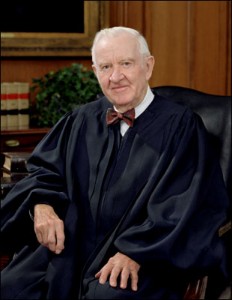
John Paul Stevens, soon to retire Supreme Court Justice
(Yes, the title of this post is sensationalistic. But it got you to read it, right?)
All of my life I’ve grown up with versions of this phrase, “Don’t judge someone by their color, race, ethnicity, gender, or religion– judge them by their character and abilities.”
I grew up in a college town, with the University of Notre Dame within my elementary, middle, and high school’s boundaries, we were as melting pot a community as you could get in Indiana. Lots of ethnicities, lots of religions, lots of races. Growing up with that sort of diversity makes you hungry for it. It’s one of the things I love most about San Diego, where we live now.
“Stuff like that just doesn’t matter.” That’s what we were taught. That was really our mantra growing up. And if I’m really honest– that’s what I believe in the core of my being. In fact, given the choice I still prefer to celebrate diversity. Kristen and I exhibit this by where we chose to live and the schools we chose to put our kids in and the church we chose to worship in.
With just five exceptions, every member of the Supreme Court in the nation’s history has been a white male, like Justice John Paul Stevens.
But Justice Stevens cuts a lone figure on the current court in one demographic category: He is the only Protestant.
His retirement, which was announced on Friday, makes possible something that would have been unimaginable a generation or two ago — a court without a single member of the nation’s majority religion.
— [moving to the end of the article] —
For his part, Professor Stone said there were ways a justice’s religious affiliation could have an impact on the court. President Obama, for instance, could nominate an evangelical Christian.
Mark Tushnet, a law professor at Harvard, had another suggestion.
President Obama, he said, could use Justice Stevens’s retirement as an opportunity both to honor tradition and to break new ground.
“The smartest political move,” he said, “would be to nominate an openly gay, Protestant guy.”read the full article
So, if I read that right the Supreme Court nomination is open to anyone who isn’t… a white protestant straight male.
I’m not calling it discrimination. But I find it odd. I’m all in favor of choosing people for the Supreme Court for political reasons. That’s certainly a tradition and one of the major privileges of being elected President. And I understand that as our nation has fought to make diversity a value, we had to intentionally place individuals in places of power and decision to communicate that value. All things equal, for more than a generation, we’ve chosen to elevate someone of another race, gender, religion, or whatever.
This has helped significantly communicate, “It doesn’t matter where you’ve come from you can get anywhere in our culture.”
But I wonder at what point does the discussion get back to purely, “Who is the most qualified?” and “Who would keep the courts balanced to represent a variety of worldviews?”
In other words– I’d like to think we’ve arrived at a place in our nations history where it truly doesn’t matter the color of your skin, what nation your parents came from, where or if you worship, what your gender or sexual preference is, or even where your degree comes from.
Have we reached a place where white, protestant, straight, males are not put on the sidelines because of their race, gender, and sexual preference?