
• Are blogs a voice to extremism?

    For all the good social media, blogging, and other technology does for us this is a good reminder that some are out of control. Seriously, if you blog, twitter, post notes to Facebook, write on Myspace, whatever: Make sure you have some friends who can check you. If you need some guidelines, here are my rules.

    Random sidenote: I think this is the first time I’ve watched something from Fox News in more than a year. I get my news from the internets.

    HT to Mark Riddle

  • Getting Started in Investing, Part 4

    money_stuff4

    Free money! How often do you hear that phrase? Not very often. But generating free money in a bank account is essentially what investing is.

    I’m surprised how many people are scared of the whole topic. Among people under 30 in ministry there are three groups.

    1. I’m too young to worry about savings and retirement. These folks are typically focused on their mountain of college debt. And in their minds they shouldn’t save anything until they pay that off.

    2. I don’t know anything about investing so I just don’t do it at all. Essentially, this is who this series is for. This group of people plead ignorance or try to pretend it is all too complicated for them.

    3. I’m in it to win it. These folks understand the basics of investing and know that starting young means more free money down the road.

    It’s all about the interest. Do you remember back to 5th grade where we learned about compounding interest? The teacher would say, “if you put $500 on a credit card with an APR of 22% interest, how much would you owe at the end of 12 months? Essentially, investing is the same process in reverse. The earlier you can put money away the sooner interest will start compounding for you.

    This is critical for those in ministry. We have to start earlier than our peers since we will make less over a lifetime than those in other industries! Fortunately for us, there are some great tax benefits that help us save for tomorrow today.

    401k, 403b, 529, Traditional IRA, Roth IRA, Education IRA… where do I start?

    The basics: Essentially, all of those accounts are going to allow you to defer when you pay taxes on your savings. Theoretically, you could save for retirement with a savings account. Three problems with that. First, the interest rate generally stinks. I’ve never seen a savings account at a bank offer more than 4% interest. Second, you can get to that money way too easily. This is long-term savings so you don’t want to be able to access it with your ATM card. Third, each year you will pay taxes on the interest you earn. A retirement plan of any variety is going to allow you to earn a higher rate of return, the money isn’t readily accessible to you, (unless there is an emergency) and will allow you to defer paying income tax on interest until you withdrawal.

    401l/403b: These are essentially the same thing. These are retirement plans for “regular employees” of either for-profit (401k) or non-profit (403b) companies. The great news is that 99% of the time you can invest in 401k/403b through payroll deduction, the money will go into the account pre-tax, and your employer will likely match a certain percentage of your investment. For instance, if they match 100% up to 5% of your income and you make $1000 per week… they would take $100 out of your check and give you an additional $100… depositing $200 per pay period into your account. ($4800 per year) With a 100% match you make 100% interest on day one! There is no better investment on the planet. To not accept this offer of free money is foolish. Since it is payroll deduction you won’t even miss the money. Typically, if you enroll in the program and do nothing else they will automatically select a very conservative mutual fund for you, guaranteeing a small return with minimal risk. Remember, by putting in a little you get free money automatically on the first day. Even if your employer only matches 50% up to 4% of your income… that’s still better interest than you will get anywhere else. The bad news is that you won’t be able to touch that money until you are 59.5 years old. Technically, you can withdrawal early but that will come with some nasty penalties. It is important to understand that money invested in your 401k/403b has almost nothing to do with your employer. Sometimes they will allow you to buy stock in the company through your retirement plan (never do that) but otherwise you are putting money into a bank. This means that the savings belong to you. If you change jobs the money is still yours. (We’ll just not talk about vesting right now to keep it simple) We’ll also talk about investment choices another time. For now, keep it simple.

    IRA: (Individual Retirement Accounts) For some reason this one is scarier to people. It shouldn’t be as it is way more fun! This is the most obvious retirement savings option for those church workers who are “self-employed.” These savings are not pre-tax, but when you file your return you typically reap the same benefits so it all works out. Most people end up with an IRA because they change jobs and want to withdrawal money from their previous employers 401k/403b program. (Called a rollover) Kristen and I did this in 2002 to consolidate about five 401k programs, it was simple and pain free. Unlike a 401k, an IRA is going to depend on you depositing money into the account. If you are absolutely unwilling to make any choices, find a broker and have them set it up for you. Any U.S. citizen can have an IRA (or IRAs). Essentially, it is just a savings account that allows you to purchase investments.  Technically, you can invest in all sorts of things with IRA money. But the most common things people invest in with an IRA are stocks and mutual funds. While your employer doesn’t typically match your investment most churches I have worked at will include retirement savings in your contract with them. So, each quarter or month they will give you a check for the agreed amount of money and it is up to you to invest that money. I use E-Trade for my IRA and they allow me to transfer money from my savings account to my IRA. But even writing a check to your broker or mutual fund is a snap.

    Which IRA do I want? Unless you have some serious cash, you want a Roth IRA. There is an investment cap for how much money you can put in every year, I’ll be honest, as a youth worker you don’t have to worry about that.

    529/Education IRA plans: A 529 is basically a 401k for your kids college education. You make an investment and they manage the funds. When the time comes for your kid to go to college, the college withdrawals the money from the account. If you invest in your state’s 529 plan there may be state tax benefits for you. Typically, the money can be used at any college that is accredited. So if you plan on sending your kids to an non-accredited training school or Christian college… this may not be the best option for you. An Education IRA is basically an IRA for money dedicated to your kids college. (You manage the investments.) So if grandma dies and leaves your kids $10,000… this is your best bet to allow it to earn interest without paying taxes.

    Kristen and I don’t believe it is our responsibility to fund our kids college. But we do have a 529 plan for them with the intention of helping out a little. (Books?) We make a simple investment each month… the same dollar amount since Megan was born… and it adds up really fast! We have a few thousand bucks in that account already and it was completely pain free. Also, we’ve always taken the small checks for their birthday’s ($10, $20) and added that to their monthly investment. We still give them the money (of course!) but we want them to know later on that grandma and grandpa invested in their education and every little bit counts.

    The key to all of this is starting now. It’s all about compounding interest to make your small investments today work for you later. (Remember 5th grade!) If you are 22 and just out of college…. this is the right time to get started! If you are 32 and haven’t gotten started… get on your horse and get it done.

    Still got questions about this stuff? Ask a question in the comments and I’ll hunt down the answer.


  • Don’t Promise, Deliver

    gm-logoIf you live in the United States, you are the proud owner of the second largest pool of retirees next to the federal government. And as a bonus you also get a small and dying breed of cars formally known as General Motors. We just spent over $80 billion to bailout a company that is only worth $7.3 billion. You can walk onto a dealers lot right now and participate in the largest liquidation of assets in the history of the world.
    And we still haven’t fixed the one thing that forced them into the red in the first place: 500,000 retirees.

    General Motors is the classic case of over promising.

    Over-promise #1: I remember talking to a GM executive about the business model as he gave me a tour of their Warren Tech Center. I asked him how often a customer was supposed to buy a new car according to the company? His answer made my jaw drop. They built their business model on the assumption that you would buy a brand new car every 3 years. No wonder their cars sucked! They only expected you to own it 36 months. No wonder they failed! No one in their right mind could afford to buy a brand new car every 3 years. They were absolutely lying to themselves. Their competitors built cars that lasted 10 years or more. Honda and Toyota owners hit 100,000 miles and knew that their cars will easily make 200,000 miles. Meanwhile, GM was building cars that were meant to be traded in at 36,000 miles.

    Over-promise #2: In the mid-1980s, when Toyota and Honda made it big in the United States market, GM was stupid to continue the retirement program. There was simply no way that they could afford to continue the program… but they lied to their employees and sold them the lie that if they took care of GM, GM would take care of them for life. The smart thing to do back then would have been to convert the program to 401k and make no promises of retiree health care. Instead, they oversold a promise they couldn’t keep. Worse yet, to deal with payroll issues they started early retirement programs which meant people in their mid-50s were walking away from GM with a “guaranteed” pension and health care. There are currently tens of thousands of people in the United States who have now been retired from GM longer than they worked for GM. No company can bear that burden. Companies struggle just to pay benefits for current employees… How did they think they could insure 500,000 non-wage earning retirees?

    My point isn’t really about GM, it’s about over-promising. Here are some ill-effects of over-promising.

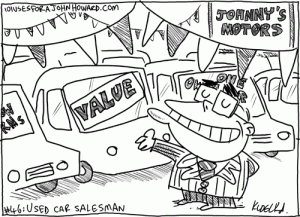
    usedcarsalesman– Advertising becomes useless. It doesn’t matter how much money you spend on ads as people won’t believe you anymore.You can’t hype up a product launch or an event that you’ve oversold forever. When you don’t deliver you are just reminding customers how much you betrayed them.
    – Your word becomes useless. When you break promise after promise, soon people won’t trust that your on their side. They will see that you only want their money and you don’t care about them.

    – Your product becomes a joke. I was in a meeting yesterday about search engines and someone used the word Yahoo… everyone laughed. Yahoo has become a dinosaur of a search engine. The only thing memorable about Yahoo is that stupid song, Yaaahhoooooo. You can’t advertise and promise a web service, you can only deliver. This is the #1 reason you can’t trust Bing.com to be any good. If it was so good why are they spending $100,000,000 to advertise it?

    Shifting gears: The evangelical church has become a classic example of the over-promise. Part of the church becoming more about programs and business models is that it has fallen into the trap of needing marketing and advertising like the business models they copies. The result is a lot of over-promising. “Come to the marriage retreat, it’ll fundamentally change your marriage.” or “Sign up for our next church production, it’ll be awesome.” or “Bring your friends to the revival and they will get saved.” In a world where the awesome is so readily available churches do nothing but give away trust when they advertise promises they can’t deliver. I’ve seen church events marketed like they were going to be on par with Disney or Broadway or Oprah and deliver like a trip to the town carnival, a middle school play, or a cable access show. At the end of the day the church spent more effort marketing the event, production, or program than they did making the program awesome. It is a sick cycle that is killing thousands of churches.

    The better way: Wouldn’t it be refreshing if churches just delivered? Wouldn’t it be amazing if they didn’t sell themselves but just helped people? What if they invested in training their volunteers and staff so much that the church didn’t need to make promises, that their programs and ministries truly worked to change lives? You wouldn’t need to advertise a life-changing marriage retreat… because results would advertise themselves. You wouldn’t need to hold a revival because every church service, small group, and youth group meeting would see people come to know Jesus. You wouldn’t need to hire a killer band and create a worship experience because people were authentically worship Jesus. The best advertising a church could ever invest in is a changed life.

    If you are a church leader I want to challenge you to think about your programs. Think about how you talk about them. Think about how you market them. And remember:

    Don’t promise, deliver.

    Don’t hype, deliver.

    Don’t sell, deliver.

    Don’t measure, deliver.

    Don’t sub-contract, deliver.

    Don’t advertise, deliver.

    In a low trust, high expectation world the best way to succeed is to undersell and deliver.

  • Signs of Health

    workinprogressmalletI’ve been open about my struggles to find a healthy work pace. I’m not sure why but I have an innate tendency to want to be plugged into work 24/7. This isn’t new… I’ve been this way since high school. I remember stopping in on the little restaurant I worked at on my nights off just to see how things were going. That habit has pretty much continued up through today! I always want to know how things are going.



    Full time ministry just made it worse. After all, checking email or making a phone call to a student on your day off is ministry and how can that be bad? Jesus wouldn’t want them to have to wait… would he? With all due respect, the staff at the church just loved the fact that Adam was always available, always game, always willing to answer the call. My work in churches took some horrible tendencies and labeled them as reliable.

    When I started at YS a year ago I dealt with a bit of culture shock. I would send e-mails on Friday night that wouldn’t get read until Monday. I would stay late and have co-workers tell me to go home. I’d respond to emails at 10 or 11 PM and get made fun of. It was actually frustrating at first. It took me some time to recognize that I wasn’t seeing a lack of dedication… I was encountering healthy work habits.

    It’s taken me a long time to begin to break some of these habits. It’s taken this long to wake up to the reality that it was me who needed to change my habits. In the past few months I’ve thought a ton about the idea of sustainability and pace. Reality is that I have a natural tendency to want to increase the pace at the cost of my personal health and the relationships with my family. The pace at which I desire to work simply isn’t sustainable. In the past few months I’ve constantly been telling myself, “Slow down.”

    The last two weekends have been great signs of health.

    – Never checked work email.

    – No responding to Facebook messages that were work related.

    – Didn’t check up on all of the websites, stats, numbers… OK, I did that once or twice. (Dangit!)

    – Spent excessive amounts of time with family and friends.

    – Said “no” to things that were outside of my goals/responsibilities right now.

    – Was not the first one to arrive nor the last one to leave the office at all last week.

    I still have a long, long way to go in establishing healthy and sustainable habits. But these are signs of health. It’s like after you start working out… it takes a few weeks until you start to feel the difference. And I hope the people in my life who are most important are starting to feel the difference.

    What about you? What are some boundaries you have established that help you have a sustainable work pace?

  • Mobile post: line at Hodad’s

    A couple pictures from our wait in line at Hodad’s.

  • Saturday Tunes

    Saturday TunesI know, I’m a day late. But it felt a little weird to miss this. Yesterday, we had a busy day. I woke up and worked on a friend’s website all morning. Kristen ran some errands. Before we knew it, it was time to go to the beach with our friends from community group. We went up to Torrey Pines, where we met our group along with our refugee family. How is it possible they had never been to the beach before? Not only that… but we were completely amazed at the kids language acquisition. Last Fall they barely spoke any English at all… now the kids feel mostly comfortable with English and mom and dad aren’t too far behind. That’s fun to see.
    A lazy evening followed. This was capped off by the delivery of a brand new mattress. Since moving to this house Kristen and I have slept on a double size mattress on the floor. It was fine but excessively ghetto. On Friday, Kristen and I decided to finally solve this aching (literally) problem and headed to a furniture store in Kearney Mesa called “Real Deal.” Just like the reviews of the place promised, this was a great furniture store. Lots of choices and a friendly, no commission staff. Long story short, we got our long-awaited mattress delivered last night. We went from a double mattress on the floor to a massive king sized bed. We both slept like rocks last night. I went to bed about 10 minutes after Kristen last night and she was completely knocked out… that never happens.

    Anyway, this morning is quiet. Kristen is off running a 5k and I am home with the kids before church. Here are the next 10 tunes I’m listening too. As always, these are completely random and my ratings are included.

    #1 Night Drive by Jimmy Eat World ****

    #2 Plain White Rapper by KJ-52 ***

    #3 Waiting on the World to Change by John Mayer *****

    #4 Sea of Love by Cat Power ***

    #5 Nothing Left to Lose by Mat Kearney ****

    #6 Enough by Chris Tomlin ***

    #7 Filled With Your Glory by Starfield ****

    #8 I Alone by Live

    #9 A King A Kingdom by Derek Webb ****

    #10 Lose Yourself by Eminem *****

  • The Blue Sweater

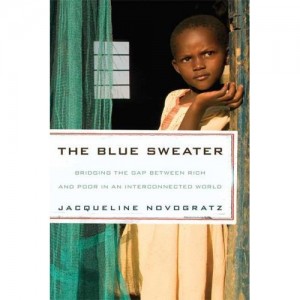
    the-blue-sweaterOver the past month or so I’ve been working my way through The Blue Sweater by Acumen Fund CEO Jacqueline Novogratz. I think this is a book worth reading for a number of reasons. Here are some high points.

    – Novogratz carries a general principle with her that makes a ton of sense: To change a families life you have to work with women. I wouldn’t label her a hardcore feminist, but her point is very valid. Traditionally in charity and community development the money goes to the men. The thing is that very little of that money ends up trickling back to the family. A much higher percentage of the income you invest in women goes towards educating, feeding, and investing in the home.

    – Novogratz sees her role in changing the world as a blend of charity and for-profit business. The old adage that “If you give a man a fish, he eats for a day. If you teach a man to fish he’ll feed his family forever” is an interesting sentiment but isn’t truly solving the problem. This book talks a lot about helping people set up businesses that are sustainable, run by locals on their terms, and yet holds them accountable for their actions. Those are qualities of an ecosystem worth chewing on.

    – Justice is beyond charity. There is a huge movement going on about mosquito nets. When Ashton Kutcher gave $100,000 to buy 100,000 mosquito nets this was both good and bad. While it is fantastic that $1 buys a mosquito net, it’d be way better if some of that $1 went to helping build a company that could produce and innovate those nets without the need for more charity. Charity is great… but it doesn’t go far enough to fix problems.

    – Dignity is more important than charity. For a lot of us who think about building systems upon which others can build their livelihood, it’s important to remeber that our role is to provide the system and get out of the way. A truly good system is a platform on which others can invest and trust.  The platform should take a backseat to the products developed for the platform.

    – For-profit is not evil. There is a sentiment of those who work for charitible organizations that anything for-profit is ignoble. I love how she shows for-profit being as important as non-profit and not-for-profit.

    Interwoven in these threads of thought, Jacqueline Novogratz shares stories from the rich tapestry of her life. Each story helps to form a patchwork quilt from various places in the developing world. From her first experience as a young co-ed where she discovers that a blue sweater she donated in America worn by a child in Africa to running a small bakery in Rawonda, to eventually creating The Acumen Fund, Jacqueline shows that she is crazy enough to change the world.

    For world changers and those longing to see the world a better place, The Blue Sweater is a great read.

  • Two Rounds of Golf in 6 Days?

    That hardly seems possible. Having not played much over the previous 3 years the thought of playing twice in a week is a complete novelty.

    The truth is I really love golf. If I ever won the lottery I’d buy a golf course and live right in the middle of it. When I retire (just 40 years from now!) I’ll be that crazy guy in the golf cart who plays all day and drives his cart home.

    Sunday I played with a co-worker at Steele Canyon. The company for the round was clearly the best part of that day! That type of golf course doesn’t match my style of play. It’s a novelty course which is unbelievably hard. Lots of elevation change from the tee, blind shot after blind shot unless you are in the landing area the designer envisioned, and greens that are elevated and sloping. Even when I’m playing my best this type of course eats me up. I wonder what the course designer was thinking when he made this course? “I want a course that costs a lot of money, makes people lose a tons of balls, and reminds people that they need a day job to support their golf habit.” We had a great time but the course was much harder than I was ready to thrive at! I never play well in a scramble because I’m always hitting shots that don’t fit my game… for whatever reason I just never got anything going. Maybe when I get in better golf shape I’ll go back and it won’t be so hard?

    Yesterday, I got invited to play with Kevin. I really like playing with Kevin… we can relax and just have a good time. Plus, he likes to play stroke play… something I enjoy much more than best ball. We met at a little course called Cottonwood. This course is much more to my style of play. It’s pretty much wide open. And even when there are trees and stuff you can almost always muster a recovery shot. The greens are big and its a course that is forgiving! That’s really the only hope I have for having fun on a golf course right now.

    I don’t know if I’m finding my game just yet, but last night there were shadows of it reappearing. A few shots actually did what I expected them to do. I’ve wrestled to have a draw on my shot without resulting in a hook… or even worse, a snap hook. As usual, iron play is returning before the woods. I feel kind of stupid pulling out a 3 or 4 iron off of every tee. But I’d much rather be 200 yards out in the fairway than “maybe 260, maybe 60… it could go anywhere.” In order to get those shots in play I’ll need to spend some time at the range. Yet there were a few holes yesterday where I strung together some shots and got things going.

    Eleven. That’s the number that sticks out to me. I took an eleven on a par five. That is the result of not playing within the limits of what I can do right now. I got buried off the tee and tried to play a recovery shot over a maintanence shed and a line of trees. I hit that shot as good as I could… just not high enough and it clipped a tree and ended up OB. I hit another tree with my next shot. Then tried to make up for it and hit a shot fat. You know its bad when you are lying 9 on the rough next to the green.

    On the course you try to foget an eleven as soon as possible. But when I’m thinking I need to work on my short game or go to the range and hit a bucket… eleven is a good number to remember. That and the knowledge that I had to chip and putt for par on the last hole to break 100. That’s a long way from grinding out the boring 82′s in Romeo.