Want to teach the students and young adults in your life HOW to do this? Pick up my 6-week curriculum, Good News in the Neighborhood.
ht to Steve Knight for the link. Shouts FTE.

Want to teach the students and young adults in your life HOW to do this? Pick up my 6-week curriculum, Good News in the Neighborhood.
ht to Steve Knight for the link. Shouts FTE.
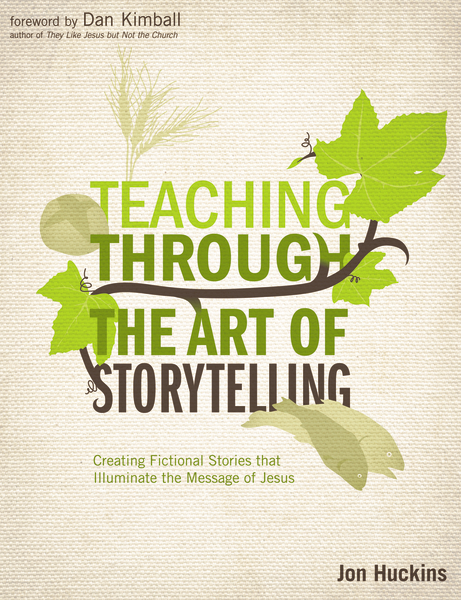 It’s the first book by my friend and co-author, Jon Huckins. If you’ve ever thought of integrating fictional storytelling into your teaching this is the book you need. (You realize this is what Jesus did with the whole parable thing, right? Yeah, totally biblical.) It’s a great resource– it flew under the radar a bit because he was a first-time author.
I first met Jon a couple years ago when I was in Berkeley, CA promoting NYWC. He came to a lunch we hosted and we met briefly. Then a few months later he moved down to San Diego to work with Nieucommunities in Golden Hill. Since August he and I have shared office space, done some life together, and worked our tails off on the Good News in the Neighborhood curriculum. Later this summer I’m fully stepping into Jon’s world by going on his trip to the West Bank. (More on this later.)
BUY IT. Head over to Jon’s site and pick up a copy. (Also available on Amazon)
WIN IN. Leave a comment to this post by midnight tonight (May 22nd) and you’ll be entered to win a free copy of Jon’s book.
That’s a question I get a lot. And I’ve got a couple friends here in San Diego that know a lot more about that than I do.
Here’s a little intro they are doing… if you’re interested in figuring out, practically, what it looks like to literally make your life Good News in the Neighborhood, this would be a great place to start.
Question: If God asked you to radically reorient your life, would you do it?

In the 1940s Billy Graham became one of Youth for Christ’s first full-time evangelists. In post-World War II America, he took to the airwaves and spoke at rallies around the world. Thousands responded. And, in some ways, modern-day evangelicalism was born.
Back then the Bible was taught in schools. It was a regular part of the curriculum for high school students to memorize John 3 or Romans 8 as part of their Bible classes. Church attendance was way up, too. Culturally, America was much more Christian than it is today.
The roots of most of what we call “evangelism” today are tied to this heritage. It’s all built on the premise that most Americans have a working knowledge of the Bible, that they believe in God. and look at the world through a somewhat Christian worldview. I’ve never attended a evangelistic rally, youth event or church service where the Gospel was presented, or anything in between that didn’t have these as working assumptions.
In proclamation evangelism the role of the speaker is to connect the dots in people’s heads. They’ve heard of God. They know who He is. They have read parts of the Bible. They’ve attended church in the past so are comfortable with the format. The speaker and evangelistic rally really puts it all together and creates an emotional, religious experience, and then calls them home.
I’m not going to say that the proclamational evangelistic rally doesn’t work anymore. But if you attend one today you’ll see that most of the people who go aren’t regular Joe’s– they are Christians who came to see a Christian band but are willing to hang out to hear the speaker. And for some of those perhaps the proclamational-style is what they need so they respond?
But take someone completely unchurched? Say, a neighbor whose parents didn’t take them to church and they think Christianity is a crock? Or, like the Average Joe in America believes that if they are a good person they’ll be OK in the end. It’s too weird for them. I know because I’ve done it. A bunch. And I’ve had to go back and apologize one-too-many-times to the point where I’d never invite another friend.
It’s not that I don’t believe, as an evangelical, that I need to share my faith. It’s that I think that for the people in my life the proclamational gospel message should be replaced with a methodology that reflects today’s culture– one that is three generations removed from the Bible being taught in schools and 50% of Americans attending church each Sunday morning.
We live in a post-Christian world. We live in a pluralistic society where Christianity is one of several religions on every block. (Go ahead, walk down your block and ask all of your neighbors what religion they’d ascribe to. I dare you.)
And every day another person, claiming to be a Christian, is deemed newsworthy because they have defrauded people, or gotten away with child molestation, or supported some right-wing cause in the name of God. For skeptics or self-proclaimed agnostics or leavers or even members of other faiths… each of these reinforces a stereotype or an idea that Christians are ____.
They simply don’t know any Christians who are legit, like you.
In a post-Christian world you are going to have to live the Gospel before your friends, family, and neighbors to the point where you are asked, “What is it about the way you live that I can have?” Or “I don’t know any other Christians like you. What makes you different than what I see on TV?”
Within pluralism, experience trumps information. Experiencing the Gospel through a neighbor’s goodness, kindness, grace, and love cuts through the stereotypes and defies logic’s last stand. It’s not that information isn’t important. It’s that information isn’t trusted until the source is trust and that trust is validated through experience.
You see, it’s not that I don’t proclaim Christ. It’s that I let my very life do the talking.
In the same way, let your light shine before others, that they may see your good deeds and glorify your Father in heaven. ~ Jesus said this in Matthew 5:16
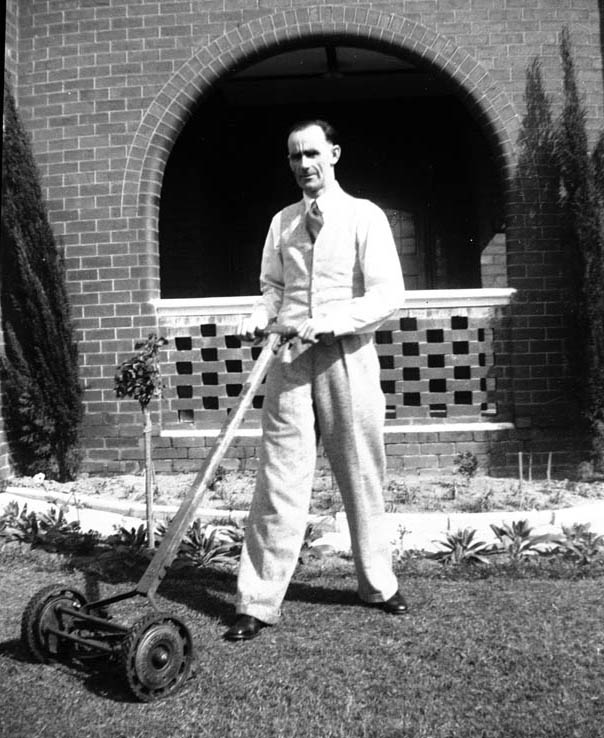
We now live in a world where the person with the microphone and the big crowd is less trusted than the guy who mows his lawn every Saturday morning. You are legit while the person on the platform is a potential suspect.
In a post-Christian world, people will hear Good News only after they’ve experienced Good News from you.
The challenge for you is this: Do you have the guts to live a life that reflects Christ?
Like this post? Get new posts automatically by subscribing via RSS or email.
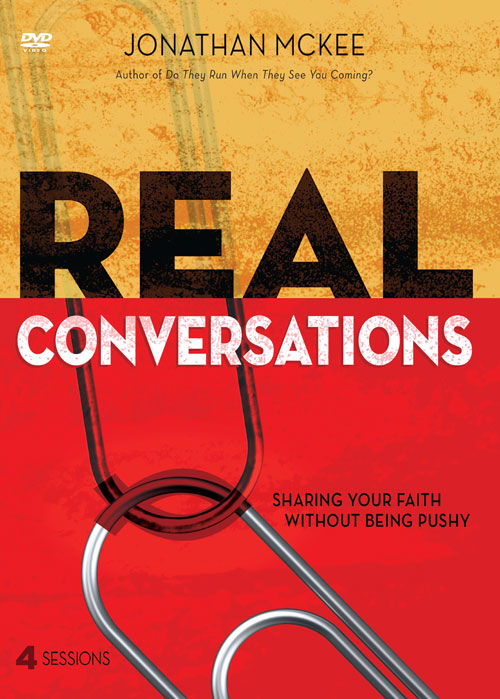 Jonathan McKee (The Source for Youth Ministry) just released a 4-week video based curriculum that’s all about how to have real conversations about sharing your faith. (Which is cool considering it’s called, Real Conversations.) As a youth leader, this is one of those plug-n-play options that would be cool to have on your bookshelf. Each week there’s a 12-14 minute video and a participants guide to help drive it home. For instance, let’s say most of your team is going to take August off and you’re solo teaching? Bam, press play and let Jonathan do the work. It isn’t quite that simple but the videos and the guides make it pretty simple.
If you know Jonathan and you know me you might not see the connection. He’s more conservative on some things than I am, approaches life a little differently than I do, and he’s from NorCal while I rock the fish tacos down in SoCal. But,while we often have a different approach Jonathan and I have one important thing in common: We long to see the church get better at reaching people right where they are… and we are putting our necks on the line to try to make a dent of a difference. I think that’s one reason we get along so well… we care first about people.
Another reason, and this shares something I don’t talk about a lot, is that I connect well to people who hustle. Jonathan works hard. Yes, he’s talented. But his stuff does so well not just because he’s talented, but also because he flat out works harder than a lot of other people in our world. He and I worked on a project earlier this year and he was RELENTLESS! He wanted to not just get it done and on time… he wanted it to be great and put in the work to make it great.
I dig Real Conversations for a number of reasons. I think that there are a lot of youth groups looking for this type of training. It’s consistently choses to stay practical when a lot of similar curriculums get lost in theory and apologetics. I like that its Gospel-oriented without limiting the Gospel to a message. I like that it’s funny, really… I LOL’d a couple times. And I like that it was shot and edited real pretty. (The crew at Zondervan did a real nice job.)
In the end, I see a lot of similarities between Real Conversations and Good News in the Neighborhood. They are two-sides to the same coin. As I’ve tried to figure out and live into the realities of becoming Good News on my block I’ve had several instances where someone, completely out of the blue, has asked me… “So, I know you believe in Jesus and there’s something about how you’re living that makes me want to know more. What is that Jesus thing all about and how do I get me some of that?”
So you can think of it like this. The Good News curriculum might teach you how to live for Jesus on your block. But Real Conversations will actually help you answer the natural questions that will come up as a result of partnering with Christ to become good news to your neighbors.
Two ways you can get this.
WINNER: Jeffrey Dyson – send your mailing address to mclanea@gmail.com
Let’s do this again next week! I’ll be giving away a DVD/participants guide for Love is an Orientation next Tuesday.

Our vision is to provide high quality, age-appropriate experiences which invite every student in our community to experience the Good News of Jesus Christ.
This could be the vision statement of any youth ministry team in the country. Like you, I’ve seen vision statements like this in youth ministry literature, on youth group websites, and even painted on the walls of youth rooms for years.
The problem is that they have a vision (mandate) to reach 4,000 students in their community but a strategy which scales to reach a lot less. The result of this strategy vs. vision mismatch is frustration-induced angst. No one strategy can reach 4,000 teenagers in a community!
We all know youth workers who have quit or been fired. And one of the reasons? They failed to focus on something they could actually succeed at. A lack of measurable results makes it easy to quit any job. (Or get fired!)
You could work 32 hours per day 8 days per week and not make a serious dent in that vision– it’s too big. Simply put, the vision is not right-sized for the strategy. (Most youth ministries employ a single strategy system– a youth group model.)
Compare that vision to the vision of the local public school system– which likely reaches 90%+ of teenagers in your community. They might have a similarly large vision/mandate. But it takes hundreds of full-time, professionally licensed employees and anywhere from $6000 to $9000 per student to enact a strategy that reaches nearly 90%+ of the students in your community.
There’s no youth ministry in America that employs enough people to reach 4,000 students built on the youth group model. It simply falls apart at a certain size.
Youth workers rightly have a burden to help students walk with Jesus and introduce others to Jesus for the first time. But we need to shrink our vision to something we can actually handle strategically instead of aiming at everything and hitting nearly nothing.
To get more effective you need to shrink your vision to a realistic size that your strategy can actually accomplish. Then, if you start to nail that, you can expand your vision a little bit bigger. (Better yet, discover new strategies altogether to reach different types of students.)
Sometimes to grow you’ve got to shrink.
Did you know that The Way wasn’t the only Jewish cult in Jerusalem in the first century?
Visit a Dead Sea Scrolls exhibit and you’ll learn all about the strict rules and discipline of the Qumran community. While they didn’t have a Messiah figure, they were disciples of a teacher. Who had his own beatitudes and life plan which sounds very similar to Jesus. Devotees left society altogether and lived in no mans land in the desert. (Remember, it took 1900 years to discover the Dead Sea scrolls– not exactly prime real estate.)
And there were others. Collectively they are known as the Essenes. Most of them were built around a claim of the messiah or a certain apocalyptic vision or a withdrawal from societies pleasures. (Some took vows of celibacy, which seems like a tough multiplication strategy.) They each tended to remove themselves from society by first creating compounds in the city, then once you’d proven yourself truly worthy, you were allowed access to the leaders.
My point isn’t to give an exhaustive list. Rather to point out that at the time of Jesus’ resurrection The Way joined a few other groups in the city. (I’m sure there are other books about this. But one I’m familiar with is Communities of the Last Days. Also see Josephus.) Jesus’ followers copied some of what they saw from these other groups since this is what all the cults did, these will seem familiar in light of the Acts record:
Of course, those groups collectively known as the Essenes, are all gone today while The Way became one of the largest religions in the world.
Why?
As Christians, we believe Christianity spread because it was true. But another practical answer is strategy.
Followers of Jesus didn’t withdrawal from society. They indwelled it.
Once followers of Jesus had proven they were all in, memorized everything, been baptized, gave everything they had to the group– they were sent out to love their neighbors in ways that were defined by the needs of the neighborhood. Instead of withdrawing they deposited and invested in their community. (This was radical thinking! No one else did this!)
All of these other groups, their contemporaries and fellow Judaic cults, believed that their strict obedience to rules would lead to the messiah coming, or the apocalypse, or revival of the people.
But Jesus’ followers became an unstoppable force because of their profoundly simple strategy. They loved their neighbors as themselves. They didn’t just know them. They didn’t just witness to them about Jesus’ resurrection.
They loved them.
As people used to harshness and exploitation, when they experienced love in the name of Jesus, they wanted that– experiencing the practical realities of Good News made for fertile ground for Jesus’ message to be received.
The Good News wasn’t just a theological reality, it was an unstoppable force of love for their neighbors. To date, no army has been able to stop the spread of love. The Way was an insurrection of the heart and it changed everything. It spread like wild fire. Think about it, within 200 years this simple strategy spread throughout the known world.
Love literally conquered all.
And my belief? My belief is that the simple strategy of The Way is what we need today.
Let’s indwell our neighborhoods and truly be the Good News in the name of Jesus.
 Roughly 45% of young adults between the ages of 18-24 are currently jobless. That doesn’t mean they all want jobs. Officially, the jobless rate is a little over 16% which means that roughly 30% of young adults aren’t looking for a job for a variety of reasons. (In school, don’t need to work, ineligible to work, incarcerated, don’t want to work, etc.)
To me, 45% of 18-24 year olds not working is a problem. That’s bad news for young adults any way you slice it.
And where I see bad news I long to see the impact of Good News.
And I think this is a problem the collective “we of youth ministry” could make a dent in.
Is it impossible to think of your ministry or small business intentionally hiring 2-3 young adults this summer? Not at all.
Here’s are some ideas I suggested 12 months ago on the Youth Specialties blog. They are just as plausible today as a year ago:
A quick resource assessment will likely reveal that your church may be prepared to provide some good news to the students in your youth group.
- You have access to the business community.
- You likely have access to a building, largely left empty during business hours during the summer months.
- You likely already have adults in your church who are ministering to 15-19 year olds, are passionate, and desire to be a practical resource for them.
- You already love 15-19 year olds and want to reach more.
- Your community has a virtually unlimited supply of children in need of free or affordable childcare.
By now, you’ve put it all together. One solution to the employment crisis of teenagers in your community could be for you to hire them.
Summer employment that provides a simple child care service is just one quick idea. 30 minutes with your team and I bet you could brainstorm 5 more ideas.
My own personal dream for my business? Both The Youth Cartel and McLane Creative are at places where our ability to grow is directly tied to hiring people. I’m trying to figure out ways to hire young adults to help me grow my business. Yes, I want to grow these businesses… But I also want how I grow these businesses in a way that reflects this value. It’s not the easiest way to grow. It’s not the most profitable. But it’s the way of growing I aspire towards.
Yesterday Walt Mueller posted this video on his blog, it’s a lot to chew on. I hadn’t seen it but I’m glad I have. As youth workers, it’s both heart-breaking and knowledge we share that too many teenagers feel this way.
My reflections
What are your thoughts?

Universally, the first day of summer camp includes a swim test. For the safety of everyone the adults needs to know who can swim and who can’t.
Those who can swim can go into the deep end while those who can’t need to learn.
As Jon and I began working on the Good News in the Neighborhood curriculum we agreed on a driving principle: Our curriculum cannot be prescriptive. It sickens me that so many curriculums dumb things down to “3 easy steps to application.” I hate the “easy” lie in ministry stuff. As if following Jesus were easy? As if becoming Good News in your neighborhood were going to be easy? It’s not, as we describe in the introduction… if you take the task of walking with Jesus seriously, you’re life will get jacked.
One of the great failures of the church is the silent driving force of dependency. We’ve made one of the core things we teach that we need to keep coming to church in order to grow. That’s keeping students and adults in the shallow end with their floaties on. So, as the line of reasoning goes, to step into “pseudo maturity” you have to become more and more involved (read dependent) on the ministry of your local church. Whereas, that might be the case for some people– but for the vast majority of people, a sign of maturity would be less dependency on the ministry of the church. Consequently, worship services primary focus has become teaching stuff you’ll never be held accountable to apply instead of celebrating what God is doing in our collective.
Instead of keeping students in the shallow end and dependent on our teaching we need to push some students into the deep end of the pool. (So we can better invest our time on people who can’t actually swim!) Sometimes, at least in my ministry, I’ve had students who grew up in the church, who won every Awana award, who come from great families. And I want to tell them the truth… the best way for you to mature in your relationship with Jesus is not to be a part of youth group but to apply all of that stuff to your life! You’re competent, now get out.
Conversely, one of the biggest things holding students back is that we let them come back to the shallow end of the pool forever without ever forcing them to apply what they’ve learned. (And what does that say about their parents? Are they hanging out in the shallow end after 30 years of walking with Jesus?)
As we move forward with youth ministry into our next 50 years, I’m hoping we drop the mommy stance. “Oh sweetie, stay in the shallow end as long as you want. Lots of people wear floaties forever.”
Hogwash.
It’s time to kick that stance to the curb. If we really want to see our ministries become Good News in our context… we need to push the people who are ready into the deep end as the most loving thing we can do. Go, swim, let’s celebrate your success in the deep end.
Wanna flip the script? Let’s give them a swim test and if they pass, banish them from the shallow end of the pool for a while.
photo credit: West Point Public Affairs via Flickr (Creative Commons)
Dig this post? Subscribe via RSS to get new posts.