Outside of facilities and staffing, youth ministry short-missions is likely the largest financial investment in young people the local church makes.
But do we think about it as much as we do facilities and staffing? I sense we don’t.
(more…)
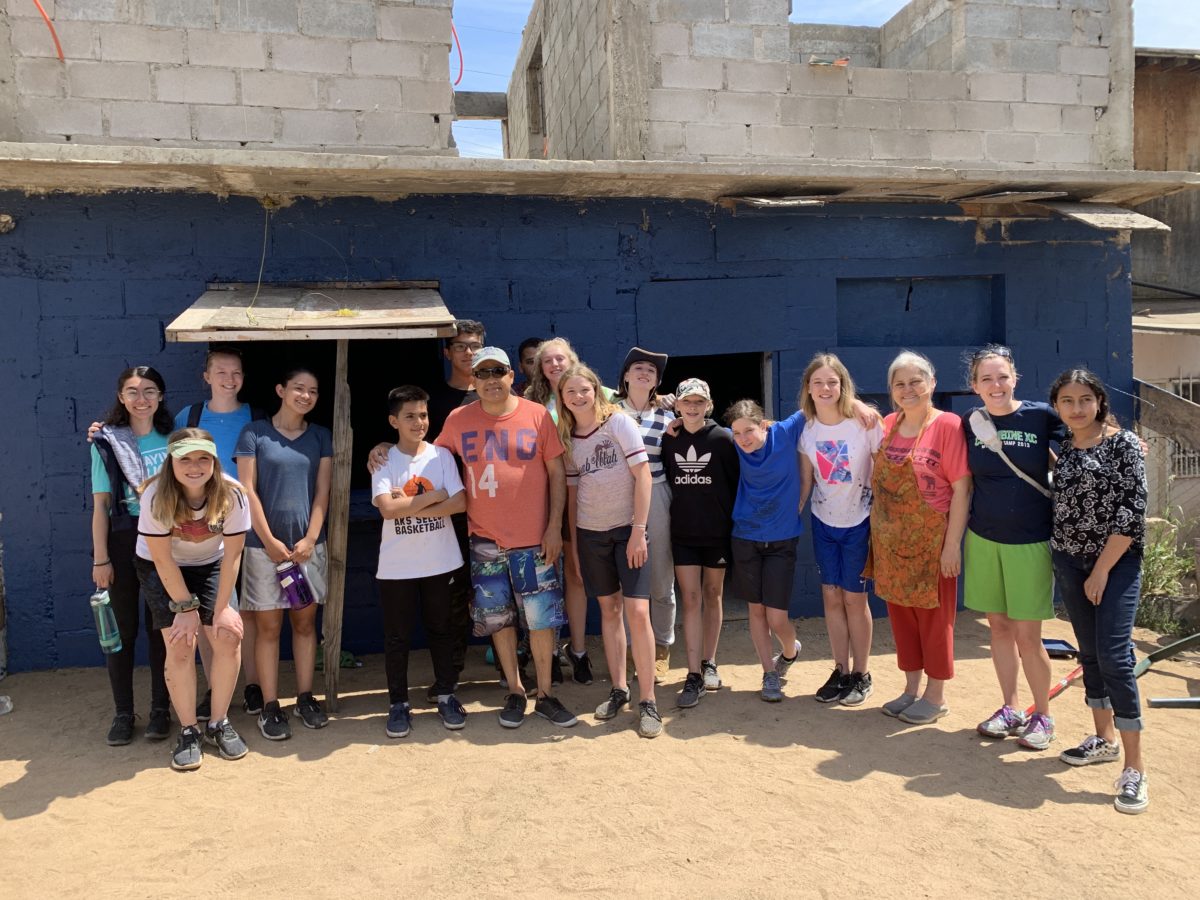
Outside of facilities and staffing, youth ministry short-missions is likely the largest financial investment in young people the local church makes.
But do we think about it as much as we do facilities and staffing? I sense we don’t.
(more…)Before we move on with a new week I want to take a second to celebrate something incredible from last week.
Last Sunday, I was contacted by a friend of a friend in the Pacific Northwest who was seeking information about a 19 year old Honduran woman who was making a migrant journey through Mexico but had been detained… where, by whom, and for what purpose… it wasn’t clear.
This is terrifying news as the journey from Honduras to the United States is extremely dangerous. A young woman is unbelievably vulnerable.
I started asking around with some immigration attorneys I’ve met along the way in TJ who reposted the story, tagging other friends of friends who might be able to help.
All we knew was her name and that she was last heard of near Puebla. I didn’t expect any news. And if we got news I didn’t expect it to be good news.
Lo and behold after a couple days we actually found her 1,000 km away, detained by Mexican immigration near the border with Guatemala.
The absolutely incredible power of Twitter.
Is your church a safe place for anyone in the community to come?
I know that’s a loaded question… “Adam, safe for whom?” In this case, I mean is your church a safe place to come regardless of immigration status? As a San Diego resident living in Mid-City you might imagine this is highly relevant as we live in a community of documented and undocumented immigrants and refugees.

“‘Do not hate a fellow Israelite in your heart. Rebuke your neighbor frankly so you will not share in their guilt.
“‘Do not seek revenge or bear a grudge against anyone among your people, but love your neighbor as yourself. I am the Lord.
Leviticus 19:17-18

It’s been a week since the internet lost it’s mind with the outcome of the presidential election. I’ll readily admit that I’m still shocked about the outcome the same way I am when I see ads on TV for the online dating website FarmersOnly.com.
I mean really, this is a thing?
And I certainly understood and felt the lament last week. Tears were shed in McLandia. But I’m also done with seeing the online lamentations.
Instead, it’s time to move from lament to action.
I want to know what people whining on Twitter are doing in their communities to contribute. Get involved, your slactivism is showing.
— Adam McLane (@mclanea) November 16, 2016
Seriously… if you aren’t actually go to do anything in your community. Shut up.
Anything. Something. Just not nothing. Tweeting, signing online petitions, passive-aggressively posting memes to Facebook… classic slactivism.
Earn the right to be heard by doing something. Like physically doing something.
Embrace your civic responsibility. It’s not just for old people, you know?
“But what? Literally, I don’t know where to start.” OK, I get it. Here’s an incomplete list of things you can do in your local community starting immediately that will actually make a difference.
Don’t try to do them all. But do pick 1-2.
Consider this a starter list. I don’t know what the needs are in your community might be. But I do know your communities #1 need: You.
Church doesn’t fulfill 100% of your local civic responsibility. I think a lot of people, and a ton of people in my life, think that if they are really involved at church– or if they work at a church— that’s somehow all they need to do. Sure, there’s things you can do at/through church that meet some of this. But don’t confuse a relatively closed circle of like-minded people at a local church as everything you can and should be doing in the community.
I might even encourage you to consider becoming Good News in Your Neighborhood at the expense of being good news at your local church.

From the outside looking in, ministry life is often romanticized. “It must be so cool to spend your days advancing the Gospel.” And yes, there are plenty of moments when you feel that.
But there’s a not-so-hidden dark side to ministry life that act as pitfalls, snares, and traps… these are things that don’t seem like a big deal early on in ministry, but over time they build up and eventually take you out.
Here’s three to highlight my point:
Christians are ruthless about plagiarism. Had my IP ripped off from college until today like its a birthright to steal or something.
— Adam McLane (@mclanea) September 13, 2016
Plagiarism is a sin that creeps in out of convenience. You start off by missing a citation or manipulating the facts to include yourself in a good story that you heard. But, over time, since literally no one is fact checking you or asking where you get your content… you move deeper into it.
See, when you are young and brand new, you really can get away with this. You buy resources sometimes (which definitely isn’t plagiarism!) but other times you lift ideas from stuff you see. You build a series here and there ripping off an idea you saw at a conference or on TV. But before long, you stop buying resources and just start riffing off of podcasts you hear or your favorite preacher’s sermons you grab from their website.
“That’s not wrong, is it? I mean I make it my own…” Actually, it’s a lack of integrity. You are taking someone else’s work, not giving them credit, presenting it as your own, then getting paid. So you’re making money off of someone else’s work without permission, license, or payment?
That’s plagiarism.
And, over time, it’ll catch up to you. Let’s say you preach a sermon in “big church” and someone notices that a story you shared was on a podcast they listen to… but you didn’t give that podcast credit? They might not say anything to you but you’ve lost credibility with that person.
They know your sin.
And so do you.
All I’m saying is have integrity. Give credit where it’s due. If you need a resource, buy it. There’s never shame in being honest about where you get your stuff from. Doing so builds credibility instead of bleeding it away.
Like a lot of people in ministry I took notice of Pete Wilson’s recent announcement that he’s stepping away from ministry. Not too long Perry Noble did the same. You could probably label much of what happened with Mars Hill and Mark Driscoll as the same. People who go hard for a long period of time eventually burn out.
And never forget that for every big name lead pastor who drops out because of burn out there are 100 non-famous, regular church staff folks who do the same.
When you see these announcements you hear people say things like, “Pray for pastors. Their life is so hard.” And, of course, people should pray for their pastors because their life is really hard whether you are pastoring in ultra-wealthy Seattle or a very poor city in Haiti like Hinch.
But the thing about burn out? It’s 100% preventable. In every profession you can expect to go through season every once in a while where you go hard. But I think sometimes on ministry staffs “going hard” becomes the mantra.
We make the mistake of thinking we can do a lot to attract people. But don’t forget, eventually those people you are attracting with all that activity are going to look at YOU and ask themselves, “Is this what following Jesus looks like? I don’t want that.” In a post-Christian world how you live is more important than what you believe. If how you’re living isn’t good news to someone they probably won’t listen to the Good News of Jesus.
My thought? Yes, of course pray for pastors. But we need to also expect less from them, too. Ultimately, burn out is about integrity. Do you take care of yourself physically, emotionally, spiritually, and socially? It shocks me how many of my friends in church ministry have no friends outside of their church life, no hobbies, no life. If that’s you… you’re on Burn Out Boulevard. Make a hard turn at the next intersection or you’re next.
Don’t impress me with your ability to go hard. Impress me with your ability to go long-term by taking care of yourself.

I’ve written about this before. While the local church should be the best place to work in town it’s often the place using it’s tax status to violate an abundance of employment laws that a non-church workplace couldn’t get away with. EOE violations, [Only interviewing men for non-exempt positions… SHAME!] age discrimination, racial discrimination, misclassification of employment status, violating overtime rules… these are all the norm, obvious violations of normal workplace standards. Then there are organizations that foster workplace environments that are full of hostility, nepotism, and intimidation that are ripe for lawsuits.
I can’t tell you how many times I’ve heard from church staff that they hate their boss, their job, their church, etc. Yeah… that ain’t good.
Again, these are questions of integrity. If the only thing that matters is growing a big church than why bother with creating an endearing place to work? But when you look at the fallout, thousands of church workers who leave the ministry each year, you need to ask yourself: At what cost?
Like the rest– this is entirely preventable. But these things creep in under the umbrella of “everyone is just doing the best they can.”
Listen, none of this is news. So why bother talking about it?
Because we need to shine light on the dark places of ministry. We need to work hard on creating space for church workers to take care of themselves, be awesome family members, be active in their community, and be amazing employers. We must give space for this to happen. And, in a lot of ways, we can do this when we lower our expectations to something more realistic.
As I read and reflect on the four Gospels sometimes it just pops off the page to me that their lives weren’t as packed in as ours are. We see being busy as being successful. But is that the measurement we really want for our lives in ministry? I’ll take being faithful over being successful all day, every day. (If I had to chose one or the other! They aren’t mutually exclusive obviously.)
What I see as Jesus interacted with his disciples is that they often times did a lot of ministry… really packed it in… then spent days getting to the next place. Walking for 2-3 days isn’t all that productive, is it? There weren’t strategy meetings or stuff like that… they walked. It was probably pretty quiet sometimes. It was probably sometimes uneventful and introspective. And they took Sabbath really seriously. Maybe even too seriously?
But man, the pendulum has really swung.
Busy is not the answer people are looking for in Jesus.
Again, that’s ultimately about integrity. These are insider things that only people on the inside will ever really know about.

Megan and I just returned from a two-week trip to Haiti Tuesday night. In February, 2010 I left a country brought to it’s knees by a devastating earthquake with a simple promise: I’ll keep coming back until it’s clear I’m no longer needed.
Since then I’ve seen the needs of Haitian churches adapt. Immediately after the quake the churches task focused on disaster relief– meeting the physical needs of the community, literally providing food and shelter to the displaced, caring for and protecting the orphaned and the widowed. As those needs were met the local church found opportunities to minister to the spiritual needs of the community, serving those who mourned the loss of family and those struggling with the lingering question: Why did I survive but not ____?
And now, with the earthquake in the rearview mirror and churches full as a culture embraced a church that truly works as Good News in the Neighborhood, the Haitian church is experiencing a new challenge.
Actually, it’s an old challenge.
Will Haitian church leadership stand on their own? Or will new dependencies on outside help re-emerge?
The reason we do short-term missions through Praying Pelican Missions the way we do– where we quite literally serve under the authority of local church leadership– isn’t because we can’t do everything. It’s because we want to strengthen the local church. We want to do short-term mission trips in a way that builds up… not builds dependencies.
The 2010 earthquake destroyed more than buildings, it also shook loose old habits, finally putting to rest something we refer to as the “White Savior Complex” where outsiders come and do stuff.
This is the heart of PPM missionaries Almando and Cassie Jean-Louis. They want to continually build into their staff and partner pastors– encouraging and empowering them– so that the work of PPM is never seen as outsiders bringing help we couldn’t do ourselves and is instead legitimate partnership.
Today I’m asking that you consider joining me in helping to raise about $9000. These monies will be used to gather, invest in, encourage, and build up two different groups of critical leaders– the staff that leads trips in Haiti and their partner pastor couples.
The staff retreat is about $3000. This will get the staff together one last time at the end of the summer to celebrate all that God has done through them over the summer, ending the season full of encouragement and leadership development.
The pastor retreat is about $6000. This will help gather all of the Haitian church partnership pastors, and their wives, for a couple of days. There they will cast vision for the continued development of the partnership, share best practices, pray together, and build up unity among them. When I talked to the pastor’s about this gathering the #1 thing they looked forward to about it was the unity… no where else in their lives are they able to reach across denominational lines and pray for one another, get to know one another. It’s truly a special and unique gathering.
Both of these retreats are coming up quickly. I’d love it if you could help me make these happen with a gift in any amount.
Make sure to add a note to indicate that the funds are for the PPM Haiti Staff Retreat. If you want more information about the cost of these events or just want more information about them, please feel free to leave a comment or contact me through my blog, Facebook, Twitter, etc.
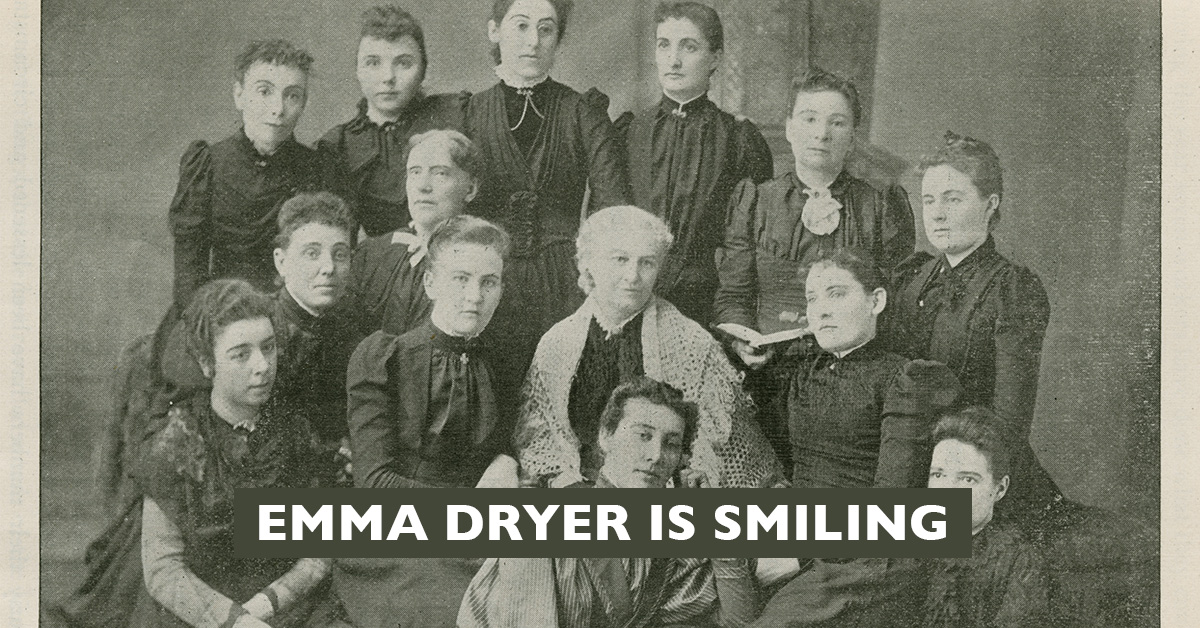
About 3 years ago I wrote a blog post that was widely read entitled, “Moody, You Are Worth the Fight.” In this post I addressed Moody’s demarkation from their historic posture on women in ministry. While the school bears the name of 19th century evangelist D.L. Moody, the Institute was the brain child of a woman named Emma Dryer. Moody Bible Institute was among the first colleges in Illinois to admit women, it’s mission was to create a place for laypeople to get trained to serve the local church and mission field.
In it’s day this was progressive. Very few bible colleges or seminaries admitted women at that time. And while throughout Moody’s history it’s been known as a conservative place, practically speaking it’s also been a place that fostered great amounts of theological diversity among it’s student body. In my time, I shared the classroom with many classmates from evangelical and non-evangelical backgrounds who both thrived there. (And we all struggled through the rules.)
But this changed abruptly more than 100 years after Moody’s founding. For reasons unknown to me, MBI formally adopted a view on women in ministry that excluded them from preparation for pastoral ministry. This went as far as reshaping degree programs specifically to limit women’s participation. For example, in 1995 the youth ministry program was moved from the Pastoral Ministries department to the Christian Education department. Why? So they could continue to prepare women to serve in youth ministry while restricting women from being in classes with Pastoral Ministries majors.
Here was the crux of my complaint in that 2013 blog post:
So I am continually, out of love and respect, asking Moody to change its policy. I’m asking that they allow women to fully participate in every undergraduate and graduate program. I’m asking that women be allowed as fully registered participants at their annual Pastor’s Conference. I’m asking that they invite women pastors to speak and train both men & women at the conference.
And yes, I’m asking Moody to re-embrace their leadership position on the role of women in the church which proudly supported thousands of opportunities for women to serve the church to their fullest giftedness from the late 19th century until the end of the 20th century.
Until that time, this proud alumni respectfully stands in protest.
[No need to read between the lines about what that means… I’ve withheld my support for MBI as well as financial support]
After I wrote my original post I had several pleasant exchanges with some higher-ups at Moody. I felt like they heard me. But ultimately the conversation died off, they stopped responding to me, and I moved on.
As promised, I respectfully stood in protest. I have deep love and respect for Moody but I felt like they were wrong.
Then yesterday, a fellow alumni and long-time friend posted a screenshot on my Facebook wall, asking if I’d seen it. It was a letter from Larry Davidhizer, a VP at Moody and man I casually knew at our church in Oak Park, letting students know that there had been some changes to the Pastoral Ministries major, clarifying that women were now invited into the Pastoral Ministries major, which is being combined into the Pastoral Studies major. The letter even includes an apology to current and former female students over the lack of clarity.
Here’s the letter:
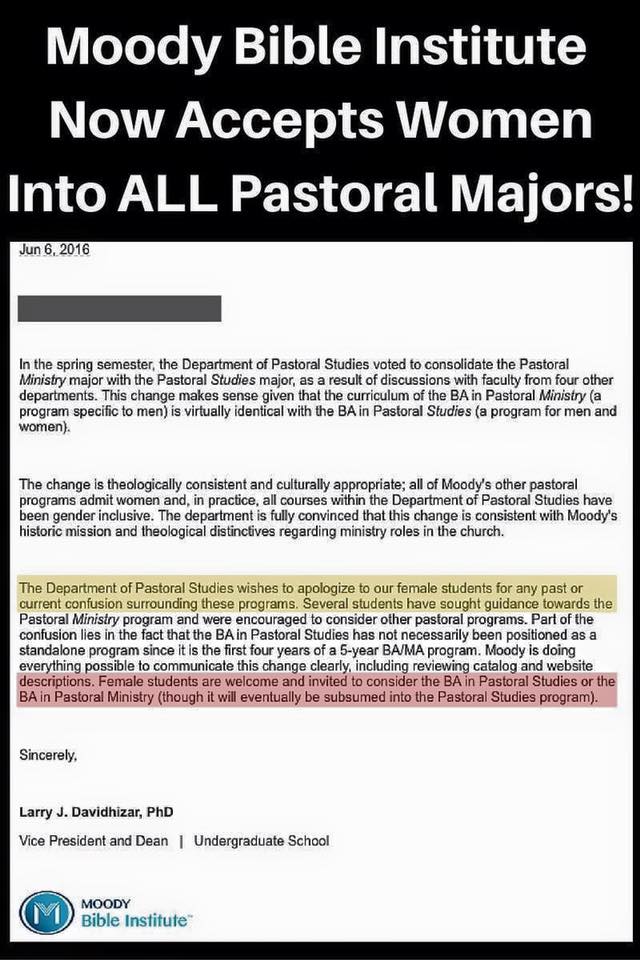
When I read that I was completely shocked. I didn’t think this would happen. Ever. I even doubted the truth in the letter posted, so I sent some emails and posted it on Twitter. And, to my surprise, they confirmed it as true.
Yes, men and women may apply to all programs at MBI, MTS and MBIDL.
— Moody Bible Institute (@Moody_Bible) June 7, 2016
Translation for non-MBI folks… that’s Moody Bible Institute in Chicago, their campus in Spokane, Moody Theological Seminary Chicago & Michigan campuses, and Distance Learning. Basically, that applies to all majors at the undergraduate and graduate level. Women are in! Title IX compliant and everything.
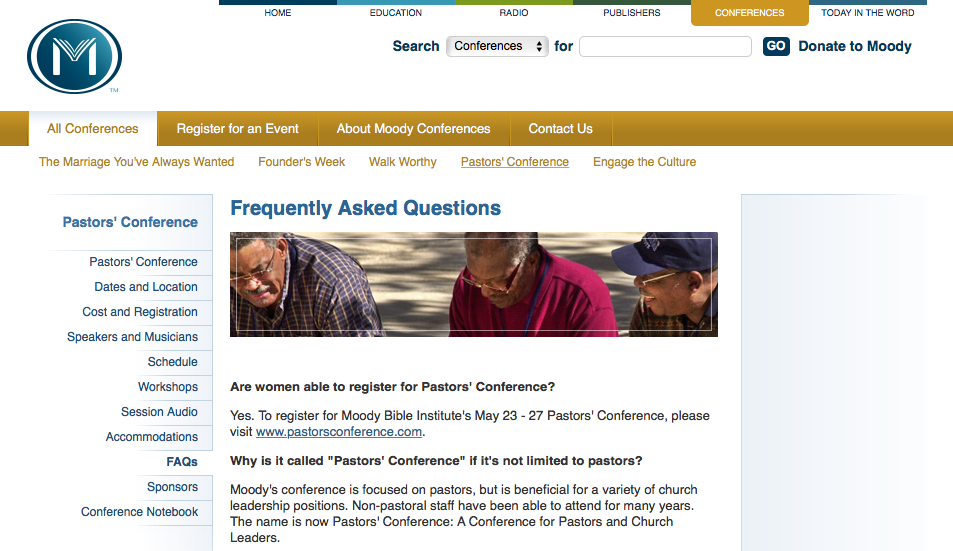
This might seem like a minor thing but I think it’s big. For whatever reason Moody’s annual Pastor’s Conference— which I’d snuck into a couple of times as an undergrad and found very encouraging- didn’t allow women to register. Spouses were invited to come to main sessions, as guests, during the main sessions. But women were prevented from registering independently or attending the breakout sessions and seminars.
That’s no longer the case. Women are now invited.
To be honest, it’s not clear to me if Moody has walked back from their official complementation position or if they’ve merely gone back to their historical non-position position on women in ministry. To me, as an egalitarian it’s almost makes no difference. Ultimately, students will make their own choices and these changes create space for those differences to co-exist.
The victory, in my opinion, is leaving those choices more on the movement of the Holy Spirit than as an institutional decision. A place like Moody does best, in my opinion, when it sees itself as preparing graduates to serve the local churches, ministries, and missions and worse when it tries to hold the line of a specific position within the broader evangelical spectrum.
I have no idea if what I wrote 3 years ago made any difference. I know that there are lots of people who made similar complaints as I did. So I’m not making any claim (or blame!) to these changes. Certainly, besides a few pleasant conversations– mostly by email– I’ve had very little contact with Moody about this.
But I do want to say thank you to whomever pushed to make these changes. I feel like they are reflective and honoring to the founding of the Institute and likewise reflect current realities for the ministries Moody claims to be preparing graduates to serve at.
Bit-by-bit, the Institute is addressing my concerns and regaining my support.

A youth worker from Arizona posted in a Facebook group:
Do you any of you carry during youth events? Concealed or open?
A shocking number of practicing ministers responded affirmatively. They carry a gun while working with teenagers.
A minister of the Good News of Jesus Christ standing before his flock armed with a loaded handgun.
Let that sink in.
It’s simply unfathomably wrong to me. Yes, Americans have a right to bears arms. But a representative of Jesus bears sacred rites that far exceed the man made rights of a nation-state.
On Sunday, we celebrated the resurrection of Jesus. Remember the Garden? Jesus, the Second Adam, was tempted one last time by Satan.
Whereas Adam and Eve failed the test in the garden:
“You will not certainly die,” the serpent said to the woman. “For God knows that when you eat from it your eyes will be opened, and you will be like God, knowing good and evil.” – Genesis 3:4-5
Confronted with controlling the knowledge of life and death, Adam failed.
But Jesus did not. This is at the very heart of understanding the Gospel message. This is why we celebrate Resurrection and the conquering of sin in the first place! In the Garden, tempted with control over his very life, Jesus conquered death… not with the sword… but by power that comes only from the Father.
Then Simon Peter, who had a sword, drew it and struck the high priest’s servant, cutting off his right ear. (The servant’s name was Malchus.)
Jesus commanded Peter, “Put your sword away! Shall I not drink the cup the Father has given me?”
Now, gun advocates cling to phrases from the New Testament to try to justify their right to carry a gun or protect themselves. Let’s peak at the oft referred to Luke 22:36, He said to them, “But now if you have a purse, take it, and also a bag; and if you don’t have a sword, sell your cloak and buy one.) They take this as Jesus commanding his disciples to arm themselves for self-defense… which surely means you can own a gun for self-defense, right? But don’t forget… that sword Jesus told them to go get? That conversation took place the night of Judas’ betrayal. That sword that Jesus told them to get is the same one he told Peter to put away. Oops.
And still people cling to this?
Of course, you don’t see many people preaching with a purse and a bag, or even a sword. This is the maddening joy of literalism! Literalism allows you to contextualize what you want while ignoring other aspects of the same verse! Why is it that this somehow justifies owning a handgun for self-protection in the home when the men Jesus was talking to had no home? Why is it about carrying a gun at all? Why don’t Christian bookstores sell purses, handbags, and swords in the pastoral resources department? That is, after all, so precious a command.
Instead, what we see is Jesus’ followers doing the exact opposite. Not only did Jesus not defend himself in the Garden, not only did he command Peter to put his sword away…. Christian tradition holds that each of the men in the garden with Jesus went on to suffer a similar defenseless death as Apostolic leaders. (With the exception of John, who apparently died of old age.) Moreover, the Apostle Paul and the first generation of pastors planting churches all over the world did not arm themselves as they traveled! In fact, the example of Paul giving his life to the cause of Jesus while remaining defenseless was the great catalyst of growth for Christianity in the first 100 years.
Therefore, I urge you, brothers and sisters, in view of God’s mercy, to offer your bodies as a living sacrifice, holy and pleasing to God—this is your true and proper worship. Romans 12:1
The cult of Judaism known as The Way, had they armed themselves, would not have survived the first century! The secret sauce of Christianity’s spread under the thumb of the Roman empire was that it was not an insurrection of the sword, it was an insurrection of the heart. Pax Romani would have never allowed a militia of armed religious leaders gathering up people! But men accused of overthrowing Pax Romani with a message of love and forgiveness? This proved unstoppable.
To argue that a Christian leader should arm himself in the course of his sacred duties is to deny the very actions of Jesus and first century Christian leaders. You cannot read the Gospels, Acts, or the Pastoral Epistles and argue otherwise.
When I saw that Facebook post I instantly thought of the martyrs.
 Can you imagine Nate Saint, Jim Elliot, Ed McCully, Pete Flemming, and Roger Youderian being known not for dying at the hands of the Huaorani but instead tried for crimes against humanity as they defended themselves on Palm Beach? “They threw spears at us so we shot them.” (Read more)
But don’t forget the preachers, who for millennia have gone before us.
Can you imagine Charles Spurgeon, pistol in hand, preaching these words on April 14th, 1840?
Let us stand to our preaching like soldiers to their guns. The pulpit is the Thermopylae of Christendom where our foes shall receive a check; the field of Waterloo where they shall sustain a defeat. Let us preach, and preach evermore! (Charles Spurgeon, sermon The Model Home Mission and the Model Home Missionary, April 14th 1840)
Maybe he’d squeeze off a few rounds right there, just to make a dramatic point?
Can you imagine an armed Billy Graham? How about Billy Sunday in his Chicago White Sox uniform with a sidearm… just in case? You know he preached to the drunk and scoundrels of his day, surely that was less safe than a church youth room.
And what about military chaplains? You know… men who go into combat to minister to soldiers. Surely those guys have sidearms… you know, just in case? No. Throughout history chaplains on the battlefield have been unarmed.
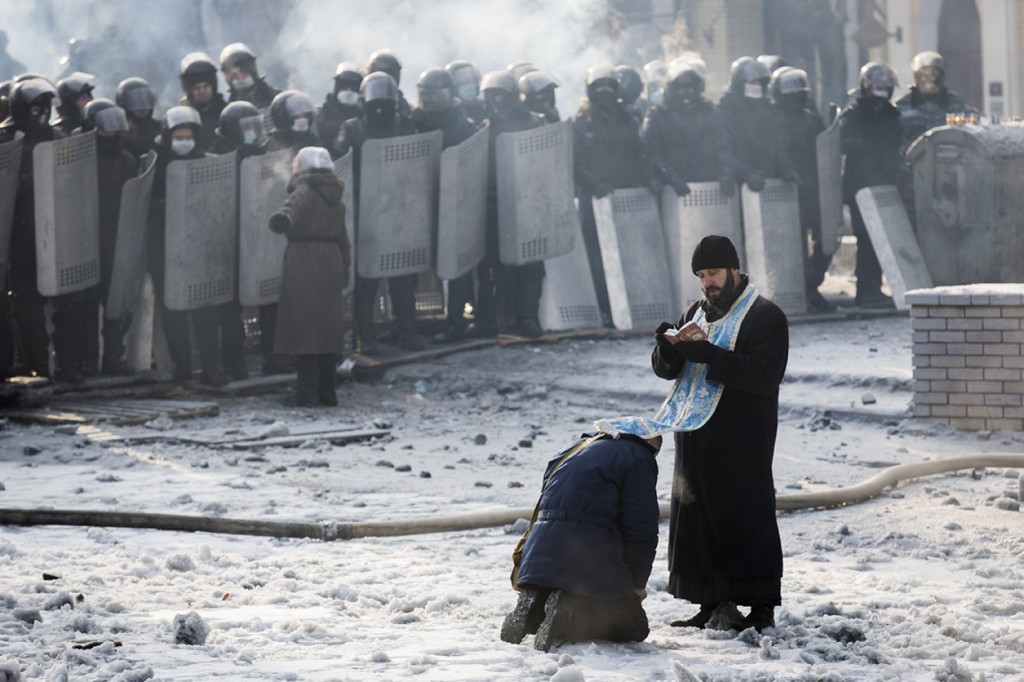
Just two years ago Ukrainian clergy of all Christian traditions bravely stood, unarmed, in the lines between unarmed protestors and the government-controlled, heavily armed henchmen sent by the former president to gun them down.
What about those men’s right to defend themselves? Why didn’t they arm themselves instead of being murdered in the streets by their own government?
Throughout history you will see that clergy– when acting in good faith– rarely arm themselves. Instead churches are places of sanctuary and refuge from the battles of the day. And you would be hard pressed to find clergy with concealed handguns in the pulpit while teaching the word of God!
Look, let’s say you forget the New Testament narrative. Let’s say you discard completely the historical role of the pastor. Let’s say that you’ve only got the teenagers in front of you to serve the best that you can figure out yourself.
Do the teenagers in your youth group need to see a person teaching them the bible or taking them on a mission trip with a handgun? How can you say “Put your life, future, and faith in Jesus” while showing them with your actions that you don’t? A teenager is wondering, “Is this stuff true? Can Jesus really transform my life, the way I think? Can Jesus give me a new life? Can he forgive my sins… like for real?” and the actions of the youth pastor who is standing there with a Bible on his phone and a gun on his hip seems to contradict the whole thing. “He doesn’t put his life in Jesus’ hands… look, he has a gun. He decides who lives and dies.”
So play it out. Let’s say that you’re playing Chubby Bunny with 30 teenagers and a man walks in with a gun. Is the only possible resolution to that scenario that the youth pastor pulls out a gun and kills that person in the youth room? The power of Christ is limited to bloodshed? I pray not. What happens if a teenager gets pissed off and runs into the youth room with a baseball bat or a knife? Is the youth pastor going to discharge his weapon at a teenager he’s been called by the church to minister to? I pray not.
Let’s pray not.
So why is the youth pastor carrying a gun in the first place? I can only guess at the reasoning.
When I saw the Facebook post this morning my heart sunk and my mind raced. I hurt for my tribe. Are we so insecure in our faith that we arm ourselves to go to work? At a church. A CHURCH!!!!
Surely, we don’t live in a country where a youth pastor is so fearful for his life that he arms himself while teaching the Word of God, do we?
And it made me wonder… Where are the Heroes?
Surely, someone can speak to the nonsense? Surely there is a voice that people respect enough to listen to and admit that their behavior does not reflect the position they hold nor the faith they profess.
Surely, someone can help a fellow minister of the Gospel understand that the Second Amendment of the United States is subservient to our God who holds power over government and nations? He is the author and finisher of life. He feeds the sparrows. Like our old preacher Ray Pritchard loved to say, “He is God and we are not.”
And yet…. Where are the voices pulling people aside to say that preaching while armed is wrong? Where are the steady voices reminding leaders that the power of Jesus is bigger, better, and more awesome than the perceived power you feel carrying a gun while teaching teenagers in a church?
My fear is that we’ve exchanged our heroes for Christian celebrities. A hero stands up for what’s right, says and does what needs to be done, and doesn’t worry about making people made. A celebrity? He offends no one. He protects his brand. He murmurs to his friends while saying nothing to his fans.
We need fewer celebrities and more heroes.
Where are the heroes?
Where?
I see none.
I am thankful for the youth pastors in my life who were heroes to me.
My first exposure to youth group came on an army base in Germany. Ironically, we met in a middle school about 100 yards from a firing range where helicopters and mortars and tanks regularly practiced their crafts of destruction.
Our volunteers were soldiers. And the students they ministered to had moms and dads who knew combat. Not the stuff you see on TV, they knew the real thing.
Did Dan arm himself? Of course not. He fears only God. He respects his role in lives too much. (Though, like myself, Dan doesn’t mind guns for sport or even target shooting.) I learned a lot from him about whom and what to fear. Even now, as we’re both a little older, Dan continues to teach me that lesson. Life has thrown him some pretty nasty curve balls but his hope, his future, and his day-to-day… they remain in Jesus.
We need heroes like Dan. I pray that each teenager who walks into a church gets the pleasure of learning from a man or woman like Dan, a hero of the faith, unconcerned about anything else but the primacy of the risen Christ, even his own life.