Category: Social Action

  • A new kind of missions trip

    I’ve been on a lot of missions trips. But never one that was three dimensional before.

    The three dimensions of the Haiti trip:

    1. Going and experiencing for myself.
    2. Using Twitter and Facebook to tell stories live, sharing pictures and videos with thousands around the world.
    3. Watching the experience change my friends while they participate in the trip from their living rooms, offices, and cars.

    Here’s how this scenario played out over and over again.

    We would load up the team van and head to a destination. Whether it was a meeting of pastors, a prayer meeting where thousands spontaneously had shown up, or walking around a devastated community and meeting people effected by the earthquake.

    All of a sudden, my iPhone became a powerful ministry tool.

    I would post on Twitter a simple message.

    And instantly, my friends were engaged in what we were doing.

    As free moments were available, often times while walking or driving from one place to another I was able to update my Facebook status or post a tweet so that people could continue to pray for what we were doing… and more importantly join in the story of what God was doing.

    It’s important to note that this wasn’t a distraction from what I was doing on the ground. I was deeply engaged in the moment. But as free we walked from one place to the next or as we drove, I was able to utilize that otherwise down time as ministry time. Doing these things didn’t distract, they amplified what we were doing.
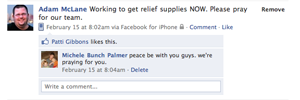

    Thanks to the power of Twitter retweets and hastags, there were now hundreds of people engaged in our ministry, watching every step of our journey. People gave us advice. Sent us links. Added our efforts to databases and websites. Encouraged us. On and on. This was missions far different from what is documented in Acts, when reports from missionaries trickled in from letters!
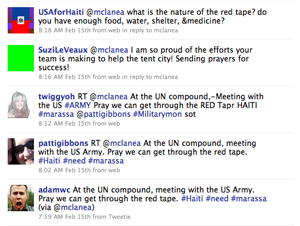
    As the need for more specific prayer arose, I was able to update these friends… who were now looking for ways to pray for our team.
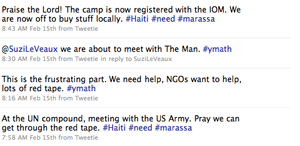
    Read the updates from bottom to top, in sequential order

    At this point in our day, I was in hog heaven. This was the convergence of all of my favorite things. I was engaged in social action as we advocated for people. I was engaged in social media as my cloud community prayed and sought solutions for the problems I was experiencing on the ground. And I was engaged as a pastor as we prayed and worked with people in the camp.

    And social media was also documenting a miracle. (and my getting punk’d by Marko!)
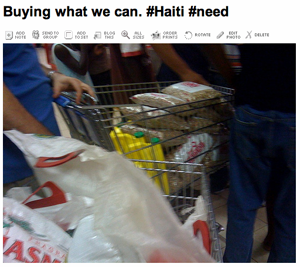
    Little did I know that the three dimensional missions we were doing had taken on legs of its own. My friend Tash was updating her radio audience in Auckland, New Zealand with my Twitter updates so people could pray. Tons of people retweeted and added commentary . Literally, people around the world were following this story and about to see God do something amazing.

    Using $2000 we had raised on Twitter the night before. We were able to go to the only supermarket in Port-au-Prince and buy nearly all of the rice, beans, and baby food they had. (The money was given one day, utilized the next!)
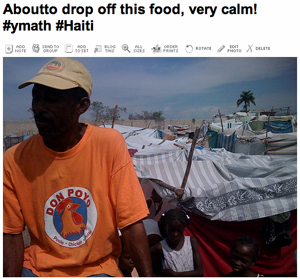
    While hundreds of people back home participated in our journey, we were able to continue pressing into what God was doing.
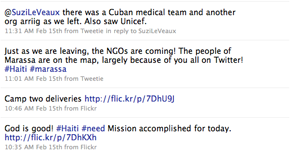
    I don’t think this is somehow the beginning of a new age of missions engagement, but I do know that for our team this was a powerful way to tell stories as we went and amplify/report on what God was doing.

    As a fellow youth worker, I know thousands feel compelled to respond to the humanitarian need in Haiti. But the concerns of safety and appropriateness will over-power the prompting of the Holy Spirit to take a team for most. (This is a faith issue, but that’s another blog post.)

    It’s my hope that this new variety of missions will embolden many more to pray for Haiti, give to NGOs doing good work on the ground, and go to Haiti to see for themselves what God is doing.

  • Affirm One Another in Christ

    We live in divided times. In particular, those of us who love Jesus are more divided than ever. A trip to the “church” section of the yellow pages or Google is heart-breaking.

    The church is polarized today.

    This is contrary, of course, to what the Bible teaches.

    There is neither Jew nor Greek, slave nor free, male nor female, for you are all one in Christ Jesus. Galatians 3:28

    If we contextualize that statement made by Paul to the church today that statement would read like this.

    There is no liberal or conservative, Baptist or Catholic, black church or Korean church, suburban or urban. For we are one in Christ.

    I pray that we lay aside or differences… as real and pressing as they seem… and live in the tension and knowledge that all people who call on the name of Jesus for salvation are one in Christ.

    It’s easy and childish to focus on what divides us, it is mature and difficult to instead embrace the common mission we share.

    Amen?

  • 5 Socially Conscious Christmas Gift Ideas

    The retail world is made or broken based on what happens the 6 weeks surrounding Christmas. The entire world may not bow at the throne of Jesus, but a made-up celebration of his birthday is the biggest fiscal holiday on the planet. Jesus declares his glory even through the mundane giving and receiving of presents at Christmas. You simply cannot deny it.

    But what if the world’s people started giving and receiving gifts that reflected the heart of the Gospel? Just like The Passion of the Christ radically transformed the movie industry… what if God’s people radically transformed the Christmas retail space by how they spent money?

    Here are five gift ideas that would change things if masses of people did them.

    1. Kiva gift certificates
    2. Purchase a Community Supported Agriculture membership
    3. Sponsor a child with Compassion International
    4. Donate to a socially progressive organization
    5. Hire a socially progressive speaker, author, or organization to come to your town

    You want to change the world? Let’s start with at least recognizing the connection between what we spend/support and where that money actually goes. Be good stewards. Be responsible. And the world will change to meet the needs of the worlds people.

    That is the heart of capitalism, right?

  • Confronting Segregation on Sunday Morning

    church-segregation

    Sunday morning’s sermon at Harbor stirred in me the desire for the church to be a place of reconciliation.

    Stephen reflected on Revelation 7:9-12 in which people of every tribe, tongue, and nation will worship Jesus on His throne in Heaven and asked us to consider if we would attempt to do the same on earth? We live in a melting pot commununity. Literally, within 5 miles of our church are people of many tribes, tongues, and nations. The question brought forth was, will we intentionally worship together as a community or will we allow a church culture to prevail which prefers to seperate on Sunday mornings along racial lines?

    I was reminded of this exchange, in 1963, between Martin Luther King and the one-time president of Western Michigan University, Mr. Miller:

    Miller: Don’t you feel that integration can only be started and realized in the Christian church, not in schools or by other means? This would be a means of seeing just who are true Christians.

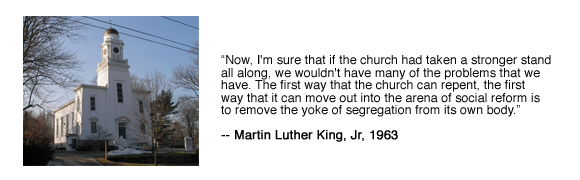
    King: As a preacher, I would certainly have to agree with this. I must admit that I have gone through those moments when I was greatly disappointed with the church and what it has done in this period of social change. We must face the fact that in America, the church is still the most segregated major institution in America. At 11:00 on Sunday morning when we stand and sing and Christ has no east or west, we stand at the most segregated hour in this nation. This is tragic. Nobody of honesty can overlook this. Now, I’m sure that if the church had taken a stronger stand all along, we wouldn’t have many of the problems that we have. The first way that the church can repent, the first way that it can move out into the arena of social reform is to remove the yoke of segregation from its own body. Now, I’m not saying that society must sit down and wait on a spiritual and moribund church as we’ve so often seen. I think it should have started in the church, but since it didn’t start in the church, our society needed to move on. The church, itself, will stand under the judgement of God. Now that the mistake of the past has been made, I think that the opportunity of the future is to really go out and to transform American society, and where else is there a better place than in the institution that should serve as the moral guardian of the community. The institution that should preach brotherhood and make it a reality within its own body.

    The truth is, 46 years later, not much has changed. Churches are still largely segregated in America. You could argue, as this CNN article points out, that we prefer our Sunday’s segregated.

    • There are major, separate, evangelical movements within the white, black, Hispanic, and Asian communities. There are relatively few places where those churches intersect. I will lovingly say that 5% of churches are truly mixed. But I am probably rounding up.
    • Within my own culture we tend to hold our personal preferences above all else. We are fine with other ethnicity coming to our churches so long as we don’t have to give up our style of worship or preaching. We hold our worship styles as canonical!
    • White males dominate the leadership landscape within American evangelicalism. Look at most conference line-ups or take a walk around a Christian bookstore or look at the top 20 Christian albums and you will see white male dominance. Are white males the only spiritual leaders? I don’t think so.
    • Open a phone book and you will likely see, in most communities, a white, black, Hispanic, and Asian version of the same church. 99% same doctrine, but we prefer to form different churches rather than deal with intentionally segregating. It’s not just a white church issue… it’s evangelicalism as a whole not dealing with this issue!

    Something about that is anti-Revelation 7, isn’t it?

    A few years ago I was at a leadership retreat in which we were asked to bring up our dreams for the congregation. The small Michigan town we lived in has a vibrant Hispanic population and a historic black community dating back to the Underground Railroad. I said that one of my dreams for the church was that there wouldn’t be three congregations in town separated by race (but not doctrine) but that we would figure our a way to have one church. I was laughed at and mocked for weeks. “We just aren’t ready for that.”

    And by “that” I suppose they meant dealing with their racist tendencies for the sake of the Gospel.

    In America, lines of segregation are alive and well. We all know it. People use their positions of power to invent new “legal” ways to segregate people all the time. But what are we willing to do about it?

    Want to see segregation alive and well in America? Head to a school board meeting when they talk about re-districting. Or head to a planning commision meeting when they talk about building an apartment complex. You will see the dominant culture take up arms so that “they” don’t allow “them” in their school or neighborhoods. Apply some nouns to those conversations and you are right back to Brown vs. Board of Education.

    It is amazing to me that no one I know would be upset– or even notice– if they worked with people of another race (or gender.) It wouldn’t even be an issue in the workplace. For the most part it wouldn’t be an issue in our own neighborhood.  Even in our own families race is not much of an issue. Six days per week our society has integrated. It’s not perfect but we’ve come a long way.

    And yet on Sunday morning… race (and gender) are major issues! This must change and we all know it. The question for leaders today is simply, “What are you going to do about it?”

    I am proud to call Stephen my pastor. He stood up on Sunday morning, not to cheerlead the efforts our church has made in the last two years, but to remind us that we have a long way to go. I hope the small successes we see at Harbor are just the beginning of a wider movement of reconciliation on Sunday mornings for the sake of the Gospel. First in our community, but also in America.

    Some questions:
    How do I need to be confronted on this issue. This is a “first me, than lead forward” deal.
    How does that reflect how I/we relate to Scripture?
    How does that limit the effectiveness of the Gospel in the community you/I live in?
    What are action items you/I will take to confront segregation in your/my church community?
  • Moody: It’s time to wake up

    Moody_Bible_Institute_logoI’m aghast at the reality that my alma mater continues to stray from its stated mission and goal. Here’s a quote from its website:


    Moody is driven by the belief that people committed to living and declaring the Word of God can actually change the world. Beginning with our founder, D.L. Moody, generations of Christ-followers at Moody have committed themselves to learning the Bible and sharing it with the world.

    This is a great goal. It’s a goal that brought me to Moody as a wide-eyed idealistic 18-year old kid. And it’s a goal that kept me going back despite every obstacle until graduation as a 25 year old. And yet, in 2009, they continue to want that statement to only be true for men.

    With hundreds of millions of people to reach for Jesus Christ today why does a place like Moody add to their doctrinal statement a position limiting who they will train to reach those people? Why limit their impact by 50%? Why water down the talent pool of candidates by 50%? If the goal is to train people for ministry… why make a value judgement to only train men for pastoral work? They are not a denomination. They are not a church. They are a training school who serves both. And plenty of alumni work in all types of churches, conservative and liberal alike.

    Two thoughts and a call to action for alumni:

    1. Moody offers a fantastic education. I am the leader I am today, largely, because of the men and women who invested in me on the undergraduate level. I know some people’s undergrad experience was lame, mine was not. Moody does not offer a wimpy undergrad. It does a pretty adequate job of preparing its graduates to serve in pastoral ministry without requiring a degree at the next level. It’s a unique place and I would love to continue to recommend it as a place to get training for ministry.

    2. Moody started as a school to train women for ministry in the local church. While the school bears a man’s name, it was started by a woman named Emma Dryer. Moody was one of the first colleges in Illinois to admit women. It’s first students were women. It wouldn’t have gotten started at all if it had been a place just to train men! Moody’s school was always progressive school when it came to women in ministry. But that changed! Somewhere along the way it became more important to please conservative donors than it was to simply prepare all who wanted the training for ministry. During my time as a student the undergrad school took a major academic swing towards the conservative right, ousting most of the Bible and theology department who encouraged students to think progressively, and issued a statement on women in ministry. (Roughly in 2000)

    Call to action for alumni: If you are like me, you love MBI but weary of the policy which limits who can study what, who can come to certain conferences, and who can serve where, based on gender alone. You need to do something about it. You need to email the new president, Paul Nyquist. You need to let their conferences know that you will not plan on attending until all are welcome to attend as a full attendee and not just a spouse who can come to parts. Let them know you will not send students their way until they deal with this. Ask them to take you off the mailing list soliciting donations until they address this. Blog about it. Talk about it on their alumni Facebook page. Call into Moody Radio and bring it up. Talk about it with staff and employees that you know. Moody does a pretty good job keeping this policy under wraps. If we want it to change we need to let the public know that the policy exists and that a minority of alumni would like to see the school open its doors to men and women alike for all majors.

    Make them live out this statement, “Moody is driven by the belief that people committed to living and declaring the Word of God can actually change the world.” There is too much work to do just to rely on training 50% of the population. To make this vision a reality, it’ll take everybody.

    Agree with me? Disagree with me? I welcome all feedback.

  • War is Over?

    If you are involved, celebrate how much has been accomplished and let’s look forward to 2009! If you’re not involved in bringing justice, mercy, and peace to the world make 2009 the time when you will get off your butt and do something.

    Learn how you can get involved with Invisible Children.

  • Christmas in the City

    Yesterday our church hosted an event called Christmas in the City. It was one of the most unique expressions of God’s love I’ve ever witnessed.

    We are an unashamedly urban ministry. Situated in City Heights, a diverse working poor community, we reach out to the neighborhood in ways that just wouldn’t work in the suburbs. This is a great example.

    How it works

    The organization that actually presents Christmas in the City [er, I forgot what it’s called!] encourages church, schools, and businesses to give toys in a way that is very similar to Toys for Tots or Operation Christmas Child. Additionally, previous year’s proceeds go to purchase more toys.

    On the day of the event volunteers from all over come to to create a store, checkout areas, and wrapping stations for the presents. Additionally, our church set-up some play areas, snacks, live music and activities for shoppers and their kids to enjoy while parents shopped.

    This is where the line comes in. Since they’ve done this event for a few years people in the city know and depend on the sale to buy gifts for their kids. So think of this line a lot like a Black Friday line. People literally showed up at 7:00 AM for this event… which started at 12:30 PM. Thankfully, this was more civilized than a typically line at Wal*Mart.

    When the store opens, gifts are sold at 10-20% of retail prices. ($2, $5, or $10) The idea behind Christmas in the City is that they don’t just want to hand parents a random gift to give to their children for free. While that is nice and many organizations do that, this is different in that they allow parents to choose some gifts for each of their children and also give them the ability to buy presents for their kids. The hope is that by doing it this way they can help the working poor while helping the recipents maintain their pride and dignity. They chose the gift. They bought it with their own money.

    How did it go?

    I had read about this type of event in community development books. So I had some idea that there would be a big line, that there would be a lot of toys, that there would be a lot of smiles.

    I guess I wasn’t prepared for the volume. On a typical Sunday our church has 150-200 attendees. (About half non-English speaking, the other half English speaking.) There were at least that many who were in line to come to the Christmas shop. Tons of different ethnic background, tons of different stories, tons of people helped.

    Another thing I wasn’t prepared for was that we’d have to turn people away. I know the need is great out there… but I never presumed that we wouldn’t have enough gifts for those who would come. We could have easily sold twice as much stuff! Now that I know how it goes I think I’ll have to do a better job promoting how people can get involved.

    I’m still getting the pictures and video together. I will share that when I have it all ready.

  • My Olympic Rant

    Beijing Olympics

    So the Olympics are over. A little over 2 weeks ago the world watched the fabulous spectacle that was the opening ceremonies. Then for 16 days the nation was captivated while new stars were born and China sold itself to the world as the new mecca.

    At the same time there was a large group of people uncomfortable with the Olympic spectacle. For me, these thoughts ran rampant through my mind as I tried to watch the closing ceremonies:

    – China is not a free nation. No freedom of speech, freedom of press, or freedom of movement. 

    – China is among the worst human rights violators. There is no doubt that thousands of people were rounded up and imprisoned for the games. I don’t think I heard NBC talking about China’s one child policy, did you? False imprisonment? The fact that the United States #1 religion is illegal in China. Did you hear that?

    – China has a labor problem. I couldn’t watch the opening/closing ceremonies without thinking about child labor, slave labor, and human trafficking. 

    – China is not a nation of middle class. There are extreme rich and extreme poor. Watching them drop $40 billion on the games… an injustice.

    NBC OlympicAnd I was disappointed to see NBC be a party to all of this. The story in China is not Michael Phelps or the basketball team, volleyball team, gymnastics success or relay team failure. To see NBC Sports play along and not mention it shows that they are more interested in corporate profits than covering the story. It’s pathetic to me that now, once the games are over, they are talking about how they were censored and how they observed things. 

    The American people needed a chance to see for themselves what is happening. And instead of C-SPAN we got The Disney Channel.