
Tag: capitalism

  • I live in SoCal, not Cali

    Welcome to California
    Photo by Kristina Sohappy via Flickr (Creative Commons)

    People are generally excited to come to Southern California.

    It’s a very cool place for our family to get to live! It is somewhere we never aspired to live but are completely enjoying.

    But I have to admit that I cringe a little when I see folks I follow on Twitter or friends on Facebook say, “I’m going to Cali.

    See, most people who live here don’t refer to where they live as “Cali.

    We aren’t offended by it. It just automatically self-identifies you as a visitor.

    Understand that California is a big state. VERY BIG. Venti. And extremely diverse geographically, regionally, in population, and culturally. On a perfect day it’d take you 13 hours to drive from Imperial Beach to Yreka along Interstate 5. (aka “the 5”) Just in San Diego County alone there are a bunch of different climates. Ocean beaches, mountain tops, arid desserts… palm trees and citrus trees to apple and peach trees; surfer to rancher.

    To smash the whole state into a phrase like, “I’m going to Cali” just doesn’t feel right to us.

    So what do I say?

    To generalize it, you can say you are going to NorCal or SoCal even though there is no official dividing line. When we lived in Northern California there was always conversations that the North should separate from the South… that’s how different they are!

    It’s perfectly acceptable to say, “I’m going to Southern California.” So don’t feel like you have to shorten it. But if you want to, it’s SoCal.

    Better yet, you can regionalize it by saying you are going to San Diego, LA, the Central Valley, Tahoe, or the Bay Area. Headed somewhere a bit more rural? Some people describe their travels by saying what county they are headed to.

    But few of our 37 million residents will post on their Facebook page, “I’m headed back to Cali tomorrow.” Just like you wouldn’t see someone say, “I’m headed back to Ala tomorrow.” Or, “Can’t wait to fly how to Wisc.

    At the same time. If you are coming as a tourist you can call us whatever you’d like as long as you leave some of your money here.

    Because primarily– you can call us capitalists.
  • Why would giving more offerings to the poor change the community?

    Yesterday, I received this comment on the post The Goal of the Staffless Church. I think that the comment is representative of a lot of people’s opinions, and I wanted to report the comment as well my response for the purpose of discussion.

    Pete’s comment:

    I get what you’re saying and where you’re coming from, but I feel like you’re ignoring the cultural differences between AD 2010 America and AD 35 Rome. Sure we can devote 90% of our offerings to the hungry and poor, but that has not had any success when we devoted 20% to it, why would it change now? Plenty of churches offer plenty of services to those in need. It rarely results in anything resembling conversion and is usually simply a faith-based form of socialism. I’m not saying we shouldn’t so those things and indeed, we do far too little of it. but if our motivation is evangelism and growth, as opposed to loving others and obeying God, then we’re missing the boat.

    And in an age where church volunteering is at an all-time low, the idea that churches should ask ministers to do as much as they do AND hold down a full-time job seems a little off base.

    The problem, in my opinion, is that the theology of the modern church is very similar to that of the Pharisees of Jesus’ time. They mean well, but focus on avoiding “dirty” people, doing “good, Christian” things and and are highly judgmental and inbred. Most of the church’s functions today are focused on the congregations and not those who don’t know Jesus. We’ve created a whole new type of Gentile. We spend far too much time and money on conventions, retreats and Christian concerts, books and seminars. We can get 100 people for a special Christmas Eve service but only 5 for an evangelism class. We’ll pay 300 dollars and travel hundreds of miles for a weekend of listening to our favorite authors talk about how to be happy people, but barely drop a 20 for missions.

    And the answer is to refocus and look outwards to those who need God, accept them without judgment and lead them to God’s love–much like Jesus did when faced with a similarly minded Jewish community.

    Adam’s response:

    We’re not too far apart here. I agree with you about theology. My contention is that most churches don’t practice monothesis worship of God, they practice a form of animism. They feed the god of fear with their teaching dependency. They placate the god of safety by reshaping the Bible about the individual. And they lay it all on the alter of the god of church growth.

    Honestly, if all churches in America gave away 20% of their offerings to the poor… we’d live in a country that looked much different.

    I think your wrong about the connection between volunteerism and busy pastors. My contention is exactly the opposite. If the pastor refused to do ALL of that stuff he/she is doing, it’d either force people to step up… or the church would stop doing those things.

    And just a reminder, the early church describes socialism. Capitalism is not a Christian value. It is a perversion of the New Testament’s view of possessions, personal value, and money. Aspirations of a capitalistic/Christian society is a syncretism with Western culture.

    Your thoughts?

  • 5 Socially Conscious Christmas Gift Ideas

    The retail world is made or broken based on what happens the 6 weeks surrounding Christmas. The entire world may not bow at the throne of Jesus, but a made-up celebration of his birthday is the biggest fiscal holiday on the planet. Jesus declares his glory even through the mundane giving and receiving of presents at Christmas. You simply cannot deny it.

    But what if the world’s people started giving and receiving gifts that reflected the heart of the Gospel? Just like The Passion of the Christ radically transformed the movie industry… what if God’s people radically transformed the Christmas retail space by how they spent money?

    Here are five gift ideas that would change things if masses of people did them.

    1. Kiva gift certificates
    2. Purchase a Community Supported Agriculture membership
    3. Sponsor a child with Compassion International
    4. Donate to a socially progressive organization
    5. Hire a socially progressive speaker, author, or organization to come to your town

    You want to change the world? Let’s start with at least recognizing the connection between what we spend/support and where that money actually goes. Be good stewards. Be responsible. And the world will change to meet the needs of the worlds people.

    That is the heart of capitalism, right?

  • Open System Health Care

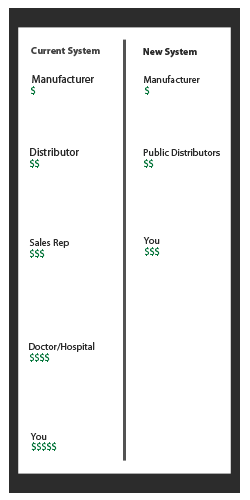
    new-medical-distribution-systemI don’t know about you, but I’m growing a little tired of the lack of progress and new ideas coming forth for health care reform. I wonder if instead of making private citizens scream at their elected officials we could get those causing the problem to scream, instead? Here’s how.

    Instead of reforming health insurance (which is what we mean today by “health care reform“) what if we reform the industries at the root of the problem? What if the government opens up distribution channels to the raw supplies so you can buy the stuff you need on the open market?

    Let’s say you need a new knee. The doctor says, “I could buy the part and it’ll cost you $2500 or here are the specs on what you need, you may be able to find the exact same part cheaper.” (Take away the fancy titles, this is not unlike going to get a new muffler!) The doctor gives you the specs for the item you need, and you go to Amazon.com and price the part you need for the operation. Amazon.com works directly with the manufacturer in Warsaw, Indiana to carry the most commor specs and carries them in stock. Based on the laws of supply and demand, you are able to go to Amazon.com and buy the exact part you need for $800. A week later it is delivered to your house and you take it with you to your surgery.

    Same thing works for medical equipment. The current system will not allow you to go to Walmart.com to rent a wheel chair that you need after your surgery. Instead, your doctor calls the local medical equipment distributor and they rent you a wheel chair for $500 that they’ve rented 25 times already but paid $322 for from the sales rep. Under the new system, since you can now work directly with the manufacturer, you go to their website and buy the thing for $280 or you go to Craigslist and pick one up for $50.

    Naysayers will toss out this right away… “what about drugs? You can’t open up the drug market!” You actually can open this up as well. Your doctor could provide you with a unique code which grants you a certain prescribed drug. You make that purchase online and cut out the middle man, it’s delivered to your door. For drugs that are abused, have it delivered to the doctors office. Since the office won’t be meeting with endless drug reps and DMEs they should have plenty of time to sign for stuff from FedEx.

    This really isn’t that complicated. It just opens the system up. Currently, everything you have delivered to you in the health care system is based on a closed distribution model. You have no ability to determine what the manufacturer made the item for, what the mark up was when they sold it to the distributor, what the sales rep made when he sold it to the hospital, nor what the hospital paid for the item. You only know what they are charging you for on the itemized bill. And you know that it is all negotiable because that’s what Medicaire, insurance companies, and private individuals do. So you may see that the hospital billed $5500 for the replacement knee but because it’s a closed system you have no way of knowing that the manufacturer in Indiana made it (at a profit to themselves) for $600. Consequently, the closed system is bloated with mark-up. It’s a closed capitalist system.

    We’ve done this same thing in almost every industry. Why not do this to health care?