Tag: church growth

  • Inhibitions to the spread of the Gospel in your community

    The church is decreasing in America while our population continues to expand. One major factor contributing to this decline is how Christians think about themselves and their community of faith in the greater community in which they interact. This “self-talk” internally acts as a mental inhibition towards the innovation and creativity we need to reach lost people with the good news of Jesus Christ.

    Here’s some examples of inhibitions:

    • There’s nothing new under the sun. Really? I hear this dismissive tone nearly every time a new idea is floated. While there are certainly many, many who just redress the same pig and expect a different award at the fair– there are also tons of brand new ideas out there. In fact, the rate at which new information about our world is gathered, disseminated, and implemented continues to accelerate. There are actually new things discovered under the sun every second of every day.
    • People aren’t interested in Jesus. To the contrary every study reveals a wide gap between those claiming Christ and those actively involved in fellowship with other believers. While the gap changes based on the studies you read, let’s ballpark it at 20% of the United States population. That’s 61.4 million people in America who are walking around identifying themselves with Christ but are disconnected from the Christian community. When Jesus said the fields are white for the harvest he wasn’t kidding. Literally, 1:5 people you will meet today already call themselves a Christian but just need to get connected. (John 4:35)
    • I am not an evangelist. Good! People desperately need community. And people with microphones selling Jesus scare almost everyone. The good news is that the Holy Spirit is the best evangelist ever. Your job isn’t to tell every person about Jesus and ask them to receive Christ. Jesus said the two most important things you can do are to love your neighbor as yourself and love God with all your heart, soul, and mind. (Matthew 22:33-35) Anyone can do that, right?
    • I’m not a pastor. Cool, neither was Jesus. He was a carpenter and a lay teacher– A blue collar regular guy like you or I who went to work every day. He didn’t have a church to invite people to. If the last 50 years of church decline have taught us anything it’s that the “If you build it, they will come” strategy can’t reach an additional 20% of a growing population. We can’t build fast enough.
    • People don’t want to come to church with me. Who said they need to go to church? Giving your heart to Jesus and finding community with other believers doesn’t mean people have to join a church. You can form a community of believers who hate church right in your house. Who knows? As they discover that you aren’t a tool, maybe they’ll want to be a part of church later? And maybe that group of church haters in your house will grow… and become a church?

    What are other inhibitions, mental blocks, that are impacting the spread of the Gospel in your community?

  • Moving towards the polite middle

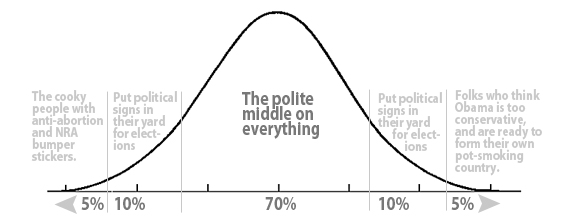
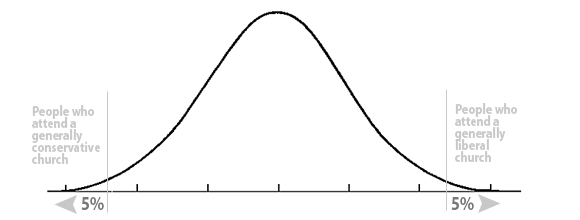
    As I think about the church and the 5%-10% of people we reach in the community I wonder where we fall on the bell curve.

    Something tells me that it looks a little like this.

    I wonder if the positions we take attracts, appeals to, and connects a certain type of people? And I wonder if church leaders are going for the sucker pin of thinking of going more conservative (politically/socially/by American cultural definitions) or more liberal is going to lead to growth in their congregation? However, this is counter to what we know about behavior from the bell curve. This just means that to attract more people “like us” we need to have a wider reach and draw people from a larger and larger geographic area.

    Sidebar: Now, immediately I have some people who will read this upset because they don’t really like my labels. And they especially don’t like that I’ve lumped nearly all churches into two categories. And some are going to be quick to point out ways that their church is neither liberal nor conservative. That’s OK. This is just some generalization and hyperbole to make a point.

    Here’s my neighborhood on the bell curve. Again, full of hyperbole and generality.

    Our neighborhood is not unlike any other urban or suburban neighborhood I’ve lived in. We have our cooky people on the fringes, we have our people who are just a little bit political, but who will quickly drop it for the sake of community… and we have the vast majority of people who probably have some personal opinions but just want the neighborhood to be a nice place to live, are willing to politely disagree on some stuff, and otherwise would rather be defined by their neighborliness than their political leanings.

    Think strategically church leader!

    Instead of trying to out-conservative or out-liberal ourselves, where we will find decreasing populations and have to incur the expense of widening our reach, the reality is that reaching the majority of the population will come as we lay aside our ideals and move towards the middle.

    As Stephen Phelan, my pastor, put it yesterday– The two extremes will come together when we focus on a common mission. For instance, if we focus on feeding and housing the poor, both extremes agree that we should do it for their own ideologies, and people in the middle are just happy to participate in something cool. The happy middle will agree to be a part of it because everyone knows it’s good to take care of the poor in your community.

    For example. I’m an egalitarian. I would love to see more women in the pulpit. And I’ve turned down positions on boards that were all male with the exception that I’d join the board if they moved towards 50% board membership by females. But I go, love, and support a church in my neighborhood that is PCA. (Which doesn’t allow women to preach or hold pastoral roles.) How do I deal with that contradiction between what I believe the Bible teaches about women and the church I attend? It’s easy… I’m in love with the mission of our church! Just like we overlook the flaws of our spouse because of our love, so I overlook this disagreement because of my love for the church. While I disagree with that one position, I am in full agreement with their strategy to reach our community and I love the staff as brothers and sisters in Christ. That over-powers my personal preferences.

    How to reach more people

    If you want to grow, from a population standpoint, you need to better represent your zip code and move to the middle. To do  this, you’ll need to take a sober judgement of your congregation. Walk around the place with centrist eyes. Ask yourself, “What is in this building that could be offensive to the general population? What would make people feel uncomfortable? What would make them feel like they didn’t fit in?

    Over the past few months people have approached me and said that I present both radical and simple ideas… that their church would never go for. The reality is this: Move to the middle to find growth and those naysayer voices will be overcome by the reality of your strategy. Focus on what we all know to be true… Jesus called the church to be good news to the neighborhood. It’s a centrist position that only feels extreme to people on the extremes scared to be pulled towards the middle!

    To move towards the middle you may need to realize that your leadership might just be on the leading edge one way or the other. That doesn’t mean that they can’t hold those positions. But it might mean that they can’t represent those personal convictions on behalf of the church.

  • Pastor as Vocation

    Confession: I do as much or more pastoral ministry now than I did when I worked in a church.

    That is no knock on my friends in full-time vocational ministry.

    It is more an affirmation for the myriad of people I know who have stepped out (or been pushed out) of their ministry job.

    Leaving vocational ministry in a church for the great unknown is an identity crisis. These friends are left asking themselves, “Am I still a pastor?

    I went through the same thing 2 years ago. You are OK. You are still very much a pastor, even if your paycheck doesn’t come from a church.

    I’m here to tell you this simple truth: When you are a pastor you are a pastor wherever you go. It’s a calling and not a vocation.

    My reality

    I opened this by saying that I do as much or more pastoral ministry now than I did while I worked at churches. So what does that look like?

    • Removed of the stigma of “going to talk to my pastor” I give a great amount of pastoral counsel. Instead of people coming to my office for that we meet at coffee shops, my house, and even bars. (Gasp!)
    • I love teaching at youth group. I don’t do it often enough to get into a groove… which keeps it from feeling like a grind.
    • I totally miss filling the pulpit. At the same time I’ve learned that I probably preach too much and act too little. I have a lot more time to do ministry rather than prepare a message.
    • We’ve rediscovered authentic relationships. When you work at a church your life is full of people who claim to be your friends– but it’s a positional thing. When you are a nobody in your congregation you have to develop friendships the old fashioned way. Better yet: When the positional ones come along you don’t feel obligated.
    • I’m ministering to people in my life that are a part of my neighborhood, work life, adult small group, and students in my youth group.
    • Straight talk, no B.S. (Stealing a line from a politician) That’s kind of how it feels. Free from the weirdness of people probing and constantly feeling like I’m answering every question on behalf of the church, I can just let it fly. Want to know what I think or what the Bible says? I don’t need a “church filter” anymore.

    Conversely, when I was a vocational pastor I was constantly thinking to myself, “This is it? I rarely spend time with people. All I do is run programs. I want to be with people and do ministry!

    Interesting how freedom from the work of running a church has lead me to doing more pastoral ministry, right?

    A global perspective for the naysayers

    My fellow Americans, live in an ethnocentric culture. And American church culture is even more insular than American culture. Those of us who are in that culture have a very hard time seeing outside of it. So when I say things like “It’s a calling and not a vocation” most people in the church have no frame of reference. So while we’ve tied the concept of “I’m a pastor” with “I get paid to work at a church” we really get messed up when we no longer work for a church.

    Two things to chew on…

    Within Christianity: Outside of major Westernized countries almost no one who is a pastor does so vocationally. (Bi-vocational is the norm) In fact, the fastest spreading Christianity is spreading is absent of vocational staff and mostly without resources like buildings, Bibles, Bible study materials, etc. I’ve been pointing out the inverse relationship between church growth and church spending for months… but no one is lining up to cut their church budget/staff to see their church grow.

    Other religions: Outside of the Christian church most religions are run by either volunteers or people who have taken vows of poverty, sustained only by the meager donations of people in their care. The Latter-day Saints are an excellent example of this. Very few people get paid within the Mormon church and yet it is one of the fastest growing religions in the world.

  • 5 Excuses For a Lack of Church Growth

    Photo by Mr. Tom Lillis IV via Flickr (Creative Commons)

    Here are things that I hear people use as growth limiters when they talk about the vision and day-to-day action of reaching a community with the Gospel.

    1. Budgets – I would do x, y, or z if I had more. More often people talk about too much money in the church being allocated for one ministry while the thing they think will really reach people is under-funded.
    2. Buildings – Either a ministry has too much building so they need to have programs that justify the building or a ministry has not enough/no building and they use that as an excuse to not do something.
    3. Boards – The board is asking too many questions. Or the board doesn’t care. Or the board cares about the wrong things. Or the board doesn’t support your vision.
    4. Butts – We don’t have enough people. Or, more likely, we don’t have the right people. Or maybe too many of the wrong people. But I never hear someone complain of having too many people, in general.
    5. Boundaries – Some congregations are limited by physical boundaries while others are limited because they have no boundaries.

    All of these are just excuses.

    All of these imply that the spread of the Gospel in your community is somehow tied to the growth of your fiefdom.

    All of these are just as much asset as they are liability.

    All of these imply that church growth is about the organization and not the individuals leaning into their walk with Jesus.

    All of these imply that its our job to grow the church and lead people to Jesus and not the other way around.

    This I know to be true.

    When you love your neighbors, when you meet practical needs, when you speak the truth in love, and when you lay aside your aspirations for the aspirations God has for your community… nothing can stop the spread of the Gospel message. It is too powerful.

  • What does the Easter Mayhem teach us?

    Several weeks have now passed since Easter. My hope is that by now, church leaders are scratching their heads and wondering if it was all worth it.

    Easter mayhem?

    A lot, LOT, of churches consider Easter to be a day for growth. For church marketing types, it is Super Bowl Sunday. With the highest attendance of the year the attitude seems to be “Since lots of people are coming let’s do something awesome and maybe those visitors will come back!

    And boy do churches go all out. They alter the schedule. They plan a special service. The kids ministry is amped up. There are meetings about the big day. There is a special marketing plan for the day. There are mailers and prizes and flowers and bands and rehearsals and... then it’s over.

    Somehow in the middle of this we try to be somber and remember that Our Lord was crucified and three days later resurrected! But the truth is that staff at those churches are hyped up on adrenaline and hope that this is the year that they will reach a new attendance record.

    Easter mayhem is the 2000s version of Vacation Bible School which was the 1980s version of Sunday School

    I don’t know how it all got started. But somehow Easter went from a holiday we solemnly celebrated to a day where people can win a car for showing up to church.

    Easter, in some churches, has become less a religious holiday and more a church growth opportunity.

    Easter is the highest attended weekend of the year in most churches. But the weekend after Easter is one of the lowest attended weekends of the year. Followed by the month of May– where church attendance and program enthusiasm typically murmurs out as the school year comes to an end.

    What’s the point?

    The point is exactly my point. While attendance is typically at an all-time high engagement is at an all-time low.

    And when you look at the return on that investment– Easter mayhem is as effective at reaching people as Vacation Bible School. There may be a whole lot of people there for the event, but does it translate to long-term attendees?

    Not in my experience.

    What translates to long-term attendees?

    Neighbors loving neighbors. Finding a community where you belong. Community service. And other things that aren’t as sexy as giving people a car on Easter Sunday or shaving a pastors head on the last day of VBS.

  • The Goal of the Staffless Church

    DSC_0027

    Which came first? The staff who ran the programs or the programs which required the hiring of staff?

    No offense to my friends who work at churches– but I wonder if their goal is to secure a job for life or to work themselves out of a job as quickly as possible?

    When I read church growth strategy books and articles I’m always amazed that they only talk about getting larger budgets, larger buildings, and larger staffs. Never mind that it’s a horrible strategy. Most think tanks only think about one strategy… how to get bigger. The idea of getting more efficient is ludicrous.

    When I read about the church of the first 100 years after Jesus I see a church growth strategy of “get in, train people up, and get out as fast as possible.

    Here’s a centuries old tried and tested church growth strategy we have rejected: With no staff your church will grow.

    The “if you build it they will come model” of the last 50 or so years has lead to utter devastation of the church. Numbers are down big time. Sure, you can point examples of big churches. And no doubt people will leave comments saying how awesome their programs are. But the percentage of Americans regularly involved in the local church has declined sharply in the current multi-staff model.

    The fact remains that a church with less staff will be forced to be the church more than a church with programs where people show up and everything is done for them. This “worked” for thousands of years. What we are doing now isn’t working and we all know it.

    At some point someone decided that everyone needed to be on staff at the church. So we hired a music pastor. A worship pastor. A youth pastor. A children’s pastor. An associate pastor. An administrative pastor. A senior ministry pastor. And all of that staff required administrative support. Oh- and they’ll need offices and space– so we’ll need a bigger building.

    If I put my businessman’s glasses on I examine this trend and say: You’ve added a lot of overhead. Your business multiplied by 25 times, right?

    Wrong. The strategy didn’t work. But now we have an entire industry of church workers in an environment where they are reaching fewer and fewer people with bigger, more expensive programs. Now we’ve created an entitlement that simply isn’t sustainable nor is it leading to the growth long ago predicted.

    It’s almost too easy for me to point to examples of this in other countries. (We certainly saw this in Haiti.) But it’s also true among the exploding Latino and African-American churches in the United States. With almost no infrastructure they reach thousands. In your own community it is likely that there is a church kicking butt with nearly no overhead of staff or a building.

    I’m well aware of the biblical justifications that church staff deserve to make an income. Yes, I’ve used that myself. I’m not arguing that you have a right to claim that to be true. I’m merely questioning the strategy and inviting you to recognize that this strategy has seemingly paralyzed the church.

    Even those who bring up the Pauline argument for getting paid in ministry often neglect to mention that Paul also didn’t implement this strategy in all the places he ministered. Nor did he ever buy a house and start a family.

    Some questions to get you thinking

    • Where does the offering at your church go?
    • Where did the funds in Acts go?
    • How much has your church grown in the last 10-30-50 years using the current staff-heavy strategy?
    • What would it look like if say… 90% of that offering were given away in your community to feed the poor, care for the sick, take in orphans, protect widows, on and on?
    • Don’t you think that would be good news to the neighborhood?

    What I’m not saying

    • The church is wrong to have staff
    • The church should fire staff
    • All of my friends who do associate level ministry are bad/dumb/hurting the ministry of the church in their community
    • My own church is bad, filled with money hungry punks who make fat salaries. (Um, they all raise their own support!)

    What I am saying

    • A church as effective as the Book of Acts is possible today.
    • Churches should ask hard questions about meeting the needs of their community.
    • A lot of church growth strategies are really “church growth industry” growth strategies.
    • Church leaders should challenge their assumptions of what they know vs. what they know to be true in Scripture.
    • It is possible for the local church to reach 90%+ people in your community.
    • We should not be satisfied to “pay the bills” and reach 5-10% of our community.

    Wake up, O sleeper,
    rise from the dead,
    and Christ will shine on you.
    Ephesians 5:14

  • 3 Lies of Church Growth Experts

    Right now there are a lot of people making a lot of money telling churches how they can grow. Along the same lines, there are a lot of church boards and pastors wasting a lot of time discussing church growth strategy.

    An observation. Have you noticed that churches that want to grow (100 to 1000 people) flock to churches that grew 10, 20, or 30 years ago but have since plateaued? It’s like asking Bill Gates, “How do you start a software company?” Bill wouldn’t have a clue! When he wants to start a software company he buys one! In the same way, asking a church of 10,000 how to grow is a waste of time because they knew how to do it in their town 10, 20, or 30 years ago but haven’t a clue how to do it today in your town!

    So let me save your church some time and money. Here are 3 guaranteed ways NOT to grow a church. There must be 20 conferences, 50 books, and 100 consultants based on these three lies. 

    #1 You have to have a great ____ ministry. This lie has been out there forever. A church with a great van ministry that’s really reaching people will one day go, “Hey… let’s start teaching people how to start a van ministry so they can copy us!” Same thing with student ministry, kids ministry, music ministry, puppet ministry, after school ministry, seniors ministry, etc. None of these programs will grow your church! It’s just a marketing lie to think that you can grow a church by having a great program. Having great programs is vitally important to the mission of any church (reaching and discipling people) but there isn’t a program out there that will grow a church from 300 to 1000 people! If you see a conference, book, or consultant who tells you “If you just have ____ you’ll see the growth you are looking for” just know that you’re being sold an idea that worked in one location and won’t work in yours. The best consultants will look deeply into your organization before recommending anything!

    #2 If You Build it They Will Come Building stuff and remodeling stuff is highly addictive. But buildings and environments don’t grow churches. I’ve been to some real dumps that were exploding in growth. And I’ve been to some beautiful buildings that were empty. Have you ever been to Europe? There you can visit some of the best looking church buildings in the world, they are mostly empty on Sunday mornings. As a 16 year old I toured the Cathedral in Strasbourg France. Completed in 1439 the cathedral is amazing in its beauty. It was the tallest building in the world from 1647 to 1874. Talk about a city on a hill! Want to know how many people go there now? None.

    A ministry will endure when it focuses on its task at hand way more than its location. Location means squat. (Just ask the Chinese!)

    If someone is telling you that a new building or a new _____ will grow your church, they are either deceived or trying to sell you something. Take a tour of some of the fastest growing churches in the United States and you won’t be overly impressed with architecture, ornate decoration, or interior design. What’s on fire in those places is not the building!

    #3 “You have to be more focused on reaching people than keeping people.” This is just ignorant marketing! It’s even worse pastoring.

    The best thing you can do to grow a church is to lead, grow, and love the people in your church. If they are growing, being lead  to deeper expressions of their faith, and feeling loved by the people of the church, they will tell their friends. That makes sense along every front a church looking to grow. Marketing, strategy, leadership. 

    The only church growth advice that I’ve ever heard that is truly a guarantee is “All healthy organisms grow.” That is dead on. If only the folks looking to grow their churches would focus on getting the church they have today healthy, it would grow. But to take an unhealthy church and try to grow it with a new building or a new program or a new focus is just silly. 

    Q for Church leaders: What do you think? Do you think I’ve captured 3 lies in church growth? Or do you think those experts out there really have something that can help you grow your church?