Tag: engagement

  • Competitive Advantage

    This clip from Tin Cup highlights the differences between an amateur and a tour professional. 

    Whether you are a casual golfer or a week-to-week preacher in a church. You and the guy on tour are fundamentally different in how you approach your craft.

    What you do is similar! But how you approach it and how it’s carried out are completely different.

    As the movie shows, the tour pro takes calculated risks, repeating the same simple winning swing over and over again, week-to-week, tour stop to tour stop.

    Whereas the casual golfer, even the aspiring professional, has to take greater risks to see lesser rewards, often swinging wildly and taking big risks in hopes that it’ll pay off.

    Having been around PGA and Champions Tour players as a tour volunteer I know that there are a lot of differences between their game and your game. 

    • They will hit +/- 1000 practice balls per day. (Driving range, sand, putting green, chipping)
    • They are surrounded by people who advise them on their game all the time. (People who know what they’re talking about, too.)
    • They only play on courses at the top of their condition. The greenskeeper at a Tour stop builds his whole growth cycle around that week.
    • They have a caddy with them who does all of the math and can tell them exact distances and best approaches to every shot on the golf course.
    • The TV cameras only show the best players on shots that have been edited. Each minute during a tournament 40-50 players take a swing, you only see the best of the best.

    I’m a 12 handicapper on my own. But I guarantee you that if you put me on that stage, in those conditions, with that practice… I’d look a whole lot better than I do normally. Give me a week with those set of circumstances and I’d break 80.

    It’s not that they don’t have skill or talent. It’s that their skill has been put on display in the best possible conditions for them to look good. (They would argue that they rose to this spot just like everyone else. Sure, they take advantage today. But they got to that point with nothing but hard work and rising through the amateur, college, and mini-tour ranks. Fair enough.)

    It’s that the game they play is similar, but completely different from the game I play with my friends. It’s set up for them to look good.

    What’s my point?

    A lot of times we go to a conference, camp, retreat, or a convention and we see a tour pro on their best day, in the best conditions, absolutely NAIL a talk. And we walk away thinking… “Why do I even bother?!? I’ll never be that good. Why not just buy that dude’s DVDs and play them at my church each week?

    But before you get upset or lament realize this: The talk you’ve just heard has likely been delivered dozens of times. It’s been critically reviewed by an inner circle. It’s been refined, they know when to drop what line, they know how to adapt it to your setting. They have only booked themselves at events they know they’ll play well to. The lighting, sound, and environmental conditions are tailored to their strengths and weaknesses. A professional band set them up. Someone else introduced them. At best, their talk has 1-2 calculated moments of risk.

    It’s not that they are better than you. It’s that given the conditions their talents are amplified and you’re able to see them at their absolute best.

    In the end… the act of speaking at a conference is similar to what you do on a week-to-week basis, but completely different at the same time. They are only thinking about that talk. They didn’t drive the van to the retreat. They don’t have to give a new talk each week. On and on. It’s completely different from what you or I do on a week-to-week basis in our ministry.

    Here’s the fun part: Just like in the movie– you could tell that the tour pros got a kick out of the caddy hitting the big shot on the big stage. There’s a little glimmer in their eye when you take a big risk. They kind of wish they could do it, too. 
  • Wedding Weekend

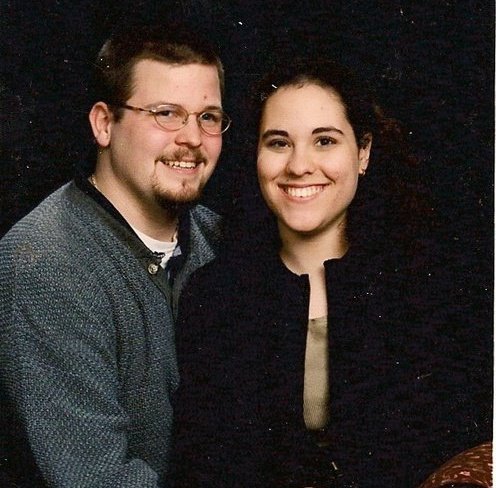
    Kristen Tucker & Adam McLane, Fall 1996

    I’m performing a wedding this weekend for long-time friend Dave Luke and his fiancee` Justine. Thinking about their engagement and wedding brought back this lovely memory.

    I’m not sure Kristen has changed a bit. But I’m glad that zit finally healed up and I got over the Friends look.

    I’m a youth pastor, you don’t think I never rocked a goatee at some point, did you?

  • 5 Types of Engagement With Each Blog Post

    I’m an engagement preacher. No other stat matters in social media quite as much as engagement. Likes, Retweets, Trackbacks, Comments. These are the things that show that your content isn’t just getting read– it’s getting shared.

    Here are five ways each of my blog posts is engaged with.

    1. Comments (On the blog itself, on Facebook, and on Twitter)
    2. Facebook like and shares (I have a limited reach. But through my reach I have unlimited viral capabilities.)
    3. Twitter links and retweets (Did someone like you post enough to post on their Twitter account? Did anyone retweet the link?)
    4. Private discussion (I get a lot of e-mails, Twitter direct messages, and Facebook messages with each blog post. I even tally the number of times people see me in person and mention something I’ve written. That’s all engagement.)
    5. Blog excerpts (Getting a paragraph pulled from a post and having it create content for another blogger/online magazine is awesome engagement. It’s like an annotated recommendation.)

    What are ways you engage with your audience?

  • Measuring Success in Social Media

    I laugh when I see the term, “social media expert. Let’s be honest. It’s an emerging field and the only thing that makes someone an expert is that they have labeled themselves as such and they read Mashable and Seth Godin.

    With that in mind, I’ll just point out that for the last two years I’ve gotten paid to handle social media. I don’t know if that makes me an expert in the field, but it does mean that I’m employed in the field. (And I read Mashable and Seth Godin just for good measure.)

    So, how do I measure success?

    False positives

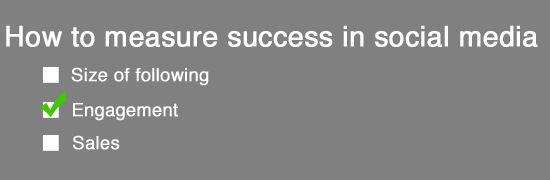
    • Size of following. Having 25,000 followers on Twitter or 10,000 fans of your Facebook page doesn’t mean jack.
    • Contest excitement. I love hosting contests as much as the next guy, but hosting a big contest doesn’t mean jack.
    • Being active. Utilizing the tools of social media is important, but just showing up doesn’t mean jack.
    • Atta boys. [Or atta girls] When you first get started everyone in your organization will be excited, but that doesn’t mean jack.
    • Sales or lead generation. This may make the boss happy, but in most cases it doesn’t mean jack.

    True positives

    • Engagement. Are your followers, fans, subscribers listening to the stuff you send out in a measurable way? Do they click on links you recommend? Do they comment on stuff you post? Do they open the emails you send? Having a large following is only as valuable as your ability to engage those people. Otherwise, your just another message they are ignoring. I’d rather have 100 engaged Twitter followers than 25,000 who ignore me. What to measure: comments, likes, open rates, click rates, number of clicks, mentions on fan/followers feeds.
    • Users who contribute. Is your effort a two-way conversation? Traditional marketing is about pushing a message. Social media is about pulling a response. It’s shocking to me how many organizations have large followings but only push. And they wonder why they think their social media efforts are a waste of money? They are! What to measure: Submissions, Facebook messages, Twitter direct messages, unsolicited or solicited ideas.
    • Repeaters. This post is the perfect example. When I press publish on this blog post, my own network will draw a couple hundred visitors. But this post will be read several thousand times in just 7 days. How did that happen? Repeaters. What to measure: Facebook shares, Twitter retweets, add-to-this analytics, trackbacks, blog posts about your content/product/service.