 If you live in the United States, you are the proud owner of the second largest pool of retirees next to the federal government. And as a bonus you also get a small and dying breed of cars formally known as General Motors. We just spent over $80 billion to bailout a company that is only worth $7.3 billion. You can walk onto a dealers lot right now and participate in the largest liquidation of assets in the history of the world.
And we still haven’t fixed the one thing that forced them into the red in the first place: 500,000 retirees.
General Motors is the classic case of over promising.
Over-promise #1: I remember talking to a GM executive about the business model as he gave me a tour of their Warren Tech Center. I asked him how often a customer was supposed to buy a new car according to the company? His answer made my jaw drop. They built their business model on the assumption that you would buy a brand new car every 3 years. No wonder their cars sucked! They only expected you to own it 36 months. No wonder they failed! No one in their right mind could afford to buy a brand new car every 3 years. They were absolutely lying to themselves. Their competitors built cars that lasted 10 years or more. Honda and Toyota owners hit 100,000 miles and knew that their cars will easily make 200,000 miles. Meanwhile, GM was building cars that were meant to be traded in at 36,000 miles.
Over-promise #2: In the mid-1980s, when Toyota and Honda made it big in the United States market, GM was stupid to continue the retirement program. There was simply no way that they could afford to continue the program… but they lied to their employees and sold them the lie that if they took care of GM, GM would take care of them for life. The smart thing to do back then would have been to convert the program to 401k and make no promises of retiree health care. Instead, they oversold a promise they couldn’t keep. Worse yet, to deal with payroll issues they started early retirement programs which meant people in their mid-50s were walking away from GM with a “guaranteed” pension and health care. There are currently tens of thousands of people in the United States who have now been retired from GM longer than they worked for GM. No company can bear that burden. Companies struggle just to pay benefits for current employees… How did they think they could insure 500,000 non-wage earning retirees?
My point isn’t really about GM, it’s about over-promising. Here are some ill-effects of over-promising.
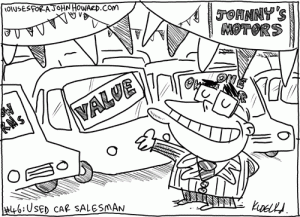 – Advertising becomes useless. It doesn’t matter how much money you spend on ads as people won’t believe you anymore.You can’t hype up a product launch or an event that you’ve oversold forever. When you don’t deliver you are just reminding customers how much you betrayed them.
– Your word becomes useless. When you break promise after promise, soon people won’t trust that your on their side. They will see that you only want their money and you don’t care about them.
– Your product becomes a joke. I was in a meeting yesterday about search engines and someone used the word Yahoo… everyone laughed. Yahoo has become a dinosaur of a search engine. The only thing memorable about Yahoo is that stupid song, Yaaahhoooooo. You can’t advertise and promise a web service, you can only deliver. This is the #1 reason you can’t trust Bing.com to be any good. If it was so good why are they spending $100,000,000 to advertise it?
Shifting gears: The evangelical church has become a classic example of the over-promise. Part of the church becoming more about programs and business models is that it has fallen into the trap of needing marketing and advertising like the business models they copies. The result is a lot of over-promising. “Come to the marriage retreat, it’ll fundamentally change your marriage.” or “Sign up for our next church production, it’ll be awesome.” or “Bring your friends to the revival and they will get saved.” In a world where the awesome is so readily available churches do nothing but give away trust when they advertise promises they can’t deliver. I’ve seen church events marketed like they were going to be on par with Disney or Broadway or Oprah and deliver like a trip to the town carnival, a middle school play, or a cable access show. At the end of the day the church spent more effort marketing the event, production, or program than they did making the program awesome. It is a sick cycle that is killing thousands of churches.
The better way: Wouldn’t it be refreshing if churches just delivered? Wouldn’t it be amazing if they didn’t sell themselves but just helped people? What if they invested in training their volunteers and staff so much that the church didn’t need to make promises, that their programs and ministries truly worked to change lives? You wouldn’t need to advertise a life-changing marriage retreat… because results would advertise themselves. You wouldn’t need to hold a revival because every church service, small group, and youth group meeting would see people come to know Jesus. You wouldn’t need to hire a killer band and create a worship experience because people were authentically worship Jesus. The best advertising a church could ever invest in is a changed life.
If you are a church leader I want to challenge you to think about your programs. Think about how you talk about them. Think about how you market them. And remember:
Don’t promise, deliver.
Don’t hype, deliver.
Don’t sell, deliver.
Don’t measure, deliver.
Don’t sub-contract, deliver.
Don’t advertise, deliver.
In a low trust, high expectation world the best way to succeed is to undersell and deliver.