Tag: kara powell

  • Sticky Faith Book Club, Chapter 5

    This is part 5 in an 8 part series on Sticky FaithJoin our book club by signing up here. (part 123, 4)

    Let’s be careful about Chapter 5. It’s easy to read this and think about our ministry by default. To not apply what we are learning to our home would be a shame.

    A couple quotes from this chapter jumped out at me:

    • “The closest our research has come to that definitive silver bullet is this sticky finding: for high school and college students, there is a relationship between attendance at churchwide worship services and Sticky Faith.”
    • “the high school students we surveyed who served in children’s or middle school ministry seemed to have stickier faith in both high school and college.”
    • “Contact from at least one adult from the congregation outside the youth ministry during the first semester of college is linked with Sticky Faith.”
    • “One family we know has a special ritual that involves sending their two sons to work with men they respect.”

    Kristen: I think that I give up too easily by assuming that my children don’t want to sit at the grown-ups table. I grew up sitting in church with my family. At the time there wasn’t a simultaneous children’s church or youth service option. I’m sure there were times where I was disengaged although I can’t recall specific occasions. What I do remember even several years later is being together as a family, observing my parents in worship, and talking about the sermon on the drive home. Nowadays I almost feel apologetic if one of our children sits with us in the main service. While I’m thankful for fun, “age-appropriate” learning opportunities for my children, this chapter has me re-considering ideas to integrate them better at church.

    Adam: When I think of my first interactions with the Tuckers (Kristen’s parents) I can’t help but laugh. I’d never been around a family like them. They hung out together all the time. They intentionally did stuff as a family… cheesy stuff like go to the library or park or zoo together. They all listened to Christian praise music on Sunday mornings to get their hearts ready for worship. And after church, I kid you not, they talked about the sermon. I sarcastically referred to them as The Swiss Family Robinson.

    Of course, there was nothing wrong with the Tuckers. I just had no idea that there were actually families like that in real life who talked to one another and genuinely liked being together. In truth, they were just ahead of their time… developing Sticky Faith in their girls way before Kara & Chap wrote the book.

    Kristen: I love the concept of purposely surrounding each of my children with five adults who care about them. I feel like this is especially important since we don’t live near extended family who would otherwise help fill that role. Reading through this portion of the chapter also prompts me to want to be “that” adult for my friend’s children. This chapter has so many great ideas. I particularly love the idea of forming an intergenerational group of families to invest in one others families.

    Adam: I need to confess that this is an area we need to improve in. This chapter came with some good/convicting ideas we need to try. As I reflect on God’s Word in regards to parenting it is so clear that God intended plurality in parenting. As Kristen said, while that naturally involved extended family, we don’t live close to grandparents, aunts, uncles or cousins. So that means we need to be more intentional about building that web of relationships for our kids.

    Discussion questions

    1. To what degree are your kids at the “kids’ table” in your life? What is good about that? What might be problematic?
    2. What are the advantages of trying to surround each of your kids with five adults who care about them? What are the challenges as someone in ministry?
    3. In your role in your church, how (if at all) can you help change your church’s culture? While you may have a limited sphere of influence at your church, what changes can you suggest in your own sphere?
    4. What ideas do you have to help your kids connect with other adults and move toward the 5:1 ratio?

    5. How would you explain your 5:1 goal to your kids?
  • Sticky Faith Book Club, Chapter 2

    This is part 2 in an 8 part series on Sticky FaithJoin our book club by signing up here. (part 1)

    The Heart of the Matter

    I read chapter 2 with a heavy heart. As a lifelong youth worker I had a hard time fully concentrating on what the words had to do with my family. Instead, my imagination ran wild with examples of students, core students, who walked away from their faith. Great students from great families whose seemingly solid faith evaporated in college.

    Like you, I know families who have zero of their children walking with Jesus. (Or one out of four; two out of five, etc.) I’ve drank that bitter coffee with those tearful parents. I’ve heard their lamentations. I’ve even seen some of them start to doubt Jesus because “he wasn’t there for their kids.” Those are tough meetings and we’ve all had them. We wish we had answers but all we can offer is compassion and shared frustration.

    If you are like me those meetings end and you get in your car and cry. Sure, those are tears for those students. But they are also tears of resolve. “Not my kids. What do I have to do? How can I do things differently? I can’t afford to go 0-3 in my own home.

    That’s the heart of the matter. Am I wiling to change the trajectory of my parenting for the sake of their faith? Am I willing to forego my “non-negotiables” for the sake of my children wrestling with their faith in my home? (As opposed to pushing that until college.)

    Inarticulate, sin managing, parent pleasers

    Kara and Chap were too nice to put it this way but that’s essentially what their research reveals. Their research showed that Christian students can’t articulate in their own words or testify from their own lives what walking with Jesus means. And since we’ve elevated the role of rules to a place higher than faith, our children know how to act like a Christian without knowing what it means to truly have faith in Christ.

    We assume that if our child walks like a duck, sounds like a duck, and acts like a duck they must be a duck. Unfortunately, that’s not how it works with trusting Christ.

    Kristen’s thoughts

    Trusting God is a discipline necessary for sticky faith development. Reading this chapter has helped me realize that I need to be a stronger communicator. In not wanting to over-share certain decisions or events in our lives, I’ve missed opportunities to articulate how decisions are made based on my trust in Christ. As our children grow older, I see the value of creating discussions and activities to help develop their framework of trust.

    I specifically recall a conversation last year when I asked Paul if he had ever made a decision to trust Christ. His response – “every week!” Digging deeper, what he meant was that every week in Sunday school his teacher made the class pray with along with her to “accept Jesus”. Defining what it means to trust Christ is a challenge after sorting through all the do’s and don’ts thrown their way, even (and perhaps especially) at church.

    Discussion Questions

    1. Sometimes it helps to start with a goal and work backwards. Have you ever stated goals for your children’s faith development? What is the goal of toddler faith? Of elementary-aged faith? Of middle school faith? Of high school faith? Or college faith?
    2. As ministers our kids feel extra pressure to perform as “professional Christian kids.” What are ways you’ve seen your children practice “sin management?”
    3. The book stated that “obedience is a response to trust.” Why is it better to begin with trust and then respond through obedience? Is it ever good to go the other direction: obey first and hope that trust follows? Have you ever experienced either of these in your faith journey? If so, what was it like, and what happened?
    4. How do you see your child’s faith in light of this chapter? Where do you see them growing in what it means to trust Christ, and where do you see them living out the do’s and don’ts of Christianity?
  • Join the Sticky Faith book club

    To join us, buy the book and read chapter one by October 10th

    “Lord, make me a better dad.” 

    Chapter 1, Chapter 2, Chapter 3, Chapter 4, Chapter 5, Chapter 6, Chapter 7, Chapter 8

    This is my daily prayer. Literally, it is my prayer every day. Why? Because there have been times when I’ve not been a good dad.

    Here’s a painful reality that I’ve had to face: There have been times when I’ve cared more about ministering to other people’s kids while neglecting the needs of my own kids. And as I’ve shared that painful reality I’ve come to realize that I’m not alone in that struggle. It’s a common problem among ministry families and one I think we need to address together.

    Your invitation

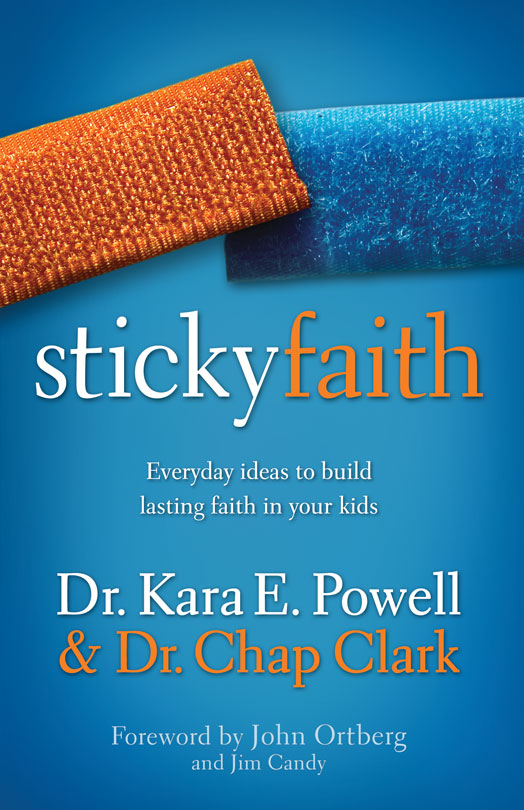
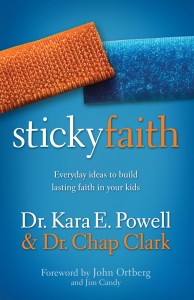
    Kristen and I would like to invite you to join us in an online book club here on my blog where we will be reading, writing about, and wrestling through a brand new book. It’s called, Sticky Faith: Everyday ideas to build lasting faith in your kids by Kara Powell & Chap Clark.

    About Sticky Faith

    Nearly every Christian parent in America would give anything to find a viable resource for developing within their kids a deep, dynamic faith that ‘sticks’ long term. Sticky Faith delivers. Research shows that almost half of graduating high school seniors struggle deeply with their faith. Recognizing the ramifications of that statistic, the Fuller Youth Institute (FYI) conducted the ‘College Transition Project’ in an effort to identify the relationships and best practices that can set young people on a trajectory of lifelong faith and service. Based on FYI findings, this easy-to-read guide presents both a compelling rationale and a powerful strategy to show parents how to actively encourage their children’s spiritual growth so that it will stick to them into adulthood and empower them to develop a living, lasting faith. Written by authors known for the integrity of their research and the intensity of their passion for young people, Sticky Faith is geared to spark a movement that empowers adults to develop robust and long-term faith in kids of all ages.

    Each Monday we will write a brief reflection and some questions specifically geared for ministry families. (It’s open to anyone, obviously all Christians are in ministry to some extent, right?)

    And then, just like a book club, we’ll open it up for discussion.

    How long will it last?

    The book is 8 chapters long, each week we will discuss a single chapter. Don’t worry– the chapters are pretty short.

    Here’s the schedule:

    October 10th – The not-so-sticky faith reality

    October 17th – The sticky gospel

    October 24th  – Sticky identity

    October 31st – Stick faith conversations

    November 7th – A sticky web of relationships

    November 14th – Sticky justice

    November 28th – A sticky bridge out of home

    December 5th – The ups and downs of the sticky faith journey

    Why this book?

    1. There are a lot of great books out there for parents, but this one is grounded in brand new research conducted by Fuller Youth Institute. Then they took their findings through a series of tests and dry runs to make sure that their learnings correlated. And only then did they boil it down into transferable principles. I think that sets it apart from most.
    2. Like I shared at the beginning, I think parents in ministry sometimes lose sight of their own kids. I’d like to help bring the focus on learning how to raise our own kids for a bit.
    3. I want to be a better dad. Kristen and I don’t have it all figured out. And we’d like the opportunity to learn from others so we can parent better.
    4. Kara Powell, Chap Clark, Brad Griffin, and the folks at FYI are amazing people. They have poured their heart and soul into this project. And I would love to see their hard work benefit families in my life.

    How do I join the book club?

    1. Fill out the form below so we can follow-up with you along the way.
    2. Buy the book; read the first chapter by October 10th. (It’d be great if couples joined us!)
    3. Agree to participate in the discussion and contribute to the group. (Guest posts totally encouraged!)

    Where do I buy the book?

    • Amazon.com – paperback or Kindle (I make 6% commission if you buy it this way)
    • DougFields.com – Pretty sure Doug is selling it cheaper than anyone, I don’t make anything from the sale but I did build his store, isn’t that cool?
    [gravityform id=2 name=Jointhe Sticky Faith online book club ajax=true]

    Have questions? Leave a comment.

    Q1: I’m not in ministry, can I be in the book club? Absolutely! Just know that we’ll be gearing the discussion towards ministry families.

  • 3 Books Youth Workers Need to Buy this Fall

    Of all the books that are new this fall, here are three that I’m recommending you buy:

    Parents

    Sticky FiathSticky Faith: Everyday ideas to build lasting faith in your kids – Put together a 6-week parents discussion group with the parents in your youth group and work your way through Sticky Faith together. You don’t want to see students leave the church; parents don’t want to see that either. Kara Powell & Chap Clark put together an amazing study of 500 students and their transition from high school faith to college faith.  Sticky Faith shares their learnings plus robust ideas for helping reverse the trends their research revealed. Check out this article about Sticky Faith in yesterday’s Washington Post.

    Small Groups

    The Jesus Creed for StudentsThe Jesus Creed for Students – I loved Scot McKnight’s best seller The Jesus Creed. This is an excellent adaptation of that work for middle/high school small groups. Chris Folmsbee and Syler Thomas, two youth workers with years of experience, help students grasp what it means to love the Lord with everything and love their neighbors as themselves.

    Youth ministry strategy

    Youth Ministry on a ShoestringYouth Ministry on a Shoestring – Let’s quickly have the chuckle. Yes– it’s a bit funny that the Lars Rood works at one of the most resourced churches in the world in one of the wealthiest communities in the world. What the title doesn’t convey is a fantastically freeing strategy: How to do amazing things for no, or almost no cost. Lars’ ministry strength is creating unforgettable experiences and moments in the lives of his students and he will share with you how to do that, generally at zero cost to your youth ministry budget. The back section of the book is full of real-life examples from youth workers around the country applying the strategy.

    Question: What’s your favorite new youth ministry resource?