
Tag: psychology

  • How do you measure teenage maturity?

    News on teenagers consistently conflicts.

    • We are ecstatic about teenage Olympians. No one puts a teenage qualifier on their accomplishments, an Olympic medal is an Olympic medal, it doesn’t count for half a medal because someone is under 18.
    • Our laws define someone as an adult the moment they hit 18 while providing a completely different legal statute for people under 18. Yet neurologists and developmental/behavioral psychologists are proving that every adolescent matures are a different pace depending on a wide variety of variables. (Some inborn, some learned, some internal)

    The Love/Hate Relationship with our Nations Teenagers

    We have a love/hate relationship with teenagers. We love their accomplishments, we are disgusted when they fail. We are simultaneously infatuated and disgusted by teenage sexuality. Gasp, Justin Bieber has a girlfriend! OMG, I can’t believe she might be pregnant. Oh, I’m going to watch 2 hours of TV talking about it and tweet/Facebook about how disgusted I am… gimme, gimme, gimme more news on teenage sexuality! I’m not exaggerating all that much, am I?

    A 16 year old wins a gold medal and she’s on The Today Show. That girl is so mature for her age! (Succeeding at sports makes you mature) Her girlfriend, in the same school and grade gets pregnant? Oh, becoming a mother isn’t an accomplishment… that’s a statistic! She is SO STUPID! We might even make her go to a different school. 

    We (rightfully) decide things have to change when a teenager attempts suicide. But funding the school counselor or making sure her parents insurance covered her treatment before it was a suicide attempt? Well, common logic states, that’s really a parental issue.

    This continues on after 18, of course. Those who go to college– well, we give them a pass on being adults because they are students. And students can’t be expected to act like adults because they are students. So we allow college students a pass on being mature. In fact, walk around a college campus and you’ll see that “what’s cool” is to act like a 13 year old, fully fulfilled! (Think about it… a “cool college guy” is loud, obnoxious, gets drunk, sleeps around, avoids responsibility, and doesn’t take school all that seriously. There’s nothing mature about that– but college culture celebrates this as a fully embraces college lifestyle.) But someone doesn’t go to college? Well, they better get a job and fend for themselves. They are an adult now…

    So how do we measure maturity?

    The point of this post is to point out that our society gives many mixed messages about adolescent maturity. Science and common sense says that maturity isn’t an arbitrary age. It depends on a wide variety of factors. One person becomes and adult at 16 while another might not become an adult until 25.

    But we have an arbitrary line. Legally, and to a lesser extent culturally, a person is an adult at age 18.

    The Supreme Court has now affirmed that not all teenage criminals are the same, some can get life sentences for their crimes while others can’t, the courts are now allowed to look at other factors besides physical age to judge their ability to understand their crimes. This is a big step. 

    I suppose I’m wondering when we, those who work with students in schools, churches, and our neighborhoods, will begin to do the same?

  • Jesus is the worst sales pitch ever

    I'm sure this is a real page turner…

    Have  you ever sat in on a timeshare presentation? You’re on vacation, spending $100 every time you get out of the car with your family, and a very nice front desk person tells you… “Mr. McLane, if you’d be willing to sit down and talk with us about our vacation packages, we’ll give you $100 in cash and free tickets to a show. It’ll only be about an hour.

    It seems like it will be worth it until you actually do it. For an hour they berate you with every sales tactic in the book. They show you the property. They say, “Imagine coming here for two weeks every year, wouldn’t that be great?” Or “You can trade your weeks for points and go anywhere in the world! And it’ll already be paid for.” Or my favorite, “Mr. McLane, you work hard. Doesn’t your family deserve a vacation like this every year?

    It’s moment of insincerity, remembering your kids names, relating stories of other pastors who have joined, on and on. The more they talk the more you want to punch them in the face. It’s hard to say $100 for an hour of your time isn’t worth it. But it’s not worth it.

    No offense to those who have bought timeshares. But you go into the presentation either knowing you want to buy one or you don’t.

    In which case, since I’m already wanting to buy in the pitch is useless. And for the person who already knows they don’t want to buy the salesperson is just going through the motions and so are you… you just want to be nice enough to get the $100. (And those who get talked into it are more preyed upon than sold on it, right?)

    It’s all just a game, isn’t it? I know I’m not going to cave and buy a $30,000 timeshare because I don’t want one. And before I arrived at the presentation my wife and I already told ourselves that no matter what, we’re going to be polite, but we’re just taking our $100 and going to the beach later.

    We are not buying a timeshare in Ft. Lauderdale.

    Selling Jesus

    Photo by David Prasad via Flickr (Creative Commons)

    This is, at it’s core, the problem with the “If you build it, they will come” strategy so popular in Christianity.

    The sales manager (aka the pastor) polishes up his sales pitch and tells his sales team (congregation) that if they can bring the prospects, (non-church goers) he will close the deal. (I mean, get them to give their lives to Jesus.)

    When pastors tell their congregation to do this, there is always a sly little smile, as if to say… “They’ll never know that what we’re about to do is tell them about Jesus.”  Yeah– as if visitors are surprised that your marriage seminar is really a Gospel presentation? Doubt it.

    The problem is that the psychology doesn’t work.

    Put yourself in the car of a non-church goer about to visit your church with you. You are either interested or you aren’t before you even get there, right? If you aren’t interested in church you are thinking, “No matter what, just be polite, drink the coffee, and peace out ASAP. I’m doing this for my friend.

    No amount of manipulation or sales pitch methods will get that person to change their mind. Why? They are locked in as uninterested. And one could argue that those who get talked into it are more preyed upon than sold on it, right?

    The problem is that the theology doesn’t work.

    Jesus isn’t a deal.

    • Regeneration of the soul happens only when the Holy Spirit calls a person to Himself, right? (Westminster Confession of Faith, Chapter X) A sales pitch can be used by the Holy Spirit. But, as I heard over and over again in Haiti, an earthquake can be just as effective a call.
    • A life with Jesus is messier than a tight 35 minutes with 5 points, isn’t it? While a presentation of the Gospel is excellent at piecing things together in someone’s mind, coming to faith in Christ is more an unwinding of life’s ball of yarn than winding it up into a ball.
    • Jesus promises that a life lived in relationship with Him will be more difficult than a life without Him in your life. (Romans 12:1; John 15:18) That is a pretty tough thing to “sell” from a platform. Come and be like Jesus, who died on a cross penniless and almost no friends!
    • In a world that lives for today, an assurance of heaven, pearly gates, and a mansion tomorrow is a program they don’t want. That doesn’t make salvation any less important. You just can’t stand in front of people and say, “If you were to die tonight… would it be heaven or would it be hell?” Culturally, that’s just not what people are thinking about!
  • The Double Edged Sword of Awe

    geiserWe are all born with a desire for religious experience. God made us this way. Each of us has had experiences in which the only description of our emotions is awe. These are intimate moments between you and God, a person, or a even location or event. While God intended for this awe to be for Him, our humanity doesn’t reserve them to Him exclusively. It’s a human response of deep connectedness. Most often there is a build-up and anticipation to the experience. You want it to happen so bad, it finally does, and the experience overwhelms you because it is better than you’d imagined.

    Here are some awe experiences people mention as the highlights of their lives.

    – Seeing a bear in the wild.

    – Liftoff of the space shuttle.

    – Sexual intimacy

    tiger_17_425x600– Hitting the winning basket, scoring the winning touchdown, nailing the winning putt.

    – Exploring a beautiful coastline in Ireland.

    – Worshipping with thousands of believers at a conference.

    – Meeting God for the first time at a retreat.

    – Starting your own business and earning your first dollar.

    Most often, these are intensely personal moments of awe. The experience defies description and is often too intimate to even talk about. Even during the moment your emotions run high.

    This is the first edge to the sword. It’s a good edge. The pursuit of this high and the after effects/remembrance of this high produce tremendous energy for people. This religious experience forms a deep bond between that individual and that event, object, or person. It is something they shared that was intimate and powerful.

    Industries exist to help people pursue this experience, don’t they? We seek the awe-inspiring moment and wise capitalists provide tours of Ireland and Yellowstone. Religious events build anticipation for these moments knowing that they will draw thousands of seekers. How many clubs, bars, and dance clubs exist for the sole purpose of a common meeting ground for people seeking a sexual experience? On and on.

    But that sword has a second, more dangerous edge to it, doesn’t it? Once you have this religious experience you seek to have it again. I mean, if the high of that moment… seeing the bear… crossing the rope bridge to a tiny island… having a killer day with a new business… sinking the putt to win the big tournament… it will never be the same as the first time.

    In fact, many industries sustain because they know there will always be people who are seeking the second experience. They are in the exhilaration/disappointment business. They know that a weery businessman will lay down tens of thousands of dollars to go on tours of Ireland again. And then when he doesn’t find what he is looking for he will go to Scotland, Iceland, and the Gallapogos. The sex industry exists because people are seeking a more amazing sexual experience than “that amazing time.” Parents will relentlessly drive their children into sports in hopes that one day their kid will have the amazing experience they did of scoring a touchdown to win the big game. Certainly, many youth groups thrive because teenagers are seeking to repeat an intense religious experience they had at a retreat.  Get-rich-quick schemes work because people remember that one time when they made easy money and they want it to happen again.

    The truth is this. The secret is this. The learning point is this. Once you have that amazing moment, don’t try to repeat it. It will never be the same the second time. When you take someone back to that spot… it’ll be awesome for them… but a let-down for you. If you can’t handle that let-down, just let that awesome one-time experience live in your memory.

  • Defining quotes

    you_suck“I’m rubber, you’re glue. Whatever you say bounces off of me and sticks to you.” That’s a bunch of crap, isn’t it? The truth is that sometimes words said to you hurt way more than any of us would like to admit.

    There’s something in my personality that remembers these words, embeds them as self-talk, and run through my brain like a broken record… and they serve as a powerful motivator for me. The negative ones, I desire to shove them back into  the face of the person— long since forgotten– who spoke them. The positive ones, I try to live up to in all that I do.

    Here are some negative examples:

    – “Adam is a spiritual orphan.” — my first “real pastor” in Indiana. This implied that my parents didn’t care about me and always made me mad.

    “You’ll never finish college. You’re destined to be a community college drop-out.” — my stepmother said this my senior year of high school.

    – “You’re not cut out for pastoral ministry. You’re too much of a maverick.” — a co-worker at my first church said this… repeatedly.

    – “You are a legacy hire, I wouldn’t have hired you.” — a former boss said this all the time.

    Here are some positive examples:

    – “Your work ethic makes up for a lack of talent and money.” — a high school golf coach

    – “There’s something special about you. God is going to use you in big ways.” — a favorite camp counselor

    – “Adam is one of the most organized/driven students I’ve ever had.” — an undergrad professor

    – “You made a big impact on my kid. Thank you for letting him in to your family” — a parent

    So what’s the point?

    First, I’m convinced that the self-talk that we all have can be either a severe motivator or a severe motivator. If you’re finding that you beat yourself up endlessly, there’s no weakness in going to see someone to help you. I’m not going to claim that I’m the most healthy emotional person in the world. But I’m here to tell you that good self-talk has gotten me through some tough stuff.

    Second, be really aware of the words you speak into people. Of the eight examples I gave above I’m convinced none of them felt like they were saying something prophetic. Some of them were even just little side comments that stuck. Words have weight… things we say to and about others can impact them for years!

  • Comedy and the Human Condition

    Last night I was watching a PBS piece of the history of comedy on television in our country. While the documentary itself wasn’t all that interesting or funny there was a cultural parallel there which caught my attention.

    In times of peace, comedy is introspective and makes fun of the human condition. In times of war, comedy is external to the self and makes fun of politicians and the enemy.

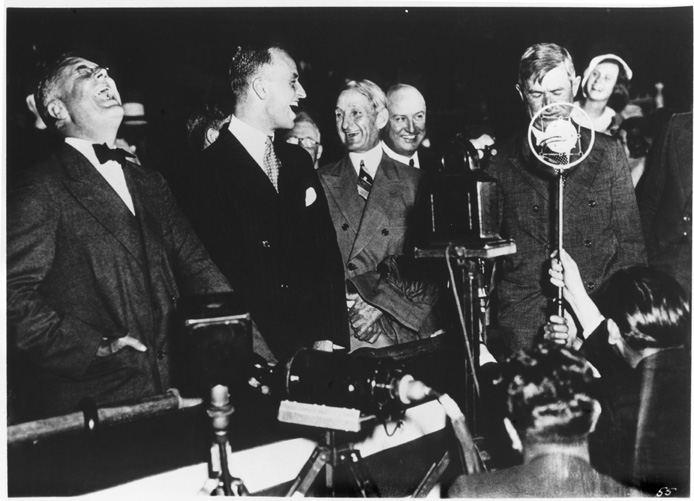
    This explains why the video I posted yesterday isn’t as funny today for its content as it was 15 years ago. The piece pointed to Will Rogers as being hilarious in the 1920s-1930s [Seen above mocking FDR to his face!] but immediately falling out of “funny” when Pearl Harbor was attacked. Likewise, Jon Stewart and Stephen Colbert would seem out-of-place if we were not at war in the Middle East.

    But I wonder how much that the condition or war and peace effects how we think of ourselves? I wonder if times of peace make us introspective while times of war make us look at external things to ourselves?

    As the culture gets more individualistic I wonder if we can take it a step further. (This is where it gets purely hypothetical) I wonder if what’s funny to you or I is dependent upon war or peace in our own lives?

    If I’m depressed, is my sense of humor darker?

    If I’m generally happy, is my sense of humor jovial?

    I’m probably reading way too much into this. But it does have me thinking about what is funny to whom and when.