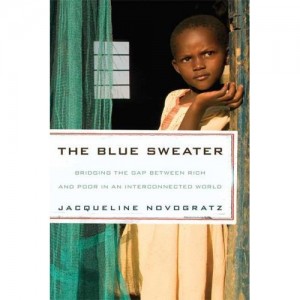
 Over the past month or so I’ve been working my way through The Blue Sweater by Acumen Fund CEO Jacqueline Novogratz. I think this is a book worth reading for a number of reasons. Here are some high points.
– Novogratz carries a general principle with her that makes a ton of sense: To change a families life you have to work with women. I wouldn’t label her a hardcore feminist, but her point is very valid. Traditionally in charity and community development the money goes to the men. The thing is that very little of that money ends up trickling back to the family. A much higher percentage of the income you invest in women goes towards educating, feeding, and investing in the home.
– Novogratz sees her role in changing the world as a blend of charity and for-profit business. The old adage that “If you give a man a fish, he eats for a day. If you teach a man to fish he’ll feed his family forever” is an interesting sentiment but isn’t truly solving the problem. This book talks a lot about helping people set up businesses that are sustainable, run by locals on their terms, and yet holds them accountable for their actions. Those are qualities of an ecosystem worth chewing on.
– Justice is beyond charity. There is a huge movement going on about mosquito nets. When Ashton Kutcher gave $100,000 to buy 100,000 mosquito nets this was both good and bad. While it is fantastic that $1 buys a mosquito net, it’d be way better if some of that $1 went to helping build a company that could produce and innovate those nets without the need for more charity. Charity is great… but it doesn’t go far enough to fix problems.
– Dignity is more important than charity. For a lot of us who think about building systems upon which others can build their livelihood, it’s important to remeber that our role is to provide the system and get out of the way. A truly good system is a platform on which others can invest and trust. The platform should take a backseat to the products developed for the platform.
– For-profit is not evil. There is a sentiment of those who work for charitible organizations that anything for-profit is ignoble. I love how she shows for-profit being as important as non-profit and not-for-profit.
Interwoven in these threads of thought, Jacqueline Novogratz shares stories from the rich tapestry of her life. Each story helps to form a patchwork quilt from various places in the developing world. From her first experience as a young co-ed where she discovers that a blue sweater she donated in America worn by a child in Africa to running a small bakery in Rawonda, to eventually creating The Acumen Fund, Jacqueline shows that she is crazy enough to change the world.
For world changers and those longing to see the world a better place, The Blue Sweater is a great read.


