Tag: tips

  • How to talk to parents about parenting

    Over the past year or so I’ve had the opportunity to lead an hour-long seminars for parents. In fact, earlier this year partnered with Simply Youth Ministry & Marko to turn the content of my seminar into a book that comes out in a few weeks, A Parent’s Guide to Understanding Social Media.

    For me, this has meant going to churches and presenting content without knowing a thing about the context of the church. Sure, I can figure out some things just by driving around or overhearing small talk in the foyer.

    (more…)

  • How to buy a used car for way below Kelly Blue Book price, part 2

    In Part 1 of this series I shared some general used car buying tips that I gleaned from my own experience and reading a few articles on the topic. In this post, I get specific about how I used those general tips to get a great deal on my used minivan.

    Preface: I spent several weeks looking for vehicles on AutoTrader and researching dealers on Yelp. I highly suggest you do the same before attempting to buy a car.

    Goal: To get a high quality minivan from a reputable dealer at a great price.

    How we bought a minivan for thousands under Kelly Blue Book

    1. I looked at tons of minivans for several weeks on AutoTrader and in person. If used minivans were porn I would have had a major problem… that’s how many I looked at. I drove around the area so many times I’m willing to bet that at least one dead beat dealer thought I was a private investigator.
    2. I walked off 20-30 lots simply because I didn’t like the salesperson’s attitude. You’d be surprised how many dealers allow their sales staff to be rude, as if you’re going to bully someone into buying something they don’t want?
    3. I took my eight year old with me to buy what I wantedPaul was awesome. He ran recon with me on every car on the lot. For the price of a Coke and some Starbursts he was a valuable asset. Plus, who doesn’t love jumping in and out of vans you’re not going to buy to find what’s wrong with them?
    4. We waited until the end of the month. We dangled that end-of-the-month carrot in front of the sales guys face mercilessly. We weren’t even out on the street on the test drive before I brought it up. As soon as he told me he was short a few sales I dropped the price in my head another $1000.
    5. I did the math while I waited. There’s a lot of standing around when dealing with a dealer. In that time, I looked up the van with all of the exact specs and mileage on the KBB app. Their list price was right at KBB’s price. I knew from my research that I could go at least 20% off of their asking price and they’d still make money. So I put that number in my head. Between Evernote, my iPhone’s calculator, the KBB app, and the AutoTrader app… I had all the information I’d need.
    6. When we got back to the dealership I asked the salesperson to go ask his manager for the absolute lowest offer they’d accept that day. He came back with a number about 10% lower than the sticker price and started to tell me about a few details. Basically, his offer was just enough to get all of their “out the door” fees back to the asking price. He was about $2000 off the price in my head, but I didn’t let him know.
    7. I looked at the CarFax report. I made a mountain out of a couple molehills. But I never responded to his offer directly, just made it clear it wasn’t what I was looking for.
    8. Then I made Mt. Everest out of a speed bump. He said that his dealership required he run a credit check, even though I wasn’t financing through them. (I paid cash) I decided this was going to be a sticking point and used it as a distraction from the numbers game– a way for me to take the power position AND get the sale price I had in my head. The salesperson told me it was a state law that they run a credit check. (It’s not, that’s ludicrous. The form next to the application was a standard disclosure for allowing them to use/sell my credit information to marketing companies.) So I told him that this was going to be a deal breaker, it wasn’t something I was going to do and there was no room for negotiation. He came back with the manager who told me the same thing.
    9. And then I walked away. Literally, Paul and I stood up and thanked them for their time. We shook hands and wished them well. Then we walked out the front door and went to our car. I told Paul that I just caught them in a lie and now I’d use it to get what I wanted… a better price. We sat in the car [I never park in their parking lots, always on the street] and waited a few minutes. Then, the salesperson came out of the building, got in the minivan, and started to drive it from the new car lot to where it was on the used lot.
    10. The buddy move. The salesperson parked the car, locked it up, and started to walk back to the office. I caught him about 50 feet from the van and said, “Hey, what was that all about?” He softened right up, clearly annoyed he’d just lost a sale. “Look, I’m not going to do the credit thing, but that doesn’t mean we can’t do this deal. It’s not a state law but probably a company policy. I know you want to do this deal and I want to see you get paid for it. If you can go print out the policy for me to read and convince your manager to sell me the car at ____, a total out-the-door price, we will have a deal.” He had worked at other dealers, knew it was just a policy, and agreed to make that happen. In other words, he took the bait.
    11. Read the policy. I’m not saying car salesmen aren’t smart, but they clearly aren’t familiar with policy language. When the salesperson showed me the policy in his handbook it said in 3 places that the general manager could authorize them to bypass the credit application for cash sales. So I told the manager, “It’s up to you. If you want to move this car off your inventory and you want to see your guy get a sale today, this is the phone call you’ll need to make. But if you can’t make this happen I’m gone. The exact same van is on lots at ____ and ____. Somebody is going to sell me this van in the next 2 days, I’d like it to be you.” This was all totally true. I was going to walk if I couldn’t get him to budge on this issue. And those other lots really did have the same van. I knew I had them at this point because the salesperson was standing right there. I used the buddy move to put the manager in a position where he had to make the deal happen. If he didn’t make it happen the salesperson had his boss to blame, not me. Cute, eh?
    12. No surprise. Three minutes later he comes back and tells me that I don’t need to do the credit check, but will need to bring in more ID to satisfy a state law that forces them to verify my identity.
    13. Closing time. I looked at the sales guy, “OK, so you told him the price and everything? We’re good now?” He looked at me in terror. They were on the ropes at this point– time for the knockout. “No, I didn’t get a chance to do that yet…” “I told ___ that if we could take care of the credit check thing and you’d do an out-the-door price of ____ we’d have a deal. Will you take that?” [I lowered it another $200, oops. :)] He stuck out his hand and shook on it.
    14. Paperwork, schmaperwork. I spent the next hour doing paperwork with their secretary. Wam, bam, thank you ma’am.
    15. The net result. I got the #2 choice minivan I wanted for my family. The dealer moved a car that’d been on the lot for 3 months. The salesperson got a sale and will get paid Tuesday. My sale price was 22% below Kelly Blue Book for the exact spec/miles. My sale price was 49% lower than the asking price on the same minivan in 2 locations within 2 miles. My eight year old son learned the power of negotiation.
  • How to buy a used car for way below Kelly Blue Book, Part 1

    After a couple months of research we were finally able to purchase a great used minivan while getting a good deal from a reputable dealer.

    General used car buying advice

    Preface — Download the free Kelly Blue Book app for your phone. In order to beat the dealer in real time, you’ll want to have access to the data when you are shopping.

    Goal— This plan is loading you up on leverage so that you can be in the offensive position when it comes down to negotiating price.

    1. Start with a class, not a specific make/model/year. In our case, we were looking for something that seated 7 people that was 3-7 years old. As you get deeper in the process it’ll help to know the basics about your class. Which car is most desirable in that class? Which is least desirable? What are the best features in that class for those years? On and on.
    2. Use AutoTrader.com and Yelp. Once you have #1 figured out, create two searches on AutoTrader and set them up to send you a daily email. Do one search for the cars you are most interested in within 25 miles. Do another search for the entire class within 75-100 miles. This will notify you when something you really like is close, so you can go over and take a look. But it’ll also give you an idea of what cars are going for in your class within your area. (Lots of dealers have several locations and move cars around so their lots look fresh.) Save the ones you like the most. This will make it simple to go back and compare, plus if you use it long enough you’ll see which cars in your class move the fastest and at what price. For Yelp, get to know the dealers reputation in your community before you see their striped tie on the lot… just type in the name of your city and “used car” and you’ll learn all sorts of things about the dealers who look awesome on AutoTrader.
    3. Avoid tent sales, sales events, and anything attached to the name “Giant” or “Super.” If you don’t believe me, leave your checkbook at home and go visit one. It’s every slimy sales guy/tactic at one place trying to out-sell the other slimy guys. From a strategy perspective this is how dealers move inventory quickly at higher-than-normal prices OR ridiculous financing. These events put the seller in the power position and you, the buyer, in the weaker position. Have you ever gotten a good deal at a carnival? I didn’t think so. 
    4. Sunday and after hours are your friend. In our area (San Diego, CA) most of the lots are closed on Sunday. And most lots are closed by 6 PM during the week. If you want to get a closer look at a car you might be interested and want to avoid the people in ties this is the best time to do it. Everything looks nice on AutoTrader. Just do a few recon missions to see who carries what and at what quality. Most smaller lots and a lot of big name dealers buys their cars at auction. Then they spend $1000 on them to spiffy them up at a nice profit. But a few of the name brand dealers keep the best trade-ins and then fill their lots with some auction stuff. Get a close-up look and you’ll spot the winners from losers right away.
    5. Keep the deal simple. You won’t be able to do the math in your head if you start talking about financing, trade-in value, etc. You only want to talk about “out the door” price. (Including all their fees, sales tax, etc.) So take care of your financing ahead of time, sell your car on Craigslist– just do whatever you need to do in order to simplify the deal to an “out the door” price.
    6. Buy at the end of the month. Salesperson paychecks and quotas are measured on the last day of the month. If you are walking onto a car lot knowing you can buy when you find the right car, knowing what you can spend, and are willing to negotiate, and willing to wait another few weeks if you need to– you have about as much leverage as you’re going to get in the last few days of the month.
    7. Don’t go alone. Typically, dealerships assign one salesperson to each buyer on the lot. So having two of you and one of them is a big, tactical advantage. When the salesperson starts showing you cars the second person can open up different doors and see the price or give you a quick opinion. I took my 8 year old son and he was perfect for this job. He and I worked out little looks and gestures for when it was time to move.
    8. Test drives are free. You ultimately won’t know what you like until you get behind the wheel. If a salesperson is douchie about it just walk off the lot. (Most require your drivers license. If they ask to run a credit check in order to test drive, it’s time to bounce.) It’s not like they really think you are going to buy a car without driving it. Test out if you like where the controls are, if things move like they are supposed to, if everything works, etc. Any reputable dealer is also fine with you taking the car to a mechanic to get it looked at. (Usually this is under $50)
    9. Don’t fall in love. If you’ve done your research you’ll know that your #1 – #5 choices are likely available at various lots. Until you sign on the dotted line you need to be prepared to walk away. In fact, walking away is your best leverage point. You have everything the salesperson wants, your money. And only you can decide when the sale makes sense.
    10. Character matters. Be willing to walk off a lot and miss out on your #1 choice if the dealership is shady. Even at the best dealerships, service is going to go down drastically from the moment you buy the car. So if you feel weird about the guy in the tie talking to you– know that he’s the nicest guy at the shop. If you don’t like him you’re really not going to like the service department or anyone else. There are thousands of dealers and millions of used cars available. Just trust me, if you feel weird… walk away.

    In Part 2 of this series I’ll share our actual experience with getting a deal 22% below Kelly Blue Book price and nearly 50% cheaper than similar dealer list price for the exact same used minivan. 

  • I need your camping advice!

    Next weekend the McLane family is going camping. (A non-digital adventure!) Specifically, we’re going to Idyllwild, CA for 3 days and 2 nights.

    We need this

    Summer 2011 has been the lost summer. Especially for me. Leaving YS and starting up 2 businesses meant that we didn’t take a vacation over the summer and I’m pretty much fried as a result. In the last 90 days I’ve worked 12+ hours probably about 75 of those days.

    Our family is in desperate need of R&R– away from projects, school, and anything digital. Why? Because after next weekend the fall gets going like crazy with conferences, cool projects, youth group retreats, yada yada yada. If we don’t do this we won’t get a break until Thanksgiving.

    Here’s the deal

    Kristen and I were into backpacking before we had kids so we know the nuts & bolts stuff about setting up camp. But since we’ve had kids (10+ years) we’ve never gone camping without taking 40 middle/high school kids.

    What we need is help with fun things to do with our kids while camping beyond the obvious stuff like hiking and s’mores and exploring the woods. We know we need to try geocaching…. but what else?

    Leave me a comment with your favorite camping tip and help our family make some memories next weekend. 

  • Three Ways to Reach More Teenagers Starting this Fall

    In your community less than 10% of 6-12th graders are a part of a youth ministry.

    Photo by Martin Ringlein via Flickr (Creative Commons)

    In most communities 2%-3% of eligible teenagers are involved on a good week. Ouch. Here’s a strategic reality check for you: Tweaking your mid-week program or plugging in a new communications tool or even working harder isn’t going to help you reach the next 10% of students in your community.

    Simply put– what you are currently doing is only going to reach maybe 1%-2% more people next year. And if you believe, like I do, that a life with Jesus is better than a life without Jesus, this is a call to action more than a call to give up!

    Have you read the book of Acts, lately? It’s the most dangerous book in the Bible! And yes, that’s possible today.

    To reach more students you’re going to need to implement additional strategies. Don’t freak out. Launching additional strategies doesn’t mean you have to do more work. But it does mean that you might need to make some room and cast a wider vision for ministering to adolescents in your community.

    Here are three ideas that you can start this Fall

    Starting with resources you probably already have, these three start-ups will reach a different population than you currently can.

    1. Drop-in center – A drop-in center is a safe place for teenagers to hang out. If you have a youth room already.. or even better… a local business who allows you in, it is basically just having night hours a couple days per week and staffing it with volunteers. (Say, open from 8pm – 2 am, you know… when the students you need to reach are out and bored.) Allow local bands to come in and play. Have some occasional theme parties or movie nights. Offer beverages, snacks. Adults who staff it focus on building relationships, inviting those interested to check out Jesus in an exploratory study on who Jesus is. It can be a rough and tumble option. But definitely needed in most communities and a great way to expand your reach. If you have some bouncer looking adults in your church, they’d love this. Give to them and get out of the way. Tip: Tell your church kids it’s not for them.
    2. After-school program – This is especially helpful in reaching 5th-8th graders. I’m always surprised that more churches don’t offer after school stuff since churches usually really close to schools! You would be surprised how many middle schoolers are going home to empty houses and this provides an easy alternative. When they come, offer free time and a snack so they can unwind from the day. After that, offer a quick lesson on virtues or values or even hygiene…. Then flow into an hour of homework help. This might seem intimidating at first. But I guarantee that every church in the country has a retired teacher or someone who wants to run it, some stay-at-home moms to jump on board, and other folks who would love to pitch in because they love kids. If you break it into two roles, the free time and lesson crew and the homework helpers– it’s a lot easier to staff as one tends to intimidate the other type of person. Tip: You’d be surprised how much money is out there in federal grant money for this. You can probably do it with existing unused space and a grant to cover expenses.
    3. Partner with the school to provide mentors- Mentorship is the buzz word in youth ministry circles and educational circles. Meet with your principal before he leaves town for the summer and ask if you could help them get a mentorship program going pairing educated adults with students who need a little extra care. (Or support the one they already have.) Even if you just became the point person for the school’s mentorship program, you’d probably be the principal’s best friend for life. I’d bet my mother’s right arm that you can find 25 adults in your church willing to volunteer 2 hours per week mentoring a middle school or high school student. Chances are also good that if the school posted the opportunity you’d have an additional 25 volunteers come out of the woodwork, you’d hold one quick volunteer meeting, coordinate with the administration, and it would be off to the races. Tip: The key to any interaction with your local school is meeting with the principal and asking, “What are your needs? How can I get people to support your mission?” Coming to him and pitching a mentorship program might not be the best idea. But if it comes out that its a need of his, jump on it!
  • Just Write

    So, you want to blog? And you’d like to build a following. Great. I’m here to help.

    Here’s a quick reality check:

    • Success has nothing to do with a fancy blog design.
    • Success has nothing to do with learning the latest SEO tricks.
    • Success has nothing to do with finding advertisers to fund you.

    So save your money. And don’t waste your brain cells.

    Success as a blogger is so much simpler than that.

    Just start writing. That’s 99% of the battle. Write, write, and write some more.

    Success will find you when you are satisfied with who you are and how you write.

    Start at the beginning

    Chances are, as a reader of my blog, you’ve read something I’ve written and thought… “I could have said that, just better. I am smarter and a better writer than Adam McLane.” And you might be.

    So what is the difference between you and I? Experience.

    Go ahead and look at a tab on the right sidebar called, Archives. Then drop down all the way to the beginning. Go all the way back to May 2004 and read a few posts. I was horrible. But I was consistent, I was trying, and I was listening. And over time I wrote less about things that were interesting to only me and more about things that might be interesting to both me and you.

    2004 was my beginning. Next, skip up to 2006, then 2008, then 2010. You’ll see a progression. I got better. I’d like to think that the progression continues.

    If you are starting, just write. It doesn’t even matter what you write. Or if anyone reads it. Just write and write and write. You’ll figure it out.

    You don’t have a reputation to protect

    The biggest block to most people getting going (and later, to you growing) is a fear of embarrassment. Get over yourself. Stop it. You aren’t famous and you don’t have a reputation to protect. And if you can’t stop worrying about your reputation… write under a pen name and don’t tell anyone you are doing it. All that matters is that you start writing.

    I wrote for two years on a blogger account not tied to my name directly. Then for the next two years I wrote on a Typepad blog… I didn’t move to adammclane.com until I’d been at it for a few years. I didn’t have a reputation to protect. But I probably thought I did.

    Don’t make an announcement

    I think letting people know that you are going to start blogging is the worst thing you can possibly do. Telling people seems to mount pressure. Pressure to perform steals the joy of expressing yourself. And once the joy is gone– you will convince yourself that you don’t have time or that it isn’t a priority.

    Just write. Don’t promote. Forget about Twitter or Facebook or anything else. Just write. If it’s good, people will find it.

    Measure the right things

    I’m 7 years into this. I measure some pretty sophisticated things. If you are just starting out the only thing worth measuring is, “Did I write today?” Get a year into it… then add to that, “What kinds of posts draw comments?” Once you have enough confidence… then worry about things like, “What’s my niche`, who is my audience, and is my blog growing?

    But for now… just write.

  • 5 Sources of Creative Inspiration

    Getting stuck is a big deal. In my world it means progress stops. So getting from an uncreative space to a creative space is integral to thriving.

    One thing I’ve learned about myself is that restarting the creative process is typically a matter of moving in one of two directions. I refind my mojo by taking things from very structured to very unstructured or visa versa.

    5 Sources of Creative Inspiration

    1. Improvisational jazz or intensively introspective classical music. I have a few works from Miles Davis and Rachmaninoff that seem to come in handy at different times. The ordered chaos in Miles Davis seems to help my brain make sense of things when I’m going a million different directions on a project, all of which I like but can’t figure out how they fit. And the acapella All Night Vigil has a unique ability to both calm and awaken my senses. Anxiety, particularly that my work will be rejected, is a major block. For some reason Rachmaninoff helps me release that.
    2. Magazines. I like the staccato pace of magazines. While I do get a few regularly I can’t say that I read one all the time. But when I’m stuck I tend to gravitate to a magazine. There’s something about the page turning, the ads, and getting stuck on a story that always leads me to my notebook to draw or sketch. (Or Evernote if I’ve got new ideas.)
    3. A walk or bike ride. Sometimes I just need to think about something else for a while in order to think about a project in a new way. Taking the dog for a walk in our neighborhood or riding my bike somewhere is a great stress relief and for some reason typically helps me clear my mind enough where eventually, almost accidentally, my mind will free enough to release a creative idea.
    4. Web design showcases. For some reason this helps me even if I’m not working on a web project. I subscribe to several web design sites and when they publish showcases of cool designs I always bookmark them for later. There’s something inspiring about seeing how people are using the latest HTML5 tags or what’s hot in Polish web design or the hottest trends in mobile app sales.
    5. Deadlines. I’m a middle schooler on the inside. The pressure of a deadline gets my juices flowing. Maybe it’s the desire to get stuff done on time and maybe it’s the pending reality of failure? Who cares! I find the approach of a deadline an important part of the creative process. It helps me get to past the point of something needing to be perfect and into the frame of “What is the best I can do with the time I have available?”

    Creative buzzkills

    These are probably unique to me but maybe they are stopping your flow, too?

    • Novels and non-fiction books. I find biographies sources of inspiration. But novels and non-fiction works tend to suck creativity from my brain.
    • Pressure to perform in the moment. There are times when I can come up with amazing things in a group setting. But typically, my best group work comes in lulls in the action. But if you walk up to me and demand three ideas for something I know nothing about, I’ll punt every single time.
    • A palette too big or too small. I do best with some parameters. A few, not too many.
    • Interruptions. It can take me a couple hours of fiddling around to really get into a creative groove. But it can take only a single interruption to get me out.

    I suppose this all just proves one thing. I’m a pain in the neck to work with!

  • How to adjust privacy settings for Facebook Places

    What is it?

    Facebook describes it this way:

    Places is a Facebook feature that allows you to see where your friends are and share your location in the real world. When you use Places, you’ll be able to see if any of your friends are currently checked in nearby and connect with them easily. You can check into nearby Places to tell your friends where you are, tag your friends in the Places you visit, and view comments your friends have made about the Places you visit. Use Places to experience connecting with people on Facebook in a completely new way. link

    In other words, its a bigger and instantly more popular version of Fourquare, Gowalla, and Yelp. With 97 million American teenagers owning a mobile phone, this has the potential to be huge.

    Facebook has a very well done FAQ are for Places, I’d recommend checking it out and educating yourself.

    How to Adjust Privacy Settings

    For most people, your default settings are going to be fine. By default, you can use a mobile device to tell your friends where you are at. Additionally, by default you are allowing Facebook to point you to other people who are checked in at the same place.

    For people into social networking, this is fine. I actually like that if I check-in at Starbucks I can know who else is there because I might actually like to have a conversation with them. It doesn’t creep me out that I could check-in at Ikea and 20 other people in Ikea who aren’t my friends could know I’m there.

    But a good majority of people don’t use Facebook for social networking. They use it for existing friend connections. In other words, while Facebook is designed to help you expand your network by meeting new people, there are tons of people who want to “protect their privacy” and not network with anyone outside of people they know if real life.

    That’s a personal choice and Facebook allows for that. (Even though its outside of the original design of Facebook, they’ve made concessions.)

    Now, let’s adjust those settings!

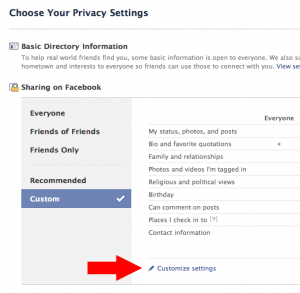
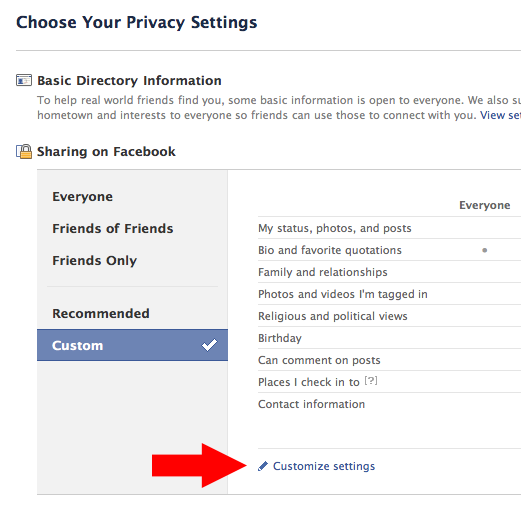
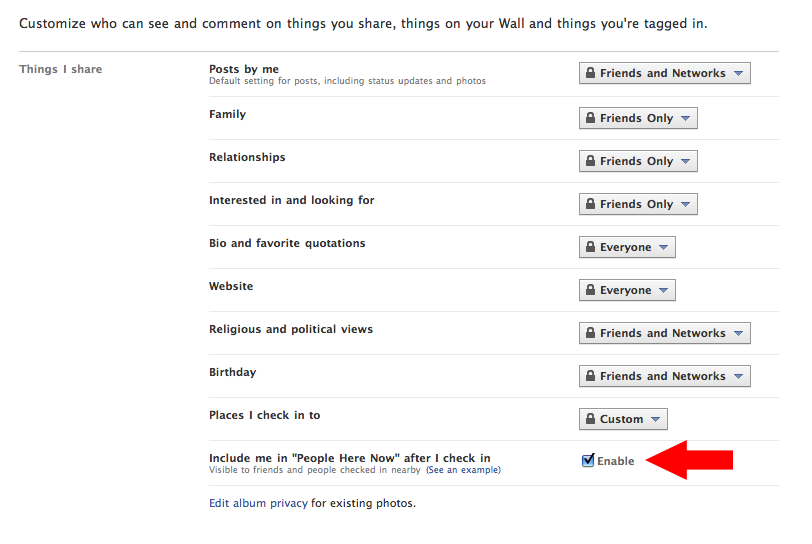
    Step one: Go to the Privacy Settings tab in your account settings. Here’s the link. This is an overview of all of your general settings.
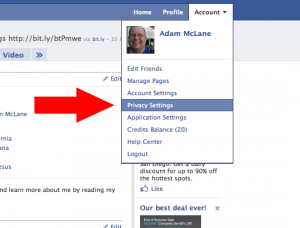
    Step two: Click on “Customize Settings.

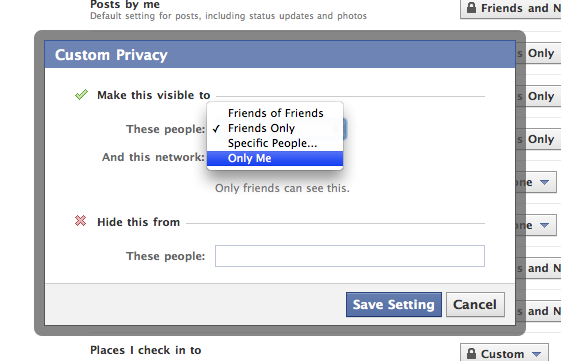
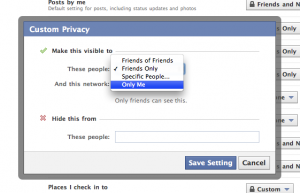
    Step three: Scroll down to “Places I Check In To” and click “Customize.” This will bring up a box where you can select exactly who you want to see where you check in at. If you just want to play with it to get used to it, but don’t want other people to see it, change it to “Only Me.” Changing it to “Only Me” is as private as it gets if you want to check in places. You’ll notice you can also block specific people from seeing where you check in at. Think about who you want to block specifically and list them there. When you are done click “Save Setting” and you are done with this step.
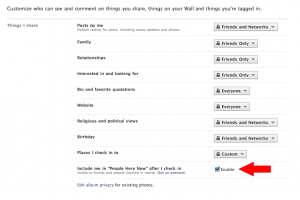
    Step four: Enable or disable the “Here Now” feature. If this whole thing creeps you out, I’d suggest disabling this setting. But also keep in mind that if you want any of the cool freebies that retailers/restaurants may come up with for checking it, you’ll need to keep this enabled. (I’ve gotten plenty of free stuff by checking in via Yelp and even Twitter.)
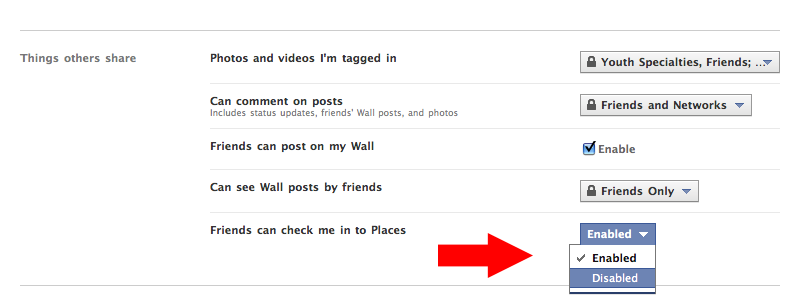
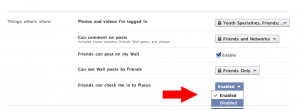
    Step five: Scroll down to “Friends can check me in to Places.This is probably the feature that will get the most people in trouble and will make people the most angry. Say you sit down for lunch at work with a co-worker. You check in and you tag that person as being with you. Now, if you didn’t have that persons permission, all of their friends know that they have checked in at a place because that check in posts to their wall. Also, if they haven’t adjusted their settings in step four, now anyone on Facebook at that location can know they are there. On the other hand, if you feel good about your selections on step three than this is no big deal.
    Done. You can go back to your profile, having adjusted your Places privacy settings to your liking.

    What does Adam recommend?

    Bear in mind that I’m a pretty open person. But I still value some levels of privacy, particularly because I’m a husband and father. Truth is, I don’t even anticipate using this feature unless I’m somewhere cool and want to brag that I am there.

    Here’s my selections for the steps above:

    Step three: I’ve selected “friends only.” I do wish I could select by groups of people. Because I have a friend group labeled “People I Haven’t Met Yet” and I’d prefer that they couldn’t see my location. But until Facebook fixes that, I’m going with “friends only. UPDATE: If you have a friend group you’d like to exclude from your check-ins, you can just type them in the field “Hide this from these people:Here’s what it looks like on my privacy settings page.  I’d recommend NOT choosing “friends of friends” because that basically opens up your location to anyone in the world.

    Step four: I’m a big fan of getting free stuff. So I’m keeping this enabled because it doesn’t bug me and I’ve enjoyed many a free meal. There will soon be lots of iPhone applications that call to this so I want to see where it goes.

    Step five: I feel pretty good about step three. And I also feel pretty good about the places I go and the people I go to them with. So I’m going to keep this enabled for now. Let me tell you though, if someone false checks me in somewhere shady and we’re going to talk. This little feature is going to land a whole heap of people in a whole heap of mess. So, if you aren’t sure about all of your friends, I’d recommend disabling this one.

    Some Places Etiquette

    1. Never, ever, EVER check-in at home. I want to hit people in the shins with a hammer when I see that. Not only are you broadcasting to people where you live, complete with Google Maps directions, you are also telling people that you are home… and when you check-in someplace else, you are tell them YOU AREN’T HOME! Dumb. Dumb. Dumb.
    2. Only check-in at public places. Just like it’s dumb to check-in at your house, it’s really rude to check in at your friends houses. Checking in at a private residence is rude, even if the person says they don’t care. Just don’t do it.
    3. Always ask before checking in your friends. It’s just polite. Maybe they don’t want their friends knowing they had a latte while at work? Just ask.
    4. Check-in sparingly. I know it feels like a game. And games are meant to be won, right? But if you check-in to places 20 times a day you look really, really lonely. My rule is that I only want to check-in places that I think are cool. Sea World? Cool. The local gas station? Not cool. Since I like tiny, family-run businesses… I’m going to check-in at a lot of those because I know it helps them out. I think mom and pops are cool.
    5. Be weary of promotions. With 500 million users and integration into Google Maps retailers are going to go nuts trying to get you to check-in. (As a Google Adwords user, let me tell you… Google is going after us to do promotions!) Don’t be surprised to see deals popping up everywhere. A check-in deal is fine to me. But if I have to tag a bunch of people or write a specific status update to save $5… that’s too far. Don’t subject your friends to that.
    6. Never check-in anywhere after 10:00 PM. Remember when mom said that nothing good happens after 10 PM? If you are out with your friends, it is just better to not check-in. Nothing good is going to come of it.
    7. Remember: Everything you post online is public! All check-ins, all that GPS data, all those tags, all those status updates… they are ultimately public information. You parents can see it. Your boss can see it. The college admissions office can see it. Your significant other can see it. Your future mates can see it. Your children will be able to see it. Even if you’ve made all of your settings private, that data all ultimately belongs to Facebook and they can do with it whatever they want. (And it could always get stolen from them!) If you don’t want those people to see it… don’t post it.
  • A new kind of missions trip

    I’ve been on a lot of missions trips. But never one that was three dimensional before.

    The three dimensions of the Haiti trip:

    1. Going and experiencing for myself.
    2. Using Twitter and Facebook to tell stories live, sharing pictures and videos with thousands around the world.
    3. Watching the experience change my friends while they participate in the trip from their living rooms, offices, and cars.

    Here’s how this scenario played out over and over again.

    We would load up the team van and head to a destination. Whether it was a meeting of pastors, a prayer meeting where thousands spontaneously had shown up, or walking around a devastated community and meeting people effected by the earthquake.

    All of a sudden, my iPhone became a powerful ministry tool.

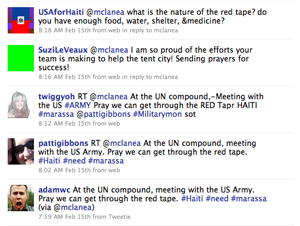
    I would post on Twitter a simple message.

    And instantly, my friends were engaged in what we were doing.

    As free moments were available, often times while walking or driving from one place to another I was able to update my Facebook status or post a tweet so that people could continue to pray for what we were doing… and more importantly join in the story of what God was doing.

    It’s important to note that this wasn’t a distraction from what I was doing on the ground. I was deeply engaged in the moment. But as free we walked from one place to the next or as we drove, I was able to utilize that otherwise down time as ministry time. Doing these things didn’t distract, they amplified what we were doing.

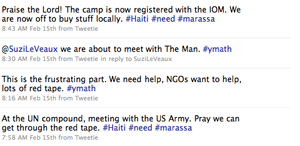
    Thanks to the power of Twitter retweets and hastags, there were now hundreds of people engaged in our ministry, watching every step of our journey. People gave us advice. Sent us links. Added our efforts to databases and websites. Encouraged us. On and on. This was missions far different from what is documented in Acts, when reports from missionaries trickled in from letters!

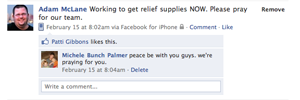
    As the need for more specific prayer arose, I was able to update these friends… who were now looking for ways to pray for our team.

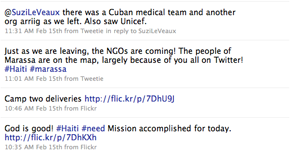
    Read the updates from bottom to top, in sequential order

    At this point in our day, I was in hog heaven. This was the convergence of all of my favorite things. I was engaged in social action as we advocated for people. I was engaged in social media as my cloud community prayed and sought solutions for the problems I was experiencing on the ground. And I was engaged as a pastor as we prayed and worked with people in the camp.

    And social media was also documenting a miracle. (and my getting punk’d by Marko!)

    Little did I know that the three dimensional missions we were doing had taken on legs of its own. My friend Tash was updating her radio audience in Auckland, New Zealand with my Twitter updates so people could pray. Tons of people retweeted and added commentary . Literally, people around the world were following this story and about to see God do something amazing.

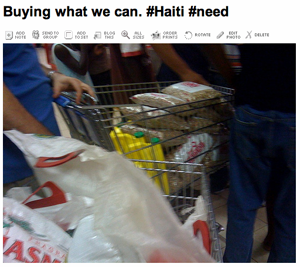
    Using $2000 we had raised on Twitter the night before. We were able to go to the only supermarket in Port-au-Prince and buy nearly all of the rice, beans, and baby food they had. (The money was given one day, utilized the next!)

    While hundreds of people back home participated in our journey, we were able to continue pressing into what God was doing.

    I don’t think this is somehow the beginning of a new age of missions engagement, but I do know that for our team this was a powerful way to tell stories as we went and amplify/report on what God was doing.

    As a fellow youth worker, I know thousands feel compelled to respond to the humanitarian need in Haiti. But the concerns of safety and appropriateness will over-power the prompting of the Holy Spirit to take a team for most. (This is a faith issue, but that’s another blog post.)

    It’s my hope that this new variety of missions will embolden many more to pray for Haiti, give to NGOs doing good work on the ground, and go to Haiti to see for themselves what God is doing.

  • My 3 Caddy Rules for Ministry

    caddy
    CC 2.0 jenni40947 via Flickr

    I’m a golfer. I’ve played the game off and on most of my life. More importantly, I love being around golfers.

    There is a joke among golfers that there are just three rules to a caddy’s job. “Just show up, keep up, and shut up.

    That’s really how I feel about our burgeoning youth ministry. I’m just trying to show up, keep up, and shut up.

    Show up

    Let’s be real. As a volunteer that is 85%. I want to get there on time, be ready to join in whatever needs to be done, and be present emotionally.

    Keep up

    I’m learning. Tonight I came home feeling good because I felt like I learned a bunch of the kids names. I feel like I have a ton more to learn so that I feel like I’m actually contributing. I’ve got to keep up.

    Shut up

    The kids in our ministry could care less what I do for a living, how long I’ve been in ministry, or anything else. I just need to shut up and be there for them.