Tag: youth ministry

  • Lie to me, baby

    Maybe we are just a little too authentic in youth group?

    Last night, our high school ministry night met. We were down a couple of adults and up a few students. Actually, the night felt right at that balance between “out-of-control” and “in control” that is some of the secret sauce of youth ministry.

    As I struggled to push my table group through a Bible study they clearly weren’t interested in I was feeling a little heart tug in a couple of directions:

    • I need to push these students through this study on Psalm 19, this is God’s Word… and David was describing some really cool stuff they need to know.
    • I need to pull the plug and call an audible. There’s something serious going on that’s more important than Psalm 19 right now.

    Instead, I decided to just let it ride. We half-pushed our way through and half-let them stay easily distracted and unsatisfied. I resisted the urge to either side.

    I’ll never know if I did the right thing or the wrong thing. But I do know I came home deflated and frustrated. Again.

    Another time, another place

    I’ve been thinking a lot about the purpose of Tuesday nights in our group’s life. On the one hand, we want to “keep it real” and be authentically who we are. But my problems aren’t their problems. And my students already deal with more crap than they can work through in a lifetime. So I’m not sure “being authentic” about a lot of stuff is very helpful.

    Nearly all of my students have spent some time in foster care. Nearly all of my students have at least one member of family member who struggles with drug addiction. Only 1-2 students have a dad in their lives. More than half have experienced some level of physical or sexual abuse. Most scrape by academically.

    At 15 years old most of them have lived a lifetime of grief.

    At the same time they deal with all of the normal pressures, temptations, realities, and burdens of being a high school student.

    They don’t want to keep it more real. They want to keep it less real.

    Maybe instead of dealing with the realities of life… Tuesday night should be an escape from all of that?

    When you desperately need a new life “being authentic” just feels like you get dragged back into the quick sand you’ve just escaped.

    A little less authenticity replaced with a glimpse of Fantasia?

    Maybe Tuesday night would be better if it were kind of an other world experience? A healthy escapism? A place that intentionally disoriented students from their own reality and allowed them to escape to another reality for a night? A place in which at some point, on the way home, they questioned… was that even real?

    Maybe youth group should be more of an escape? Sure, one on one or in small groups or in other high trust situations… we can go there and deal with that stuff. But when we gather as a large group I’m questioning the value of creating an authentic experience when a fantasy one is so much more desirable.

    For discussion: I’ve used my own group as an example. But the reality is, youth ministry-wide, the pendulum has swung back and forth about youth group nights as a whole, about the youth worker being more authentic with their struggles, about sharing in small groups about life stuff vs. Bible study groups, etc. What do you think? Is it more useful for students to have a place of deep authenticity? Or is it more useful for students to have a place of escape to play, worship, and laugh?

  • Slides: Doing youth ministry on the move

    This is a presentation I made last month at the East County Youth Workers Network meeting. Maybe it’ll be helpful to you.

    Here’s some of the content that goes with it.

    Slide 1:

    With the rapid adoption of smart phones, iPad, and hundreds of thousands of cheap/flexible apps being developed, I am quickly seeing youth workers realize that they can do more on the go than ever before.

    My prediction is that we will begin to see more and more youth workers go officeless in the next five years.

    For years we have lamented that we didn’t go into youth ministry to be a desk jockey. Finally, the technology is there (and affordable) to the point where we can be in the field full-time, working with teenagers where they are.

    Slide 2:

    This stuff isn’t going to go away. So rather than whine about the impact of media, I recommend going on the offensive and doing our best to educate parents and students on best practices of a digital life.

    For students:

    • Technologies that take off for students are really all about them and their life. From an adult perspective that sounds entirely selfish. (Because it is self-centered) But we need to remember that adolescents are developmentally limited to only think about life from their perspective. So when talking to students about technology, bear this in mind. Teach them things that will make them look good.
    • Trend-wise, I’m still seeing tons of activity amongst students on Facebook. At the same time, text messaging is infinitely more private and infinitely move mobile-friendly. So texting is still king. But I’m also starting to see pockets of students taking to Twitter. They aren’t using it in the way adults are though. They tend to have tight-knit clusters of friends who all have private accounts. For them, it’s a group texting service.
    • Lastly, it’s important to realize that students are students… they are still learning. Which means you need to teach them what to do and why. There’s been a lot of talk about sexting, I think a big reason it is getting so many people in trouble is simply ignorance about how digital files can go viral and how something so innocent and sweet can do a lot of damage to you for a long time. Yes, I said “sweet.” I think a lot of guys/girls are exchanging pictures to flirt. They just don’t have the same boundaries you or I do.

    For parents:

    • Technology is not bad. By it’s definition, it is neutral. It’s what you do with it that makes it good or bad.
    • This stuff isn’t going away. You don’t have to be an expert to be a good parent. But you can’t pretend it’s not there any more than your parents pretended they didn’t know what to do with your beeper.
    • I’m not a big fan of filtering the internet. I really feel like that creates a false sense of security for parents. And if you ask any kid over about 10 years old, they know how to disable the filters at school. I’d rather see parents focused on teaching good practices like only using computers/smart phones in public areas of the house.
    • There’s an assumption that if you don’t know more about the technology your children are using that you can’t teach them how to use it appropriately. That’s just not true.

    Slide 3:

    Let’s turn from technology use to how you can use technology to become more a productive youth worker.

    Slide 4:

    If you want to ditch your office, you’ll need to transition to cloud-based applications. All that means is that your data no longer lives on a single computer in your office or on your laptop, instead it is stored in a web-server and is accessible anywhere you have web access, on multiple devices. (Phone, laptop, even a guest computer with an internet browser.)

    Here are some cloud-based tools I’m using right now that make me more mobile:

    • Evernote – A note-taking app that syncs with all of my devices. I’ll never say “ugh, that Word doc is funky” ever again.
    • Springpad – This also has a note-taking feature. But I use Springpad for bookmarking web-content I want to come back to later. (Here’s my account) This is also amazingly helpful for event planning, meal planning, shopping lists, etc. It’s HTML5 based, which is just nerd-speak to say that it’s built to work with any web-enabled device and isn’t limited to iPhone or Android on the mobile side.
    • Dropbox – I store all of my important files on Dropbox. It allows me to not only access them from anywhere, it also makes it super easy to share. Dropbox is great if you have multiple people working on a worship service or something like that. Everyone can just save their work in the same folder and everyone can continually have access to the same stuff. I never use our work server anymore. Everything is on Dropbox.
    • Google docs – The original big player in the cloud-based app world. I use Google docs for any document I’m going to collaborate with others on. It has all of the same features as Microsoft office, except it lives in the cloud, is free, and you can add multiple authors in a jiffy.

    Slide 5:

    Larger ministries tend to move quickly into a project management mode. This just means that one person isn’t responsible for an entire project… they have to collaborate with multiple people. Most of my work at Youth Specialties and McLane Creative is tracked through project management software in an attempt to keep all of the knowledge out of our email system!

    Here’s three that I’ve used.

    • Basecamp – This is the gold-standard project management utility. It has lots of deep features, is mobile-friendly, and if you are working with outside contractors there is a good chance they are familiar with how to use it. Everyone uses it! The downside is that it isn’t free.
    • Google groups – Google groups has many of the same features as Basecamp. It has just never taken off in the project management world. I don’t really know why. You can use it in much the same way, and it’s free.
    • Collabtive – I use Collabtive at McLane Creative for project management. It’s very similar to Basecamp, is free (open source) and lives on my webserver. That said, it’s not a novice utility to administrate. So if you don’t have someone confident with PHP, mySQL, and available space on a webserver, it won’t work for you.

    Slide 6:

    Last but not least, here are some other service worth looking at to improve your communication with parents, students, and your team.

    Text-based

    • Groupme – Groupme is a free, group-based, text messaging service. I’ve used it a little and really like it. Essentially, you just add people to a group, the group is assigned a phone number, and people can text the groups number and instantly notify everyone else in the group. The upside is that it’s free and full of potential. The downside is that it’s “reply to all.” If you wanted to try this out I’d recommend trying it with your adult volunteer group first. It could get crazy with a large group of students… fast!
    • Google voice – This is basically an alternative to giving your students your phone number to text. Google voice is 100% free, has a mobile and web interface, and works great. Another cool use for this for youth workers would be that it’s pretty easy to share responsibilities for responding to texts with your team.
    • Tatango / SimplyTXT – Both of these are fine if you are looking for more of a professional grade group texting service. Both are great and both cost money.

    Other online communication apps for youth workers

    • Facebook groups – Groups recently got an overhaul. There are some cool features there for you. It’s basically a profile for your ministry. The upside is that there’s a high likelihood all of your students are already on Facebook a lot and familiar with it.
    • Mailchimp – Email is not dead. Mailchimp is the industry leader in email marketing. What I love about Mailchimp is that it isn’t just an amazing application… it’s free for lists under 2,000! (Which would be nearly every youth group in America!)

    Got questions? I’ve got answers.

  • Hope reigns over youth ministry

    Hope makes humanity unique.

    No matter how bad things may look, you can always choose hope.

    Hope is the reason a widow can smile at her spouses funeral. And hope is the reason a woman living in a tent can shock you with a smile and call out to God with thanksgiving when she is destitute.

    Hope is the fire that brings warmth to your heart during your darkest hour.

    The way I see it, hope is winning in the lives of many friends in youth ministry right now.

    The last few years have rattled us to our core as two realities crushed our confidence:

    1. We realized that the way/methods/modes we experienced youth group and even came into a relationship with Jesus weren’t effectively reaching the students in our lives in the ways or with the veracity we had grown used to.
    2. The economic crisis changed, foundationally, the way our ministry was financed. Many of us lost our jobs or were forced (or given the opportunity) to take on additional responsibilities in the church.

    While, from a humanist perspective, those crushing realities should have devastated youth ministry, I think it has made youth ministry better. When circumstances should have snuffed out the dreams of our heart, hope blew a steady, gentle breath onto the embers, igniting the flame once again.

    From my perspective this last period of youth ministry has brought about two amazing things which I aim to demonstrate more vividly in the months to come:

    1. Youth ministry was never truly about a model anyway. Youth workers have created fresh ways to share Jesus’ love with adolescents built on the best practices of “what we grew up on” and melded into the needs of individual communities we serve.
    2. Youth ministry was always a calling as much as a vocation. When the money got cut back and even when people lost their jobs– they still chose to minister to adolescents because that is who they are more than what they were hired to do.

    So, here we are! We have run the gauntlet and survived! Circumstances can not snuff out hope!

    I am snubbing my nose at those who have declared youth ministry dead. Swooned? Maybe. Knocked down? Definitely. Humbled? You bet.

    But giving up? Never.

  • Two positive trends in youth ministry

    I’m on the tail end of a one week tour of the East Coast. (Catching up with youth workers; talking about PlanetWisdomYS Palooza, and all things youth ministry.)

    One of the things I like to do when I meet with youth workers around the country, whether individually or in a group setting, is ask the same two questions. I frame the question differently depending on the group. But these are the two questions I’m asking and comparing answers to others to see if I can sniff a trend.

    1. What is a new problem you are facing in your own youth group in the past 12 months?
    2. What are you doing that is making a difference?

    For question #2 I am continuing to hear the same things all over. While I heard these in 2009 and 2010– it wasn’t emerging quite as strongly as a trend until this trip.

    For me, it’s very exciting because the two trends that I’m seeing are actually quite healthy and sustainable.

    First trend: Bigger churches (Congregations of 1000+) are continuing to see their youth ministries grow numerically. They are reaching more and more students. (Largely unchurched) And their ministry is asking hard questions which shape how they minister to students, parents, and train their teams. The lead youth worker at these churches are typically highly experienced, highly trained, and exceptional at both leading staff teams and replicating themselves to maximize impact & set-up long-term impact.

    Second trend: Smaller churches (Congregations of  >500) are ditching models altogether and approaching their ministry from a more missiological perspective. They are saying things like, “We still meet on Wednesday night, of course, but I have a small group of guys who get together every week to visit a homeless shelter. My students won’t bring a friend to Wednesday night– but they are bringing 2-3 to that.” Even if they aren’t articulating it in words quite yet, they are saying that the traditional ministry model they grew up on is fading in effectiveness. As such, they are adapting by maintaing status quo while finding new ways to reach students while meeting a real need in the community. I’d label this a shift from meeting felt needs to meeting obvious needs. Meeting actual needs is leading to growth and they are forming their ministry around those areas of growth… which look very different in every community.

    The hallmark of both big & small of these are the same— their spending, dollar per student, is quite low. Bigger churches have staff spread over large numbers; smaller churches lost their paid staff due to the economy and are adapting their ministry to a much cheaper model.

    The uncomfortable middle

    The pain seems to be in the middle. What I label “medium-sized churches” of 500ish-1000ish are all over the place. Some are fine while some are in crisis mode. I can imagine that their dollar per student ratio is high enough where they are feeling a big pinch. They seem to be feeling a lot of pressure as their midweek program isn’t doing as well, (a hallmark of a smaller church) they are too large to invest their time finding a pocket of mission that would likely lead to new students coming into the fold, and they don’t have the money to go to a staff-size that might take them into that big church team model which would likely put them into growth, as well. This is the size church where I’m seeing lots of people lose their paid staff jobs. This is also the size church I’m hearing that the leaders (church wide) are shifting to a model like their favorite megachurch.

    Quick disclaimer: I’m not a sociologist. (But I did stay at a Comfort Inn last night.) And I don’t have hard data for things I’m writing here. [This is my blog…] These are notable things I’m learning by talking to youth workers around the United States. Feel free to engage with them, but don’t assume that I’ve got data to back this up or that this is some sort of scientific process. I’m labeling a trend as something that just keeps coming up without my prompting.

  • Interview with Youth Worker Journal

    That's me in the photo. That's what my back yard looks like. I only wear the wig on weekends.

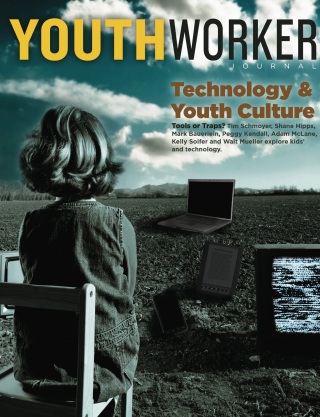
    A few months back I was contacted by Jennifer Bradbury at Youth Worker Journal about doing an interview on teens & technology. I’ve done a number of articles for Immerse, but this was the first thing I’ve done for YWJ, and it was fun for me. When the arrived at the YS offices I made sure everyone saw that my name was on the cover… and no one cared. My own children just kind of shrugged their shoulders. I’m big time in my own mind and I suppose that’s all that matters. Megan, my 9 year old, told me that I wasn’t a big deal unless I did a book signing at Barnes & Nobles. At least I have that to shoot for now.

    Also in this panel discussion were 3 smarter people than I. Shane Hipps, (Mars Hill, Grand Rapids) Mark Bauerlein, (Emory University) and Peggy Kendall. (Bethel University)

    Here’s my portion of the interview. Read the others responses here. I’d love your thoughts in the comments.

    YouthWorker Journal: How is technology shaping young people’s spiritual lives?

    Adam McLane: Technology always has shaped spiritual lives. What we’ve seen has been a change in devices that’s affected how people grow spiritually. People are involved in conversations via texts and Facebook that have devalued the interpersonal relationship.

    YWJ: Which aspects of technology are most important to teens?

    Adam: As they look for their own identities, teenagers tend to be attracted to things they can personalize—Twitter, My Space, Facebook. Those become extensions of their personalities.

    YWJ: How do Facebook and social networking influence teens’ understanding of their identity?

    Adam: It feeds our nature to self-gratify. Adolescents hunger to find out who they are from a third person perspective. Social networking gives them a false perspective. People are flippant on Facebook. It’s hard to distinguish between a compliment and what’s sarcastic.

    YWJ: How does the information that teens have access to through technology impact their understanding of authority?

    Adam: We should train students constantly to question authority in respectful ways. Technology allows truth to be validated because students can look it up.

    YWJ: If much of technology results in instant gratification, how can we teach kids the value of waiting?

    Adam: We have no concept of perseverance or what it means to wait. We get upset when we can’t access the information we want right now. This definitely affects how we process things spiritually—in a bad way. Youth workers and parents need to teach kids to be patient by teaching self-discipline.

    YWJ: How can youth workers use technology to minister to teens?

    Adam: I’m an old school youth minister, trained to do contact ministry. Go where kids are. Engage kids on Facebook and by text because that’s where they are.

    YWJ: What else should we know?

    Adam: The church always labels new things as the enemy. Today, it’s Facebook. Tomorrow, it’ll be something new. However, technology is never the enemy. The fact that people are talking about the church online—in positive and negative ways—is good.


  • Right Coast Bias

    I’m sitting in the airport, headed to the east end of our fine country. My goal for the next 6 days is pretty simple:

    • Meet up with as many youth workers as I can over the next 6 days.
    • Talk until I’m blue in the face about two ministries I’m 1000% behind- PlanetWisdom [students] and YS Palooza [adult volunteers, parents of teenagers]

    Here’s my rough schedule. If you’re in one of these areas or somewhere reasonably in between. Let me know… I’d love to grab coffee. (Or crash on your couch)

  • Retreating

    A couple weeks back I wrote about our free retreat. I just got back. It was a quick, but profitable time.

    I’m more convinced than ever that when you are good news first, not only will the Good News be received, but the news of Good News will spread like wild fire as a result.

    Last night the whole group shared some intimate details of our story. At the core we found a deep need for our Heavenly Father to step in and our desperate need for our community to become our family.

    There is great hope, there. To have a heavenly Father that literally can’t betray you, leave you, and is bound to never forsake you is a promise too important to miss.

    Half of my brain is thinking, “Wow, we’ve stumbled on a great way to minister to hurting teenagers.” But the other half of me is thinking, “Wow, we’ve stumbled on an amazing way to minister to every teenager.

    Our culture is wounded and destructive. But praise be to God that these wounded students cry out to God from Genesis 50:20, “You intended to harm me, but God intended it for good to accomplish what is now being done, the saving of many lives.

    I’ll unpack that more another day.

  • Choosing a new identity for youth ministry

    Choosing a new identity for youth ministry

    Disorganized. Uncommitted. Unreliable. Unprepared. Unprofessional. Immature. Hot-headed. Last in, first out. One-dimensional. Sloppy.

    Youth pastors are disposable.

    These are the words used to describe our profession by outsiders.

    Youth ministry needs a makeover. While that makeover may need to include some changes in strategy this is really a makeover of something far more important than how we look.

    If this were a marketing issue some would argue that we need to think about re-branding our profession. (Kind of like airline stewardesses became flight attendants.) You are already seeing some people try to shift their verbiage to say, “I’m a student pastor.” But that’s not the kind of makeover I’m suggesting.

    I don’t think we need to change the name of our profession as it serves us well. Ultimately, this isn’t a marketing problem.

    We need a new identity.

    See, the list of things I posted above aren’t really true for most youth workers I’ve met. And while you could throw up your hands and claim that a small number of people are giving us a bad name I don’t think that this is the problem, either.

    But let’s be honest for a minute. There really is a little bit of truth in all of us within those descriptions. Just like there is probably the same amount of truth in that with each person on the planet.

    What I mean by “we need a new identity” is that we need to think of ourselves differently.

    As I engage with oodles of youth workers each year I’m a little bit disappointed how the things above are actually how many in youth ministry think of themselves and are even proud of it. There’s a certain arrogance in saying things like, “Yeah, I don’t dress like a normal 29 year old.” Or “Of course I was late, I’m the youth pastor.

    The stereotype we have created for ourselves, created our persona around, and even forms the identity of our community doesn’t accurately reflect the work that we do or the work professional youth workers do.

    We’ve type casted ourselves and it is killing us from the inside out.

    This is a thinking issue more than it is a reality issue. We in youth ministry need to start thinking of ourselves differently. We need to apply some sober judgement of ourselves and think about ourselves and our ministry in more positive ways.

    Most youth workers are hard working, loyal, loving, thoughtful, amazing people. In fact, most of the people I know who work at churches and parachurches are actually inspiring to be around.

    There is a difference between not taking yourself too seriously and not being taken seriously. There’s an important distinction between having a fun-loving attitude and loving to be made fun of. And there’s a big difference between being uncomfortable with the respect people naturally give pastors and feeling comfortable with a certain amount of disrespect.

    It’s my prayer that those who call youth ministry a profession would aspire to a new level of sophistication. I hope that we shed our whiney exterior and instead identify ourselves as faithful, creative, passionate servants willing to do whatever it takes to reach this generation with the Good News of Jesus Christ.

    Join me.

  • Level of Difficulty

    Does your skill level match the level of difficulty in your ministry?

    I’ll admit it. I’m a recovering video game junky. Up until Madden 2005 I used to incessantly play anything football EA Sports produced.

    One of the fun things about the Madden games is that you can adjust the level of difficulty to match your skill level in the game. So, if you were new, you could set it to easy and still have a good time. Then, theoretically, as your skills improved you could turn the game up so that it remained challenging.

    One of the great injustices in the ministry world is that there is often a disconnect between the skill level of a staff member and the level of difficulty in a ministry setting.

    In general, those who have a low skill level (new to ministry) are only able to get jobs in ministry locations labeled difficult or expert. Meanwhile, veteran church workers tend to flow towards jobs on larger teams in healthier ministries where the level of difficulty is significantly better matched to their skill level. (Not easy, per se. But ministries which match their skill level.)

    In the past few years I’ve had countless conversations with pastors in way, way over their head. They’ve been in ministry a short amount of time and are in situations with no support, politics leaning hard against them, and socially isolated from people who think like them. They slump their shoulders as we sit down for breakfast, “Adam, am I crazy? Why does serving Jesus hurt this bad?

    Why are these people hurting?

    Because they are in ministry settings where the level of difficulty is a miss-match.

    The Way it Works

    We have a Darwinian approach to ministry jobs. Our church culture dictates that the newest, greenest, and least capable among us serve at the gnarliest of ministry sites. A youth pastor takes her first time job, replacing a youth pastor fired for sleeping with a student. A worship pastor hired from a larger church to lead a ministry from traditional worship to contemporary. A senior pastor right out of seminary replaces a long-tenured wise owl who retired after 40 years of successful ministry. A children’s worker will accept a calling to a church plant where they have to go out and raise their support while somehow trying to create a children’s program from scratch.

    All expert level ministry jobs performed by newbie staff members. They don’t stand a chance.

    A large majority of these newbies will get washed out of their first jobs in the first 2-3 years. Battered and bruised, about half will lick their wounds and find non-ministry vocations before they’ve even paid off their seminary loans.

    Yet, a small minority will learn their lessons from these impossible ministry situations and move to more healthy levels of difficulty. Eventually, through survival of the fittest, a small minority manage to work their way into roles that are matched with their skill level… or maybe a little mismatched so that they are in jobs significantly easy compared to their skill level. (You know who you are.)

    In other words, those of us with high levels of expertise gravitate to the easier jobs while our success in roles made to look easy encourages countless others into the flames of despair at the hard jobs.

    The Way it Ought to Work

    Ministry experts should flow to the expert level jobs. Jobs in healthy ministries should hire more newbies for shorter periods of time in order to increase their skill level and help match them with jobs that best suit their long-term skill level and interest.

    This would perpetrate a mantra of healthy churches helping unhealthy ones instead of visa versa.

    But that would be too much like right.

  • What Would Judas Do? Moralistic Therapeutic Deism and You

    The youth ministry world is wrestling through the ramifications of what Christian Smith coined as Moralistic Therapeutic Deism.

    What is MTD?

    After interviewing 3,000 teenagers, the authors found that many young people believed in several moral statutes not exclusive to any of the major world religions:

    1. A god exists who created and ordered the world and watches over human life on earth.
    2. God wants people to be good, nice, and fair to each other, as taught in the Bible and by most world religions.
    3. The central goal of life is to be happy and to feel good about oneself.
    4. God does not need to be particularly involved in one’s life except when God is needed to resolve a problem.
    5. Good people go to heaven when they die.

    Link

    Since the original study came out about five years ago, youth workers have been scratching their heads, more research has been done, many books/articles have been written, and essentially we are all just trying to figure out both how we got to this point and how we can rebuild our ministries in ways that combat this.

    As a simplest– I have often wondered if MTD in our students may be related to MTD in their youth pastor? In other words, are we even willing to consider that our own relationship with Jesus  (or lack thereof) may be leading students to follow our lead into MTD?

    As I look in the mirror I am left to ask myself and my fellow youth workers some difficult questions.

    • Is youth ministry my vocation or is it my calling? (The latter isn’t an independent evaluation)
    • Am I still passionate about my relationship with Jesus?
    • Do I still love and chose to be faithful the Bride of Jesus? (His church, all of it.)
    • Are my actions reflective of my first love? (personalize Revelation 2:1-6)
    • Am I setting expectations in my teaching that are realistic for my students walk with Jesus? (Am I teaching Scripture in a way that is approachable and personal?)
    • Do I consider myself a manager of a program or a minister of the Gospel?
    • Do I still have the passion for lost teenagers that I had when I dedicated my life to this cause in 1993?

    Let us look at ourselves with sober judgment and search our hearts; making adjustments and repentance a necessary part of that self-appraisal.

    As I minister to students it is always my heart that they pick up my faith.

    My fear is that in too many cases they are picking up a faith that is vastly different than the faith we want them to pick up.