Category: Tech Tuesday

  • Everyone Can Learn to Code

    Everyone Can Learn to Code

    “When did you learn to code?”

    I get asked this a lot. It’s not really a “when” question so much as it’s a “why” question.

    I’ve always been good at being able to figure stuff out. A few weeks back we bought curtains that were too long for our windows and I had to lean on skills from my 8th grade home economics class to figure out how to hem them. That’s kind of a normal thing for me. Do a little research, a little trial and error, a little asking for help, and I can figure most things out.

    This has been an attribute that I’ve come to rely on. I can always figure something out. I’ve done it twice in the past 24 hours.

    Why I Learned to Code

    That’s essentially why I learned to code things like websites, work with servers, etc. I learned because I had to figure it out. It didn’t look that hard and the cost of creating a website was more than the little churches I worked for could afford. (They complained about the $7/month we spent on hosting the website!) As I learned more I started to fiddle around with my own stuff, then I did a lot of that when we launched YMX in 2005. And from there it just kind of took off.

    I made things happen for YMX, then people started asking me for help, then I started figuring out that I should charge people for that. And then McLane Creative was born, we sold YMX to Youth Specialties in 2008, I learned more, we built stuff there, and when I left YS in 2011 I had a line of people asking for help.

    To this day I have never hung out the shingle and said I was looking for help on a website.

    And, right, I could easily make a lot more money building WordPress and mobile app properties with McLane Creative than I do with the Cartel if I really wanted to go after it. The only reason I don’t is missional. I wholeheartedly believe in the mission of The Youth Cartel and am dedicating all of my time to it.

    Why You Should Learn to Code

    Code literacy is the new literacy.

    Reason #1: Understanding Your World

    Whether it’s understanding the basics… HTML and CSS… or more advanced languages and syntaxes, so much of how our world operates and will operate going forward is driven by the code with runs the software which runs the devices. (From your cell phone to your fridge to your car to your coffee maker. It’s all

    To understand– even the basis for how a device works and what makes things tick— is to understand the very core of modern life. When you learn the basics of coding you get a behind the scenes look at how everything technological actually works and that opens your mind to both the limitations and possibilities that are out there.

    Reason #2: It’s a DIY Culture

    Allow me to let you in a not-so-secret secret. All coders help other coders, even beginners. Everything I’ve learned about coding or building websites (or businesses or hemming curtains) I learned on the internet. I’ve been to a couple conferences but I’ve never taken a traditional programming course. Everything I know about all of that stuff I’ve learned because I Googled “How do I ______.” And the truth is that some of the most successful programmers/coders out there are doing the exact same thing.

    I’d rather show you where to find the answers to your questions than you to pay me to do it for me. Why? Because in 2 months when you want to do something else, I don’t really want you to hire me again… I’d much rather you send me a link to your site and/or Github and say… “Dude, look what I did!

    Any time I’m approached about a project I first sniff out how much of the work they are willing to take on themselves. If it’s zero, I’m usually going to pass. And the more they are willing to do and learn, the more I get excited. That’s a core tenant of the Open Source community. We are all contributors, we are all bug fixers, we are all coders, we all have ideas, we all try stuff, we all make ourselves experts but helping one another out for the sake of making the community better.

    Reason #3: There’s Unlimited Opportunity for Growth and Income if You’ll Learn to Code

    I’ve already shared that the only thing holding me back from unlimited income in the WordPress world is that I’m dedicated to another mission.

    This makes me think of a guy like Scott Bolinger, who has been a part of the WordPress community here in SoCal for a while, you’d bump into him at meet-ups and WordCamps, who was developing for other people and (I think) doing a bunch of freelance stuff. Then about a year ago he started working hard on this idea of connecting an existing code base for mobile apps to the core code base of WordPress. If he could figure out how to marry the two, people would pay to license that bridge and be able to launch and operate iOS and Android apps using WordPress. (WP currently runs about 20% of all internet sites.)

    In December, he wrote about AppPresser becoming a product that was generating $30,000 a month in sales. I think anyone can look at that product, with limitless potential on reaching 20% of all internet websites, and go… yeah, this could easily be something generating $100,000 in monthly sales very, very soon.

    I’m not saying that you can go from making $0 a month to $100,000 in a year. But I am saying that if you’ll take the time to learn some skills in coding, you can very easily teach yourself skills to do your present job better or easily go from $0 – $1000/month. Quite simply put, there are far more jobs out there for even entry level coders than there are people to do the work.

    How You Can Learn to Code

    I want to point you to three learning opportunities, all are free.

    1. Codeacademy Hour of Code – I love what Codeacademy is doing! Take this entry-level 1-hour course on your phone or desktop… I think this should be compulsory for everyone. So far 24,000,000 have taken a free course on Codeacademy. If you know someone who is between jobs or wants to try something on the side, you can learn more there in a week than elsewhere in a year. (I do lessons when I’m bored!)
    2. Harvard Open Learning Initiative – One of my favorite movie lines ever comes from Good Will Hunting. Will says, “you dropped a hundred and fifty grand on a *%@*% education you coulda got for a dollah fifty in late chahges at the public library. Well, the school Will was referring to now offers some of their classes to anyone willing to take them for absolutely free. How do you like dem apples? 
    3. Stanford on iTunes U – Stanford University, you know, the one right at the heart of the Silicon Valley, also offers online courses absolutely free to anyone willing. They were the very first to do so and I’ve learned a bunch from them about programming, specifically mobile apps. How about a lecture on Programming Methodology? It’s free. Or maybe you need some inspiration? How about a lecture series called Entrepreneurial Thought Leaders featuring guest lectures by some of the world’s premier experts? Free on iTunes if only you’ll press the subscribe button. How to Start a Start-up? You guessed it, free.

    Wrap-Up

    As I’ve said many times in many venues. We don’t have an unemployment problem in this country. We have an unemployable problem. If I knew the right person, right now in the right location, I’d hire them. I have several initiatives that are excellent, that’ll work, I just don’t have the right people and it drives me crazy.

    But I see far too many people having skills that I don’t need and very few with skills I do need. (Or willing to learn)

    Too many people think education is a barrier for them. Too many people think they don’t know the right people. Too many people think that they are too young or too old to be taken seriously. And too many people think that they can’t possibly need to know new skills because they are perfectly content doing what they are doing.

    Those are all barriers between what you are doing today and your potential.

    If someone is willing to learn every day, willing to be ambitious, and willing to ask for help… the American Dream is alive and well.


  • Social Media Safety and Security

    Social Media Safety and Security

    Uh oh. Something went wrong with several social media applications late last night.

    Hundreds of millions of people worldwide were unable to use Facebook and Instagram for around an hour today.

    Hackers from online group Lizard Squad have claimed they shut down the two sites at around 6am GMT – but Mark Zuckerberg’s social media empire says it was just a technical fault.

    Both sites, which have a total of 1.5billion users, appeared with error messages in the United States, Europe and Asia for around an hour.

    The social media blackout also affected the dating mobile app Tinder, as well as AOL Instant Messenger and Hipchat.

    Source

    It was amusing to watch as Twitter went into full-on State of the Union mode, the hashtag #FacebookDown adding faux drama and humor to the occasion.


    And while I joked about it there is the potential that this could be more than old man Zuckerberg is letting on.

    https://twitter.com/LizardMafia/status/559963134006292481

    Here’s what I know:

    • Facebook is a giant target with 1.4 billion monthly users. (20% of all humans!!!)
    • They are due to release their quarterly earnings report tomorrow evening.
    • Lots of people share lots of personal information on Facebook.
    • Even more use Facebook to login to a lot more apps.

    Let’s say it really was a technical glitch caused by the rollout of some new features. (Snapchat and Twitter also rolled out new features today, they indeed do have to keep up with the Social Media Jones’s of the world.) That’s perfectly possible and my only real reason to think otherwise is based on their being a publicly traded company, getting hacked would do bad things to their stock right before their earnings report… there’s a lot at stake for them. Enough to lie? Maybe.

    But let’s say Facebook was hacked and while the site was offline hackers ran away with a billion or so people’s personal information. What’s a user to do?

    Just to be safe, I’d recommend these two courses of action:

    1. Change your Facebook and Instagram passwords today. It only takes a few minutes and it never hurts to change things up.
    2. Turn on 2-factor authentication on any and every application you can. If you use Facebook to log into a bunch of things, do yourself the favor and turn this on now.

    If you’d do that you’re good to go either way. 

    Tech Tuesday Questions

    Rachel asks, “Why did you write the post, ‘Why You Should Delete Snapchat?’” 

    As someone who talks to parents and teenagers a lot about social media, I’m actually fairly slow to judge an application. I really dislike black and white answers. I originally wrote the post because at several different speaking engagements parents asked me what I thought about Snapchat. I put them off for several months because I was still analyzing it, so I would say “Keep an eye on my blog. When I know more I’ll write about it.

    So, a few months later, when the guys started suing one another about who came up with the idea and a bunch of their emails ended up in the public record, I was able to dig around some more. Snapchat was the first time I’ve ever told people… just don’t use it. And I’ll reiterate the two main facts of why I don’t recommend people use Snapchat.

    1. They lied to their users from day one about what does and doesn’t disappear. I wrote about it in August 2013 and in May 2014 they reached an agreement with the Federal Trade Commission where they admitted they mislead users.
    2. They are not good digital citizens. You see glimpses of it my original post, how they speak about women, things like that. But bigger than that and far more important. The operators of Snapchat know that a percentage of their application is used in the course of crimes. (Child pornography, prostitution, drug trade, etc.) But, unlike basically every other social media company, Snapchat does not make their data available to law enforcement to help put criminals behind bars. Every investigator or prosecutor in the United States knows this is true. And to me? That they would knowingly hold data that could put people in jail for terrible, terrible crimes… usually against their own target audience of young women… well, that’s reason enough for me to stand by my post and say, “I think every user should delete Snapchat. You might use it for something fun, but people are getting hurt. Bottom line: Your [probably innocent] activity on the app is helping to fund other people getting hurt.

    Julia from California writes, “Which is safer, Facebook or Snapchat?” 

    I wrote back to Julia asking for clarification on what she meant by “safer.” As in “safer doing what?”

    But here’s the answer: Neither are safe.

    When you use any social media application you are taking a risk. It’s in the applications best interest to convince you that your data is safe, that what you think is private will stay private, on and on. But never forget that this is a perception. Ultimately, anything you post online is public. As soon as you hit the “send” button on your phone or computer you have given up control of what happens to that message, picture, or video.

    That message could get intercepted. It is most definitely being monitored by, at least, the country you live in. (But potentially other governments) The person you send the message to could share it with others or use it against you. And the application itself that you are using could get hacked or sold or otherwise compromised.

    I don’t say that to freak anyone out. I say that to remind you, as a user, that the best thing you could ever do before hitting “send” is to make sure that what you are saying is OK to be seen publicly if it ever becomes public. If it isn’t? Don’t send it.


    Tech Tuesday

    Have a tech question for Adam? Each Tuesday I write a tech post. Submit your questions using the form on my site’s right sidebar. It can be about anything tech related, from social media to networking to life at home with wireless devices.

  • A Cord Cutters Survival Guide

    A Cord Cutters Survival Guide

    Every month, staring at me, were two television realities.

    One was a bill from Cox Cable for $155. The other was the simple fact that no one in our house, except me, watched television regularly. My older kids hardly watch TV at all. They watch tons of video on YouTube but almost nothing, without our prompting, on the bigger screen in our living room. Jackson, our 3 year old, watches tons of kids programming. But he uses the iPad to navigate to what he wants on Netflix, connecting to our TV with Apple TV. And Kristen? She’s never been into TV.

    When you take out our internet charges television equaled $91 per month.

    It was $91 per month for me to watch college sports, the occasional binge session of MTV’s Ridiculousness, and white noise like House Hunters International or CNN. (Since I’m confessing stuff, I have a man crush on Anderson Cooper.)

    Ninety-one bucks to watch college football and basketball. Mind you, I go to every home game of San Diego State football and basketball. So we’re talking about $91 per month to watch games I’m not vested in and away games for my favorite team.

    That’s $1092 per year.

    I had that number in my head for months. $1092. I knew I had to make a change… I put it off… but December 2st I finally made the call and cut our cable.

    How It Works

    Let’s get practical. It’s not like I’ve stopped watching live television. While cutting the cord (dropping cable) hasn’t been 100% smooth, it’s really just a different way of thinking about consuming entertainment.

    HD Antenna

    First, get yourself an HD Antenna. We got the Mohu Leaf Paper-Thin for $40. If you’re over 30 you hear the word “antenna” and you think about a tower next to your house or something you mount on the roof or even bunny ears sticking out of the top of your TV. Nah, it’s not like that anymore. Our HD Antenna picks up the basics in broadcast TV (NBC, Fox, PBS, etc) and it sticks to the back of the TV. It’s basically invisible and “just works.”

    Apple TV (or Roku or Amazon Fire TV)

    Next, get an Apple TV and plug it into an HDMI connection on your TV. If you have an iPad or a Macbook, you’ll want an Apple TV. Here’s why. It not only streams a ton of services like WatchESPN, Hulu, and Netflix, you can also use your iPad to watch tons of other video, like from Amazon Prime Instant Video, using the AirPlay feature. I find that we use AirPlay a lot because some networks stream things for free on their websites but don’t have an app, like CBS Sports. So I just set up the stream on my Macbook, go to my AirPlay settings, and boom… the audio and video are on my TV. Jackson (our 3 year old) does this all day via the Netflix and/or Amazon Video app on his iPad.

    Don’t use Apple stuff? My next choice would be the Amazon Fire TV, then the Roku 3. I’ve used both and they are great. I just like the Amazon device a little better.

    Subscribe to Streaming Services

    A quick note. If you’re just looking to score as much free entertainment as possible, I think you should stop here. An HD antenna and streaming device like Apple TV is probably going to be as good as it gets.

    But for me, while I don’t want the $91 per month I was paying for cable channels I didn’t want, there is still some stuff out there worth paying for. I have no problem paying for content I actually want.

    • Amazon Prime Instant Video – I’ve been a Prime subscriber for years, we do it mostly for the free 2-day shipping. But the streaming content on the video side is fantastic. Tons of backlist movies, plus lots of TV shows, kids programming, and lots of backlog HBO content. It’s $99 per year… but I don’t even pay this out of our entertainment budget since we get the free shipping.
    • Netflix – Two things I really like about Netflix. First, I like the new shows they are developing. While their movie selection has been shrinking as Amazon buys up their catalog, the new stuff they are developing on their own is great. (Both Amazon and Netflix were the big winners of last week’s Golden Globes.) Second, I love that there is tons of kids content and a special place for Jackson to go on their app to navigate to what he wants. Maybe that makes us bad parents, but JT will spend an hour (or three) per day completely on his own watching his favorite shows on Netflix. We pay $7.99 per month for a digital subscription, worth every penny.
    • The rest – I’m not into other services like HBO Go, Showtime’s streaming service, Hulu Plus, and the rest. But there are LOTS of options out there and new ones going out quite often.

    What About Sports?

    Let’s address the elephant in this blog post. What about live sports? It’s totally true that the selection of live sports for cord cutters is limited. Like I’ve already mentioned, we get access to most of the big games with our HD antenna. And, thankfully, ESPN also offers alternate views of their top programming. I watched the National Championship game last week on the WatchESPN app using a camera angle they called “the data center.” As a sports nut I actually liked this view BETTER than their broadcast version as it offered tons of stats in 3/4 of the screen and the game on the other 1/4. I’ve also watched a few basketball and football games with their spider camera angles and I have to tell you, it’s much more like being at the game than their broadcast versions.

    What about games I can’t stream for free or get on the HD antenna? Well, I refuse to use bootleg websites but they are out there if you go looking. (At least while I’m in the United States…) My solution for games I can’t find online is very non-digital. I just go to a bar. I can watch a basketball game (2 hours) for the cost of a beer. And, for the 2-3 times per month this happens, that’s $6 per game cheaper… and money in my local economy… than paying $91 per month to some media company that doesn’t give a lick about my community! Plus… going to a local bar is social. It’s awful fun to watch the game with other people who want to watch the game. So analog. 

    The Tipping Point

    Millions of people have dropped cable. 14% of adults with broadband do not have a cable TV package in their home.

    Though my call to Cox cable only took seven minutes it’s very clear that Cox intentionally makes it difficult to do so. I can log onto their website and order new services, they appeared instantly on my digital box. But try dropping a service. You can’t do that online, you have to call. And while they drop shipped a new box to my front door in a day, you have to go to a “Cox Store” to return you cable box during their business hours.

    When we dropped our box off there were 25 people in line. 2 people were picking up a new box or adding services, 23 people waited in line in front of me to hand their box back.

    So what is the tipping point for cutting the cord? Without a doubt it’s live sports. ESPN is the 900 pound gorilla keeping cable TV in business. Even though ESPN offers an amazing array of streaming services to cable customers they have, to date, stayed out of offering their services directly to consumers without having a cable package. At the end of the day I was paying $91 per month to access ESPN… and most of that viewing? On the WatchESPN app. (I’d have games on in the background while I was working at my desk.)

    Here’s the tipping point. The point of no return for cable companies: Sling TV

    Sling TV will cost $20 monthly for about a dozen live TV channels, including ABC Family, Cartoon Network, CNN, Disney Channel, ESPN and ESPN 2, the Food Network, HGTV, TBS, TNT, The Travel Channel and Adult Swim.

    Source

    Here’s my prediction: If Dish can get Sling TV to market, and that’s still a big IF… the cable TV business will quickly either pivot to offer ala carte services or they’ll begin a long, slow decline, meeting the same fate as telephone companies.

    Have you cut cable? What tips do you have for those thinking about it?

    Photo credit: God’s gonna cut you down by Raul Lieberwirth via Flick (Creative Commons)

    Tech Tuesday

    Have a tech question for Adam? Each Tuesday I write a tech post. Submit your questions using the form on my site’s right sidebar. It can be about anything tech related, from social media to networking to life at home with wireless devices.

  • What is Swipe?

    What is Swipe?

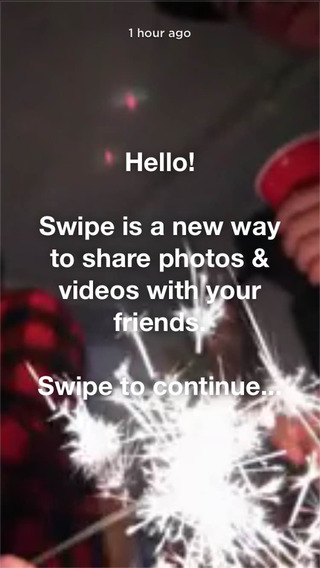
    Question from a middle school administrator – Over break I was invited by students and former students to JoinSwipe.  It has a smiley face.  What do you think of this app?  What is it?  Any advice would be great.

    What is Swipe?

    First off, their logo is a wink. The logo alone is a bit of a shot across the bow about what the app is all about.

    Second off, I’ve not heard of it. It seems to be pretty small and new, which doesn’t mean much I suppose.

    So let’s do some digging. 

    Here’s the official description on the iTunes App store:

    By invitation only.

    See the photos & videos your friends won’t post on Facebook.

    With Swipe we wanted to build something fun that made conversations more like running into friends in real life?—?wherever you are and whatever you’re doing. When you get into the app, you’ll see a stack of photos & videos posted by your friends. It’s not stuff you’d find on Facebook?—?it’s what they’re really doing. That’s because your username is invisible by default when you post to Swipe.

    You can do three things with posts, and they all involve swiping ;). If the post doesn’t interest you, swipe left to pass?—?you’ll never see it again. If you think it’s cool, swipe right to let the poster know you like it. And if you want to reply, just tap the post, write a message, and swipe up. When your friend gets the reply, they can send one back to you and reveal their identity. Replies can go back and forth until someone gets bored?—?and just swipes it away.

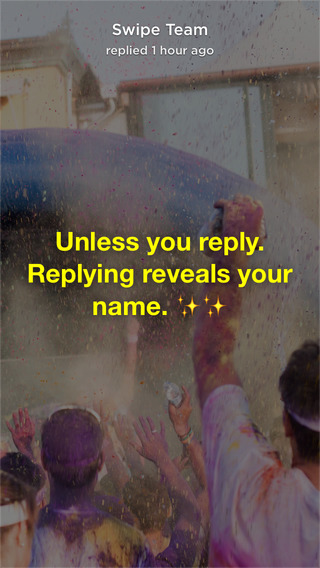
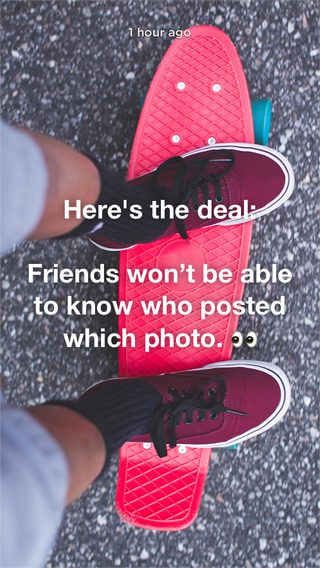
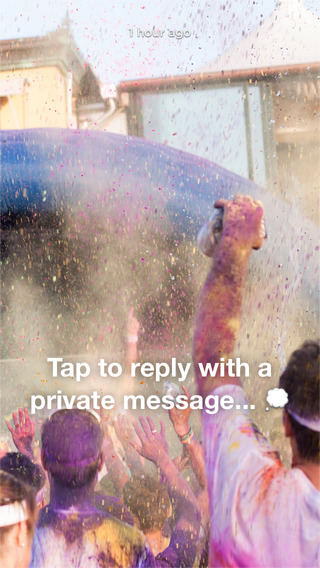
    Here’s the official screenshots:

    Here’s some background from the developers on their blog:

    With Swipe we wanted to build something fun that made conversations more like running into friends in real life?—?wherever you are and whatever you’re doing. When you get into the app, you’ll see a stack of photos & videos posted by your friends. It’s not stuff you’d find on Facebook?—?it’s what they’re really doing. That’s because your username is invisible by default when you post to Swipe.

    Source (Notice they are using Medium as their blog platform, not Tumblr. I see Medium as more of a grown up version of Tumblr.)

    Here’s the company that’s developing it, Complex Polygon, it’s small, might be just two guys.
    It looks like the domain may be registered in Panama, but that could just be a privacy setting. It’s pretty clearly being developed in Silicon Valley.
    Here’s who is funding it, it looks like a legit first round, $1.7 million:

    And here’s some backstory about the primary brains behind it, actually a really interesting read. 

    The app is a mash-up of several different trends right now.

    It’s “anonymish.” Your friends share different photos but you won’t know exactly who took them, even if you have a pretty good idea (like Snoop Lion, pictured above).

    It’s got a Tinder mechanic where you swipe left or right to like things. Or up if you want to comment on something.

    It’s ephemeral. You only get to see photos once.

    How did Roushdy and Hardy end up here?

    They wanted to build something fun that would be universally recognized; they structured Complex Polygon as a startup where they could spin out idea after idea to see which one stuck. Swipe is their second one, and it had enough promising engagement metrics that they decided to do a bigger launch.

    Source

    What You Need to Know

    I think Swipe is most like Tinder. If students are using it in your school or youth group I wouldn’t be overly concerned. It doesn’t have a positive or negative reputation at this point. But I would be curious, I would inquire with students about what they are doing with the app and why they like it.

    If I were a middle or high school student and Tinder was a little too, um, flirty and/or sexual for me, I can see playing with something like Swipe. It’s basically a mash-up of Snapchat and Tinder. (With the swiping right or left of Tinder, the disappearing image thing.)

    For students, again, it’s all about helping them understand that the images here don’t really disappear any more than they do with Snapchat. (Social Media Principle #2) And since people can send you pictures and you don’t really have any context for it… what TechCrunch called “anonymish” it could just as easily be someone doing something you don’t want to see as it could be someone making cutesy duck face at their grandmas.

    Questions for readers: How are you using Swipe? Did I get something wrong? Leave a comment and share your experience.


    Have a question for Tech Tuesday? Submit your question on the Tech Tuesday form on the sidebar of my blog.

  • Why Ephemeral Matters

    Why Ephemeral Matters

    Ephemeral – lasting for a very short time. “fashions are ephemeral” synonyms: transitory, transient, fleeting, passing, short-lived, momentary, brief, short

    In the social media world, most of what took off and gained traction among teenagers and young adults in 2014 fall into the category of Ephemeral Apps. Things like Snapchat, Tinder, Yik Yak, and others are built on the temporal nature of the messages.
    • A Snap lasts for just a few seconds. (Though Stories last a little longer, they also aren’t as popular as sending a Snap.)
    • On Tinder, you swipe to the right if you want to know more about a person, swipe to the left and they are gone.
    • Yik Yak is all about capturing the unfiltered thoughts of the moment. (I consider it to be the bathroom wall of the internet.) If you live somewhere where the app is active, your Yaks might only be on the site an hour before they go away.

    For most adults, you roll your eyes at things like Yik Yak, Tinder, and Snapchat.

    Understand this– That’s entirely the point!

    RULE #1 – Teenagers and college students want to hang out where adults don’t. The less popular something is for adults, the better.

    RULE #2 – Perceived anonymity and privacy is enough for what they want to do. We’re talking about a generation of app users who have grown up with their lives documented on mommy blogs, Facebook, and Instagram. They ultimately know that there is no such thing as privacy or anonymity online… that things get tracked back to them… but that’s not the point. The point is creating private space from the prying eyes of adults and/or people they don’t want to connect with. The perception of anonymity or privacy is just fine with them.

    Why Ephemeral Matters

    When I’m talking to parents or youth workers or school administrators they are dealing with very practical problems.

    But I don’t think you can problem solve ephemeral apps without first taking the time to understand why it’s important for teenagers and what it’s in response to within our society.

    1. Ephemeral matters because it’s seems safer than other options. “Safer” can mean a lot of things. Safer from mom and dad, safer from creepers, safer from getting tracked back to you, on and on. Posting on Twitter or Facebook, where adults persist, is dangerous. Posting on Snapchat? Totally safer.
    2. Ephemeral matters because it’s just chatting. As Danah Boyd so aptly drove home in her book, It’s Complicated, American society has systematically eliminated the places teenagers used to hang out free from the prying eyes and ears of adults. (Malls, streets, casual sports, etc.) These apps matter because these become the places where they can hang out. They may have very little “free time” that you or I grew up with, these apps provide the space to just chat. (This is why taking them away is so traumatic.)
    3. Ephemeral matters because it’s outside of adult control. Beyond the prying eyes, beyond the deep signs, beyond the misunderstanding, beyond the control-freak-parenting-methodology… ephemeral apps are a response to all of this. It doesn’t matter because of them, it matters because of  us. 
    4. Ephemeral exists because of general isolation everyone is experiencing. Here’s a challenge. Go sit at Starbucks with a pad of paper. Sit in a corner by yourself so you can see the whole store. In a 15 minute period, make a tick for every person who is in the store, comes or goes. Next, make a tick for every time someone looks at a screen. (Phone, computer, tablet.) What you’ll likely observe is that people are generally isolated from the life in front of them because they are absorbed by the life on the small screen in their pocket. This isolation creates the need for places you can speak flippantly, without worry that what you say is going to get back to your parents or boss or whomever. We all need places where we aren’t making “official statements” or having an “official position” but just have a place to say whatever comes to mind or feels good in the moment.
    5. Ephemeral persists because of the neurological high. Lastly, and perhaps an area where the least is known, is this idea that apps trigger your brain to check notifications, likes, and send responses at the neurological level which can mean that you don’t know why you’re checking it or using it so much… you just are. (More on that here)

    My advice? As an adult, it’s easy to just deal with the frustrations caused by things you haven’t taken the time to understand. Don’t waste your time trying to talk people out of using apps. (You’re actually increasing their desire to use them!)

    Instead, take the time to understand why these apps matter to the young adults in your life. Just because you don’t get it doesn’t mean something is bad. It might mean that you need to be the learner and not the teacher.