Author: Adam McLane

  • The Youth Ministry Gap

    mind_the_gapAfter 18 months of working at Youth Specialties and interacting with youth workers around the United States (and everywhere else) it’s finally sunken in: There are two different things called “youth ministry” with a major gap in the middle.

    Professional vocational youth ministry: When I talk about youth ministry this is often my default. These are youth ministries and youth ministry leaders who have formal education, continued training, experience, and live their whole lives thinking about youth ministry. When you talk to them about youth ministry they think of models, books, authors, speakers, ministry ideas, successful programs, historical viewpoints, on and on.

    This youth ministry is pretty sophisticated. Like any profession people fall into schools of thought. They have models for doing youth ministry. They have personally written and can defend philosophies of youth ministry. They run programs which implement their well thought out and defended philosophy of ministry. They train volunteers to be proteges for their school of thought. They have opinions about whether a certain models is getting stronger or dying.

    For the 20% or so of youth workers in America in this category those nuances matter to them. They are on the leading edge of thinking about Youth Ministry 3.0.

    My Church Youth Ministry: They just want to know how to minister to the kids in their church. When they e-mail me or call our customer service line they don’t want to talk philosophy or are even aware that there are different ways of doing youth ministry. They are calling because they have 15 seventh graders in their Sunday School class and they need a curriculum that will work for them. When you ask them about what they are trying to do with the group… you’ll hear the dead air or the exhale and then they’ll say, “We’re Methodist, what works for Methodists seventh graders?

    They don’t know or care about philosophies of ministry. They don’t know or care about ministry models. They haven’t heard of Saddleback or Willow Creek. They go to First United Methodist Church of Middletown– that’s it. They may know that some churches have full-time youth workers but they don’t really care. They have a full-time job outside the church. They have a kid in high school. And the pastor thought they were pretty loving towards teens and asked them to minister to their kids friends. They give of themselves to invest in the kids in their church and that’s amazingly awesome.

    ChasmFor the 80% or so of youth workers in America who fit this category, youth ministry is pretty matter-of-fact. There are kids who show up on Sunday morning or Wednesday night and they do what they can to minister to them.

    Minding the gap: There are not big steps in between the two groups of youth workers. It’s a gap with a chasm, not a ladder to the next or even a bridge.

    It is literally two different things we call youth ministry in America. They all care about the kids in their church. One group is purely interested in the kids in their church. While the other also cares a lot about the greater profession of youth ministry.

  • Dogs Welcome Home a Soldier

    Even if you aren’t a dog person, this video is rad.

    HT to Mark

  • Confronting Segregation on Sunday Morning

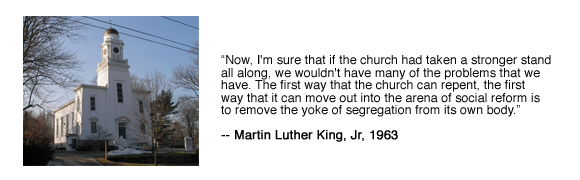
    church-segregation

    Sunday morning’s sermon at Harbor stirred in me the desire for the church to be a place of reconciliation.

    Stephen reflected on Revelation 7:9-12 in which people of every tribe, tongue, and nation will worship Jesus on His throne in Heaven and asked us to consider if we would attempt to do the same on earth? We live in a melting pot commununity. Literally, within 5 miles of our church are people of many tribes, tongues, and nations. The question brought forth was, will we intentionally worship together as a community or will we allow a church culture to prevail which prefers to seperate on Sunday mornings along racial lines?

    I was reminded of this exchange, in 1963, between Martin Luther King and the one-time president of Western Michigan University, Mr. Miller:

    Miller: Don’t you feel that integration can only be started and realized in the Christian church, not in schools or by other means? This would be a means of seeing just who are true Christians.

    King: As a preacher, I would certainly have to agree with this. I must admit that I have gone through those moments when I was greatly disappointed with the church and what it has done in this period of social change. We must face the fact that in America, the church is still the most segregated major institution in America. At 11:00 on Sunday morning when we stand and sing and Christ has no east or west, we stand at the most segregated hour in this nation. This is tragic. Nobody of honesty can overlook this. Now, I’m sure that if the church had taken a stronger stand all along, we wouldn’t have many of the problems that we have. The first way that the church can repent, the first way that it can move out into the arena of social reform is to remove the yoke of segregation from its own body. Now, I’m not saying that society must sit down and wait on a spiritual and moribund church as we’ve so often seen. I think it should have started in the church, but since it didn’t start in the church, our society needed to move on. The church, itself, will stand under the judgement of God. Now that the mistake of the past has been made, I think that the opportunity of the future is to really go out and to transform American society, and where else is there a better place than in the institution that should serve as the moral guardian of the community. The institution that should preach brotherhood and make it a reality within its own body.

    The truth is, 46 years later, not much has changed. Churches are still largely segregated in America. You could argue, as this CNN article points out, that we prefer our Sunday’s segregated.

    • There are major, separate, evangelical movements within the white, black, Hispanic, and Asian communities. There are relatively few places where those churches intersect. I will lovingly say that 5% of churches are truly mixed. But I am probably rounding up.
    • Within my own culture we tend to hold our personal preferences above all else. We are fine with other ethnicity coming to our churches so long as we don’t have to give up our style of worship or preaching. We hold our worship styles as canonical!
    • White males dominate the leadership landscape within American evangelicalism. Look at most conference line-ups or take a walk around a Christian bookstore or look at the top 20 Christian albums and you will see white male dominance. Are white males the only spiritual leaders? I don’t think so.
    • Open a phone book and you will likely see, in most communities, a white, black, Hispanic, and Asian version of the same church. 99% same doctrine, but we prefer to form different churches rather than deal with intentionally segregating. It’s not just a white church issue… it’s evangelicalism as a whole not dealing with this issue!

    Something about that is anti-Revelation 7, isn’t it?

    A few years ago I was at a leadership retreat in which we were asked to bring up our dreams for the congregation. The small Michigan town we lived in has a vibrant Hispanic population and a historic black community dating back to the Underground Railroad. I said that one of my dreams for the church was that there wouldn’t be three congregations in town separated by race (but not doctrine) but that we would figure our a way to have one church. I was laughed at and mocked for weeks. “We just aren’t ready for that.”

    And by “that” I suppose they meant dealing with their racist tendencies for the sake of the Gospel.

    In America, lines of segregation are alive and well. We all know it. People use their positions of power to invent new “legal” ways to segregate people all the time. But what are we willing to do about it?

    Want to see segregation alive and well in America? Head to a school board meeting when they talk about re-districting. Or head to a planning commision meeting when they talk about building an apartment complex. You will see the dominant culture take up arms so that “they” don’t allow “them” in their school or neighborhoods. Apply some nouns to those conversations and you are right back to Brown vs. Board of Education.

    It is amazing to me that no one I know would be upset– or even notice– if they worked with people of another race (or gender.) It wouldn’t even be an issue in the workplace. For the most part it wouldn’t be an issue in our own neighborhood.  Even in our own families race is not much of an issue. Six days per week our society has integrated. It’s not perfect but we’ve come a long way.

    And yet on Sunday morning… race (and gender) are major issues! This must change and we all know it. The question for leaders today is simply, “What are you going to do about it?”

    I am proud to call Stephen my pastor. He stood up on Sunday morning, not to cheerlead the efforts our church has made in the last two years, but to remind us that we have a long way to go. I hope the small successes we see at Harbor are just the beginning of a wider movement of reconciliation on Sunday mornings for the sake of the Gospel. First in our community, but also in America.

    Some questions:
    How do I need to be confronted on this issue. This is a “first me, than lead forward” deal.
    How does that reflect how I/we relate to Scripture?
    How does that limit the effectiveness of the Gospel in the community you/I live in?
    What are action items you/I will take to confront segregation in your/my church community?
  • Find Rest, Oh My Soul

    My sleep patterns have been seriously jacked up since coming back from Cincinnati. Last night I was up super late– 7:15 PM. Yesterday, while in church listening to Stephen preach one of his best messages ever, an emotion came over me. I realized something and it sent chills down my spine. It’s not just me that is struggling to find rest right now. It’s everyone I know.

    We are all off-kilter on rest. Even when some of us rest, we are still working or thinking about work or dreaming up things that result in work. Even in our rest, we are chasing after kids. On and on. In our rest, we are not really resting at all.

    That’s why this week I am praying this Psalm as a prayer for myself, my family, and my friends. I pray that we find rest:

    Find rest, O my soul, in God alone;
    my hope comes from him.He alone is my rock and my salvation;
    he is my fortress, I will not be shaken.

    My salvation and my honor depend on God ;
    he is my mighty rock, my refuge.

    Trust in him at all times, O people;
    pour out your hearts to him,
    for God is our refuge.
    Selah

    Psalm 62:5-8

  • Women’s Soccer Gone Wild

    Dang! Thankfully, the Mountain West Conference took care of this. I can’t believe the referees only gave her a yellow card for this. My guess is that her soccer career just ended.

  • Fork Lift Driver Fail


    Something tells me this guy is looking for a new job.
    The news story reported that he was actually only slightly injured. And those boxes… all vodka.

  • Tool for the forgetful child

    There have been many days when something like would have come in handy. Can someone please put this on my Christmas list?

  • What Do I Look for in a Pastoral Staff?

    pastoral-teamFor a variety of reasons I know a lot of people in church transition. Some were on staff at a church which has let them go for budget reasons and they need a new church home. Others have moved to new states for a job. Still others just can’t stand their current church situation anymore and are looking for a new church home in their town.

    So the question presented to me, as a friend is: What do I look for in a church? (We’re talking about believers looking for a new church, not people brand new to the faith.)

    I like to immediately rephrase the question to be about the pastoral staff. You simply cannot go visit a church and make a judgment on whether or not you want to be a part of it based on a site visit and observation of programs or even the weekly service. The quality of a church is determined by the quality of leaders. If you want to see the heart of the church and get exposed to what is really going on– you will need to meet senior leaders. If the church is so big that you don’t get to meet the senior leaders if you request a meeting… decide for yourself if that’s the type of church you’re OK with being a part of. Me personally? That tells me everything I need to know. If I can’t get a meeting for a cup of coffee with the pastoral staff they don’t want me to be a part of their church, got it!

    Things you are trying to figure out when you meet a pastoral staff member.

    1 Timothy 3:1-7 outlines the Biblical qualifications for being a pastor. (overseer) This becomes the basis for my bullet points below.

    Here is a trustworthy saying: If anyone sets his heart on being an overseer, he desires a noble task. Now the overseer must be above reproach, the husband of but one wife, temperate, self-controlled, respectable, hospitable, able to teach, not given to drunkenness, not violent but gentle, not quarrelsome, not a lover of money. He must manage his own family well and see that his children obey him with proper respect. (If anyone does not know how to manage his own family, how can he take care of God’s church?) He must not be a recent convert, or he may become conceited and fall under the same judgment as the devil. He must also have a good reputation with outsiders, so that he will not fall into disgrace and into the devil’s trap.

    • Above reproach- Do the senior leaders have a good reputation? When you talk to other church leaders in the area do they know who they are? Do they show up to local pastor network stuff? Do the people of the church have nice things to say after the first cup of coffee?
    • Husband of one wife- I don’t think this means divorce and I don’t think this is exclusive to men… so it could be “wife of one man” in my eyes. But I do think this means… are these people true to their spouse? Are they working so hard that the church is really their spouse?
    • Temperate, self-controlled, respectable, hospitable– If you want the inside scoop on this talk to the secretaries. They will tell you flat out if the pastoral staff are a bunch of jerks or not. “Does he ever blow a gasket?” If you really want to dig into this, talk to the vendors who service the church. The computer people, the copier salesmen, or even their insurance broker will know if these people just put on a happy face for parishioners but are otherwise jerks.
    • Not a drunk- I’ve actually never met a pastoral team member who was a drunk. I’m sure they are out there. I just wouldn’t worry about this one too much.
    • Gentle- You need to trust your gut on this. This is one of the most important qualities of being a pastor. So even the jerks can “put on gentleness” as a survival skill. But you need to determine if the staff are gentle when it counts or just gentle for the church show. You can test this out by bringing them an absurd idea. If they aren’t jerks when you tell them that you will only go to a church that uses free trade communion wafers… you know they are gentle. 
    • Not quarrelsome, not a lover of money– We’re getting somewhere now! If you talk to your pastor and you sense that they are in the church to build their kingdom instead of the Kingdom of God, walk out of the meeting. Based on my years of experience this is about 1:5 pastors. It’s an American epidemic. Why flee these pastors? They will be a bull in a china shop. They will do whatever it takes to grow/build the church. That’s fun for about 2 months but gets old real fast. In short, those people tend to love a good rumble. But if the church is doing a reluctant building campaign because they have clearly maxed out their current space… this isn’t always a bad thing.
    • A good family- This is tricky as it might take a while to figure out.  You can sniff it out by asking how they manage their time. Every church will say they encourage their staff to put family first. But are they backing that up? Is it OK for a staff member to miss a Sunday for a key sports tournament with their son? Is it OK for a staff member to go home early or go late to get the kids to school? Do they punch a time clock with strict office hours? Does the church limit the number of evenings a staff member can be out working for the church? If you see inconsistencies here you know they aren’t managing their families well. And a church that permits this is not a church you want to be a part of.
    • Not a new believer- It’s all the rage right now to hire new believers as church staff. This is tied to a theory that it’s more important what you do for a church (worship leading, marketing, executive leadership, etc) than that you have a strong theological education. (seminary) Paul was wise to make it a requirement that someone not be a new believer. If you meet the executive pastor and he has an MBA, was converted at the church 3 years ago, and left an accounting firm to be a part of the church, RUN!

    If you want me to get even more practical than this, leave me a comment! We’ll start a “thumbs up” or “thumbs down” voting system!

  • The money crunch

    MoneyCrunchWe’re having a crunch month. It seems like during every calendar year there is one time when the vacuum cleaner has been attached to our accounts and we suddenly find ourselves going from “feeling comfortable” to “How much do they give for blood these days?” That’s about how things are for our family right now.

    • Semi-annual and annual bills just got paid.
    • All the regular bills paid, but were higher than budgeted.
    • Bought a car. (paid cash, huge win!)
    • Silly kids are growing and needed clothes!
    • Travel expenses, haven’t been reimbursed yet.

    Even as a family who lives rather simply we come on tough financial times from time-to-time. In this case, we got through it because we had budgeted for it to happen and had the cash on hand to make it through. We’ve had times in the past where we didn’t plan so well and literally had to depend on the kindness of our church to eat. You live a little and you get a little wiser, I guess.

    In some ways I wish we felt this crunch more often. These times in the calendar are refreshing! I rest in our routine. I rest in our budget. I rest in simple things. I rest knowing that when we make things even simpler it is better for our family. I rest knowing that we’re not touching our long-term savings to ride out a short-term crisis. I like wincing when we give to our church. I like scrutinizing what we spend. Actually, I kind of like even noticing what is being spent because all-too-often I get into habits where I don’t see how much we are spending.

    Of course, I’m really thankful because I know three things are true. First, I know that things will go back up from here. We have an annual low point, this is it, and we can budget ourselves out of it again. Second, I know who provides for me. God sustains us no matter what. Kristen and I will never forget the mystery bags of vegetables we received in Oroville. God is our provider. Third, while we have less cash than we’d like we also have less debt than we had a year ago.

  • Flying Eagle

    For big parts of the country, it’s bowlin’ season. Next time you are at your league try this!