The grave danger is to disown our neighbors. When we do so, we deny their humanity and our own humanity without realizing it; we deny ourselves, and we deny the most important Commandments of Jesus. Herein lies the danger, the dehumanization. But here we also find an opportunity: that the light of the love of neighbor may illuminate the Earth with its stunning brightness like a lightning bolt in the dark; that it may wake us up and let true humanity burst through with authentic resistance, resilience and persistence.
Some of what I explore in my new book is a recalibration in my life, distinguishing between things that seem important in a 24/7/365 world and what’s really important.
It’s been a week since the internet lost it’s mind with the outcome of the presidential election. I’ll readily admit that I’m still shocked about the outcome the same way I am when I see ads on TV for the online dating website FarmersOnly.com.
I mean really, this is a thing?
And I certainly understood and felt the lament last week. Tears were shed in McLandia. But I’m also done with seeing the online lamentations.
Instead, it’s time to move from lament to action.
I want to know what people whining on Twitter are doing in their communities to contribute. Get involved, your slactivism is showing.
Seriously… if you aren’t actually go to do anything in your community. Shut up.
But what can I do?
Anything. Something. Just not nothing. Tweeting, signing online petitions, passive-aggressively posting memes to Facebook… classic slactivism.
Earn the right to be heard by doing something. Like physically doing something.
Embrace your civic responsibility. It’s not just for old people, you know?
“But what? Literally, I don’t know where to start.”OK, I get it.Here’s an incomplete list of things you can do in your local community starting immediately that will actually make a difference.
From Slactivism to Activism
Don’t try to do them all. But do pick 1-2.
Check on your neighbors. Do you even know their names? If their yard touches your yard, you need to know their names. Knock on their doors this week just to say hi.
Volunteer for a local service organization, just pick one. Kristen and Megan have been helping out at San Diego Refugee Tutoring one evening a week and loving it. (6 year-old Syrian refugees are definitely not scary) There are so many amazing volunteer opportunities out there. If you’re frustrated about national politics, pick something local to get involved with. Trust me, it’ll help.
Join a local activism group. Even if you don’t 100% agree with everything they stand for, you’ll learn a ton and discover things you can get involved with which you can be passionate about. They say “birds of a feather flock together.” That’s totally true with local activism as many groups are inter-related. I’d encourage you to start by checking out Showing Up for Racial Justice.
Show up to school board meetings. You don’t have to be on the board to know what’s going on. And the local school board impacts so many people’s lives. So many.
Attend town council meetings.
Participate in community council meetings. (In San Diego, there’s “City Council” which is a big formal deal. Then every neighborhood has smaller, less formal community councils that address local issues.)
Go to zoning and city planning meetings that impact your area. I know, that sounds really, really boring because there’s going to be a lot of truly boring stuff about sign ordinances and parking variances. But if you want to get the pulse for what’s really going down… zoning boards are the front lines.
Join Nextdoor and participate. I know, there’s a lot of lost pets. Push past that to get to know your neighbors.
Vote. For crying out loud. Vote. Unreal how many people didn’t vote in the national election. (Except you, San Diego… 80% turnout… dang! Amazing.) Seriously, vote at anything and everything you can. Big, small… show up and cast your ballot.
Become a mentor or tutor to an at-risk teenager. Here’s one thing I know for sure. If you call a local middle/high school and say, “I’d like to volunteer as a tutor, I’ll jump through whatever hoop you have for me, I’ll pay for a background check or whatever it takes…” approximately 0% of schools will hang up on you.
Consider this a starter list. I don’t know what the needs are in your community might be. But I do know your communities #1 need: You.
Church doesn’t fulfill 100% of your local civic responsibility. I think a lot of people, and a ton of people in my life, think that if they are really involved at church– or if they work at a church— that’s somehow all they need to do. Sure, there’s things you can do at/through church that meet some of this. But don’t confuse a relatively closed circle of like-minded people at a local church as everything you can and should be doing in the community.
I might even encourage you to consider becoming Good News in Your Neighborhood at the expense of being good news at your local church.
On Wednesday, an incident occurred on campus a mile from my house that’s being investigated as a hate crime against a Muslim woman:
At approximately 2:28 p.m. today, a San Diego State student was the victim of a strong arm robbery in Parking Lot #12. Comments made to the student indicate she was targeted because of her Muslim faith, including her wearing of a traditional garment and hijab. SDSU Police are investigating this robbery as a hate crime.
Again, I wish this were isolated. But things have popped up this week. And with every report things get more tense.
What’s My Responsibility as a Parent?
If you weren’t already uncomfortable enough let’s go ahead and get totally uncomfortable. As the parent of three children from the dominant culture in our society I am asking you, What is our responsibility as parents to talk to them about in regards to race? Because the reality is this… parents of minority cultures have to talk to their children about this from in details I’m not even aware of because these aren’t issues I face.
For example: (Watch this… please. Watch.)
It’s not just African-American families. If you watch the video above you’ll see other videos about raising kids of other ethnicities and races.
I can tell you this, as a white man my parents never had that conversation with me. Quite honestly, my parents had the opposite conversation because my parents knew the local police. “If you get pulled over tell them who your parents are.” Does it get any more privileged than that?
And, if I’m 100% honest, nothing has changed. Literally. Nothing. This is what privilege looks like. I can [and have several times in 2016] called the police because I know they are on my side. Even though I don’t live in Northern Indiana anymore I know several of the cops on the beat in my San Diego neighborhood by name and they know me.
As uncomfortable as I am in saying it I benefit from racial privilege every single day in ways that I’m both aware of and not aware of. My kids do, too.
So what’s my responsibility as a parent? It’s talking to your kids about race and privilege… acknowledging that it’s unfair… and helping them see how they can help level the playing field.
My Confession to You
In 2008, when we moved to San Diego, Kristen and I made the choice to move to Mid-City San Diego. When you move to a new area your friends will tell you where the white people live. Sure, they won’t say it like that, but they’ll say “the best school are in _____.” Or “Don’t move to ____ because there’s a lot of problems. Look for a house in _____ where it’s nice and quiet.” We all know those are codes for where the white people live, right?
Little did they know that we weren’t looking for racially homogenous, we were looking for diversity. One of the greatest assets I have as an adult is growing up in diverse schools filled with kids whose parents worked at Notre Dame. Not many kids growing up in Northern Indiana grew up going to school with kids from all over the world, but I did. As a missionary kid growing up in Indonesia, so did Kristen.
And we wanted to pass that along to our kids. So we picked Mid-City San Diego.
Our kids have grown up as minorities in the classroom. You could argue it was an exercise in privilege. Sure, they didn’t have to be there. Sure, we had choices. But nonetheless this was the reality we wanted them to grow up with. As our country’s landscape changes we wanted them to walk intuitively through it.
But here’s the confession: Even with all that desire from mom and dad, I never talked to my children about how to talk about race. Or, at least, I didn’t talk about it clearly enough or sternly enough.
And it came back to bite us in the butt. One of our kids got in trouble for using a racial description (not an inflammatory one) of a person in their class.
And while it wasn’t “our fault” in that mom/dad didn’t say it. We do own some of the responsibility because we’d not been explicit enough about the nuances of language and how to talk to/about people respectfully.
Setting Expectations for How Our Family Talks About Race/Ethnicity/Gender/Sexual Orientation
Now, please understand we’re not perfect parents who are pretending to have it all together. (Re-read the previous section!) Please understand we live in a context where our kids are often extreme minorities but still members of our society’s dominant culture. I’m not an expert on talking about these issues. Literally, I’m just a dad trying to figure it out and raise responsible, respectful kids.
We live in a community full of immigrants, legal and illegal. We live in a community full of refugees. Just 52% of my communities adults were eligible to vote on Tuesday. The park 500 feet from our house is a virtual United Nations on weekends as people and cultures from all over the world come to have parties, fiestas, play soccer, football, basketball, and Sunday morning cricket.
So here’s what we’re telling our kids for our context:
Whenever possible refer to someone by their actual name. If someone is in your class it’s your job to learn their name. If you don’t know, ask. Just like you don’t like being called “the white kid who sucks at soccer” the same is true for everyone else. Learn names and use them.
Never, ever, never ever begin describing a classmate you don’t know by their race, ethnicity, or sexual orientation.
Instead, it’s more helpful to start by describing other things about them beyond race/color/ethnicity. “She always has a purple backpack, she sits on the other side of the room from me, she’s friends with ____. I don’t know her name though.” She’s not “the Muslim kid over there.” This is why learning names is so much better.
Whenever possible we’d prefer you referred to other nationalities, races, ethnicities, etc in a positive light. Celebrate, be curious about our differences, but don’t tear down. If you don’t like someone keep it to yourself.
You may not join in joking or otherwise about race, ethnicity, gender, or sexual orientation… this is SUPER DIFFICULT because it’s nuanced in that among friends people tend to be self-depricating about themselves, including these things. There’s so much in the world that is funny, let’s just not get caught up in joking around that could be misinterpreted. If your friends are doing it and you can’t speak up, walk away.
You may not ever use a racial slur even if you are repeating what someone says of themselves. Specifically, the N word may never come out of your mouth. Ever.
What’s the Point, McLane?
I hope you hear me on this.
I’m not saying that what I’ve shared above is what you need to tell your kids tonight at dinner. What I am saying is that you and I, if we want to prevent the stuff I mentioned at the top, need to own our responsibility in it. As we’ve learned in our own home… if you don’t talk about it… your kids might not be part of the solution, they might actually be part of the problem. There’s nothing quite as embarrassing as trying to explain to a school administration that you didn’t talk about it.
When I see what happened at the middle school in Michigan or the parking lot of San Diego State I hope we all agree that there is a parental responsibility there which each of us owns part of. If we don’t teach our kids what is and isn’t OK, that could be our kid.
I know it’s uncomfortable. I know it requires some self-reflection. But it’s worth it. You need to do it. Please have this conversation with your children.
If this election cycle has has revealed anything about the current state of the church it’s these two things:
We’ve taught people what we think at the expense of how to think.
We’ve confused felt needs for our needs.
How did we get here?
Full disclosure. You’re not seeing a 2,000 word rant about why I think “you” played a role, and how we got here, in creating the problem I’ve summarized in the above two statements.
I deleted it.
It’s easy to blame “you.” “You” is a perceived enemy I can easily create. “You” is everyone that’s not me.
“You” is blaming.
“You” is easy. “You” is a bit lazy writing, creating a monster that’s easy to vilify.
What’s my role?
But “you” is also “me.”
It’s much harder to look in the mirror, realize I’ve played as big a role in this as anyone else, and instead say… “What’s my role in making it better?”
So I’m wondering…
What can I do to help encourage independent thinking, celebrate intellectual conversation, and create spaces to facilitate that?
How can I better connect with “them” so I’m not guessing about felt needs? What can I do to truly meet needs for actual people instead of imagined ones?
How can I help us move from “topical” to “full”? In other words, how do we help people see that Scripture isn’t just what’s interesting to us– skipping around from short burst to short burst in 4 or 6 week “series” and instead dive deeply, sometimes into the boring parts, to connect to a deeper narrative?
How do I justify elevating real, researched felt needs above my own needs? You know, because the latter pays the bills sometimes better than the former.
Want to talk to Kristen? She works 50 feet away, too.
It’s as quiet as I want it to be. Want to listen to music from the 90s? No problemo.
Want interaction with others? Do it.
Don’t want interactions with others? Just turn it off.
For better or worse it’s a me-centric way to work. And it has advantages. I don’t sit through pointless meetings and there are no office politics. A little too warm for my liking? Turn on the AC. Too cool? Turn on the heat. I’ve got no co-workers to negotiate that with. No one knows and frankly no one cares.
When you work alone, in your backyard, it’s easy to think only about yourself. Me. Me. Me. Me. Me. Me. Me.
We is Better than Me
In the daytime quiet of my backyard, plugging away on an endless… seemingly self-feeding todo list… I have a rational choice to make.
Is this about me or not?
I have a little mantra that I repeat to myself all the time: We is better than me.
From the earliest moments, from Creation, God recognized this value… We is better than me. When I’m alone, when I’m about myself, it’s not good. (Being about me and having alone time are different)
This mantra, We is Better than Me, expresses itself when I’m frustrated in a we setting. I’ve got this in-born desire for things to be about me all the time, to be awesome, to be for me– to want things my way in my time. And when that doesn’t happen? I’ve got this tiny bit of righteous indignation that feels like I need to not just be frustrated that something isn’t working for me but also the deep-seeded need to tell people, to get people on my side, to declare… “This isn’t working for me and you should do something about it because it’s not working for this person either.”
The mantra is especially helpful in these moments. When I’m feeling my most about me, when I’m wanting to grab the pitch forks and let everyone else know that my needs aren’t feeling met… that’s when I repeat the mantra: We is better than me.
Just because it’s not about me doesn’t mean it’s not good for we. Just because I think I know a better way doesn’t mean my way is better. Usually, it just means I need to learn something new– I need to shut up.
And in a world where everyone can say whatever they want, whenever they want, to whomever they want: Shutting up might just be the most powerful thing you can do.
Lately, I’ve been doing a lot of thinking– more like rethinking— about the nature of work, vocation, and how all of that impacts daily life.
In short, I think I’ve over-specialized and/or overused “calling” as an excuse to embrace work-a-holic habits, expect overwork, and otherwise potentially make work an idol.
With those two statements in mind I’m asking you, my faithful readers and friends, to help me brainstorm some works that I should look into. (Books, articles, blogs, etc.)
Two things will make you act drunk, blind, and stupid.
Love. And fear.
Sure, there are real things to fear in life.
Instinctive fear in response to danger is completely normal. You hear gunshots and you instantly ducks down and wonder, “Is someone shooting at me or is it New Years Eve and I didn’t know?” Or you are weeding the garden, hear some rustling, and look to the side to see a snake slithering towards you. Or you are crossing the street while looking at your phone and you hear screeching tires.
But that’s not the type of fear I’m talking about. I’m talking about fear that paralyzes us from making a choice or taking an action. You know you need to go back to school… but you just don’t because you’re afraid. You hate your job… but you don’t do anything about it because it’s too risky. You feel compelled to speak up, to tell the truth… but you stay silent because you don’t know what’ll happen if you do.
I believe fear drives us to deeper and deeper levels of insecurity and, for Christians, further and further away from Jesus.
The more I’m afraid the more I’m thinking about me: “What will people think of me if I ____? What are the consequences if _____ goes wrong? What will they say to others if _____? Is that too much risk? If I fail will people think I’m a failure?”
While not necessarily bad questions to ponder none should paralyze. Consider, weigh, make a decision and move along.
The Word became flesh and blood, and moved into the neighborhood. We saw the glory with our own eyes, the one-of-a-kind glory, like Father, like Son, Generous inside and out, true from start to finish.
In Jesus-speak this is “the incarnation of Christ.” We believe God became a man to [among other things] bridge the gap between the Father’s divinity– His “not-humanness“– and to walk with us. The Son took all the risk in coming to earth, to become fully human. Here he experienced everything we experience, including fear. (Jesus got 1-on-1 time with Satan.)
Therefore for Christians, the people who identify with Jesus as their Savior and the measure of which is to live a Christ-like life… As we identify our daily life in light of Jesus’ incarnation we are drawn closer and closer to hugging our problems, pushing us past fear, realizing that our most dangerous life is one dictated by fear instead of faith.
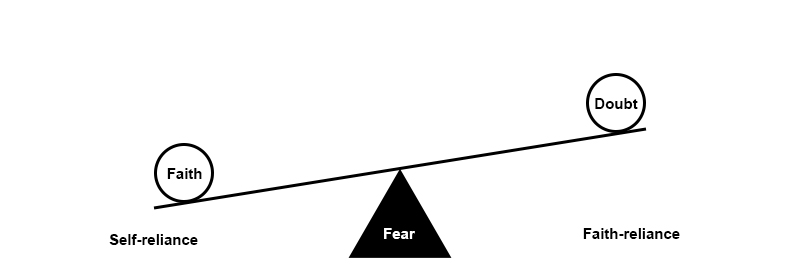
Think of fear as a fulcrum on the teeter-totter of faith and doubt. When we walk in self-reliance we are overcome by fear and all the insecurities and me-ness that comes with it. When we walk in faith-reliance we dwell in the knowledge of what’s worthy of our fear and what’s merely a human response we can push past.
Fear, by itself, isn’t bad. It’s not sinful to experience fear. But the consequences of living a life dictated by fear– or the avoidance of things which might be scary– can lead you to make lots of bad choices. (Indecision is a decision, after all!)
Two things will make you act drunk, blind, and stupid.