Category: Christian Living

  • Called to Plumbing

    Called to Plumbing

    Ministry people [usually accidentally] make it seem like theirs is the only vocation with a calling, not so.

    One of the things I love about where we go to church is that it’s full of men and women who might get featured on Mike Rowe’s Dirty Jobs.

    • Builders
    • Military, ex-military
    • Metal shop peeps
    • HVAC experts
    • Dry wallers
    • Plumbers
    • Landscapers
    • Car mechanics
    • People who work on ships and boats
    • On and on…

    These folks get their hands dirty, work alongside ordinary folks, and many of them are absolutely called to ministry right where they are.

    They are doing what God made them to do. Our community needs folks like them, skilled laborers, hard working people with integrity, who serve their clientele with pride.

    I Corinthians 10:31-33 says,

    So, whether you eat or drink, or whatever you do, do all to the glory of God. Give no offense to Jews or to Greeks or to the church of God, just as I try to please everyone in everything I do, not seeking my own advantage, but that of many, that they may be saved.

    Yup, you can sling grease or fix pick-ups or lay tile or roof houses to the glory of God. When you hang out with these folks and ask them about what they do… it’s so much more than a job: It’s a vocational calling!

    It’s kind of a pet peeve of mine when people pick up the idea that if they are serious about ministry they’ll work in a church. (I should say that our church does a pretty good job of avoiding this trap.) It happens accidentally… of course, the preacher doesn’t really believe that his is a vocational calling to ministry and the plumber isn’t a vocational calling to ministry. But when the preacher talks a lot about his own life and not the life of the plumber… the congregation seems to pick up a narrative that the pastor is called to ministry and the plumber is not.

    Yes, working in a church is one way to minister to people… absolutely. But let’s acknowledge that 9 out of 10 people aren’t going to walk into a church in order to connect to Jesus… so instead of hyper-inflating the calling of the role of the pastor, who might have access to 10% of the population, we should instead intentionally hyper-inflate, lift up, equip, and send out the ordinary folks in our congregations doing ordinary (yet, important) jobs in our community who have access to the other 90% of the population day in and day out.

    Photo credit: The Plumber by by Rick via Flickr (Creative Commons)
  • Speak Up

    Speak Up

    A few weeks ago I snuck in a quick midweek kayak fishing session.

    As I was coming in and taking gear off my yak near the Bahia Hotel there was a family setting up a little sailboat. The boat belonged to their teenage daughter, maybe 16-17, she had clearly never sailed before… or if she had, she wasn’t the skipper. Though equally green her dad was totally confident. The mom and the rest of their kids were all there, taking pictures. It was probably a birthday gift. It was probably her birthday.

    They were very excited about this boat.

    I slowly packed up my gear while they spent 10 minutes rigging the lines and all of that. They borrowed my Gerber and I offered them some paracord. While they were excited and the boat was indeed awesome, they clearly weren’t sea-ready. And I hoped they’d realize that and pack up to reboot at home. It was so obvious. They needed a class or at least a friend who could show them what to do.

    It was windy so I joked with them, “Should I call 911 now or wait?” They were unashamed about not knowing what they were doing but totally determined to give it a try. They shrugged it off. What could go wrong?

    I got all of my gear put away and my kayak mounted up on the roof of our van… but something just told me to hang around for a bit. I couldn’t stop them from going but maybe I could help them somehow?

    I sat in the drivers seat of the van, warming up, and they finally got the sail rigged. The daughter sat on the side of the boat, texting and taking selfies.

    And the dad pushed them off the beach… the family cheered, dad hopped over the side onto the boat… then boat swung wildly, the sail went the wrong way– literally into their faces, they nearly capsized, and less than 5 seconds later the sailboat slammed back on shore.

    They failed hard. 

    I laughed hard. 

    Everyone laughed hard.

    It was so obvious. Don’t sail today. 

    I was 100% confident that even if they got out on the water they were going to capsize or hit another boat, etc. These weren’t newbie conditions. It was windy and cold and the tidal current was fierce.

    They weren’t dissuaded. They were going to keep trying. And, frankly, I didn’t want to be the one to shatter their dreams. While they were likely to capsize or cause other boaters to evade their chaotic movements, who am I to tell someone not to do something? And hey, with the Coast Guard nearby as well as fellow boaters chances were pretty good everything would be fine.

    But the bigger and more immediate thing was that their lifejackets were on shore.

    The law requires that each boater have a lifejacket. And frankly, these two were going to end up in the water and they needed to be wearing them.

    So there I was, in my toasty car, enjoying the sideshow of Gilligan and his mates trying to sail… and left with a choice.

    Culture says, “Mind your own business. Leave people alone. There’s no need to say anything to someone you don’t know.

    Culture says, “Just drive away.

    Culture says, “If you say something they’ll probably get pissed.”

    But I know culture lies. 

    Culture costs lives everyday. 

    You aren’t on this planet to be silent.

    You don’t possess knowledge for yourself.

    That feeling, that little twinge that says you ought to do something, it’s not just for you.

    Your silence is kills.

    That voice?

    Listen to it. 

    Act on it. 

    Photo credit: Andrea Bowman via Flickr (Creative Commons)
  • Fishing

    Fishing

    If we’re connected on social media you already know that I’ve got a bit of a fishing thing going on. It’s not quite an obsession, but I’m trying to figure out how to salt water fish.

    • Last year I bought kayaks, equipping them for both recreation and fishing.
    • I’ve acquired all sorts of fishing gear.
    • I’ve spent hours and hours watching “how to” videos on YouTube.
    • I’ve spent hours and hours working on casting techniques and finding spots to find fish.
    • I’ve learned about a wide variety of species found in local waters.
    • I’ve learned way more about the impact of tides and the lunar phase than I ever cared to know.
    • I’ve jumped in on a couple local fishing forum communities.
    • I’ve gone out on open party charter boats, including this week when several of us from church went on a boat to the Coronado Islands in Mexico.
    • I’ve spent hours and hours fishing with varying levels of success.

    Fishing is Hard

    What’s the pay off? To be honest… I haven’t seen it yet. I really want to be near the water. I really need any sort of physical activity. But I also really want to learn how to catch fish!

    When I was a kid I used to fish with a bobber, a couple sinkers, and a minnow at our family cottage. And we caught tons of blue gill, perch, crappy, and the rare small mouth bass. And in my mind that was pretty easy.

    But fishing on the San Diego Bay or Mission Bay just isn’t easy. There’s a learning curve to it… and that learning curve comes with the double-cost of acquiring all the right stuff and putting in all the time practicing.

    Sometimes I don’t even really know why I’m fishing. I definitely enjoy it and I love being outdoors. But there’s something beyond what I can grasp right now going on. (I almost never keep the fish I catch to eat.)

    Pursuit

    Fishing is, to some extent, about catching. Certainly there are people who do it for work where they are fishing to make money, so they have to be experts and haul in fish.

    But fishing is also about pursuit. 

    If you just went to Wal-Mart, bought a basic kit, and slung a line in the water to haul in fish… that wouldn’t really be a pursuit. And I can’t lie to pretend that it’d be all that interesting to me. If it were easy, I’d probably only go out to fish if I wanted to eat fish. It’d be more of a chore (work) than a hobby. (recreation)

    They Thought Jesus was an Idiot

    One day as Jesus was standing by the Lake of Gennesaret, the people were crowding around him and listening to the word of God. He saw at the water’s edge two boats, left there by the fishermen, who were washing their nets. He got into one of the boats, the one belonging to Simon, and asked him to put out a little from shore. Then he sat down and taught the people from the boat.

    When he had finished speaking, he said to Simon, “Put out into deep water, and let down the nets for a catch.”

    Simon answered, “Master, we’ve worked hard all night and haven’t caught anything. But because you say so, I will let down the nets.”

    When they had done so, they caught such a large number of fish that their nets began to break. So they signaled their partners in the other boat to come and help them, and they came and filled both boats so full that they began to sink.

    When Simon Peter saw this, he fell at Jesus’ knees and said, “Go away from me, Lord; I am a sinful man!” For he and all his companions were astonished at the catch of fish they had taken, 10 and so were James and John, the sons of Zebedee, Simon’s partners.

    Then Jesus said to Simon, “Don’t be afraid; from now on you will fish for people.” So they pulled their boats up on shore, left everything and followed him.

    Luke 5:1-11

    Having been on some fishing boats and having NOT caught fish a whole lot, I can’t under-emphasize how crazy this story is. The guys fished out on the water all night, they’d cleaned their boat, the nets were hanging up to dry… and Jesus tells them to push off just a little bit and drop their nets?

    Not even an idiot would do that.

    Only someone completely insane would even ask that.

    But Jesus had something to teach… you might pursue fish for a living.

    But even the fish know to pursue Jesus.

    It’s about pursuit.

  • The Most Difficult Place for The Gospel in America

    The Most Difficult Place for The Gospel in America

    The Bible Belt.

    The None Zone.

    Those liberal tree huggers in California.

    It’s hard to reach people in the Northeast.

    Or was it the Pacific Northwest?

    Over the past couple of years I’ve grown increasingly weary of hearing about how one area is especially hard or easy to be a minister of the Gospel.

    One group will point to a set of statistics and say how it’s nearly impossible to do ministry– it’s so much harder than ____.

    Another group will lay claim that they, of course, live in the hardest to reach region of the country.

    It kind of makes my head spin. On the one hand I don’t want to discourage anyone. If pointing to a statistic is somehow motivation for someone to keep going or be more creative or adapt the Gospel to their local context better than that’s great. But on the other hand I think a lot of people miss the bigger, more important point.

    The Most Difficult Place for The Gospel in America is…

    Dinner is The Most Difficult Place for The Gospel in America

    But really? What’s the most difficult place for the Gospel in America? 

    None of those statistics mean anything to the two groups of people you’re actually responsible for reaching with the Good News… and the most difficult.

    1. Your family, the people living in your house…
    2. Your neighbors, the people’s whose house touches your house…

    You can’t make the Gospel big in your community until you make the Gospel small in your life.

    For most, you live on the most difficult block in America to reach. It’s the challenge of a lifetime and one we too often ignore for the sake of trying to reach people we aren’t commanded to reach at all.

    Reach your own family. Then reach out to your neighbors.

  • Sacrificing Today for Tomorrow

    Sacrificing Today for Tomorrow

    There’s this really funny scene in Bill Bryson’s book A Walk in the Woods.

    Early in their trip up the Appalachian Trail, about two days in to a six month journey, the main character gets separated from his hiking partner. He goes back to a meadow to see his friend, furious, chucking things from his backpack into the distance. He runs up to him… “WHAT ARE YOU DOING?

    His enraged friend shouts back… “I’m getting rid of stuff. Heavy stuff!

    I think there’s a really important lesson there, something I’ve been working through in my life the last couple of months.

    The greatest danger to leading any organization is settling for less than you’re capable. I think many most organizations settle into being the size/style they are, not because that’s the ultimate they can achieve, but because they get comfortable, they settle into what feels manageable for them.

    Here’s what I know: A fat and happy team never innovates.

    My best ideas, my times of biggest innovation, my defining moments– they all come from a place of desperation and hunger.

    And so I’m going through a period of time where I’m frustrated with myself. I’m frustrated that, while 2014 saw HUGE growth in so many areas, we’re not growing at an aggressive enough pace for what I know we are capable of.

    I’m owning that. I got fat and happy on a couple things.

    And so, like the frustrated hiker chucking cans of beans and D cell batteries into the woods on the Appalachian Trail, I’m chucking some stuff that’s holding me back from what I feel is our potential. We know we are capable of real, long-term, measurable change in the youth ministry world. But to get there I need to make some sacrifices on stuff I like doing. It’s stuff I like, stuff I’m great at, that’s important to me, and has been core to me.

    But it’s heavy. And heavy stuff has to go.

    Why?

    Because I refuse to settle.

    I refuse to get comfortable.

    I’m making sacrifices today for to get where I want to go tomorrow.

    What needs to go in your life so you can reach your full potential? 

    Photo credit: Matt Matches via Flickr (Creative Commons)
  • Patience

    Patience

    First Presbyterian Church

    I didn’t start attending church until about 5th grade. I don’t know exactly what triggered it, but my dad got married to a woman who went to the local Presbyterian church, so when I was there on weekends we started going.

    I liked the idea of going to church. But I loathed the clip-on ties that I had to wear.

    I liked that my dad took me to J.C. Penny and bought me a couple pairs of dress pants, a couple button up shirts, and nice dress shoes. There was something special about dressing up for church. Putting church clothes on reminded me of going to a wedding reception or a fancy person’s house for dinner. But the tie? I’ve always hated ties.

    First came the Sunday school hour. Aptly named since it was an hour long. The adult teacher was one of our parents, at one point it was my dad. Everything about my Sunday school class felt old. The chairs, the tables, the chalk board, the little hooks we hung our jackets on in the winter, it all felt (and smelled) old. Yet Sunday school was harmless enough. Pleasant even. We took attendance, inquired about kids who weren’t there, there was a printed lesson given to everyone, we read the lesson out loud, no one ever had prayer requests (ever), someone prayed… and that was that.

    Next came the coffee hour in Fellowship Hall. This was a rip off of a name because it wasn’t really an hour long, more like a coffee half-hour. But there were snacks and freedom which made it awesome. Donuts, coffee cakes, and orange juice for the kids. Donuts, coffee cakes, and coffee for the adults.

    The coffee hour was dominated by mischief. The kids would tear through a pile of donut holes and gallons of orange juice. Then, with our parents making small talk in Fellowship Hall, we’d roam the old church like it was a treasure hunt. The old Presbyterian Church on the corner of Mishawaka Avenue and Church Street was full of nooks and crannies to explore. There was the real library (which was off limits) and an old library (which was off limits but no one seemed to notice if we went in there). And there was a parlor area with lots of little rooms with ancient feeling stuff to touch when we weren’t supposed to.

    Then the bell rang telling everyone that church would start soon. Play time ended and people started to move towards the sanctuary for the service. Things quickly turned from sweaty jubilation, running around with your friends, to somber… a time to be serious and sit with your family. Time to put the tie on again… God was best worshipped in a clip-on tie. (Sidenote: The pastor didn’t wear a tie, she wore robe over her dress.)

    I loathed the worship services more than my tie. It was 100 times worse than my tie. Services made my blood boil in a way I still can’t explain. These feelings also brought out shame. I was mad about sitting through the service but I felt intensely guilty for being mad about sitting through the service. My jaw clinched tight until it caused a headache. I’d sweat even if it was freezing in there. And I’d stare at the altar with hopes that my stare would light it on fire.

    Silently, I’d sit there, an unwilling participant in a procession of boredom, each moment bringing about more and more rage with each verse.

    Each week a weird thing happened. As the pastor blabbed on and on through the sermon I’d slowly calm down. Shame would win out over rage. The blood boiling within would calm. And usually by the end of the sermon I’d relax, almost glad I was there.

    The Doxology won me over.

    Unexplainably.

    Incredibly.

    Predictably.

    It didn’t matter how grumpy or enraged I was at the beginning of the service. When we stood to sing that song all of that was gone. A wave of gladness washed over me, I’d get goosebumps, sometimes a tear would well up and I’d have to hide it.

    Soon enough the acolytes would come down and put out the candles at the front of the sanctuary, we’d process out.. choir first, we’d shake the pastors hand, the tie would come off, and we’d go home.

    Lovely

    We have a cat named Lovely Gorgeous. She’s about 8 years old and belongs to Megan. Lovely is a hunter and social with all the other cats in the neighborhood. So sometimes she’s inside, usually during the day for a long nap, and sometimes she is outside.

    She drives us nuts because she wants let inside or outside 100 times a day.

    Let’s be clear– Lovely is the neighborhood serial killer. Lizards, mice, rats, and birds are her normal prey, she kills several each week. She’s even developed a knack for hunting hummingbirds. (Made slightly more cruel by the fact that we have a hummingbird feeder.)

    Watching an adult female cat hunt is incredible. Sometimes she stumbles on prey somewhat by accident, just walking through tall grass something will move and she pounces by instinct. A hop, a shake of the head, and it’s over in seconds.

    But other times she has spends a long time laying in wait. She sits under a citrus tree lounging in the shade, napping. While it might look like she is just staying cool or grabbing a cat nap, she is also staying in position. A lizard scurries from it’s hole and hops over a little wall to feast on bugs in our strawberry patch and she there watching the whole thing.

    She is silent.

    She gets into position.

    She crouches low.

    Her tail puffs up, swinging back and forth, twitching with excitement.

    And the moment her target comes within range, without even a sound, she’s on top of it.

    It’s over before the lizard saw it coming or had a chance to escape. Pinned to the wall she kills it in an instant, a few seconds later she stands up proudly. The hunt is over and she’s carrying it’s corpse off for dissection.

    A Patient God

    The Lord is not slow in keeping his promise, as some understand slowness. Instead he is patient with you, not wanting anyone to perish, but everyone to come to repentance.

    2 Peter 3:9

    In some ways, God’s work in your life is like the common house cat.

    He is patient in His pursuit of you.

    He steps in to kill what He wants to kill, your rage or pride or desire for revenge or whatever He wants.

    He overcomes you by His will and not yours.

    He waits for His right time and not yours.

    When He acts it is swift.

    He knows when to pounce.

    He works silently.

    He overpowers you with His strength.

    He has the power and skill to hold dominion but power and dominion to let you be.

    Our God is a patient God, not wanting you to perish.

    He saw things in me I didn’t see. He saw a life for me I couldn’t have. He has pursued, stalked, pounced, broken, held dominion, and hunted me my whole life. 

    His patience for me is better than my impatience with myself.

  • I Dare You to Chill

    I Dare You to Chill

    I’m “off” for basically the next two weeks.

    It’s not technically vacation in my mind. I’ll poke around with some end of the year stuff. (wrapping up accounting, inventory, sending a book to the printer, and probably some light email marketing.)

    If the first half of December was “light work” than the rest of December is “very light work.”

    • I’ll probably buy a fiction book or two for Kindle and disappear to a coffee shop at some point.
    • I’m going to re-engage lobster fishing.
    • I’ll go kayaking out on Mission Bay a bit.
    • There are basketball games to go to and the Poinsettia Bowl to attend tomorrow night.
    • We’re taking the kids to the zoo, thinking about a day trip to LA.

    Basically, I’m not doing much.

    It’s a rest period. It’s simple. And it’s intentional.

    This little window of time has been on my calendar for all of 2014. I’ve been looking forward to it. All year long when people say “you are busy” I reply “yeah, but I basically take December off.

    So this is it. And I’m doing it.

    Seasons

    For so long, all of my 20s and most of my 30s, I’ve been afraid of a “working chill period.” Some of it was insecurity. Some of it was a fear that I’d miss something important. Some of it was being threatened that if I didn’t work 50 hours per week or more that I’d be fired. (Uh, even in churches this is illegal. But it’s rampant.) And some of it was simply that I really and truly loved my work and wanted to do more… I’ve always been ambitious.

    A few years ago I got introduced to the concept of seasons. This way of thinking really helps me. I’ve got high seasons where I work a ton, travel a ton, and just go from thing to thing. And I’ve got low seasons where I don’t travel much, less has to get done, and I lean into healthy rhythms of work, play, and reconnection.

    June and July? Low season. Mid-September through Mid-November? High season. December? Super low season. January – March? Normal time.

    I Dare You to Chill

    The point of all of this wasn’t to overshare or somehow brag that this is a super low period of work for me.

    The point is that the next two weeks set themselves up perfectly to chill.

    Christmas is on Thursday. That means nothing will happen most of Wednesday. Thursday. Or Friday. Then it’s the weekend so nothing will happen. That’s four days of built in “chill” if only you’ll take it.

    And it repeats next week. New Years Eve, nothing happens after about 12:00 PM. Thursday is an off day. No one does anything on Friday. The weekend.

    Literally, that means there are 4 work days in the next two weeks for most people.

    Take them.

    Chill.

    Postscript for Church Staff – I’m sorry this isn’t a chill period for you. I don’t know how Christmas and Easter got painted as “outreach opportunities.” That thought just doesn’t seem logical to me. High attendance doesn’t equal high return rate, but somewhere someone does. I just want to encourage you to truly shut it down when you can.

  • Is Jesus for those who aren’t ever coming to church?

    Is Jesus for those who aren’t ever coming to church?

    “Who is Jesus for?”

    This is what has been on my mind lately. A lot. It is a question that is haunting because of it’s implications. And the more I express it to my friends the more I realize that I’m not alone in this question.

    And I’m finding it’s a dangerous question to ask.

    So– today– I want to start at the beginning. I want to explore a question at the very foundation of what it means to be a Christian.

    Is Jesus for those who aren’t ever coming to church?

    As I talked about last week in my talk at The Summit, we have enough data to know that a relatively static percentage of the population will be a part of a local church. (Whether formally or informally)

    In other words, there is a chunk of the population who will never come to church. It’s not that they haven’t heard of church. It’s not that they don’t know where to find one. It’s not that they haven’t been or anything else. It’s that they aren’t going to go to church.

    I don’t mean to say that they won’t ever go to church. Like, forever and ever in their whole life. But what I am saying is that there are a whole lot more people who know all about church but simply chose to not go and have no intention of ever becoming part of a local church.

    There are a myriad reasons for this and volumes of books and articles about who these people are and their reasons. That’s not the point of this question.

    The question is… is Jesus for those people? 

    Let’s say that 20% of the population of the United States is the maximum reach of all the churches in our country. Does that mean that the reach of the Gospel is limited to 20% of the population?

    See, it’s an important question. I bet if I asked most of my friends in ministry to name a percentage of the population that they’d describe as a “theologically appropriate percentage of reach for the message of Jesus Christ” that it’d be a big number.

    • Some would say that Jesus is for everyone. (100%)
    • Some would say 100% should hear but that Jesus is for everyone who responds to the message of Jesus. (whoever%)
    • Some would say 90%.
    • Some would say 50%.

    But few would say the low percentage that it actually is.

    Does following Jesus mean you have to be part of a church? That’s somewhat theologically rhetorical, right? We would all agree that being a Christ follower does not require involvement in a local church. To believe that would mean you believed in faith in Jesus PLUS the works of church attendance.

    But, if you talk to people who work in churches, is the answer any different? You bet it is. They’ll say things like “Well, we all need community.” or “Hebrews talks about not giving up meeting together.” or “If you want to mature in Christ you need to be part of a community of believers.”

    That’s stuff that people who work at churches should say. And why do they say that? Well, church works for them and a whole pile of people in their lives, so it’s true for them even if it’s not true for others. (Heck, even if they don’t really believe it they feel like they have to say it because a church pays their bills.)

    But, if you talk to people who used to work in churches, the answer is often very different. Kristen and I chose to be part of a church. In some [but not all] ways “it still works for us.” And more importantly, it works for our kids. But I know lots of people who used to work in churches who are, at best, loosely affiliated with a church. Are they still Christians? Absolutely. They just acknowledge what another silent group of Christians have known all along… church isn’t for everyone and I don’t need a church to do ministry or be ministered to any more than I need to go on vacation to experience rest.

    See, the longer I’m outside of traditional church employment the more I see that there is a big chunk of the population that truly loves Jesus– or is interested in having a relationship with Jesus, what we would describe as someone seeking after Jesus– but has no interest whatsoever in being part of a church. Ever. 

    That leads to two important questions, one we’ve already asked, and another one. 

    1. Is Jesus for people who won’t go to church?
    2. Who are we equipping to minister to this tribe of people?

    I’m legitimately asking these questions. Please feel free to respond in the comments. 

  • People of Transition

    People of Transition

    “Why do you like youth ministry so much? Clearly, you could do other roles in the church?” 

    I think it’s a conversation so many of us in youth ministry have had repeatedly. In this case, it was a casual conversation with another pastor on our staff while we attended a conference.

    “I love this time of life. They are in transition.” 

    But, when you think about it, it goes deeper than that.

    People of Transition: Students

    Middle and high school students are obviously in transition. There’s the physical impact of puberty. There’s the emotional and psychological emergence of all sorts of brain development. There’s the social convergence of developing friendships based on affinity versus proximity. There’s the sudden awareness of their sexual self, manifest in crushes and dating and all that goes with it. And, relevant to the church, this is an incredible time of faith formation.

    This is a tremendous opportunity for youth ministry because if you can point a teenager to Jesus in this time of transition they can and will do amazing things with this faith in Jesus. History has proven time and again that great movements of the church are fueled by teenagers and adolescents.

    People of Transition: Parents

    Not to be lost in the big and obvious transition of teenagers is the transition of parents of teenagers.

    Parenting a teenager is flat out different than parenting an elementary-aged kid. So that’s a transition right there… things that “worked” for a 5th grader just aren’t working, and parents have to wrap their heads around figuring out how to parent a child who is much closer to adulthood than infancy.

    At the same time, parents in this age group are dealing with their own transitions. They’ve left the educational years in the rear-view mirror, they are invested in their careers… for some it’s going great and for others its a disappointment. Moms especially, seem to be transitioning out of wrapping their lives up as a “mommy” and figuring out what life is like without kids needing her all the time.

    And, if married, there’s a whole myriad of stuff going on in that 10-20 years of marriage thing. It’s a marriage in transition.

    People of Transition: Youth Workers

    Lastly, let’s not forget our tribe itself. The past few weeks has been a reminder that we are a people of transition ourselves.

    • Since we trend younger, we tend to move around vocationally and educationally.
    • Since we trend younger, we tend to experience dating, engagement, marriage, babies, and all of that is transitional.
    • Since we trend newer in church leadership, we tend to be still sorting out things like organizational fit. And since we’re lower on the totem pole we tend to get bounced.
    • Since we trend younger, we tend to take more chances, see things as easier to fix, and are less likely to be effective leaders, meaning we get in over our heads or end up on organizational islands… which means we either get bounced or mess up so bad we need to bounce!

    Ministering to People in Transition

    As I’ve been reflecting on what it means for me to minister to teenagers, parents, and youth workers in transition I’ve been continually pushed back to stories of transition in the Bible.

    Over and over again I see this pattern: In Scripture, people who step out willfully (or are forced into) times of transition depend the most on God as their provider, protector and source of wisdom and strength.

    I’m thankful to God for putting me in the lives of people who are in transition. And I’m fully enjoying the irony that in His wisdom He’s placed me in a position to speak truth into the lives of transitional people.

    We just chose to label these groups of transitional people in the church as “youth ministry.”

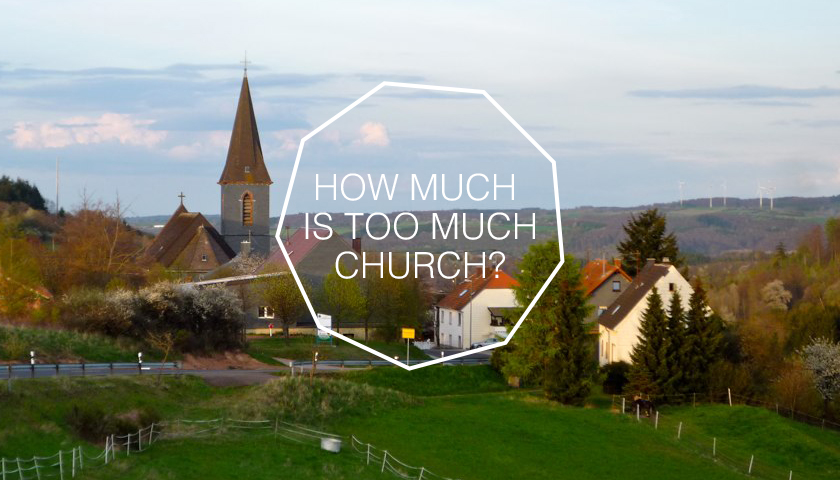
  • Get a Life! How much is too much church?

    Get a Life! How much is too much church?

    Several weeks back, Jason Raitz posted this on his Facebook wall:

    So, I’m curious and need your help. Quite a few people have asked me this question in the past 2 weeks. ‘Is attending church consistently really all that important’? What do you think? I’ve been writing a blog post on this for awhile now, but would love your help!

    Read the post & comments here

    My very first thought when seeing this question was this, “Is that a rhetorical question?” It’s impossible to imagine that he’d really think that anyone would post on his wall and say no to him. I mean… dude is a pastor of a church plant. His Facebook wall is 99% mentions of his church. His Facebook profile picture is the logo to his church. I know Jason, he’s a great guy, and he’s 120% about his church.

    So obviously, Jason thinks everyone on the planet should be consistent about church attendance.

    He and I agree on that point, 100%. I believe consistent church attendance is part of walking with Jesus. But when I see a church leader say stuff like that I have to read between the lines because I’m willing to bet that his definition of “consistently” is different than mine.

    Here’s what I replied:

    I guess I’ll be the voice of decent. (Shocker, I know) I used to think it was a big deal… when I worked at a church. And now we make church a priority, we go a lot, but more like 35-40 weeks a year instead of 50-52 when I worked at a church. But I would say that nothing happens there that is magical and makes me OK with Jesus any more than not going. Plenty of times I go to church and leave completely unsure of why we went. So is going to church consistently “really all that important?” I think there are a lot of other things more important. The flip side question is also really important, “Is there such a thing as going to church too often?”

    The Right Question

    Ultimately, I think Jason’s heart was, “What level of church involvement is healthy and good for a believer?

    And, as a dude who used to work at a church but is now trying to figure out life in ministry without being on staff at a church, it’s one I think about.

    I used to be Jason. My life used to revolve wholly around the life of my church. And I remember dealing with the frustration of seemingly never having enough volunteers or money or consistency from people who were part of my church. I was wondering “how do I get the most out of people” and it ripped my heart out to have people pull me aside and ask, “What’s the minimum level of involvement I can have here and be OK in your eyes?

    But I’m not in Jason’s seat anymore. My life has changed. Things are different and as much as I empathize with it and understand it, I long for Jason (and people like him) to really see things from the perspective of people in the community.

    On the one hand I want to be part of my church, I want to find community there, and I love investing in the guys in my high school small group. On the other, I almost see getting involved at church as a trap: Attending ANYTHING includes ovations and invitations to attend more stuff at church. (We’ve been part of 2 churches in San Diego since making this transition, while they are both wildly different in size, this one aspect is exactly the same. Being a part of one thing almost always includes invitations to more things.)

    Addressing the Elephant in the Room

    “The thief comes only to steal and kill and destroy; I have come that they may have life, and have it to the full.”

    Jesus in John 10:10

    When you drive around in many places in Europe you’ll begin to notice that the church is the tallest building in town. Quite literally, the church in many Europeans was designed to be the central focal point of a community.

    In America, churches are rarely the high point of a city. Instead, churches try to make themselves the high point of congregants lives.

    And in the same way you or I would drive into a small Bavarian town and laughingly think… “Did they really think that if they made the church the biggest building in town it’d become the most important thing in people’s lives?” The same is true when we wrap our whole lives around the day-to-day activities of being a part of a church.

    It works and doesn’t work at the same time.

    I think wrapping every free minute and thought up in the life of our church misses the point of John 10:10. It’s not living life to the full. It’s living life full-of-something-less.

    I have many friends who work in churches and I think, “Do they have a life outside of their jobs?” Because addiction to a church job is just as unsexy and unhealthy as addiction to teaching or being a CPA or any other job. Being a workaholic as a church leader is incredibly dangerous (it impacts EVERYONE in your life) but also somehow seen as incredibly normative. (Which is why so many people don’t want to be involved in churches, they see it as unhealthy!) I find myself lovingly telling friends, “You need hobbies, you need a life, you need adult friends.” But at the same time you’d think a pastor wouldn’t need to be told that. You’d think they’d be modeling health to me instead of the other way around?

    Newsflash: There are not “non-church-y people” walking around your neighborhood right now thinking, “Know what I need? I need to get involved in something that keeps me really, really busy!

    We, as a society, are busy enough. We need rest. We need less. We need Sabbath.

    Desperate for Good News

    Think about it like this. I believe humans are hardwired to inately seek out good news. (Both the Good News of Jesus and good news, more generally. General revelation means all things that are good come from God, right?)

    Is how you live, as a church leader, good news in your neighborhood? Do you have a life? Do you have hobbies? Do you practice Sabbath? Are you present with your children? Do you date your spouse? Do you manage your house? Are your weeds pulled?

    Because that’s the stuff your neighbors notice about you. Do they look at your life and go… “Dang, I want that!” Or are they looking at your life and going, “I don’t know what that dude does… but I don’t want to be like that.

    If the answer to that question is… “Um, crap. Probably not” and you want your community to hear the Good News of Jesus you’re going to have to figure out how to live a life that’s good news. You are going to have to make some changes.

    No one walks into a church building thinking “How can I get more busy?”

    If you could preach to me, the sermon I long to hear, the good news I need in my life– is for someone to stand up and help me discover less church life and more life of being the light of Jesus in my community. Someone, anyone, please tell me what’s enough church involvement instead of inviting me to more. If you can do that it’d be the best news I’ve heard all year.

    A fully devoted life to Jesus simply cannot be a fully devoted life to church life.

    I’d love to hear thoughts, comments, call for my head below in the comments. People who work in churches… does what I just said make any sense at all? People who go to churches… does what I said resonate with you? Why or why not?

    Photo credit: German Village Steeple by a_peabody via Flickr (Creative Commons)