Category: Christian Living

  • Sabbath So Hard

    Sabbath So Hard

    I talk about the sabbath and I think people freak out because its sounds so hard or is somehow not for you, maybe even some sort of “affluence” thing. But I think one thing that holds people back is the idea that making the Sabbath a personal priority is boring.

    So here’s a practical look at what Sabbath looked like for me today. (And how I closed out a 68 hour work week.)

    5:00 AM – Alarm
    5:30 AM – Drive to Bayside Park in Chula Vista
    6 – 9 AM – Paddled 2.5 miles and fished, completely alone almost a mile offshore in the bay, glassy water, so crazy peaceful.
    10:00 AM – Arrive back home
    10:30 AM – Leave for church
    11-12:30 PM – Everybody at the church getting church-y
    1:00 PM – Lunch
    1:45 – 2:15 – Nap!
    2:30 – Leave for bay play day with the Reams
    3 – 7ish – Splashing, kayaking, picnicing, and otherwise playing with the Reams.
    7:30 – Arrive back home, wash down all the fishing & boat gear

    I watched sun rise by myself as a paddled in San Diego Bay. I watched the sun set with friends in Mission Bay. A perfect start. A perfect finish.

    Remember… the Sabbath isn’t just about not working– Sabbath is practically trusting the Lord to provide 7 days of provisions for you and your family in only 6 days of work. Sabbath is something you do to express your faith in a Provider. 

  • Dog Strollers and Other Dumb Stuff

    Dog Strollers and Other Dumb Stuff

    There is a woman boarding the plane with a stroller for her dog. Really?

    Efrem Smith via Facebook

    Have you seen dog strollers? It’s a thing. Check out this search on Amazon. There are dog strollers with hundreds of 4 and 5 star ratings.

    I see them at Lake Murray. There’s a path that’s like 3 miles around the lake and you see lots of people pushing little dogs in strollers.

    Here’s the deal: Taking your dog for a walk means that you and the dog take a walk. It’s healthy for you and it’s healthy for them. Actually, the healthy part of it for the dog is more than just physical, it’s mental. Walking with you, sniffing other dogs butts, peeing on bushes, chasing squirrels, this is all normal and perfectly healthy behavior for your dog.

    Putting it in a stroller and not letting it walk? That’s not good for the dog in any way!

    If “taking the dog for a walk” means driving to a park to push your dog in a stroller– you need to know you are doing it wrong.

    Exception: Every once in a while I see someone with an injured dog in a dog stroller. I’ll give you a pass for that. 

    Dog Flash Lights

    14414945780_f8fb89cc08_zYou might think I’m kidding but I’m not. Kristen and I see people all the time with lights attached to their dogs. There are hundreds of collar lights on Amazon. This one has 600+ reviews!

    I think the intention is to make the dog more visible at night to owners and other people who might not see your dog.

    A dog on a leash walking with an owner doesn’t need a light and it isn’t helping the dog. In fact, while I’m not an canine ophthalmologist, I would guess that the light attached to Buster is actually making Buster see worse because his pupil’s can’t adjust to the low light conditions… meaning that light is putting your beloved dog in more danger than it’s helping them.

    “Dogs have evolved to see well in both bright and dim light, whereas humans do best in bright light. No one is quite sure how much better a dog sees in dim light, but I would suspect that dogs are not quite as good as cats,” which can see in light that’s six times dimmer than our lower limit. Dogs, he says, “can probably see in light five times dimmer than a human can see in.”

    Paul Miller of University of Wisconsin in Science Daily, 2007

    We often go on our evening walk as the sun is going down. In the summer, because the concrete and asphalt is so hot from the sun, it’s a good idea to wait for it to cool off before walking your dog, and as it gets darker we see more and more people sporting flashlights, headlamps, and doggie flashlights in our urban neighborhood.

    Look, your dog doesn’t need that to see, it’s probably hurting their eyesight. And if they are on a leash their visibility isn’t important. And, just keeping it real, you don’t need a flashlight to walk through an urban neighborhood either. We have street lights! (Not to mention humans can see OK at night, too, if you let your eyes adjust.)

    Let Dogs Be Dogs

    In so many ways, I get it. We love our pets. We adore them with gifts and treats and special trips. I do the exact same thing. I can’t tell you how many times we’ve driven 30 minutes to take Stoney to the beach or the hundreds, thousands probably, of dog walks.

    But you have to let your dog be a dog. They don’t need to be pushed around like a baby. And they don’t need a flashlight to see at night.

    The single best thing you can do for your dog, in my opinion, is let them be a dog. 

    Misplaced Care

    What is this all about? In this instance, I’m talking about people who love their dogs so much that they are making it something it isn’t. Putting a dog in a stroller isn’t about the dog, it’s about the human.

    We do this type of thing all the time. We allow something in our lives to become something it isn’t and in the process, we change it. We convince ourselves that our professional pursuit is about the pursuit when it’s about something more significant. We convince others that we’re working out because we want to accomplish a goal or raise some money for charity when it’s about something deeper. We convince ourselves that we have to parent our kids or they need to pursue education in a certain way for the betterment of that child… when it’s really about something much deeper.

    We say it’s about love when, at it’s core, it’s about misplaced care. To truly love that child. To truly love that dog. To truly gain success at work. To truly be healthy– you need to get to the bottom of some of these underlying issues.

    A dog in a stroller is misplaced care.

    Deal with the stroller in your life.

    Photo credits: Dogs! by Weiji via Flickr (Creative Commons) LED Dog Collar by The Pet’s Tech via Flickr (Creative Commons)
  • Sometimes you lie yourself to honesty

    Sometimes you lie yourself to honesty

    Certainty scares me a little.

    Let’s start off by admitting that. I can’t talk about honesty until I admit that people who are absolutely certain about their work life, personal relationships, and non-essential elements of their faith make me nervous. Like I don’t know if I’d trust them to go to a timeshare presentation and not buy a condo. 

    • You don’t own that company but you know for a fact you are going to be doing that until you retired? … Really? 
    • You don’t think your spouse would ever leave you for any reason? … Really? 
    • You are absolutely certain about a pre-tribulational rapture of believers? … Really? 

    I’m much more comfortable with people who add conditional statements to soften their certainty a bit. “The way things are going, I can see doing this for the rest of my career” sounds much more honest. I’ve met too many 50-somethings who thought they were going to do something forever then wake up one day and realize they hate it and need to quit or show up to their office one day to be greeted by an HR professional and a box.

    3 Types of People Who Are Certain

    1. Fast-talking 20-somethings. Yeah, I know you went to college. Oh, cool… you went to graduate school or seminary? Wow.
    2. The unintelligent. Come on. We’ve all met the person at the bar who is absolutely certain Nick Saban is the best coach in the history of college football or that America was ruined by Bill Clinton’s ____ policy.
    3. The Salesmen. Often times these are intelligent people. But somewhere along the line they got hooked on the high of sales. And it doesn’t matter what they are selling, cars or stock or religion or real estate. They sweat certainty. Certainty is their currency.

    Those 3 types are tied together with one thing… they are talkers. Sure, we all talk. But some people are talkers.

    If you’ve spent any amount of time with a talker you know that often times talkers aren’t talking to you. You are just there. They are talking it out.

    13255640145_0a212837d5_k

    Dishonesty vs. Self-Convincing

    Let me illustrate this with an example from my own life.

    Our last couple of years in Romeo were difficult. I wasn’t dishonest or dispassionate in my output. But I was also not being honest with myself. I was doing things in an unhealthy, unsustainable way and convincing myself that it was just for a season and that I’d get past it. I was convinced, with absolutely certainty, that if we could just get the church past the hump things would get easier again.

    I knew I wasn’t the dad or husband I wanted to be. I knew I wasn’t the pastor I wanted to be. I knew I wasn’t the me I could be. But I just kept convincing myself that we’d get past it and that everything would be OK.

    But my ministry there had long since stopped being fun. Everyone could see that except me.

    I share that to point out this. Even if you are in a mode of self-convincing that doesn’t automatically mean that everything you are doing is somehow bad or that you’re being dishonest. The day-to-day things I was doing were good and right and true. I wasn’t lying, as in saying things which I knew weren’t true. I just wasn’t being honest with myself.

    See, I was lying my way to honesty.

    6275000130_b4b9c6e8a9_b

    Just Keep Talking it Out

    I meet folks in the youth ministry world all the time who are full of certainty. Usually, they aren’t unintelligent… so they fall into either the first or last category of people who are full of certainty… young or selling something.

    When I read a blog post entitled something like: “6 Easy Steps to Leading Small Groups” I automatically think, “That person is either really young or selling something.” I mean, anyone who has ever lead a small group knows that the one thing it isn’t is easy. But it’s most likely that a person writing posts like that is just trying to convince themselves that leading a small group is easy. (Or that they are linking to a book/workshop/seminar/cult gathering) My hope is that they keep writing and serving and figuring it out… because I know too many folks filled with certainty who left youth ministry when certainty was back-filled with doubt or when they found out that they could better care for their family selling insurance than a $8 book on Amazon.

    My advice to both of them is the same: Just keep talking it out.

    Seriously. When people are selling something they believe in they think that if they just keep trying to convince you that what they are selling is great that you’ll buy it. But if they just keep talking they will start to listen to themselves eventually, and that leads to honesty. (Unless they are unintelligent.)

    When people are young and certain they also need to keep talking. The more I’ve taught on things I was trained to be certain the more I’ve had to wrestle with what I’m uncertain about. I remember trying to teach Revelation as a sequential narrative and watched how things I’d been taught as certainties crumbled beneath the weight of the thinly glued together logic. It’s not that I don’t believe in the stuff John wrote about any less, I’m just filled with a more healthy uncertainty because I spent months talking it out.
    3841717181_337a4e37bb_b

    Space for Listening & Silence

    The last thing I’ll share about lying your way to honesty is the role of listening & silence.

    Within the weekly grind of working at a church I never had room for either practice. I listened enough to discern what I needed to say. When a student would come into my office to talk I had a tendency to want to get them into my on-ramps, navigating their spiritual journey into pre-determined pathways that I’d seen work before. It wasn’t that I didn’t want to listen or wasn’t equipped to listen. It’s that I was too busy to listen. Sadly, I can remember cutting people off — issuing some advice — and sending them off because I had to get to my next meeting.

    When you have to teach 2-3 times per week 49-50 weeks per year there really isn’t a place for silence. Silence is different than listening. Silence is just not talking.

    The space for listening, for me, really came when I stopped working as a full-time pastor. Since 2008 I’ve largely been silent at church. I teach occasionally but not 2-3 times per week like I used to. When I go to meetings or even to a training I’m not in charge… so even if I’m the trainer I’m not talking way more than I am talking. As I’ve shared before… when I lead a small group of high school guys my self-talk mantra is “Shut up. Stop talking. Listen.

    It’s not that I don’t have something I could say… it’s that I’ve learned the power and necessity of listening & silence. I’ve learned that it’s more honest (for me) to wish I’d said more than regret saying too much.

    No one has ever said of a person, “I wish they had listened less.

    But each day millions look at someone they love and think, “I wish they’d shut up.

    Photo credits: gr8 minds by wagaboodlemum via Flickr (Creative Commons) |  A Face in the Crowd by Just Ard via Flickr (Creative Commons) | 1000 Faces of Canada #084 by Ryan Seayeau | A Drop of Silence by Thanh Mai Bui Duy via Flickr (Creative Commons)
  • You Need a Personal Philosophy of Recreation

    You Need a Personal Philosophy of Recreation

    We use words all the time that we’ve not thought about the meaning, intent of the word itself.

    And my experience over the past 2 weeks of vacation proved something to me afresh: A lot of people have no idea what recreation means… they don’t have a personal understanding or philosophy of recreation. 

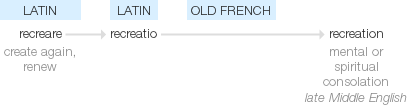
    Recreation – activity done for enjoyment when one is not working.

    The process of being created again.

    Synonyms – pleasure, leisure, relaxation, fun, enjoyment, entertainment, amusement; play, sport;

    Antonyms – work

    recreation-defined

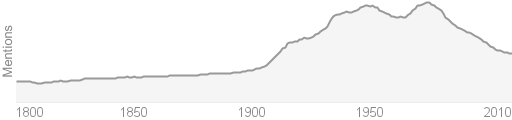
    Here’s something that’s very interesting to me. Despite a culture that celebrates, supports, and invests heavily recreational activity, according to Google the usage of the word “recreation” is on the decline.

    recreation-usage-over-time

    source


    What’s Recreational to Me?

    As a Christian there’s no way to argue that recreation is not part of God’s plan for a healthy life.By the seventh day God had finished the work he had been doing; so on the seventh day he rested from all his work. Then God blessed the seventh day and made it holy, because on it he rested from all the work of creating that he had done.” (Genesis 2:2-3) When God said He “made it holy” that means that one day per week… the seventh day we refer to as Sabbath… is set apart from all the others as a day of rest– to stop creating and to re-create. Notice that the Sabbath day in Genesis 2 wasn’t set aside for worship… it was set aside for rest

    So when it comes to the question, “What’s recreation to me?” it is defined first as something set apart from my day-to-day life and second as something that isn’t work.

    For me, most recreation / Sabbath activities / vacation are loosely boundaried activities. My ministry life is highly integrated with my personal life. For instance, this blog is part ministry and part hobby. Sometimes writing a blog post is absolutely work and other times it is absolutely hobby. The difference is nuanced, I suppose only I know the difference between something written for fun or as a release and something that’s written because I have to do it for work. Another example would be my social media usage. Sure, there are definitely times when I post things for work on various social media accounts, both personal and professional. So does that mean that if I’m on vacation I can’t post a picture on Instagram to share something with my friends or just to document something cool? Again, that’s nuanced because so many of my friends are also part of my ministry. (work) It’s what happens inside of me that’s set apart or holy.

    That doesn’t mean I don’t have strictly boundaried times. One boundary I have for myself on vacation is that I don’t take a computer. One of the boundaries I set-up for myself this year was that the first half of my vacation I kept my phone in the glove box of the car rather than my pocket. We also asked the kids to leave their electronics in the car so that when we were camping… we were camping.

    On a smaller scale, recreation can be taking the dog for a walk or heading to the beach on a Sunday to boogie board or go to the zoo. It can be sitting down on a Saturday and binge watching Deadliest Catch or meeting a friend for a beer or taking my kids to an Aztec game. All of those are decidedly non-work.

    Recreation and Being a Husband/Dad

    One thing that we’ve discussed in our house over the last year is that different people in our family recreate in different ways. I travel a lot, I go a lot of places, a lot of my work is the action of go-ing. So the most relaxing thing I can do is not go anywhere. I long for a small-life vacation where we don’t do much, where the biggest thing we do is make a move from the beach to the hot tub or we’re just too lazy to make dinner.

    But my family, Kristen specifically, recreates best by doing stuff. They want to go to somewhere new and see everything. They relax while I drive. 

    An essential part of having a personal philosophy of recreation is having open conversations about what each person finds recreational. (Harder for little kids to articulate, but Megan and Paul can tell us what they find relaxing versus what they find boring versus what they find “work.”) But having those conversations has helped us create good compromise. For instance, we spent 5 days in Yosemite with a daily activity of going somewhere. But we also spent 5 days in Cayucos doing nothing. One of the most relaxing things, for me, about our beach vacation was that I didn’t drive for a few days. The minivan didn’t move and that was relaxing to me.

    5 Steps to Creating a Philosophy of Recreation

    So I’ve made the case. I think it’s useful to take a little time to actually write out a personal philosophy of recreation. Heck, it might be the most soul-saving thing you do in the next year. Here’s how I’d recommend getting started.

    1. Start with creating a definition of recreation. What is it? What is it to you? Specifically, what activities do you find recreational? Are there any thing that some people find recreational and you don’t? (example: I don’t really find going to the movies recreational because it’s expensive… but watching a game on TV? Totally recreational.)
    2. Next, define some boundaries for recreation. Here’s a pro tip: You won’t recreate well if you just try to plug it into the white, empty space on your calendar. If you know you suck at recreation than I’d encourage you to create an appointment 1-2 evenings during the week and a specific 4-6 hour block of time over the weekend. I actually think you need boundaried space for recreation every day in short bursts, one dedicated time during a work-week, and at least a half-day over the weekend… plus a couple really good vacations per year.
    3. Experiment a little to see what works for you. Look, until you’ve tried a few things you might not really know what works for you. Even forcing yourself into something you might ultimately hate isn’t bad, it’s just an experiment. Play with the idea of recreation… and I guarantee that your idea of “what’s restful” will change over time. We used to think backpacking was recreational. And right now? The idea of dragging myself from campsite to campsite sounds like way too much work. Stuff changes, keep experimenting.
    4. Take the time to write it down. Way back in my undergrad days I actually had to write a paper called my “Philosophy of Recreation.” I thought it was stupid to have to write it out. But you know what? I’ve referred back to it, revised it, and re-written it a couple of times. I’ve found having it in writing really helps me… primarily because I acknowledge that recreation is part of God’s plan for me.
    5. Verbalize it with the people you love. Kristen and I have been married 18 years and it’s only in the past 4-5 years that we’ve taken the time to really articulate to one another what we find relaxing. We can laugh about our differences in vacation styles but we went on some vacations where she was way too bored by my sitting by the pool for days and I was way too stressed out by driving all over the place exploring. It wasn’t until we started to talk about it that we’ve started to create better space for one another inside of our recreation. (And outside of vacation, we have some shared recreational activities… but most are individual, stuff we do with friends or solo.)

    I’d love to hear about your philosophy of recreation in the comments. How has this helped you in your life? 

  • Be Less Careful

    Be Less Careful

    “Be careful.” 

    I say this to my kids all the time. I cringe a little each time I say it. And yet I can’t stop myself. It just happens.

    Paul jumps up on a banister to slide down 30 feet with concrete in every direction.

    Be careful!

    Jackson chases after his 6-year old cousin at Glacier Point, rambling up a big piece of granite after her.

    Be careful! 

    Megan goes for a bike ride in our neighborhood, a place we’ve lived for 6 years.

    Be careful! 

    Without even thinking about it, without even realizing it, heck– without even wanting to: I say it over and over again. Be careful! Jackson, our 3 year old, will look at me with his gigantic blue eyes when he’s doing something cool and say with a dagger, “I’m being careful, daddy.”

    Ugh.

    Why do I do that? Why do I put that “be careful” thing on them? That’s not really who I am. And it’s certainly not what I want my kids thinking their primary directive is. Sure, I don’t want them to get hurt. But I also hate that I must say it so much that my kids know to look at me and say, “I’m being careful, daddy.”

    Be Less Careful

    Risk aversion isn’t just about managing to keep my kids safe. A “be careful” mentality can get lodged in your soul. It sucks the life out of you. It lies to you. And it turns a life of boldly walking in faith into a life with a faith-flavored cologne sprayed on when needed.

    If I want the people in my life to see anything from me it’s that I live a life of walking in faith, not a life walking in risk aversion.

    Culture tells me that I need to manage risk. The New Testament is full of stories of men and women who lived out a faith free of risk aversion.

    I’ll pick the New Testament lifestyle all day, every day.

    A Commitment to Risk

    A couple weeks back I wrote about turning thirty-eight. I don’t know what it is about this age, but I think it’s related to our kids rounding the corner into adolescence, my marriage closer to 20-years than any semblance of being a “newlywed,” and our small business growing… I now have a (new) natural tendency to be protective.

    As I reflected on this last week I realized that this innate desire to protect had impacted important decisions about my family, what I write here on the blog, stuff that we’re doing at work, on and on.

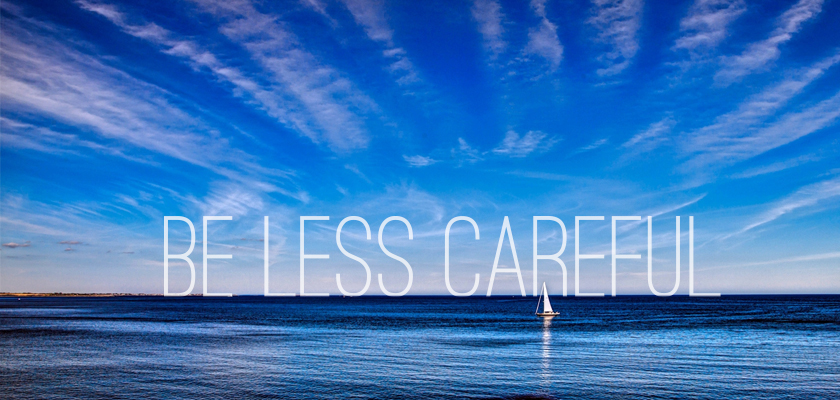
    Fear of failure or what people will think mixed with a tendency to protect what I have from what I fear could happen to it is like having an ocean worthy sailboat but being afraid to sail it on the open ocean. There’s no sense in having these things unless you really allow them to flourish where they are supposed to go.Putting that into Christianese… risk aversion is a perverted view of stewardship. 

    So that’s my commitment to myself: Be less careful.

    And that’s my encouragement to you: Take the time to examine your life and separate “be careful” from “be faithful.

    Photo credit: Sailboat by Cindy Costa via Flickr (Creative Commons)
  • Can You Vacate?

    Can You Vacate?

    Vacation – the state of vacating.

    The suffix turns the verb vacate into a process, state, or condition.

    The verb vacate comes from the Latin vac?tus, past participle of vac?re, to be empty. 

    About 8 months ago I read an article by Tim Maurer about his justification of a 10-day vacation instead of a 7 day vacation. Here are his points, all of which hit home:

    1. A 10-Day Vacation Gives You Time to Surrender, to Capitulate, and to Truly Vacate
    2. Travel Consumes a Lesser Percentage of Your Total Vacation Time
    3. It Opens the Door to a Vacation with Multiple Stops
    4. You’re Gone Long Enough That You’re Forced to Off-Load Your Duties at Work
    5. You’re Gone Long Enough That You’re Forced to Budget Financially
    6. It Leaves Sufficient Time for the Creation of Memories Through Experienceand the Catharsis of Do-Nothing Relaxation

    All of those resonated with me. All. of. them. 

    So, almost on a whim, Kristen and I booked a 10-day vacation we’re jokingly calling “The Surf & Turf Vacation.” We’re leaving tomorrow to spend 5-days in Yosemite National Park, camping with my cousins Trent & Marisa and their kids. After that we’re going to spend 5-days in a tiny little California beach town called Cayucos in a beach house we found on Airbnb.

    So that’s the plan.

    August through November is going to be a sprint. We have lots and lots of awesome stuff to do at the Cartel and to get it all done with the right attitude the most efficient thing I can do is a good & proper vacation.

    So it’s 10-days away from home. No computer. I’m locking up my iPhone in the van. No blogging. No social media-ing. No texting. No meetings or troubleshooting. We’ve got a housesitter to take care of the house, work stuff will wait, my job is to play with my kids, hang with my wife, read some fiction books… watch some movies… and vacate. (Loving that word!)

    Question: How good are you at vacating?


  • To Create Enmity

    To Create Enmity

    Enmity – noun – the state or feeling of being actively opposed or hostile to someone or something.

    The english word enmity is based on the latin word “inimicus,” plainly translated as enemy. 

    (more…)

  • The Wisdom of Seasons

    The Wisdom of Seasons

    This Spring, while we were in Haiti, our team bumped into a young American woman who was visiting Haiti to make a very big life decision. She had met a Haitian man in college, fallen in love, and their relationship had progressed to the point where they were contemplating marriage.

    (more…)

  • Assume the Best in Everyone

    Assume the Best in Everyone

    • Most people are generally good.
    • Stranger danger doesn’t apply, necessarily, to adults.
    • Crime is way down. You grew up in a more dangerous society than your kids.

    In yesterday’s post, Impending Doom, I shared about a segment of our society whose entire  life narrative is built around the hope they find in a world headed to hell in a hand basket, praying for and even seeking to manipulate world events to usher in the imminent return of Jesus.

    (more…)

  • Impending Doom

    Impending Doom

    Last month, I drove from Nashville, Tennessee to Starkville, Mississippi for a Sunday afternoon speaking engagement. As I drove across rural Alabama and Mississippi, through small towns, flooded fields, and by countless small farms, I got a glimpse into a religious phenomenon oddly familiar.

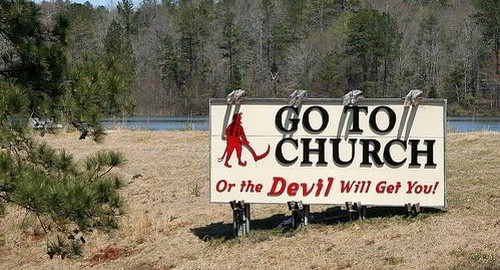
    On this drive were hundreds of religious signs. Most mentioned the name of a church or the times of a service. But many focused on a central message: Impending Doom.

    (more…)