Category: Church Leadership

  • The Solid Rock, The Sinking Sand

    What do I see happening in youth ministry? I think this song sums up the conversations I’ve had with youth workers of the last 2-3 years.

    On Christ the Solid Rock, I Stand
    All other ground is sinking sand
    All other ground is sinking sand

     Things that have always worked, successes that we could always predict, and stability we could always enjoy are all gone. Kaput. Poof. Vanished.

    And so I meet wonderful, wounded, hopeful people and all they can say is, “I’m holding on to Christ, my Rock. But I’m standing in sinking sand. What is going on?

    Conversely— redemptively and mercifully— I run into ministries/individuals/organizations figuring it out and moving forward.

    Here’s four common threads I see gaining traction, whether articulated or unarticulated amongst these organizations finding success today.

    From transactional relationships to transformative community

    I don’t know how else to say it. But I think full-time, paid youth workers are at a disadvantage to their volunteering peers in many ways. Students are sophisticated, savvy, and motive-sensitive. It used to be that being a paid church staff member created instant trust. Now, for a multitude of reasons, being a pastor can be (though not always) a block for students. This was revealed to me in a conversation I had with a recent grad. She said, “There comes a point when you realize that outside of your parents every adult who ‘cares’ about me is paid to care about me.”

    People today are looking for long-term, transformative community. In a world where everything changes all the time we instinctively desire stability that is found in long-term community.

    From competitive to collaborative

    Individuals, organizations, and local ministries who are gaining traction are rejecting the competitive/high-power business-driven models and seeking collaborative relationships. This means anything from churches combining forces to create a community-wide youth ministry to youth ministry organizations putting aside their long-term differences for the sake of working together.

    There simply no place (or resources) for a competitive spirit when we are reaching so few people.

    From experts to innovators

    I don’t foresee us going back to a time when 1000s of people drooled over every word from an expert, writing notes furiously, and trying to wholesale implement their teachings.

    It seems almost silly to mention that this is the way it used to be. But this used to be the way it was! 

    Instead, I see people/organizations/ministries seeking inspiration from experts and contextualizing their learnings to innovate local solutions. Just like the Real Food Movement has people looking from national to local sources of food, youth workers are looking less at national experts and more towards local innovators.

    From sound bytes to application

    Isn’t it interesting that we have access to every bit of information we could ever want and yet we are reaching fewer people than ever in youth ministry?

    I’m not alone in this observation. People who are figuring it out and finding success are walking away from teaching styles which delivered “aha moments” and are focusing their attention on application. That’s not devaluing teaching the Bible. In fact, it’s refusing to just glance over the Bible without holding their ministries accountable for applying what God is teaching them.

    It’s no longer about pushing out the Gospel to whomever will listen. It’s about pulling people into the storyline of what God is doing and inviting them to accept their role.

    These are ways I’m seeing people find bedrock. What are ways you are seeing this? 

  • The Marin Foundation Featured on BBC

    1. Heart and Soul: God and Gays: Bridging the Gulf     

    To play the audio, click the play button

    I have huge respect and admiration for the work of Andrew Marin and The Marin Foundation. Their ministry is simple– build bridges between the LGBT community and the evangelical community.

    While Andy hasn’t been as active on the Christian speaking circuit as he was in 2008-2009, this year the influence of The Marin Foundation has stretched into high levels of government and education here in the US and around the world.

    Recently, Andrew was featured on BBC World Service show, Heart and Soul, all throughout the UK and around the world. In this 28 minute segment, you’ll hear from Andy, the history of The Marin Foundation, and their work in Chicago and around the world.

    Here’s the source for the audio.

  • The OTHER other side

    A priest happened to be going down the same road, and when he saw the man, he passed by on the other side. So too, a Levite, when he came to the place and saw him, passed by on the other side. But a Samaritan, as he traveled, came where the man was; and when he saw him, he took pity on him.Luke 10:31-33

    Sunday afternoon we left our campsite and intentionally turned the wrong way on highway 243. It’s a winding, scenic route that goes from Idylwild to Banning through the San Bernadino National Forest. Near the peak, at about 6000 feet above sea level, we spotted a vista point where we decided to stop for a picnic and take some pictures above the clouds.

    It was a perfect day and we were in high spirits exploring the rugged terrain of eastern Riverside County.

    I pulled over into the lonely turnoff parking lot and the McLane clan piled out of the car to scout a place for our impromptu meal. We raced out onto a giant patio in the sky and found a tree with some shade perfect for our intentions. The view was amazing and stretched far off into the horizon.

    Paul and I went back to the truck to grab our cooler.

    As I was pulling the cooler over the gate I heard the roar of a motorcycle engine coming up the hill. The driver downshifted which made the high performance engine whine a wheezing exhale, followed by the screech of tires. We turned our heads the other way as he flew by in a cloud of grey smoke. Then the bike dumped on its side and the rider skidded across the pavement, tumbling to a stop about 25 feet later. His shoe landed right next to us and his bike bounced off of the parking lot, over the curb, smashing into a concrete barrier before flying up into the bushes.

    I looked at Paul. Paul looked at me. “Did that just happen?

    He got up in a fit of cuss words. Throwing his gloves and ripping off his helmet. Kicking at and punching the air in anger. A few seconds later 5 of his friends on equally powerful, more prone, motorcycles pulled up. He was clearly not horrifically injured but in pain nonetheless.

    Dazed, bloodied, humbled, his excuses quickly turned into confession. He was going too fast, trying to show off, and now he was going to pay the price with his body & his precious bike.

    Not knowing what to do I picked up his shoe and walked it over to him.

    Um, here’s your shoe dude. You were pretty lucky to not go over that cliff. Are you OK?

    He didn’t really know if he was OK but told me he was fine. I gave him his shoe and started walking down the path to my family.

    When I saw Kristen I said, “Some idiot on a motorcycle dumped his bike in the parking lot. That was CRAZY!” Paul was stoked. He’d never seen anything like it. Neither had I. Neither one of us knew what to do with our nervous energy. It was terrifying and exhilarating at the same time.

    When I put the cooler down and opened it up I just couldn’t escape the reality that I should do something. How could I possibly see that accident and then a minute later sit down to eat a peanut butter & jelly sandwich with my family? What kind of man would do that?

    I guess I should go do some first aid. That dude is pretty banged up.

    I went back to the truck and dug out my first aid kit and some bottles of water. He and his friends were standing around not really knowing what to do. They shared some laughs and recalled what they had seen. One of them actually captured the whole thing on his GoPro and was joking about putting it on YouTube.

    Hey dude, I’m not a doctor but I do have a first aid kit. Want to clean up those cuts?

    And so it began. Before I knew Ryan’s name he dropped his pants and we started cleaning his road rash. His knee and thigh were scrapped up pretty bad. His shoulder bore the same fate.

    Do you think you could clean up my cuts, too? I fell a couple miles back.” Another young man walked up to me showing me his gnarly wrist, probably broken.

    Yeah, let’s clean that up. You don’t want to get it infected.” About two minutes later he too dropped his pants to show me his knee, oozing with blood and gravel. His damage was actually worse than the other guy. He said, “I’m supposed to work tomorrow. Do  you think I’ll be OK?

    I don’t know. But you should get an x-ray for your wrist and a couple of stitches… because I can see your knee cap.”

    For about 15 minutes I helped these two guys clean up their road rash. Some water to wash it off, some gauze to clean it out, some disinfectant, and more gauze taped over to keep it clean.

    We made small talk about motorcycling and their other accidents and the thrill of why they do it. I didn’t talk much, just listened to their stories and got them patched up. I told them I was sorry this had happened to them and hoped that they made it home OK. (His bike was totaled) A few more bottles of water for everyone and we parted ways.

    It just so happened that we stopped there. And it just so happened that I had a truck full of supplies from our first aid kit. Clearly, this moment had been orchestrated in advance, right?

    The Parable of the Good Samaritan and You

    Luke 10 is one of those passages that stinks to teach as a religious leader because as you’re teaching it you realize that you are the goat in the joke. Jesus sets up the story that the priest and the Levite mess it up while the outcast gets it right. His point is that religious people are often so worried about doing their religious things that they forget to love their neighbors as themselves.

    But when you are teaching it in front of people your minds rushes with times where you were exactly that priest or that Levite, too busy and self-important to do something so basic.

    It’s one of the most convicting passages of Scripture you’ll ever teach.

    For every 100 Ryan’s I encounter I only get it right 1 or 2 times. (And here I am writing about that one time I get it right to make a point? See what I mean? I’m such a hypocrite sometimes.)

    It wasn’t until later in the drive, with the accident miles behind us, that it sunk in.

    The religious leader who asked the question which started Jesus on his parable? I wonder if he changed? I wonder if the next time he saw someone injured on the side of the road if he stopped to help? I wonder if he made a conscious effort to stop being a religious snob and start being a person who actually cared about God’s people more than he cared about looking like he cared about God’s people?

    For self-reflection: How will I slow down from my “important religious stuff” enough to notice the man on Jericho’s road? And what am I going to do about Jericho’s road? (It’s a place where people get beat up while travelling.)

  • How to minister to god-fearers in a multi-ethnic, multi-cultural, pluralistic society

    Photo by fortune cookie via Flickr (Creative Commons)

    We all know the church in America is in trouble…

    • More than 50% of Americans, if given a box to check, would label themselves as Christian while less than 10% affiliate with an actual church.
    • While the dominant suburban white church ignores this reality, we are becoming a multi-ethnic nation. (again)
    • While the church is typically racially/ethnically homogenous, our society has embraced multi-culturalism.
    • While church leaders have lacked a thoughtful, tactical response our society has rapidly embraced the philosophical framework of pluralism.

    In other words– society is doing things that the church has no clue how to respond to. In any given community in our country on any given Sunday less than 10% of the community is actively involved with a church. (Any church)

    The only place the church is seeing growth? Circling the wagons. Big churches are getting bigger, little churches are getting littler, and medium-sized churches are squeezed.

    In the last decade we’ve seen three general concepts rise and ultimately fail to reach more people:

    • Political involvement. The early part of the 2000s was marked by the rise of power of the Evangelical politically. This completely backfired. Society was repulsed by our Scarlet Letter-like tactics to try to change society.
    • Church planting movement. The last 10 years has seen a massive mobilization of younger leaders to plant churches. Unfortunately, these church plants are ineffective because they are just re-dressing the same pig. While it’s true that lots and lots of churches have closed in the last 20 years and church plants are supposedly out to replace them, the people aren’t fooled. Putting a nice marketing edge on the same old tactics won’t ever work.
    • Christian hipsters. Also popular in the 2000s was a desire for Christians to quietly embed themselves in pop culture industries like movies, television, and music. The idea seemed to be that if Christians could embed themselves in things seen to create culture we could reach people by interweaving redemptive analogies into our culture. That backfired because it just became a marketing ploy by those industries. (A very successful one at that.)

    What does this have to do with the book of Acts? EVERYTHING. The parallels between the first Century synagogue and the 21st century church are shockingly similar. The Jewish people, many of whom had dispersed to other parts of the modern world, struggled to maintain their numbers. Many congregations had shrunk to the point where they couldn’t even hold services because they couldn’t get 10 men there. (Which Jewish law requires for worship.) While they were strictly monotheistic and moralistically concrete, scattered in the Greco-Roman world they struggled to survive.

    Several times in the book of Acts you see Luke mention a group of people called, the god-fearers. (Greek derivatives of the word, “theophobes”) These were people who hung out around the synagogue, worshipped with Jews, identified and sympathized with the Jews… but weren’t actually pursuing conversion. This wasn’t a rare thing. This was actually a subculture of people who hung out around the synagogue and in some contexts likely out-numbered the Jews in a community.

    They were fans of God, worshippers of God, but they didn’t know God and certainly weren’t on His team.

    They just kind of hung around. And the rabbi’s probably seemingly had no idea what to do with them. Maybe they even had conferences to talk about what to do with them? I’m just saying….

    Does this sound familiar? 

    The American church is full of these people. And I think the second half of Acts gives us a few ways to minister to them. Let’s look at a few.

    1. Present the facts and call them to repent, invite them to join God’s team. (Acts 13:38-43)
    2. Raise the bar and demand painful obedience. Look at how Paul dealt with Timothy. (Acts 16:1-4)
    3. Call them to not only hear from God, but respond to him. (Acts 10)
    4. Ask them to examine the Scriptures for themselves and then ASK them to believe. (Acts 17:10-15)
    5. Stop wasting your time and move on. There’s no time for people who are merely looking for intellectual debate. Move on. (Acts 18:4-7)

    Call me crazy on this but it’s all over Acts. Stop calling them Christians. Luke was careful to label them what they were and there was likely a community of god-fearers in every synagogue. They knew who they were and they knew what they needed to do to identify with God.

    If we keep telling them they are a duck. And they keep acting like a duck. They are going to think that they are ducks. 


  • The Fall of Individualism in our Biblical Understanding of Walking with Jesus

    One of the truly fascinating things about the Bible is that our interpretation of it morphs so much over time. When we say the Bible is living and active… it’s actually living and active.

    For example: 40 years ago most people would agree that Christians should avoid the casual consumption of alcohol. This vantage point was supported, enthusiastically, from the Bible. Today? Those same arguments could be taken apart by anyone. It’s that culture has shifted on the issue and we are looking at the topic through a different hermeneutical lens.

    Just As I Am is becoming Just As We Are

    Over the past five years, in my observation, individualism has begun to fade. Messages that are about “us” are connecting a lot stronger than messages aimed at “me.” The tone has been subtle but the resonance has been noticeable.

    The rise of the neo-reformed movement has lead to a general acceptance that the Good News of Jesus Christ isn’t just meant to make my personal life better, it’s an understanding that Christians in culture should be living the Good News in their neighborhood. As Jesus renews our hearts we help renew our community.

    But this isn’t limited to the neo-reformed movement. It’s everywhere you turn. Out with the individual and in with community. And that, my friend, is changing how we read the Bible.

    A Tribal Understanding of Response to Jesus

    From an individual perspective, Acts 10 is hard to comprehend. I remember teaching through Acts several years ago and struggling through chapter 10 because I had a need to call students to accept Christ individually. But I couldn’t do that with any integrity… through the lens of my hermeneutic it was clear– Cornelius’ family came to Jesus as a tribe of people and not really as individuals. It was a corporate response. Do a word study on this passage and you’ll see the parallels between “I” statements and “we” statements.

    Through the strict lens of “You come to Jesus individually” this passage is difficult. But through the lens of “sometimes we act as a tribe in making decisions” it makes total sense. Each individual decided to follow Jesus because it was good for all.

    From I Speak to We Speak

    In our high school ministry we are careful to have a plurality of voices. We’re finding that today’s students distrust the talking head. 24 hours per day for their entire life they have been able to compare and contrast vantage points on TV news, sports, and everything in between. “That’s what CNN is reporting about that… but I read ___ on Huffington Post.” Or “ESPN is saying this about that player but they wrote ____ on Twitter.” Students need to know that what we have to say stands up to scrutiny because they have ready access to scrutiny.

    If our high school pastor were to stand up every Sunday and present God’s Word as “I’m the person the church has put in authority so you should trust me” than that would actually foster a sense of distrust. Howver, one reason we are seeing the response we are seeing from the students is because we use a plurality of voices. We don’t just talk at students… we invite them to speak and think for themselves. Why? Because that’s how you encounter truth in a pluralistic society! If Brian just talked students would walk away with Brian’s perspective on things. But if we open it up and allow them to participate, the truth of the Gospel isn’t just Brian’s perspective it’s our perspective.

    For discussion:

    “A Gospel message about me is no Gospel at all. Let’s kill individualism and embrace community.” Agree or disagree? And why?


  • I’m not a commodity and neither are you

    Photo by green kozi via Flickr (Creative Commons)

    In the past 3+ years I’ve known countless friends who have lost their jobs in ministry. 

    One day they are a centerpiece of the churches living room. The next, like a couch, they find themselves on the curb. Alone. Broken-hearted. Trying to figure out what’s next or if there is even a next.

    Their hope is that someone picks them up before the rains come and ruin them. They know they still have some life in them. But being taken out of the living room and dumped on the curb hurts. Bad.

    Sure, it hurts to not have a place to serve. And it definitely hurts to lose a paycheck. But what really hurts these folks suddenly displaced, often blamed on the economy or a new vision, is that it reveals a hidden side to their relationship that had never been revealed before.

    Somewhere, in hushed tones, they were talked about like a commodity. A thing and not a person. I line item and not a minister of the Gospel.

    They gave their heart. They gave time money couldn’t buy. They invested time in other people’s kids at the expense of loving themselves or even their own kids. They proudly told people which church they worked at. They stood up for the pastor when it all went to pot. They prayed with countless people about countless things.

    Until one day they discovered that all of that had a revenue goal tied to it. Or an unspoken expectation. Or that their ministry was just a line item on a budget. And somewhere. Somehow. Some way. Somebody didn’t look at their ministry as doing life. Instead, they looked at them as a role, something to be bought or sold or traded or dispatched.

    And suddenly, in a letter or in a meeting or yes– on a sticky note, they have found themselves on the outside looking in.

    Friends- you aren’t a commodity. Jesus doesn’t look at you that way. And I’m sorry that the church has treated you that way.

    It’s not supposed to be this way.

    If you’ve been left out on the curb I want to hear your story. Leave a comment with your story or drop me a line at mclanea@gmail.com. 

  • Stop. Collaborate. And Listen.

    August beckons new life in ministry. 

    School starts. Our programs relaunch. We recruit and train (hopefully) a batch of volunteers. And we find ourselves, emotionally, in this weird place of hopeful dread.

    We’re hopeful because fall is our spring. Fall is full of new life, new energy, new commitment, and new dreams for the school year to come. Dread because we’ve felt this way before. We’ve printed the agenda, met with parents, trained volunteers… and it’s not gone as expected. 

    We need this year to be different. We are tired. We are weary. We need some success to come easily. We need our strategy to work. Because we don’t know if we can take another year like last year. Which was like the year before. And the year before that.

    In order for this year to be different we need to be a different type of leader.

    Stop.

    I remember in my first semester of classes in youth ministry being told that as the youth pastor it was my job to be the leader. And being the leader meant that I was in charge and ultimately responsible for everything that happened. The reality is that people don’t trust this type of leadership anymore. It might feel familiar or comfortable to them, it might make you look good to the board, but this type of leadership is only going to deliver the results you’ve already seen.

    To grow you’ll need to change.

    To clarify, an autocratic leadership style work great if you’re an ultra dynamic leader. I’m not. And most of the people I know in ministry are not. I’ve found it to be a growth limiter.

    Collaborate.

    I suck at telling people what to do and inspiring them to be all that they can be. But I’m pretty good at working as a leader in a flat, collaborative environment.

    I think that the old style of leadership, especially in the church, feels like a collaborative style is weak leadership. We make the mistake of believing that giving up the headship or giving up the microphone is giving up what we’re paid to do.

    Instead, I see it as forcing new leaders to emerge. It takes no leadership ability at all for me to say… “This is what we need to do, this is where we are going, and this is how it will work.” And if I do all of the teaching and speaking I’m communicating a style of leadership that Jesus didn’t foster with his own disciples.

    Conversely, it takes all of my leadership skills to say, “We all need to work together, we need the best ideas to come out of the group, and we all need to share responsibility.” While the first feels better because I’m taking all of the responsibility, collaborating with a team allows the team to dream a whole lot bigger.

    Listen.

    Nothing makes me tune out faster than being asked to come to a meeting to listen to the leader talk. (Or read from his notes which he dutifully sent to us all in advance.)

    I am willing to be lead. But to be lead I need to be listened to. And I need to see that the leader doesn’t just listen to me, he listens to everyone. The primary task of the leader of a movement is to listen. Ask open ended questions. Sit in a circle on the same level. Provide an open-ended agenda. And make listening your primary task. Listening isn’t passive leadership, it’s where leadership begins.

    It’s fall. Our spring. Are you ready to…. Stop. Collaborate. And Listen?

  • An example of Good News to a public school

    A while ago I wrote a blog post called, 10 Ways Your Church can be Good News to Public Schools. Here’s one church doing just that.

    Amazing.

    Check out more like it at 20/20 Vision for schools.

    Imagine what could happen if your church got together and said, “How could we be Good News to a public school?” Anything is possible.

  • Do we live on the same planet?

    Sometimes I’ll meet a person in ministry and think, “Do we live on the same planet?” 

    • I’ve got a really solid core group of kids each Wednesday night– I think they have a chance at winning the Bible quizzing championship.
    • Our high school students are very involved in the community. Each year we get together with other churches in our district for a youth rally. They love it.
    • I always take my sword wherever I go. You have to be prepared for battle at all times.
    • I had to pull my kids out of public school because in California there’s a new law that teachers have to include gay history in the curriculum. (What’s really weird is that they don’t live in California!)
    • I teach my students that they need to take a stand. A life with Jesus is all about taking the stand, right?

    Code language. Insular communities. Church-centric attitudes. It leaves me wondering who they are trying to reach?

    It makes me wonder how they have a conversation with their neighbors? I wonder what they are thinking as they get to know Diane next door, who just had to put her mom in a home. Or what they talk about with the gay couple across the street? Or what their neighbors think about them when they turn off their light on Halloween? Or refuse to come to the block party because people are drinking?

    I wonder if people think of them as good news in the neighborhood?

    I’m guessing that there are a lot of neighbors hiding from a lot of their Christian neighbors in this country.

    I believe in Jesus. He is my only hope for salvation. And I fully acknowledge that the church is God’s chosen instrument for believers. But there is this sliver of people in every church who… are really weird.

    And no one ever has the guts to tell them the truth: “You’re weird. And you really need to work on that. Jesus asks us to be different in a good way. Your weirdness is making it harder for me.

    The Flip Side – The culture wars are dying

    Not all church staff are like that. It’s actually very few.

    More and more I’m hearing a bad strategy being replaced with good strategy.

    • In order to reach a community you have to meet the relevant needs of the community.
    • In order to start reaching more people we had to stop fighting culture and stop teaching that the output of a life with Jesus is behavior modification.
    • We recognize that to reach our neighbors we have to be good news before they will hear Good News.
    • Rather than bring a program into our community which worked elsewhere, we’re going to the community and asking how we can serve them.
    But it’s the really weird ones that we now have to shake and ask, “Do we live on the same planet?
  • Dear Church, You Can’t Buy Followers

    There are dozens of services online that let people buy followers.

    Prices start at about $15-$20 per thousand, with bulk orders costing less – 50,000 followers will typically run less than $500. Those followers, though, are often dummy accounts run by computers, some in a very obvious way, some in a more sophisticated fashion.

    “If you’re not familiar with Twitter and someone says I can have 10,000 people follow you, that sounds great,” says Mack Collier, a social media strategist and trainer (and frequent speaker at events like South by Southwest Interactive). “They’re not going to talk to you about how to use Twitter to meet your goals and objectives. … When we don’t really understand something, we go back to ‘what’s the number?’ The biggest number always wins until we understand how something works – especially with social media.”

    Follower for Sale: Buying Your Way to Twitter Fame, USA Today

    While no church would attempt to buy Twitter followers, churches who want to grow often think that a really slick marketing campaign is the difference between their growth and their demise.

    Church! You Do Not Have a Marketing Problem

    Unless you are a brand new start-up, plenty of people in your community already know you exist. Marketing isn’t your problem.

    You do a marketing campaign for one of three reasons:

    1. You have a product or service that is new to the market.
    2. You are trying to remind people who have used your product or service and not returned that you have something new.
    3. You are trying to convince people who already know they don’t want your product of service that they really do.
    SAT Question: Which of the speakers in this set does not match?

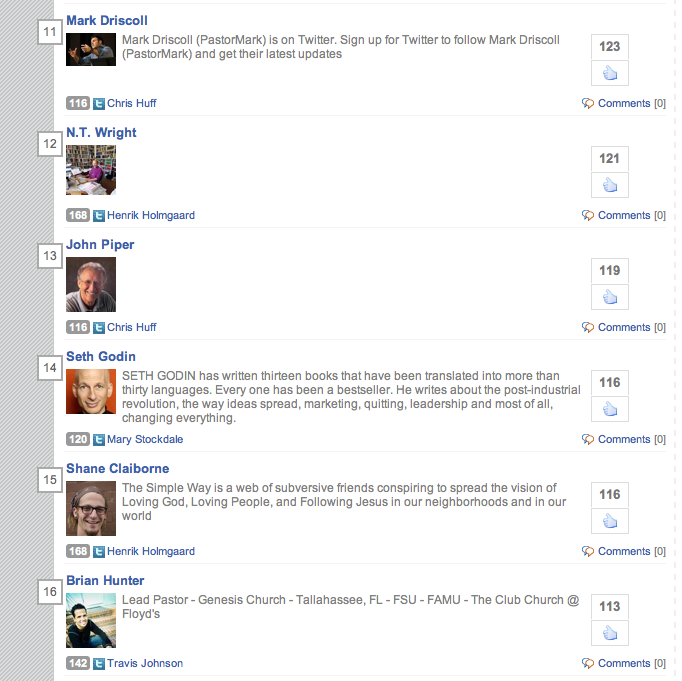
    In the past two days church leaders from around the country have voted on who they’d like to see speak at an online leadership conference called, The Nines. Scrolling down the list from the top you’ll see a bunch of pastors and theologians until you come to #14… Seth Godin. A marketing blogger and conservative Jewish man.

    The last thing church leaders need is to be convinced that they need a better marketing plan for their church.

    Spending money on marketing without changing the reason people already aren’t coming to your church is just validating the message people already know about your church– That’s not for me.

    Church! You Do Have a Follower Problem

    We have bought into a lie that the way to grow a church is one of two extremes. (And our inability to grow is a marketing and not a discipleship problem.)

    Extreme #1 – To lower the expectations we place on people who attend and follow us. Come as you are, listen if you want, that’s between you and God.

    Followers are free but the cost of following is high. In John 6 Jesus fed five thousand people and walked on water and as a result had a whole slew of people who wanted to become his disciples. So Jesus held a quick disciple orientation class to explain what the cost of following him was.

    Jesus said to them, “Very truly I tell you, unless you eat the flesh of the Son of Man and drink his blood, you have no life in you. Whoever eats my flesh and drinks my blood has eternal life, and I will raise them up at the last day. For my flesh is real food and my blood is real drink. Whoever eats my flesh and drinks my blood remains in me, and I in them. John 6:53-56

    Yeah, that wasn’t going to work. They just wanted to follow Jesus for the free lunch and magic show. John 6:66 says, “From this time many of his disciples turned back and no longer followed him.

    In reality… that’s what a lot of people come to church for. The free lunch and magic show your church is offering. When you actually challenge them to count the cost and follow Jesus they just move on.

    Extreme #2 – To raise expectations to a non-Biblical level by adding things to the Gospel message. To be a part of our team, you have to meet these 26 extra-biblical requirements as laid out in our church constitution… 

    Followers are free but you keep raising the cost. Acts 15 documents a case of this.

    Certain people came down from Judea to Antioch and were teaching the believers: Unless you are circumcised, according to the custom taught by Moses, you cannot be saved.”  This brought Paul and Barnabas into sharp dispute and debate with them. So Paul and Barnabas were appointed, along with some other believers, to go up to Jerusalem to see the apostles and elders about this question. Acts 15:1-2

    This isn’t unlike what we see today in many churches. They add extra-biblical requirements to being on board with the church. You have to be baptized in a certain way, attend certain classes, volunteer a certain way, on and on. While none of those things are typically “bad” they are extra-biblical requirements which weed people out falsely.

    In Acts 15:28-29, the council replied to these extra requirements that people were teaching with this, “It seemed good to the Holy Spirit and to us not to burden you with anything beyond the following requirements: You are to abstain from food sacrificed to idols, from blood, from the meat of strangled animals and from sexual immorality. You will do well to avoid these things.”

    You don’t need a new marketing campaign to grow your church. The best growth plan you could ever have is to start eliminating the extremes. (Too little or too high.)

    Question: If you have an existing congregation and the community has already decided they don’t need you. How do you change that perception?